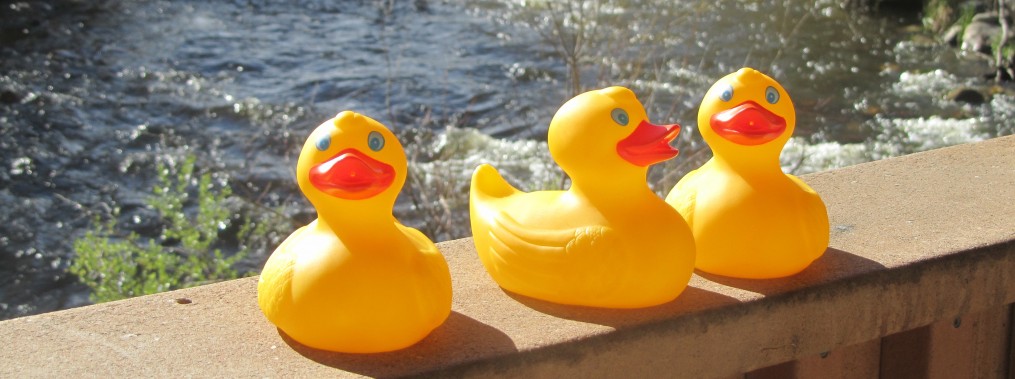
Northern Arizona’s Meteor Crater with Zeb and Soapy Smith Duck

Fifty thousand years ago, a meteor ripped through the skies over the land we now call Arizona. Traveling at roughly 40,000 miles an hour (64,000 kilometers an hour)–11 miles per second (18 kilometers per second), it smashed into the surface of the high plateau.  Within a few seconds, the resulting massive explosion threw millions of tons of rock over the surrounding area, opening a crater three quarters of a mile across and 700 feet (210 meters) deep.  A shock wave of hurricane force winds flashed out in every direction, causing destruction for miles.  So reads the sign, The Birth of Meteor Crater, at Meteor Crater Visitor’s Center in northern Arizona.

Let’s go inside and learn about the meteor

We visited this site in March 2016, but it is definitely worth another look.   After watching the short movie, we spotted this, the Holsinger meteorite, weighing in at 1,406 pounds, and the largest known piece of the 150 foot (45 meter) meteorite that caused this crater.
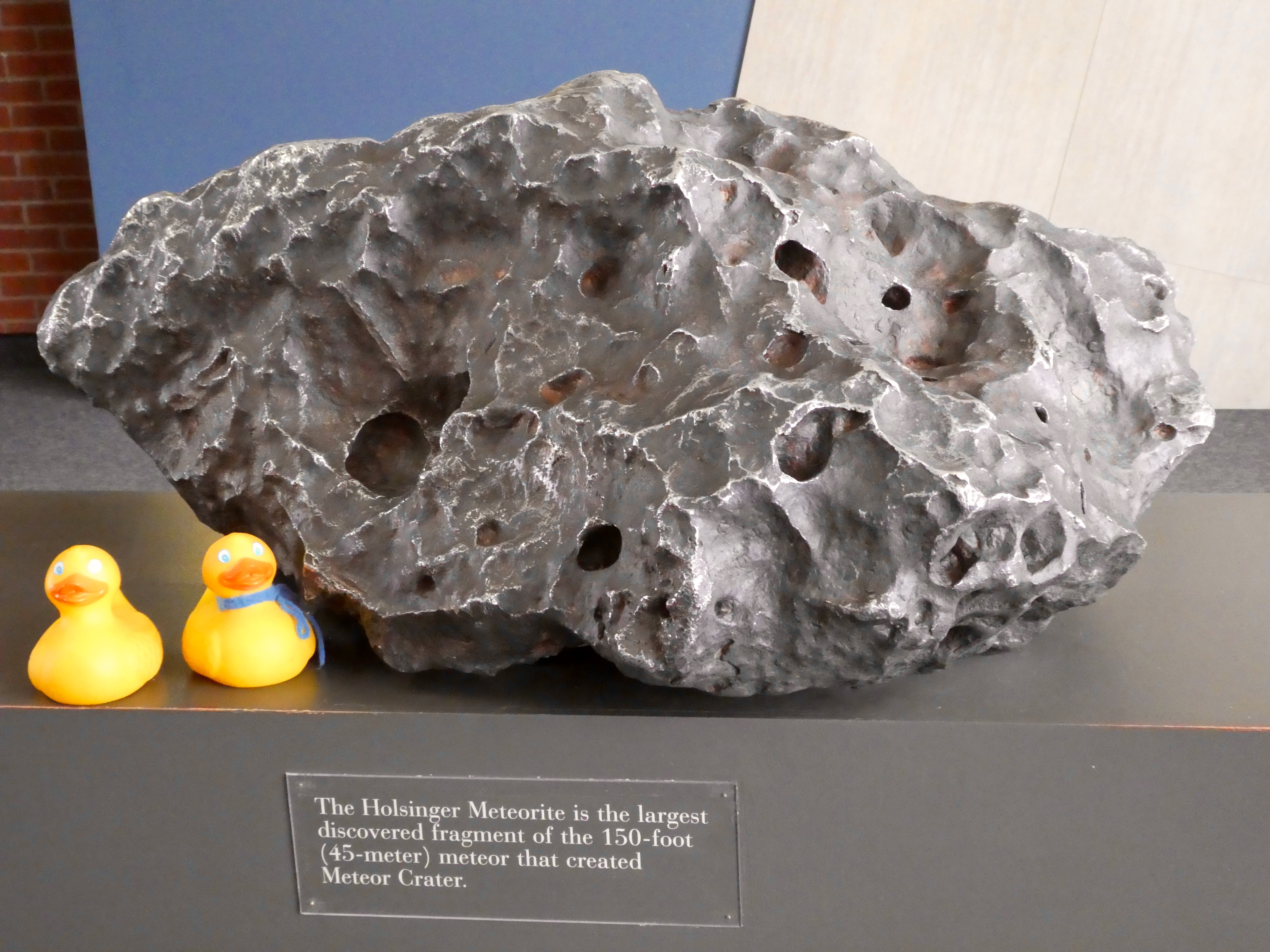
Largest piece of meteorite found

The meteor, before impact, was estimated to weigh 300,000 tons.   Let’s go outside to see the crater.   It is really windy here, so again the walking tours on the crater’s rim have been cancelled.   This is a big crater.
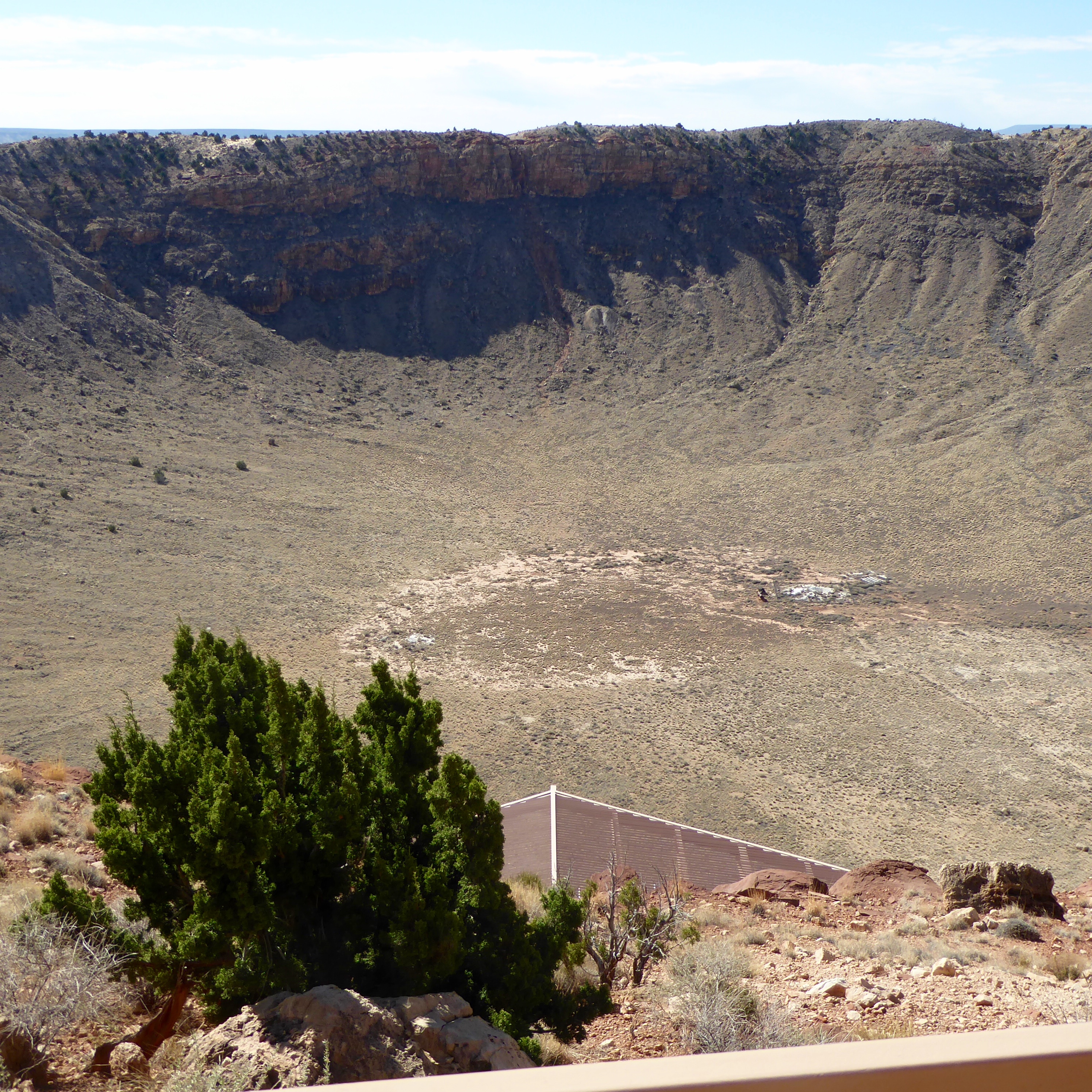
Meteor Crater

The impact resulted in a crater 750 feet deep.   Due to erosion of the surrounding land, and sediment at the bottom from a former lake, the crater is now 558 feet (170 meters) deep. This crater could hold 200 football fields with 2 million fans watching the games.   Wow!   There are 3 levels of viewing platforms at the crater and some free telescopes, pointed at various places in the crater.   We saw drilling sites, astronaut training sites and fault lines.  This is a simulation of what the bottom of the crater is like.
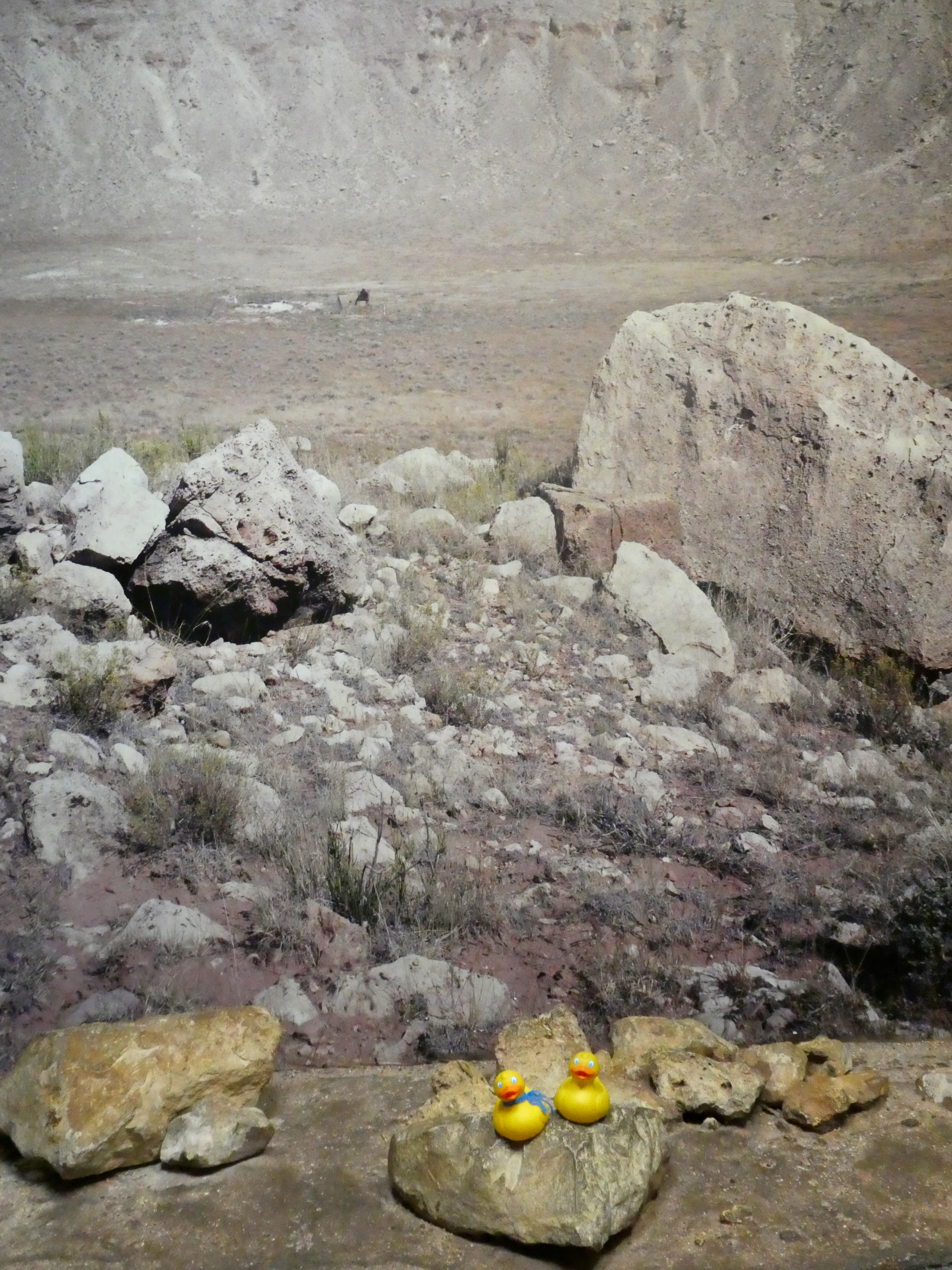
Simulation of bottom of crater

We could not go to the bottom, but this is what it is like.   You will like this place.  But be prepared for high winds.    For years it was believed that this crater was formed by a volcano.   Even though there was no lava found here.   Scientists did not know how to prove a meteorite landing then.   In the early 1900’s Dr. Daniel Barringer, a geologist, believed this crater was formed by a meteorite.   From 1903-1905 he actively mined inside the crater.   He believed he would find a large part of the meteorite below the surface of the crater and he wanted to mine, find and sell the iron.   He continued to believe he would find the meteorite, but he never did.   He died in 1929, nearly bankrupt.   Later Dr. Eugene Shoemaker, another geologist, visited the crater.
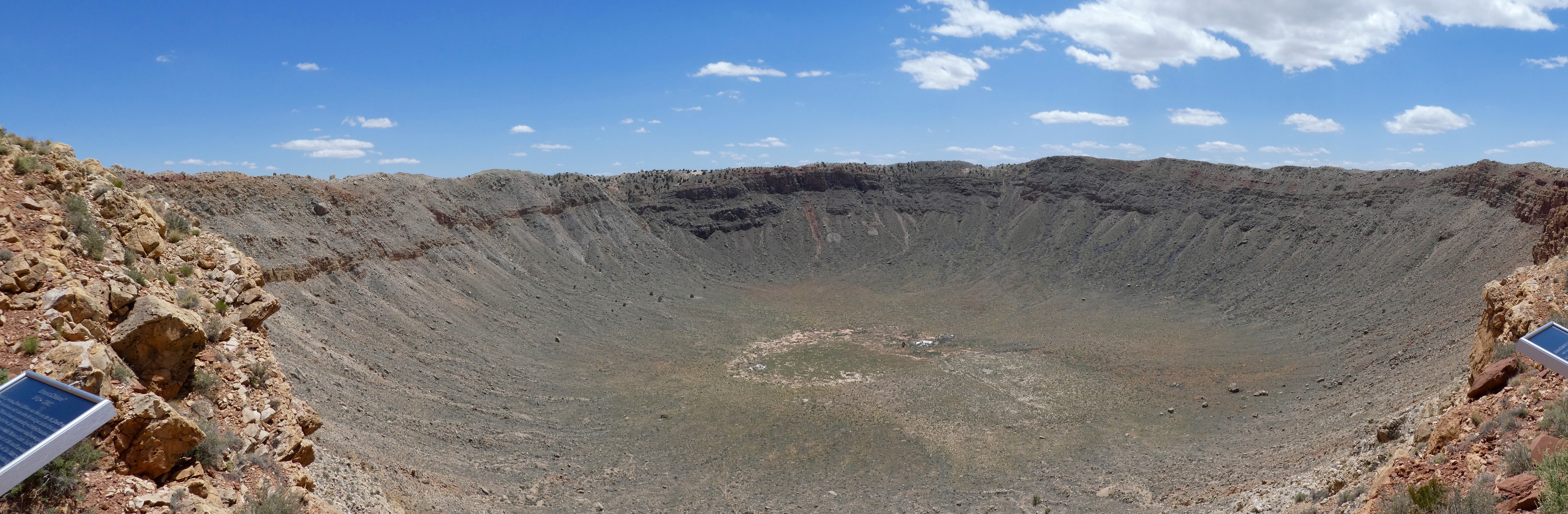
Meteor Crater  Panorama

He had been studying the craters after underground atomic bomb tests in Nevada.   Dr. Shoemaker recognized the signs of high temperatures and pressure.  He discovered the expected material, including shocked quartz (coesite), a form of quartz that has a microscopically unique structure caused by intense pressure and high temperature.   Dr. Shoemaker proved Dr. Barringer’s theory of a meteorite impact.    These are the same tests still used around the world to identify meteorite craters.   And meteorites are shattered and do not survive the impact.  The surface of the crater seemed to be very similar to the craters on the moon, so US astronauts trained here, at Arizona’s Meteor Crater before the first lunar landing. The astronauts scheduled for the Apollo missions to the moon, trained here, under the guidance of Dr. Eugene Shoemaker.   Among those training here were Neil Armstrong and Buzz Aldrin, the first humans to walk on the surface of the moon.  Neil Armstrong and Edwin “Buzz” Aldrin, in Apollo 11,  landed and walked on the moon July 20, 1969.   This is the type of capsule the astronauts lived in during their time in space.
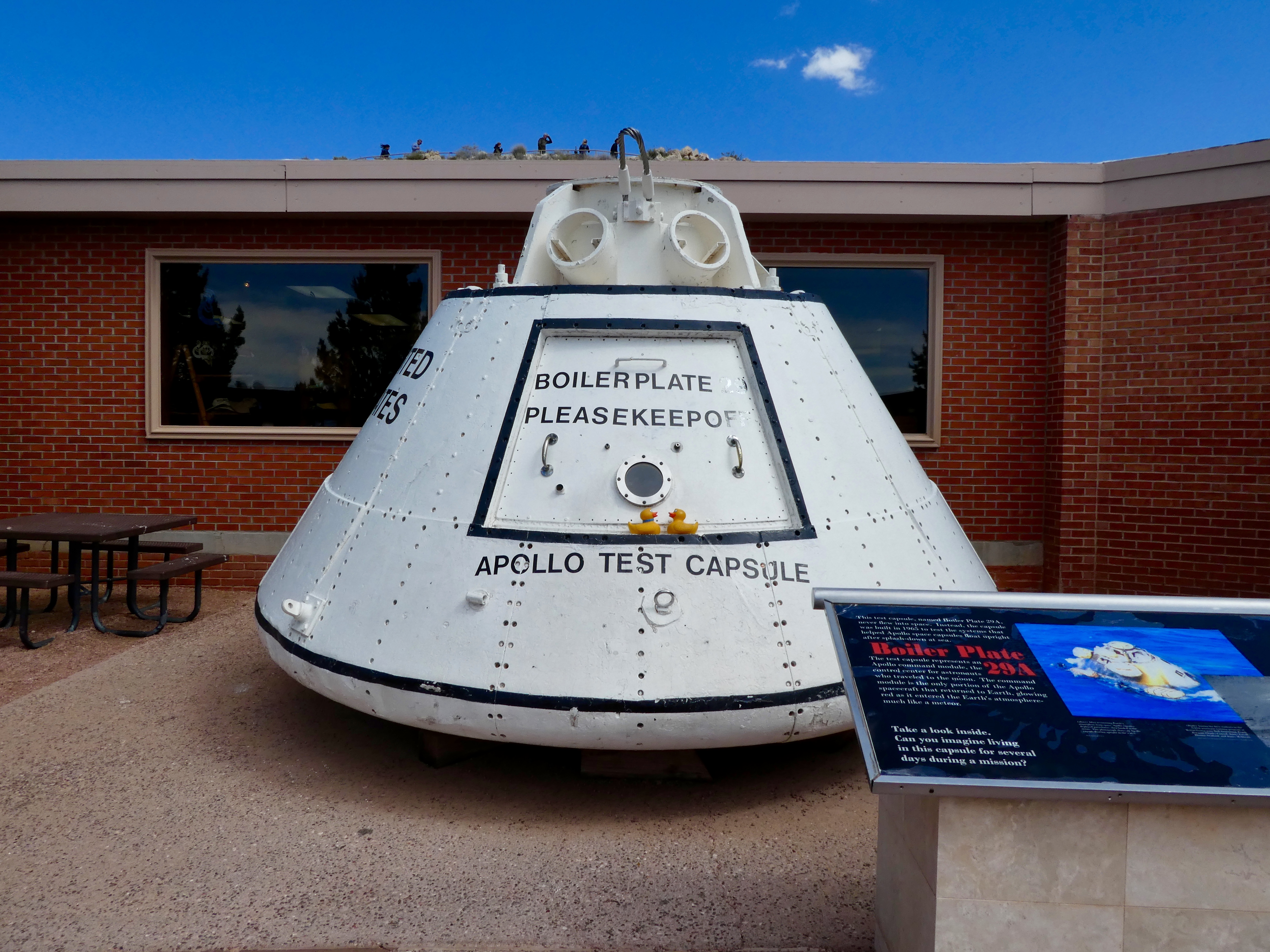
Space capsule

A little small for several days, but they did it.  We ducks wrote about our first visit to Meteor Crater in March 2016 if you care to read that post also.   Just click on March 2016 in the right side of your screen.   When driving to Meteor Crater, drive slowly as this is a private working cattle ranch and this is free range country.

Free range cattle next to road

We don’t want any person or animal to be injured.    Our Meteor Crater is not the largest and not the oldest, but it is considered the best preserved and the first to prove a meteor impact.   And some scientific trivia.  An object traveling through outer space is an asteroid.   When it enters the earth’s atmosphere it becomes a meteor.   Upon impact with earth, it is a meteorite. We were confused and this is what we were told at Meteor Crater.   For more information visit http://www.MeteorCrater.com   When you are near Winslow, Arizona stop to visit Meteor Crater.   We enjoyed it.   We even enjoyed it twice.
Painted Desert and Petrified Forest National Park 2017

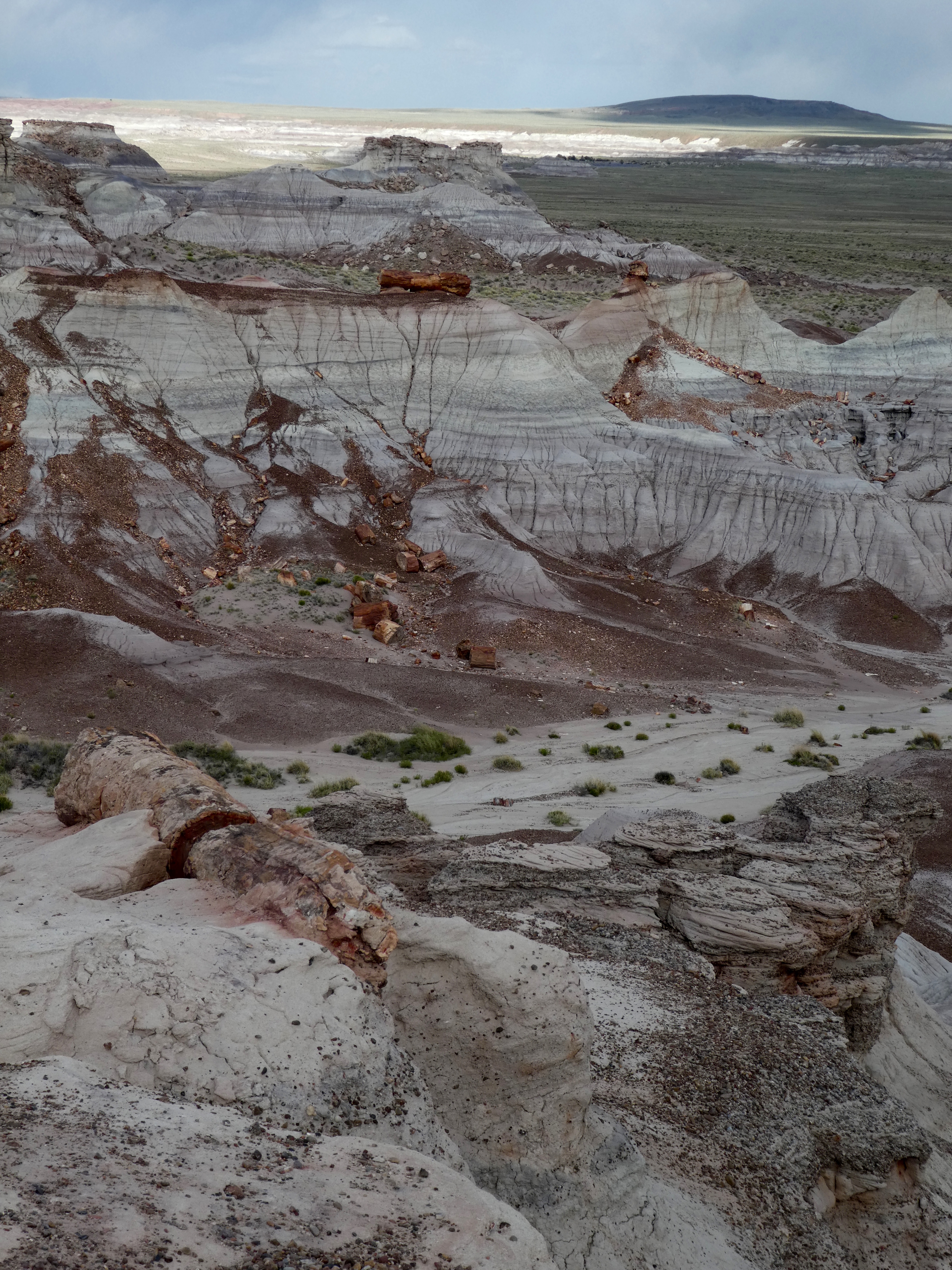
Today Northern Arizona has a desert climate.   But it wasn’t always that way.  During the Triassic Period, 225 million years ago, this was a tropical landscape with abundant vegetation. Also home to early dinosaurs and reptiles while the rivers supported fish, clams, snails and crayfish and giant conifer trees reached 180 feet to the sky.   Trees fell in the rivers.   Soon they became covered with silt, volcanic ash and minerals, which prevented decay.   The wood became saturated with minerals.   Silica crystals replaced the wood.   Now we have petrified logs here, in northern Arizona at the Petrified Forest National Park.

Petrified Forest National Park

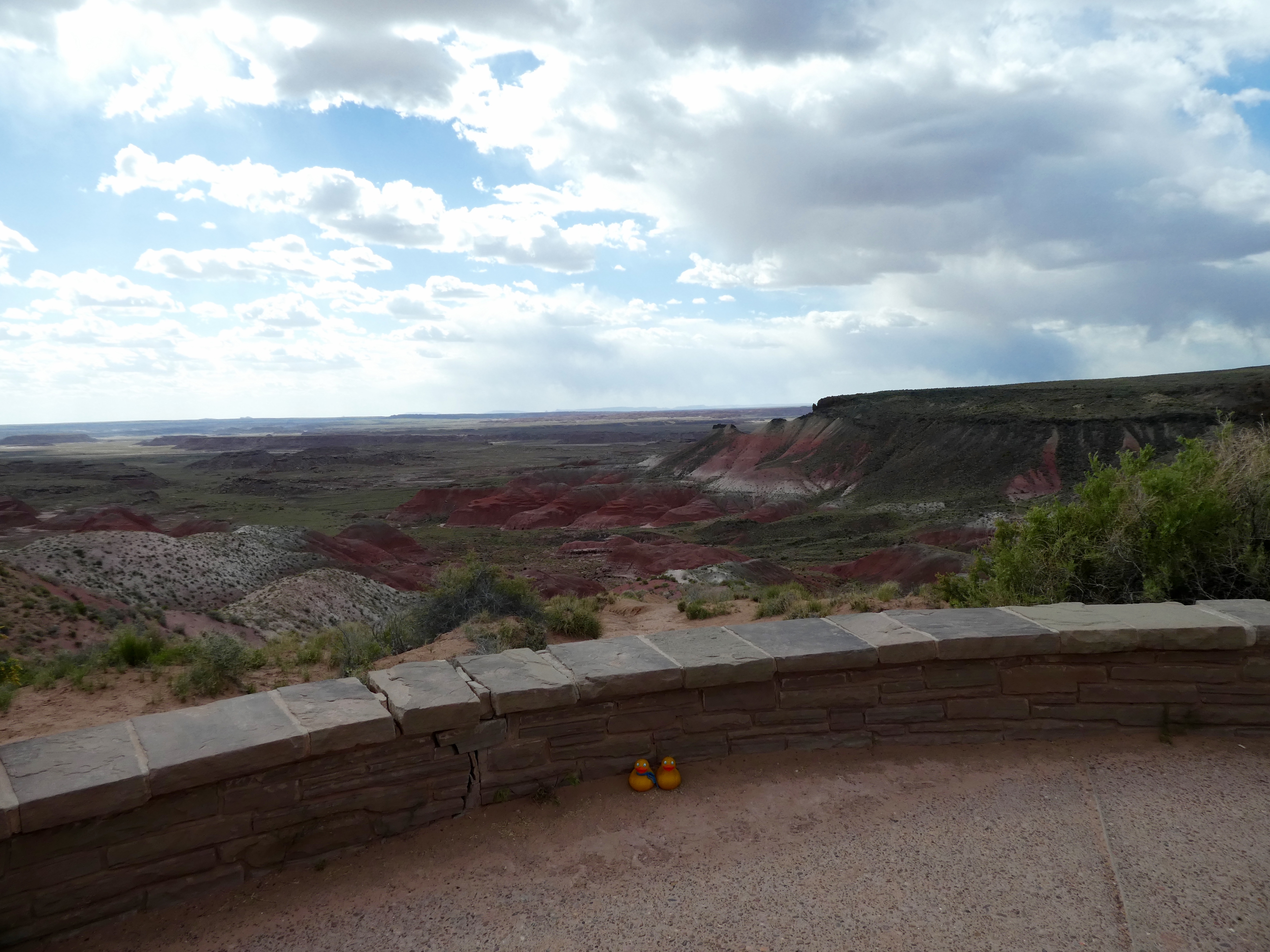
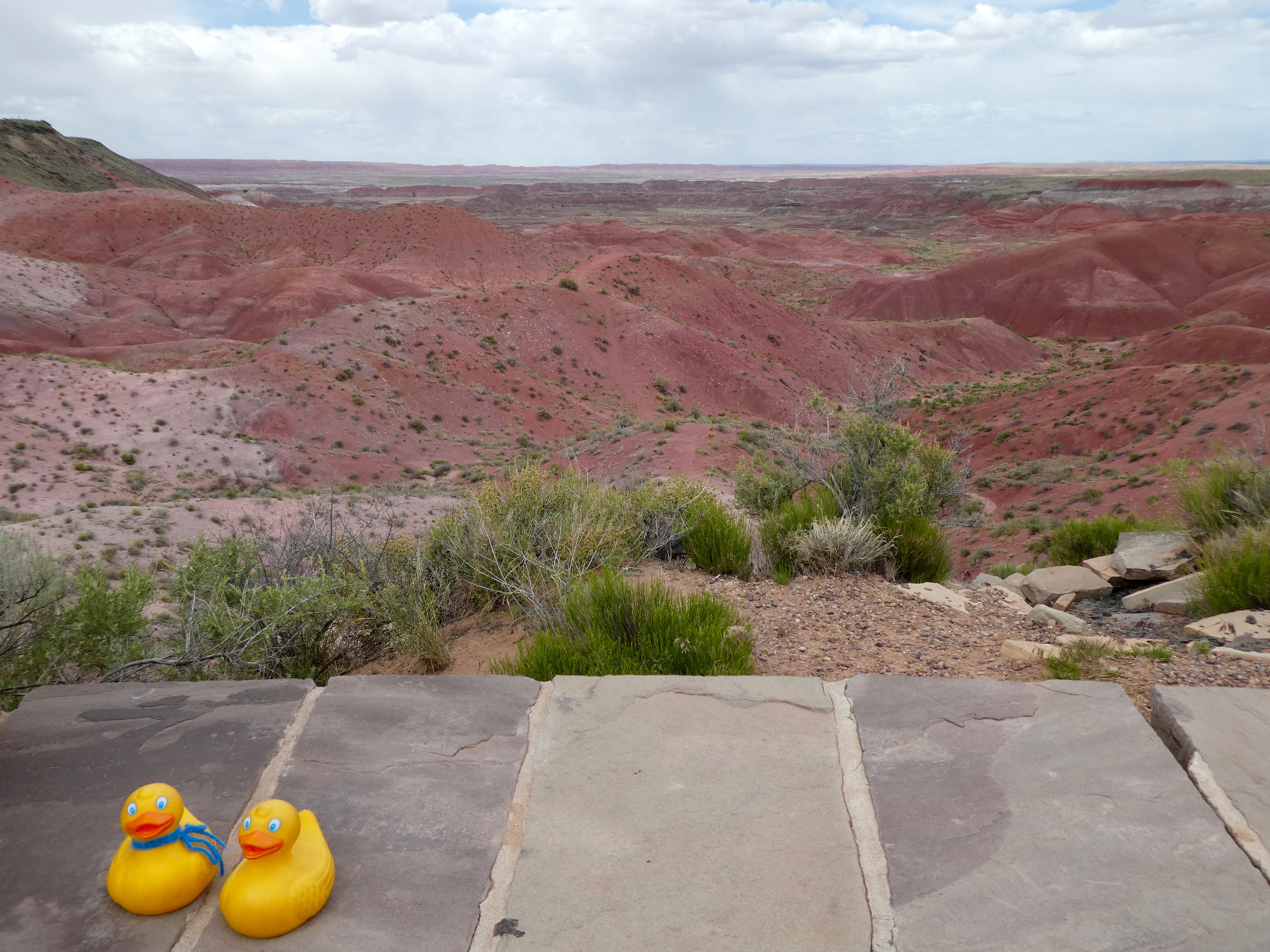
The is reputed to be one of the best areas for petrified wood in the world.  We visited here in March 2016, but like so many places, it is worth another visit.   The weather is warmer now, but it is still windy and many clouds in the sky.   This year we visited the Painted Desert section of the park first.   The colors of the desert are spectacular.

Painted desert

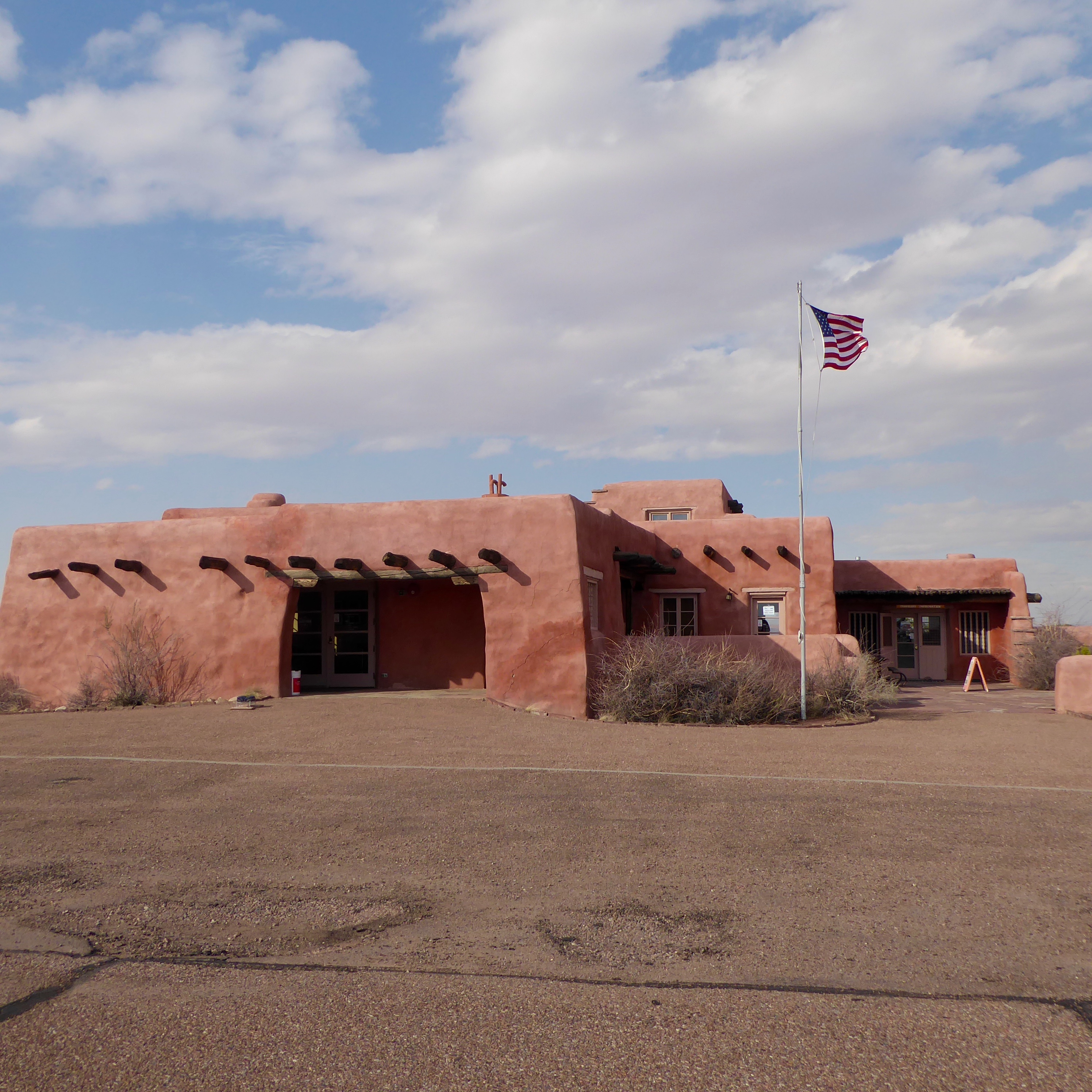
We stopped at most of the lookout points along the way.   We enter the historic Paint Desert Inn.

Painted Desert Inn

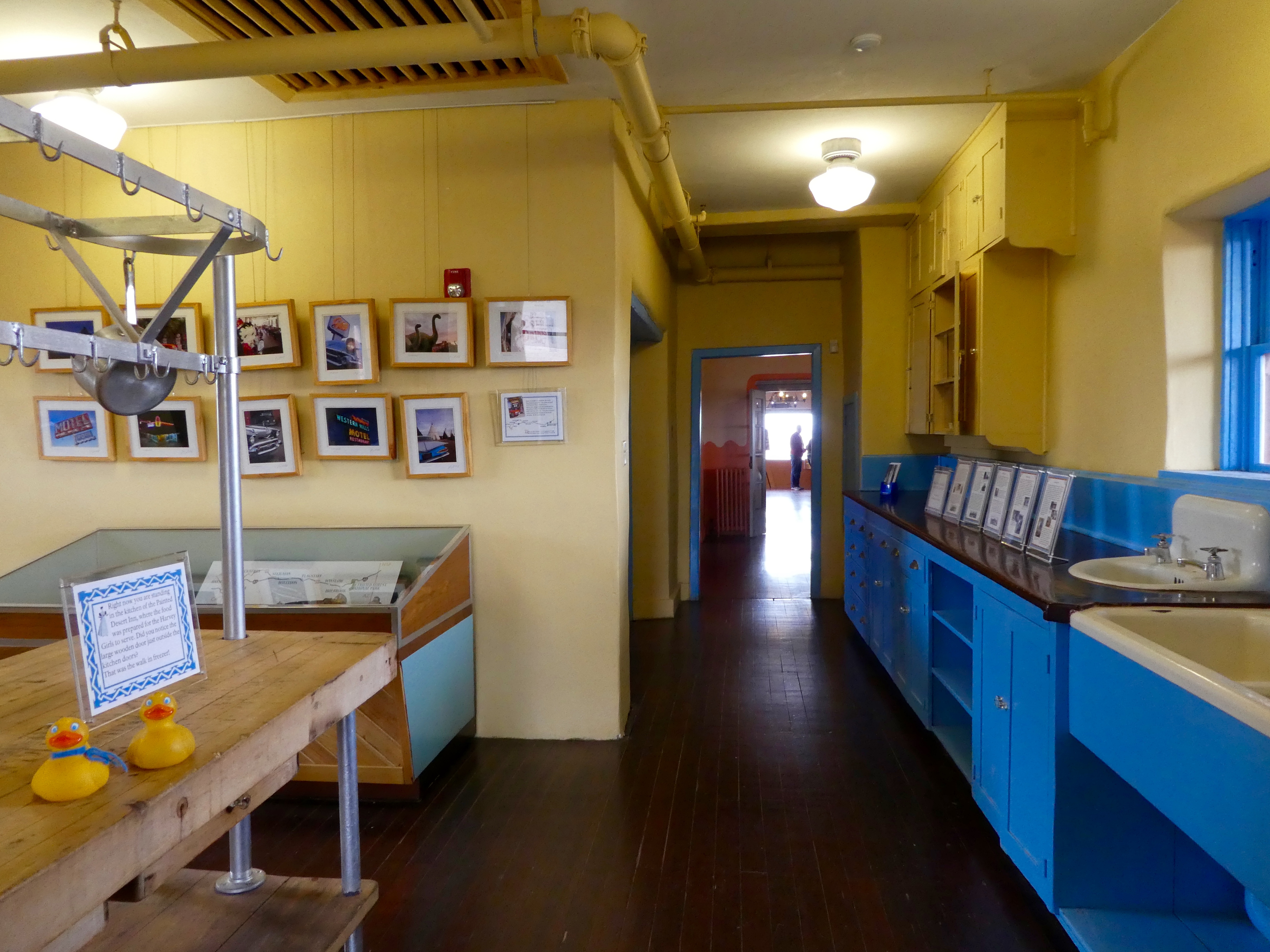
This inn is on the National Historic Landmark List.   The kitchen is still used.

Kitchen

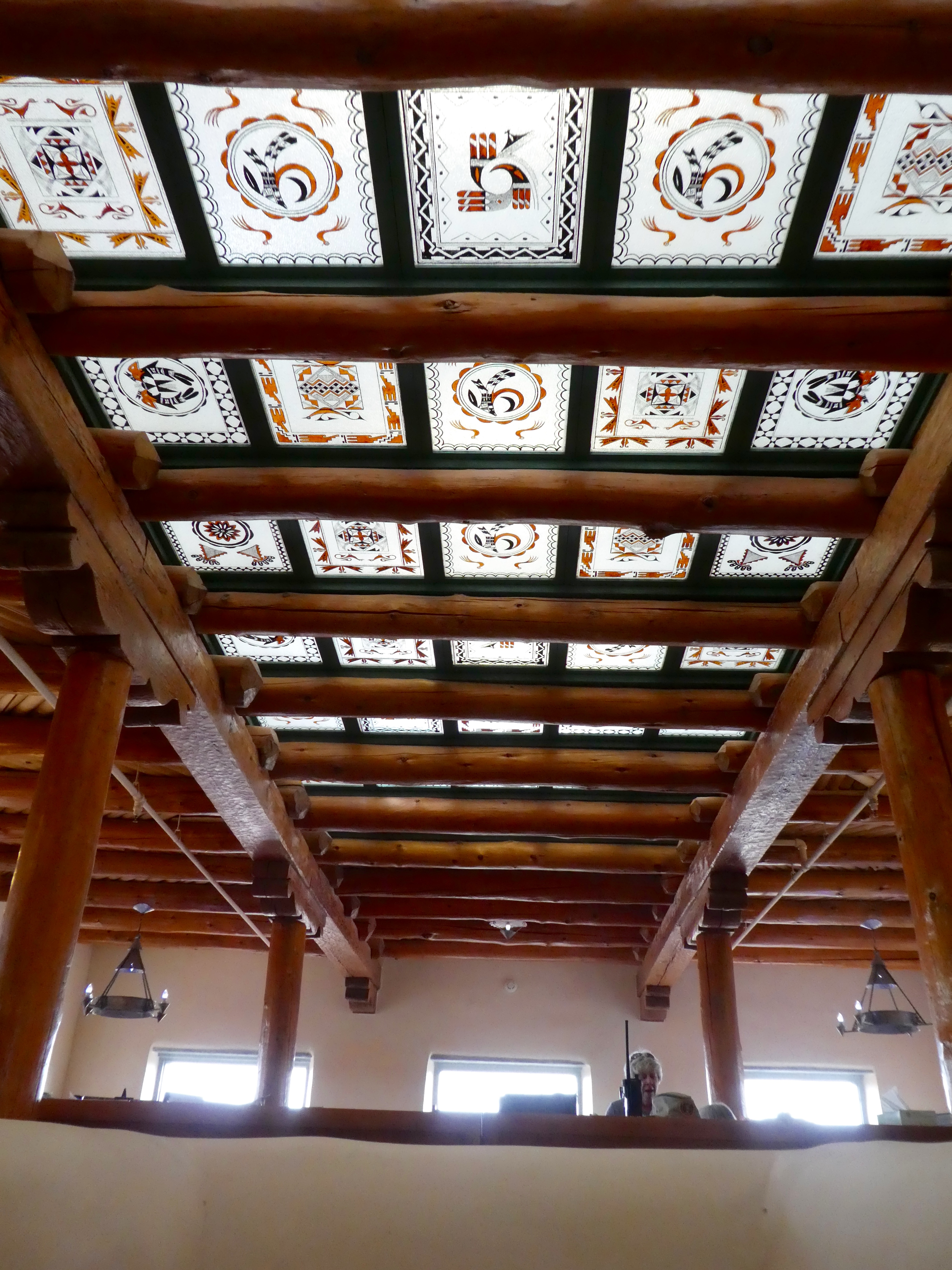
Passing through the kitchen we admire the desert views from a lounging area.   Aren’t these hand painted ceiling tiles beautiful?

These ceiling tiles are beautiful with the old wooden beams.

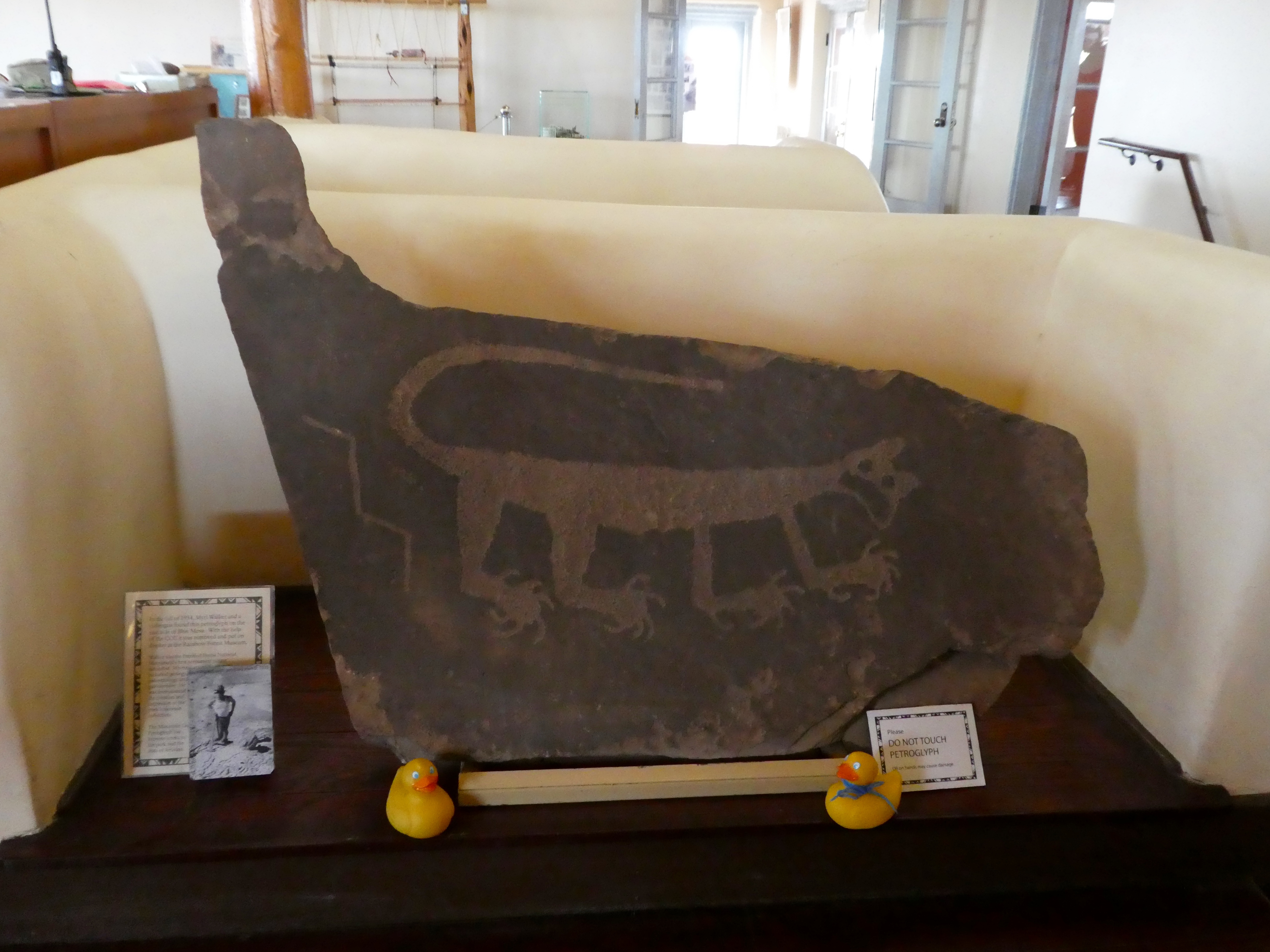
And the old wooden beams are gorgeous.   This petroglyph look familiar.

Petroglyph

We stopped at the Painted Desert gift shop and information center.   A copy of this petroglyph is proudly displayed in the plaza between the buildings.  The summer tourist season is here, so the ice cream shop is open.

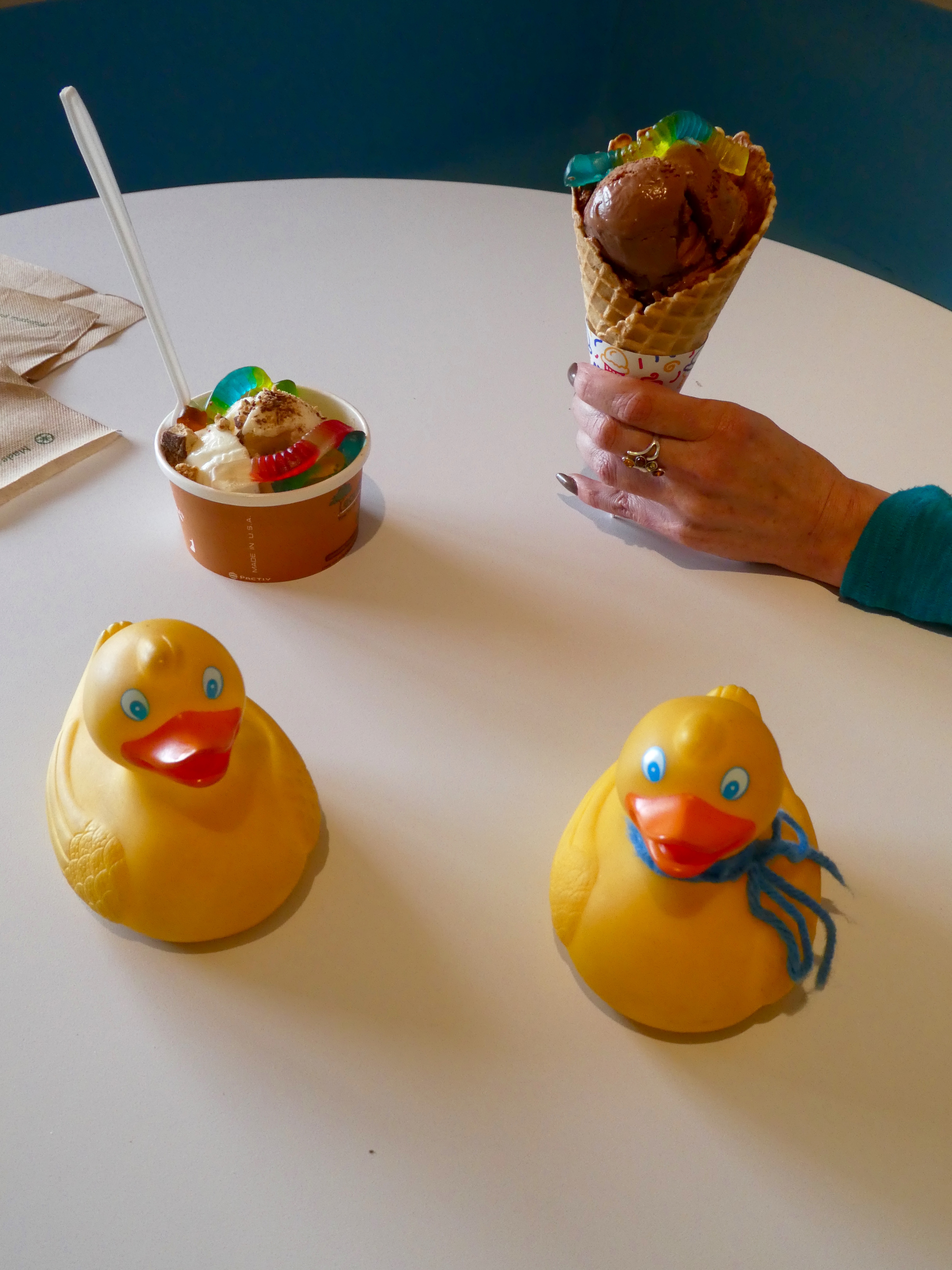
Ice cream. Always good

We love ice cream.   And, yes, those are gummy worms on the ice cream.   We probably won’t do that again.   Cold gummy worms were interesting, but once might be enough.   This is the view from the ice cream shop.

Painted desert from Painted Desert Inn

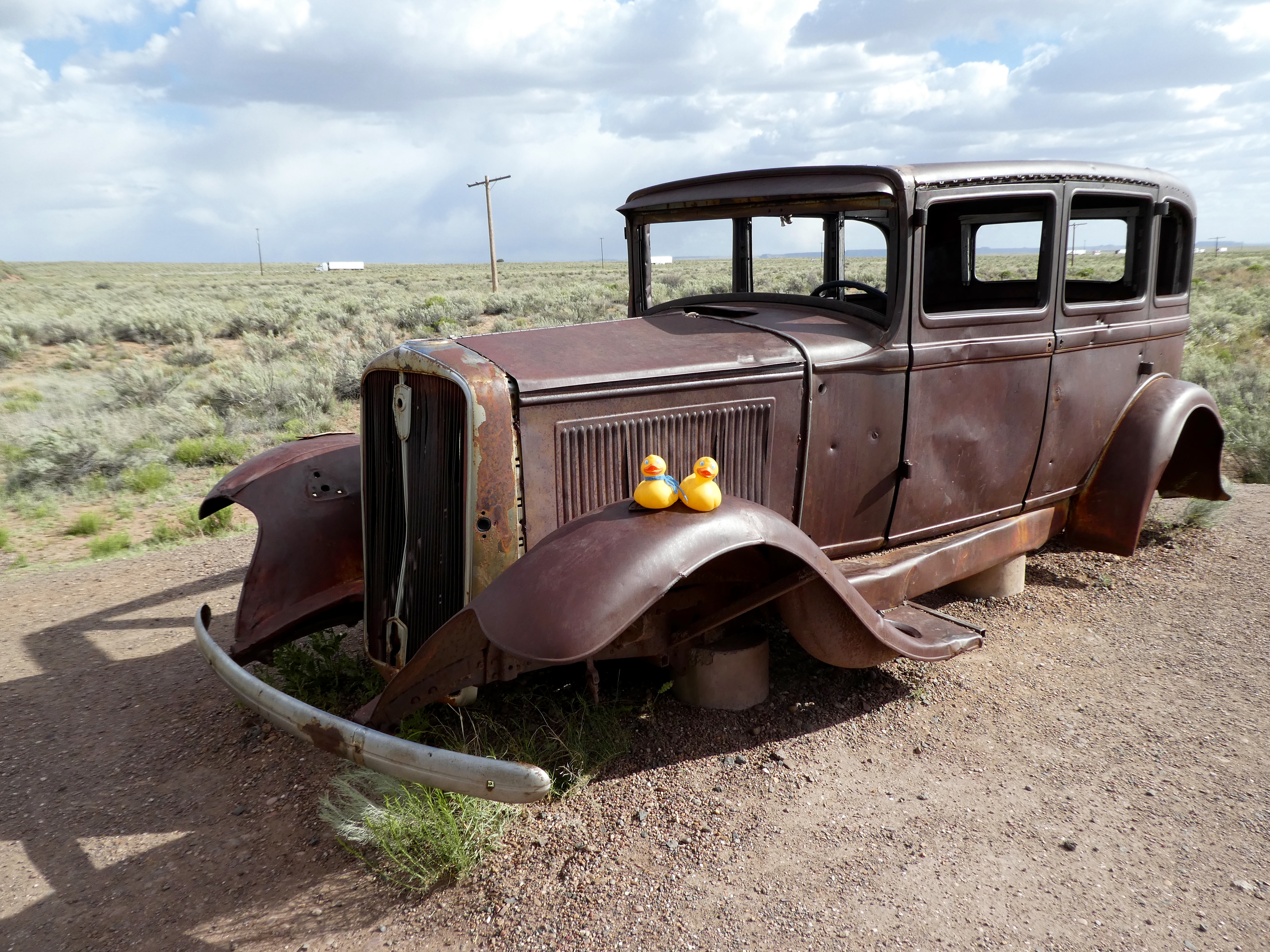
America’s historic Route 66 separates the Painted Desert and the Petrified Forest.   Route 66 connected Chicago and Los Angeles.   Americans were buying cars, gasoline was inexpensive, and people wanted to drive across the United States.   Route 66 was the most famous road of the time.   This 1932 Studebaker is a reminder and tribute to all who traveled this road.

1932 Studebaker on Route 66

As the landscape changes from desert to desert with petrified wood, we want to show you what we saw.

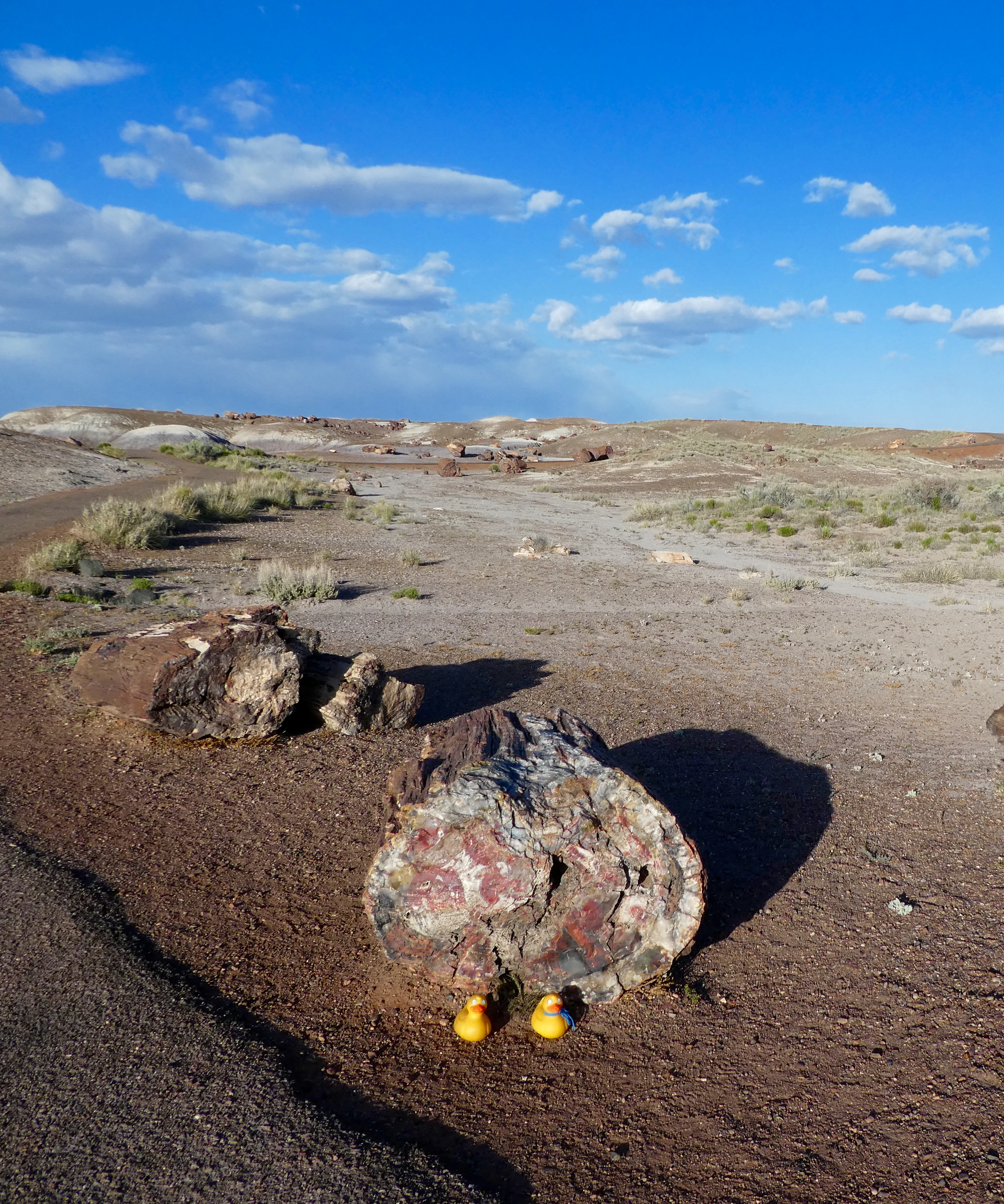
Those are not rocks. They are petrified logs

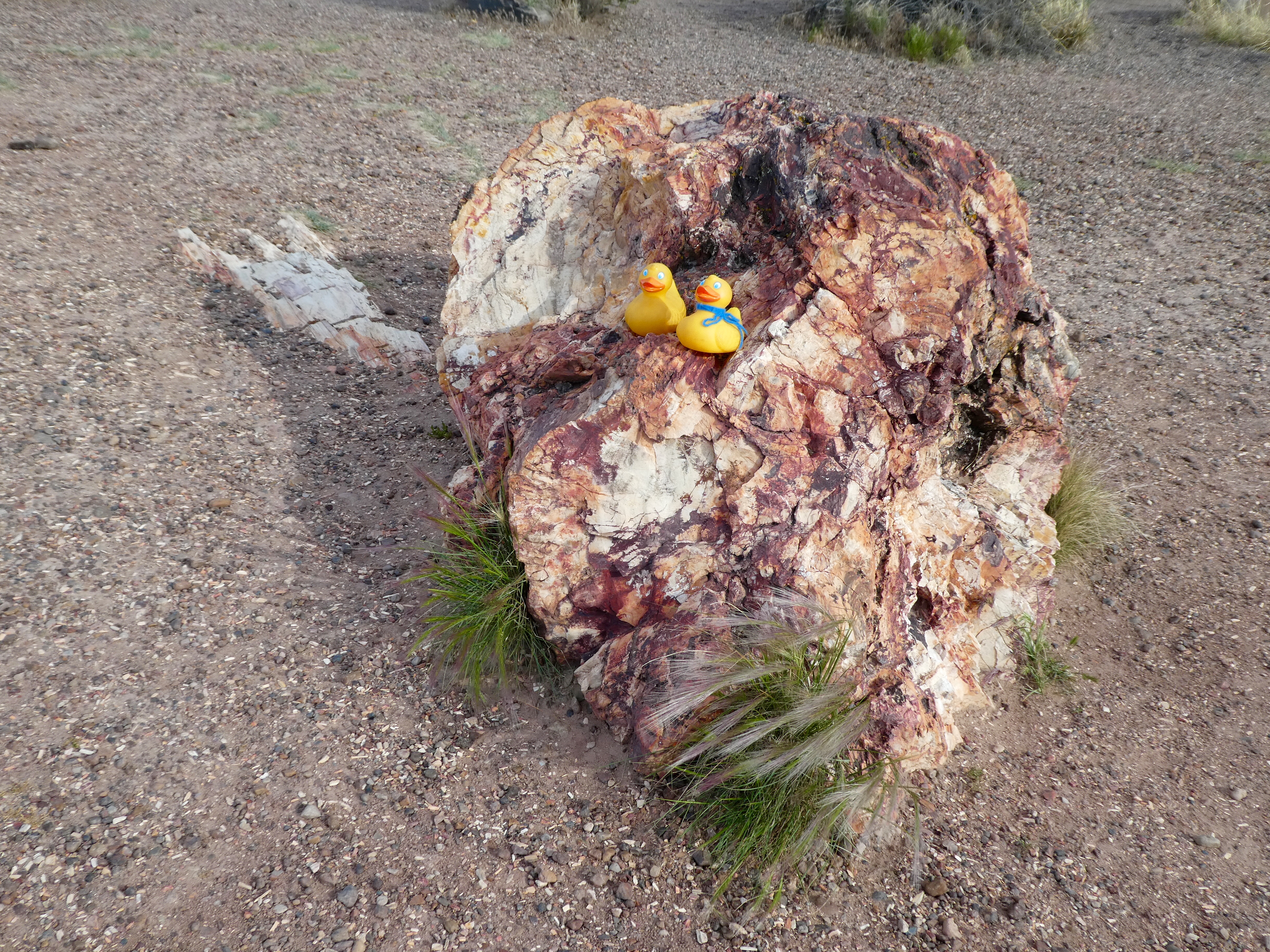
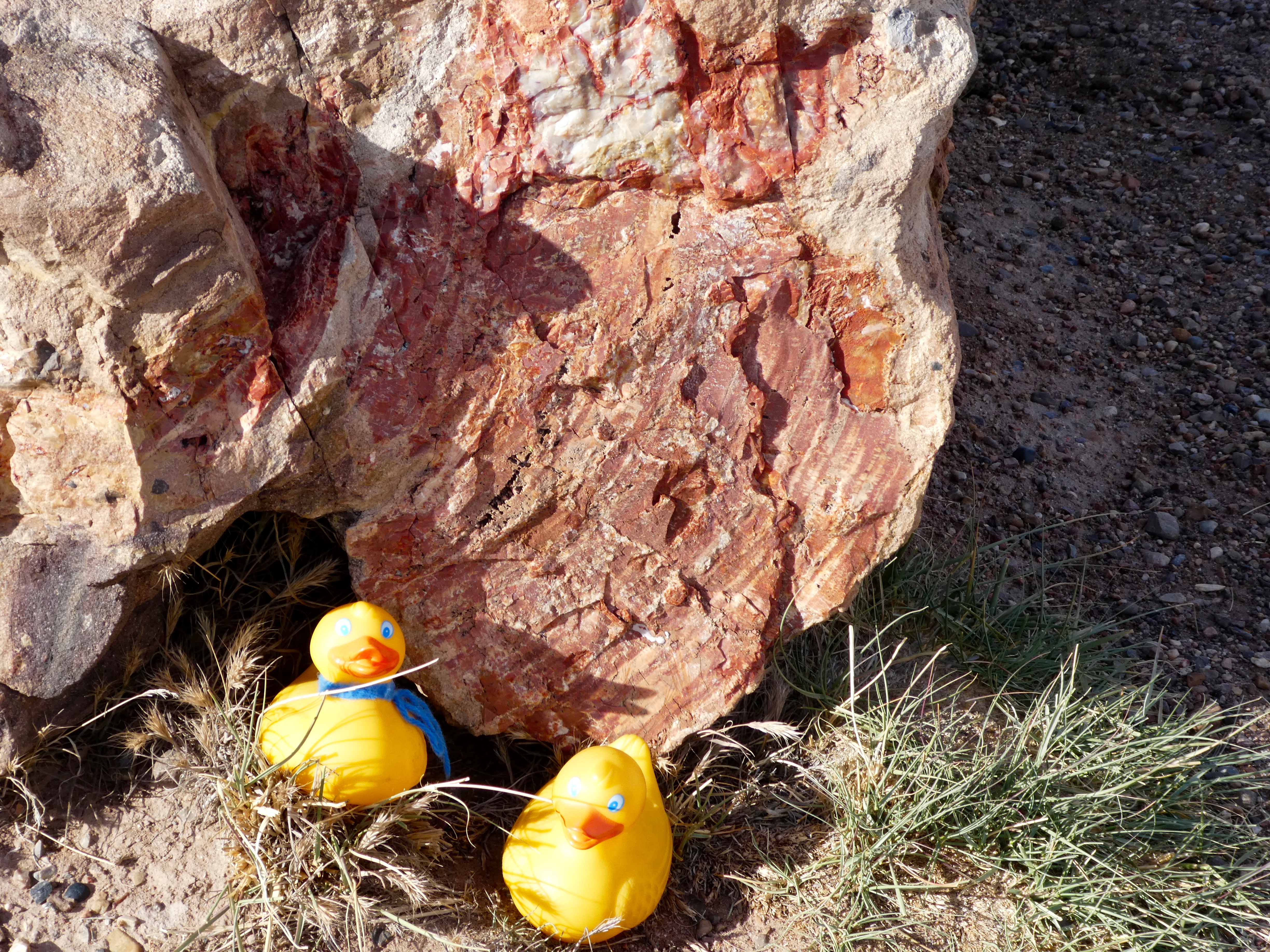
The hills is the distance appear to have large boulders; they are petrified logs.   The colors in the logs are produced by minerals.   Red and pink show a presence of hematite.   Yellow, brown and orange have a presence of goethite, derived by weathering from iron bearing minerals.   Green is from pure reduced iron.   White is pure silica.   Black results from either organic carbon or pyrite.   Purple and blue are produced by manganese dioxide.    This information was provided by the gift shop at the park.

This really is wood.

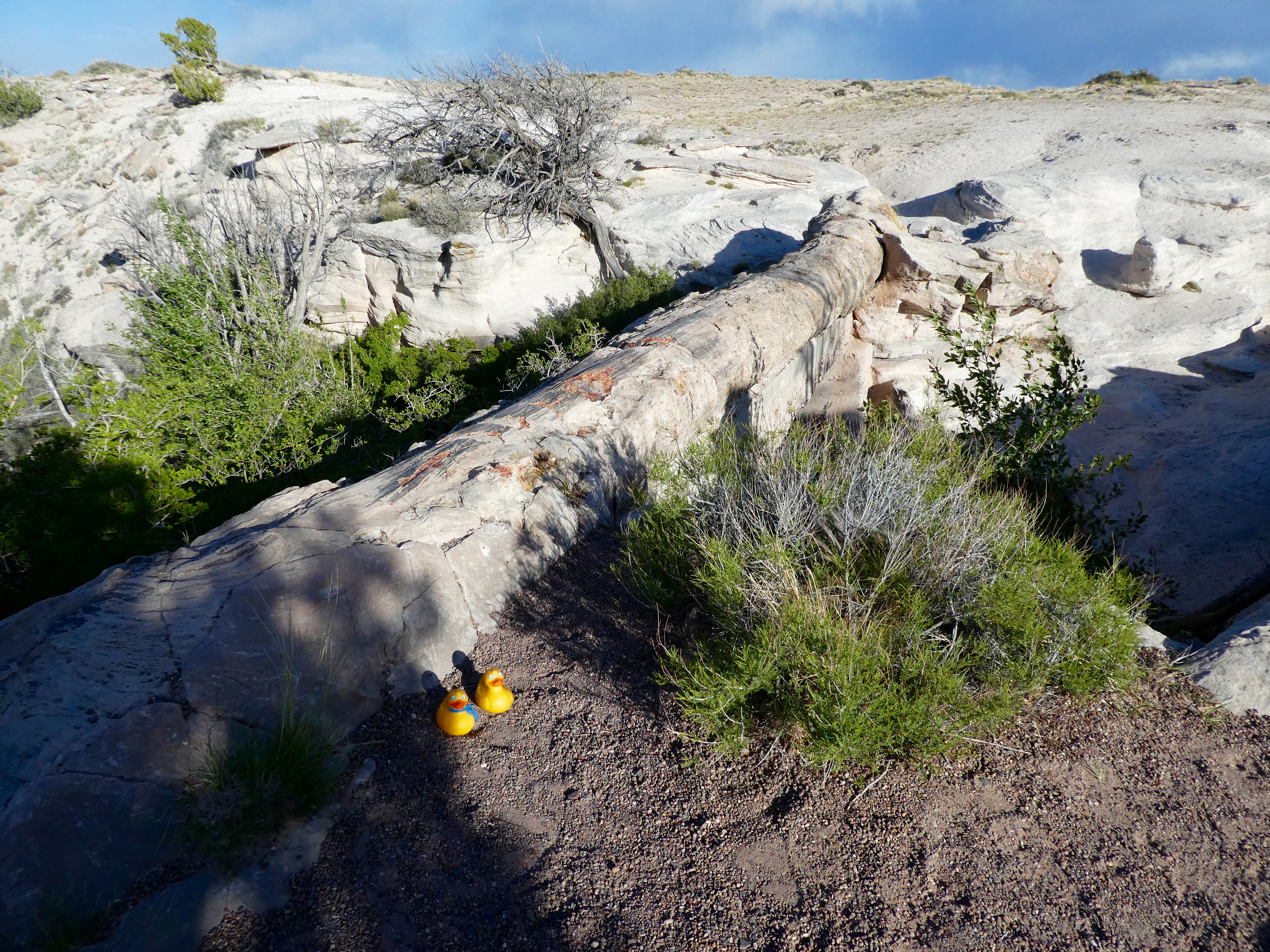
Agate Bridge is a fossilized tree, 110 feet long.   This tree grew in the tropical forest 217 million years ago while dinosaurs roamed the area.

Agate Bridge

This bridge was once used by humans, but now humans and traveling ducks are not allowed to be on the bridge.   In 1917 (a hundred years ago), the concrete supports were built.   Even though we know this is petrified wood, we are still amazed how much it looks like rock.

Love the colors of the wood

This log is great also and we see so many more in the background.

Petrified log with many more in the background

We are in a National Park so it is not allowed to take anything, including petrified wood from the park.  We are happy about that.   We hiked on some of the trails and enjoyed the wood laying around.   We were here last year also and would love to return again.   We ducks, and humans, love our National Parks.   You will enjoy a visit also.


Zeb and Soapy Smith Duck Take a Road Trip to an Ice Cave and Volcano

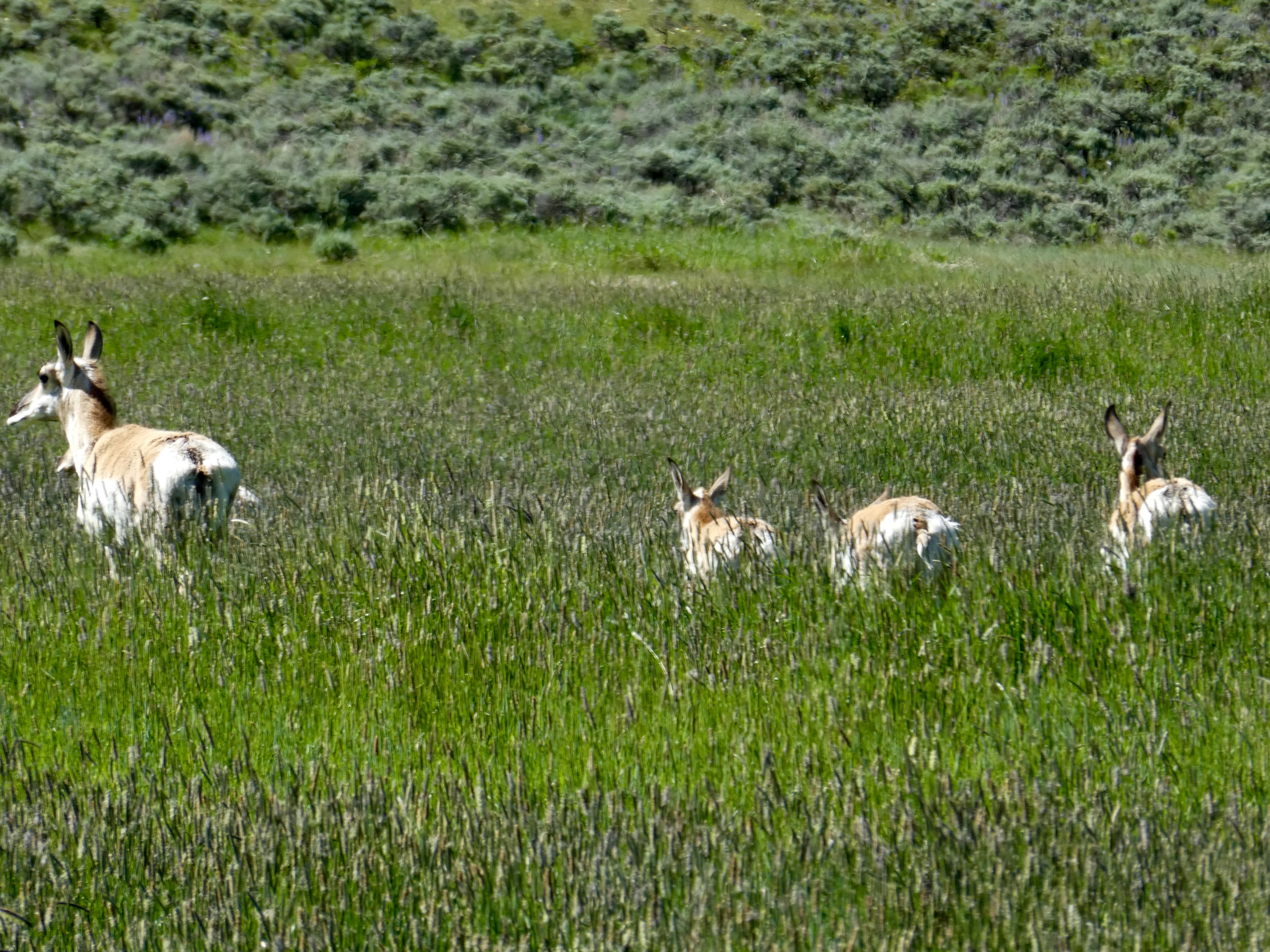
Road trip!   We love road trips.   I, Zeb the Duck and Soapy Smith Duck are in the car, waiting for our moms.   Like many road trips, there is no rigid schedule.   We are not sure where we are going or when we will return.   Heading in the general direction of the Grand Canyon, but wanting to see things much different also, from Denver we head south on I-25.   Along the way we see several pronghorn, or American antelope.

Pronghorn or American antelope

We often just call these animals antelope.   They are the second fastest animal in the world, behind the cheetah.   Of course, they are the fastest animal in North America.   These animals appear so delicate and graceful.   We love them.   In Albuquerque we leave I-25, heading west on I-40.   This is still rather high in elevation and somewhat mountainous, so the heat is not a problem.   We are near Grants, New Mexico.   Let’s go to the ice cave.   We were here in March 2016, but we want to see it again.  The ice cave is located on the Continental Divide.

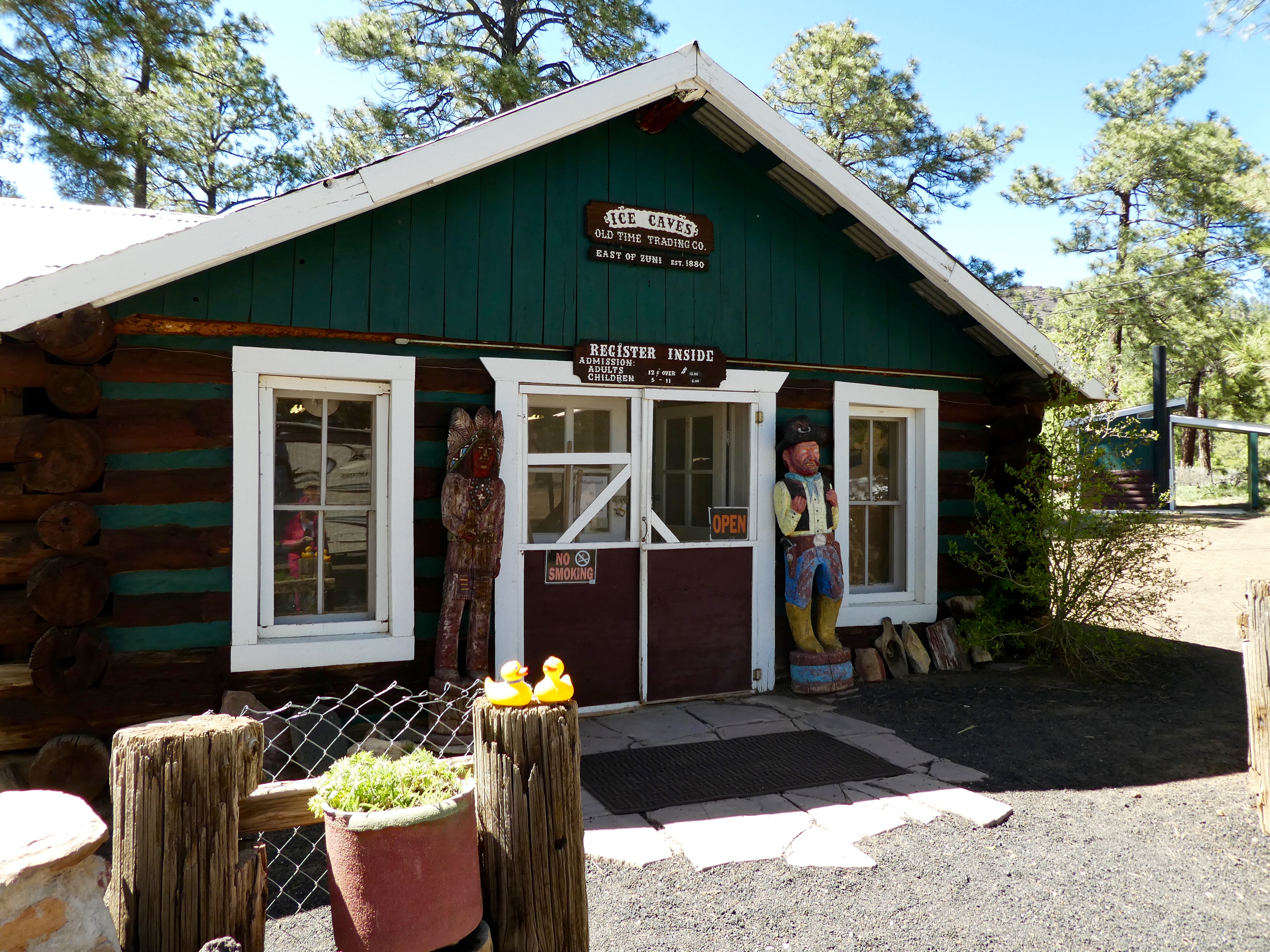
Inside we pay our fee, get our map and look at the museum stuff.

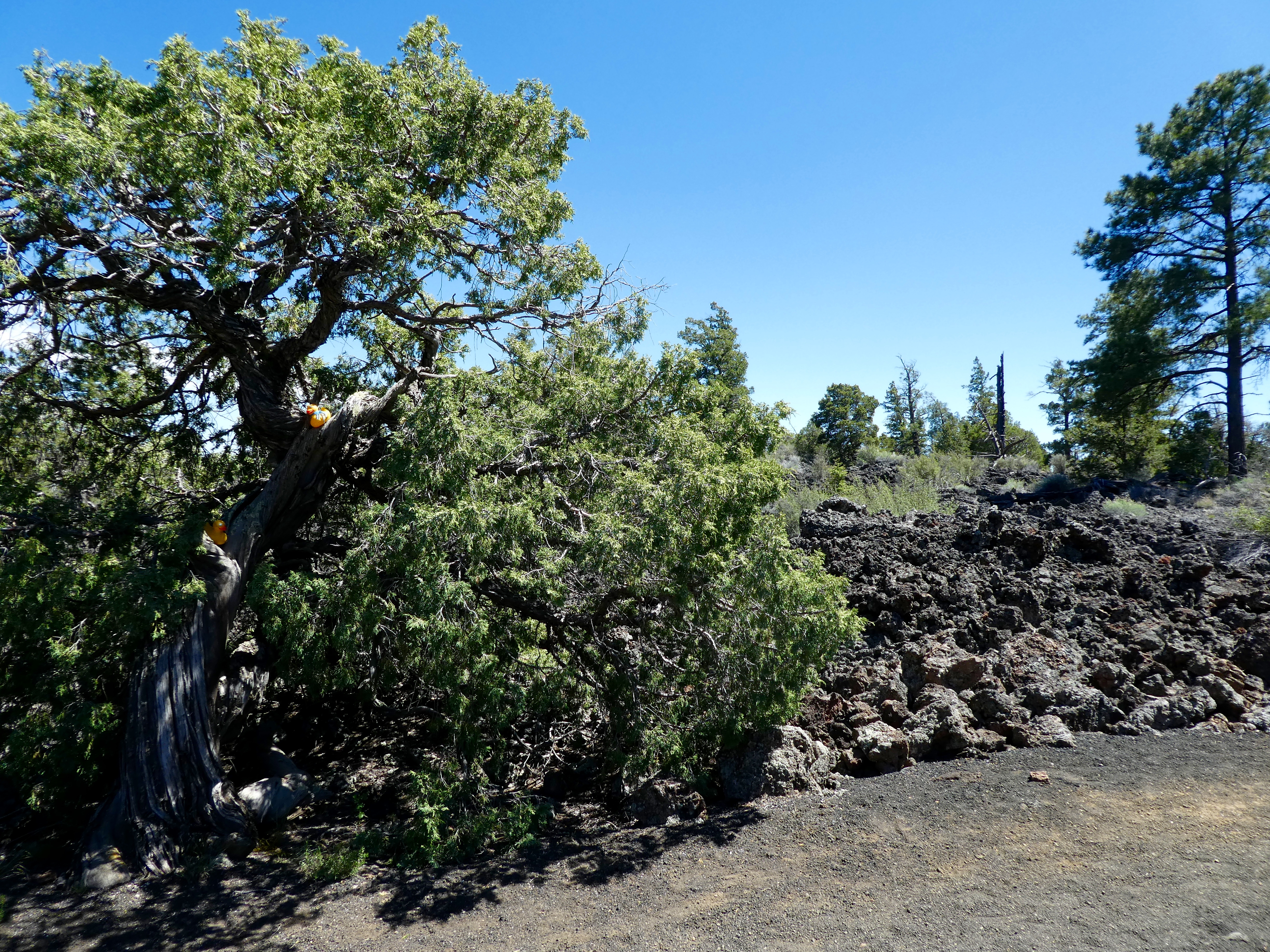
There are several dormant volcanos in this area of New Mexico, and the ice cave is inside a partially collapsed  lava tube.   As we walk to the cave, we admire this old, twisted tree.

Ducks sitting on twisted tree with old lava behind and to the right.

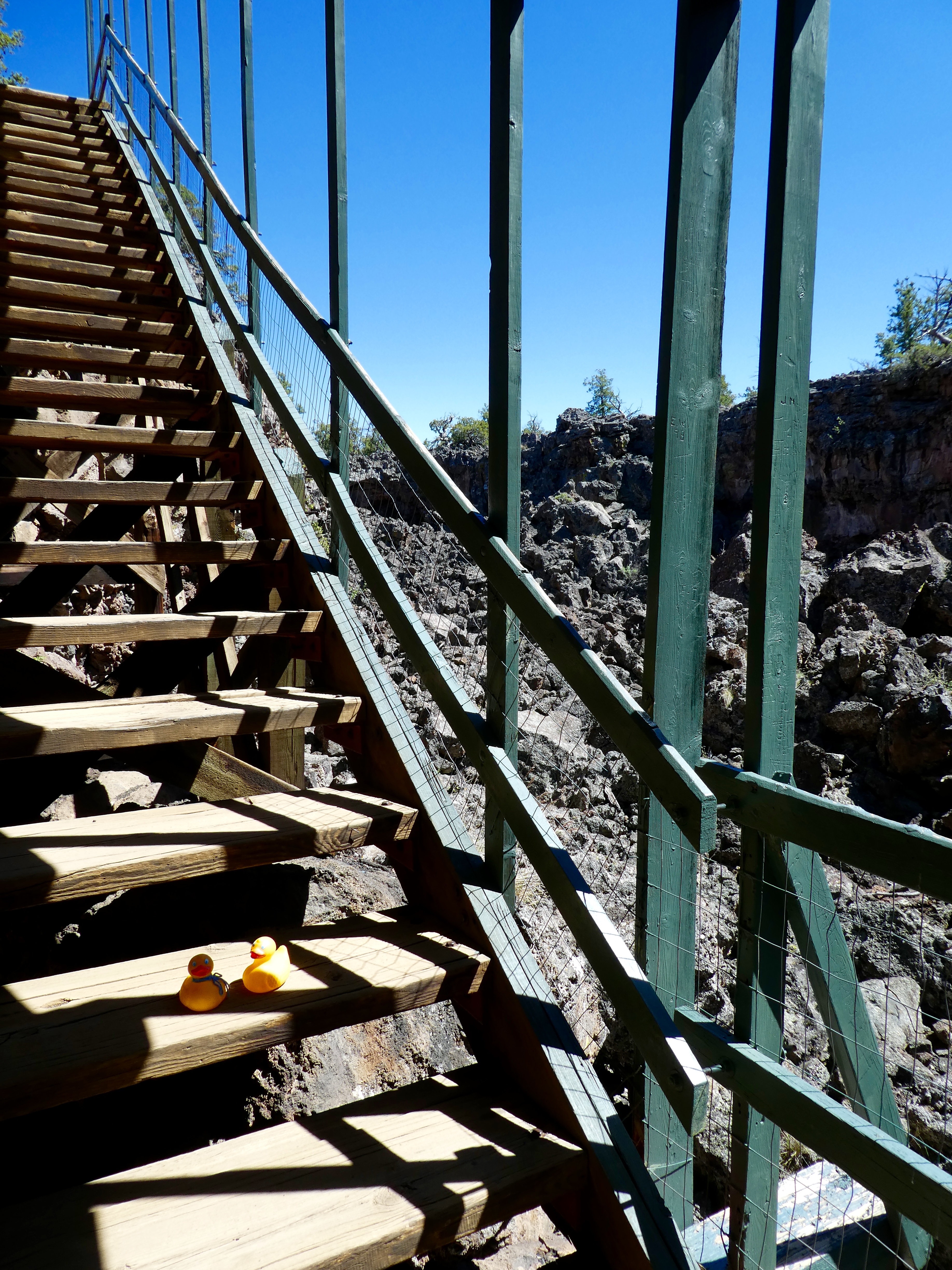
And we rest for a moment here.   Ducks have short legs you know.   Last year we showed you some of the things along the way, so we won’t repeat it.   Now, down 70 stairs to the ice cave.

Down the stairs to the ice cave.  And still more stairs!

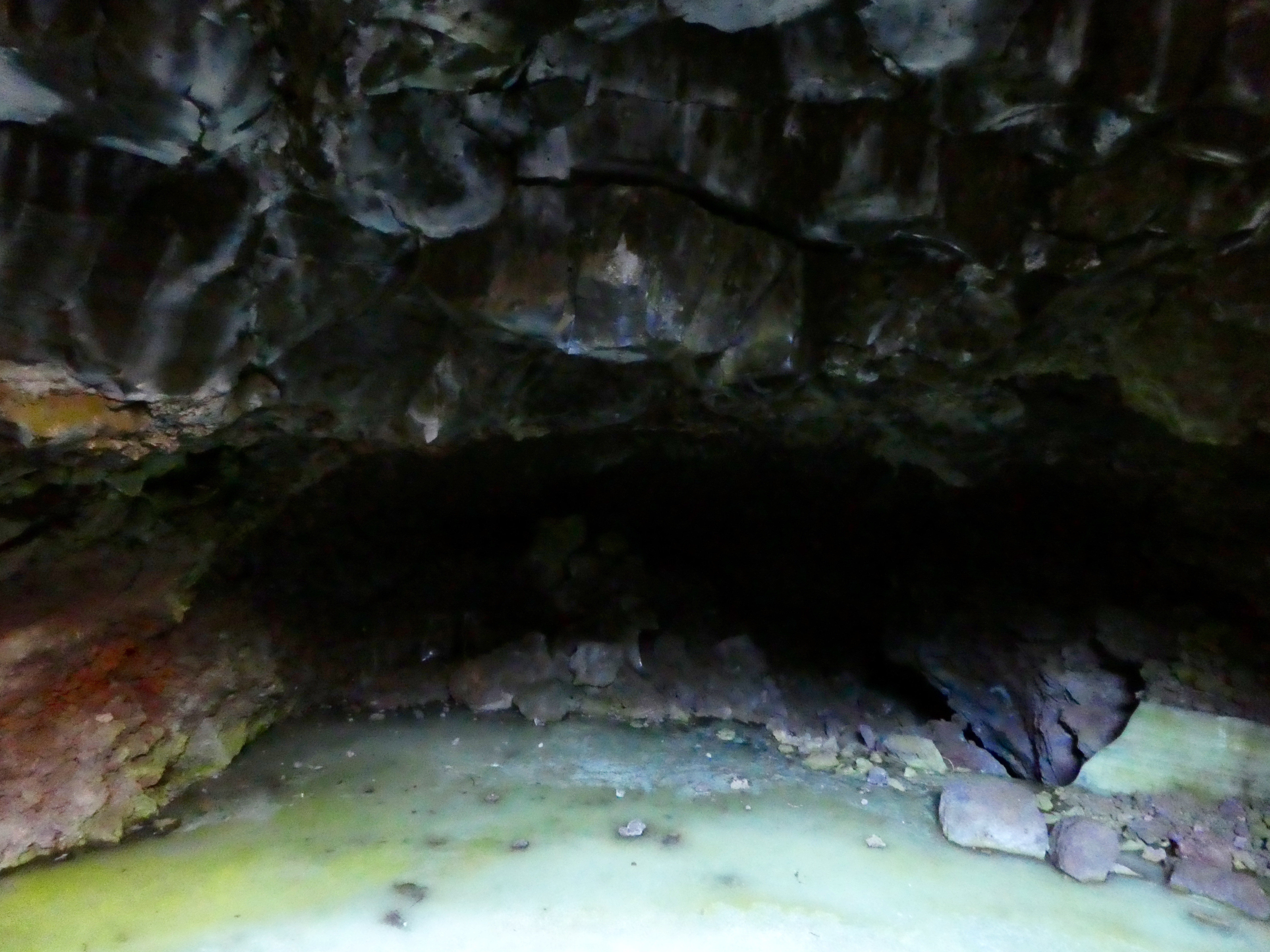
Photos are difficult here for mom, but this ice is deep and old.

This is really old ice

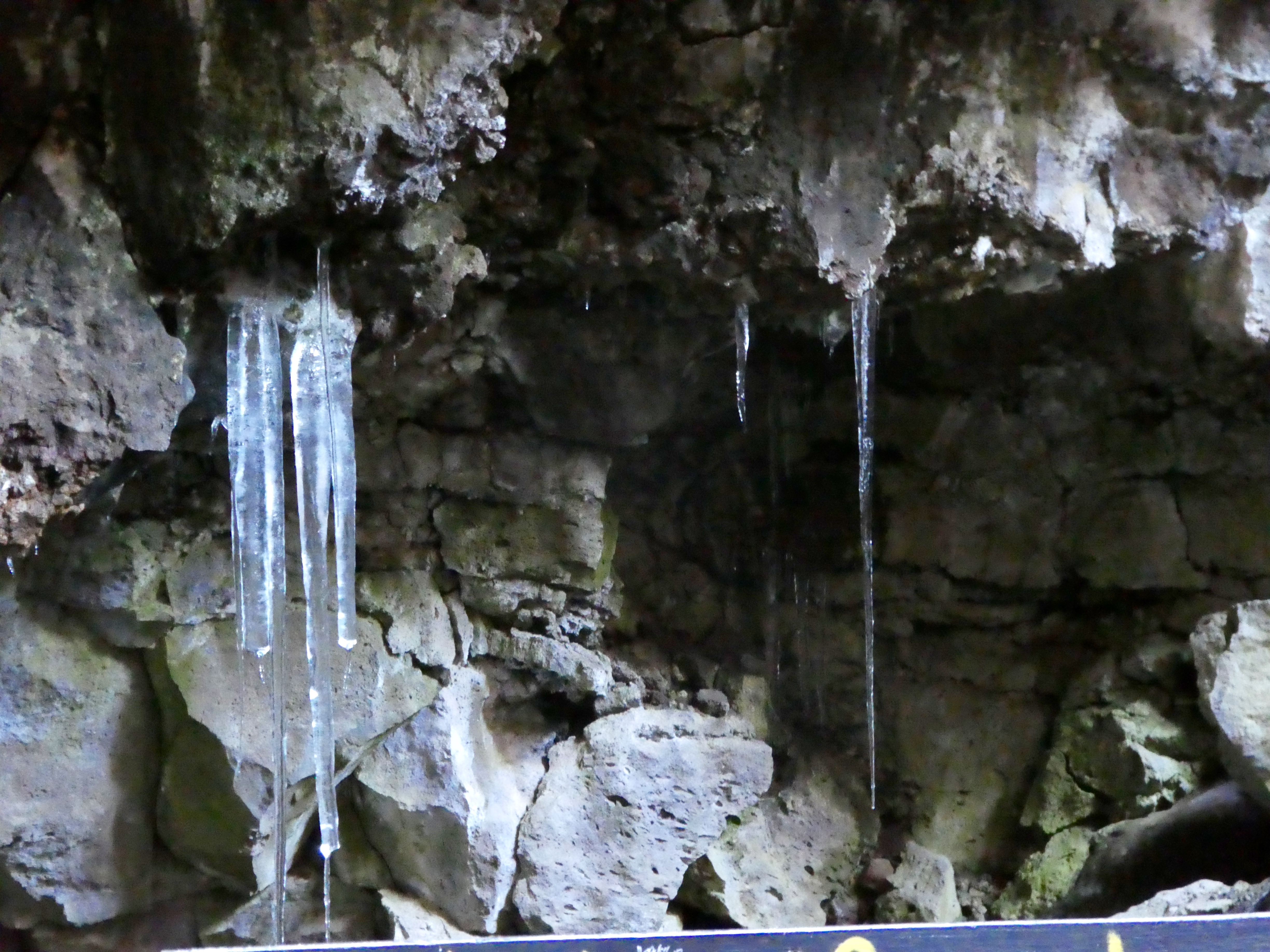
The temperature dropped as we reached the bottom of the stairs.   There are two levels to see the ice, probably less than 10 feet apart, but the lower level is much colder.   This ice is about 20 feet deep.   The blue-green tint is from the natural Arctic algae.  The oldest ice is on the bottom, and is from 1100 A.D.  That is old!  New ice is added each year from rain and melting snow.   We love icicles.

Permanent icicles

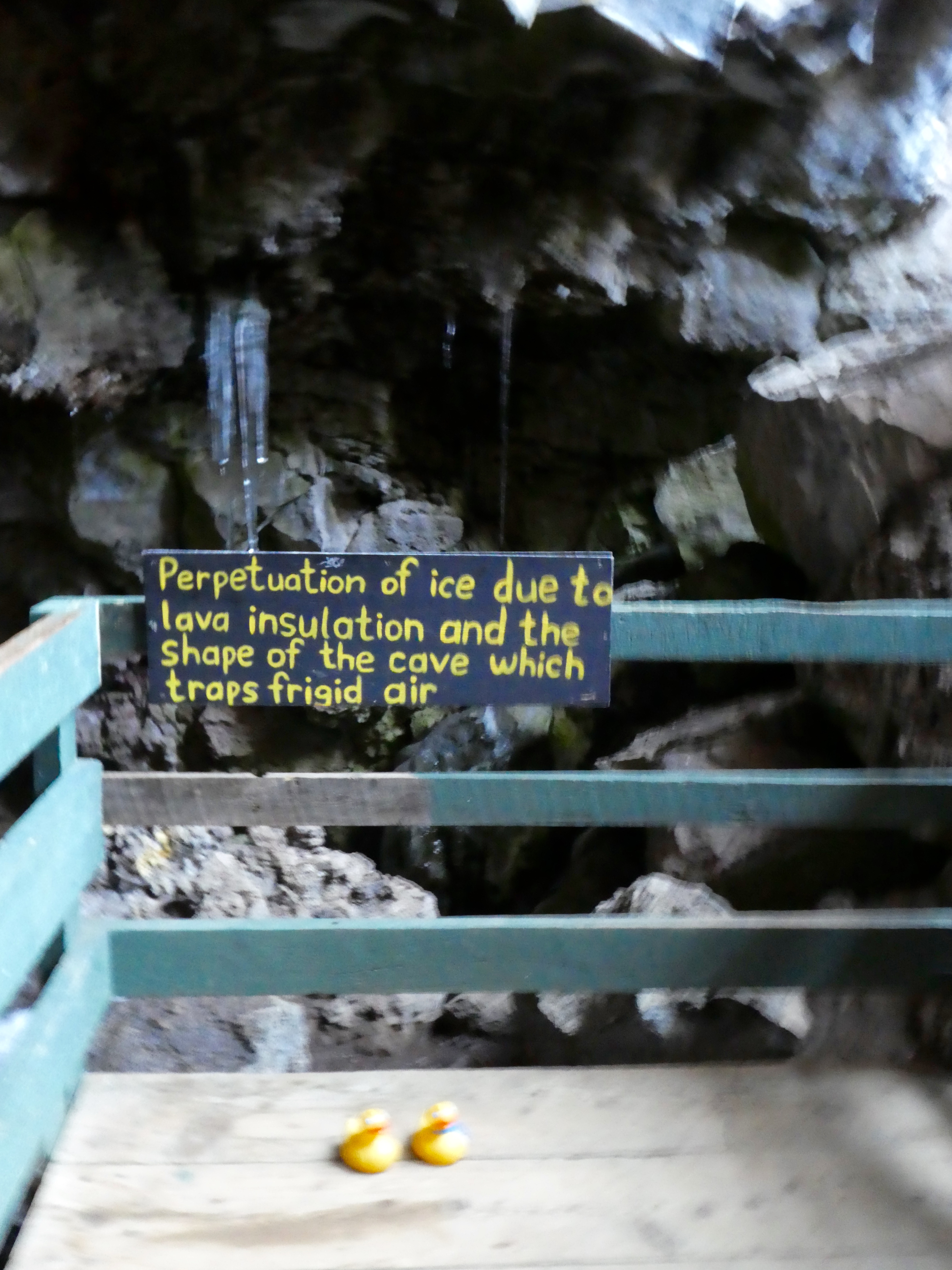
Especially in the summer.   I don’t remember this sign from last year, but it explains a little about the ice never melting.   The temperature here on the ice never gets above freezing.

Inside a lava tube this ice does not melt

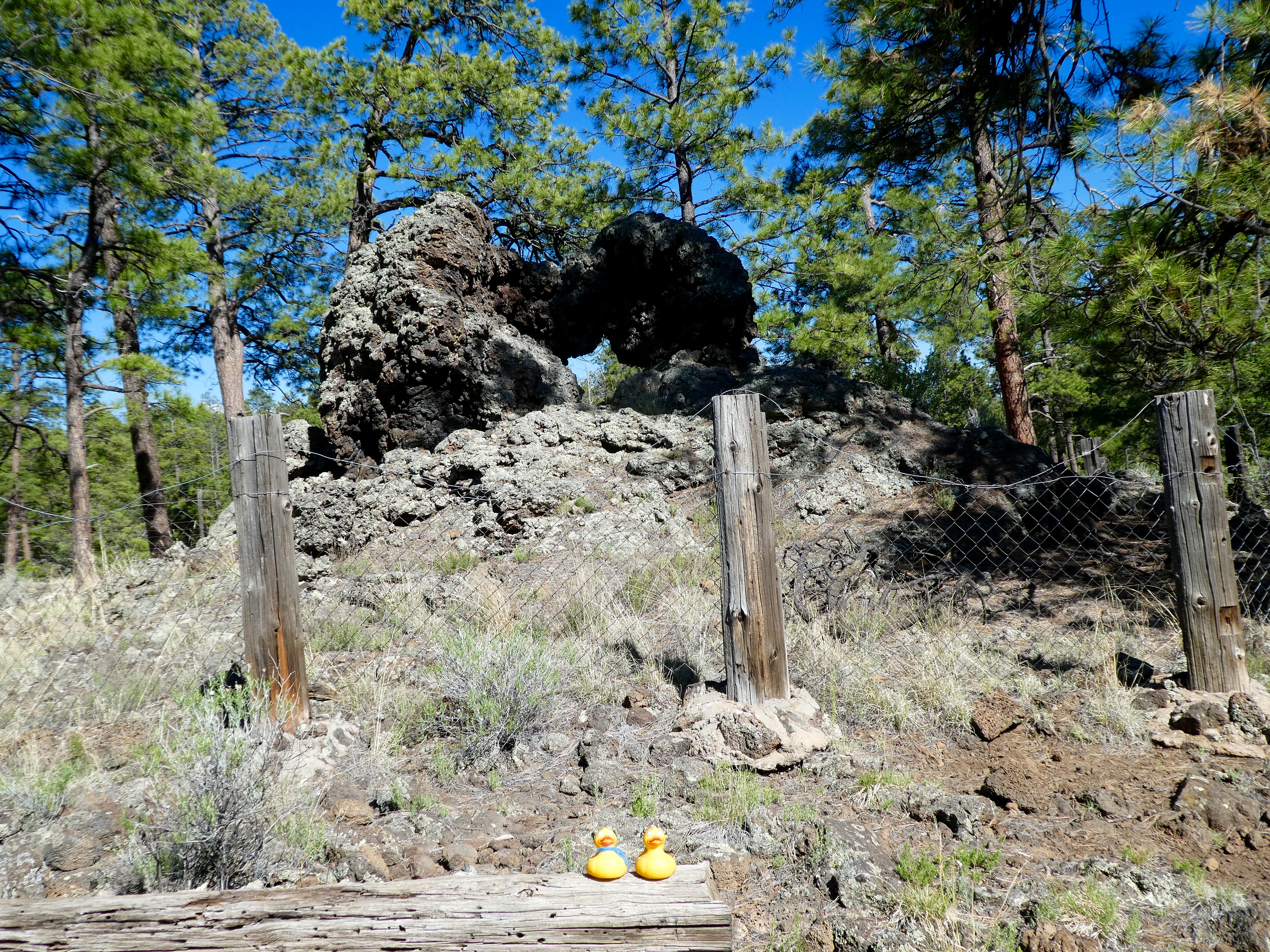
The lava tube is partially collapsed, so we can see outside.   We like this place.   If we are in the area again, we will probably stop again.   March 2016 was colder and windy when we were here, so we did not hike to the top of Bandera Volcano.   But today is nicer, so up the hill we go. We pass this lava formation.

Lava Arch

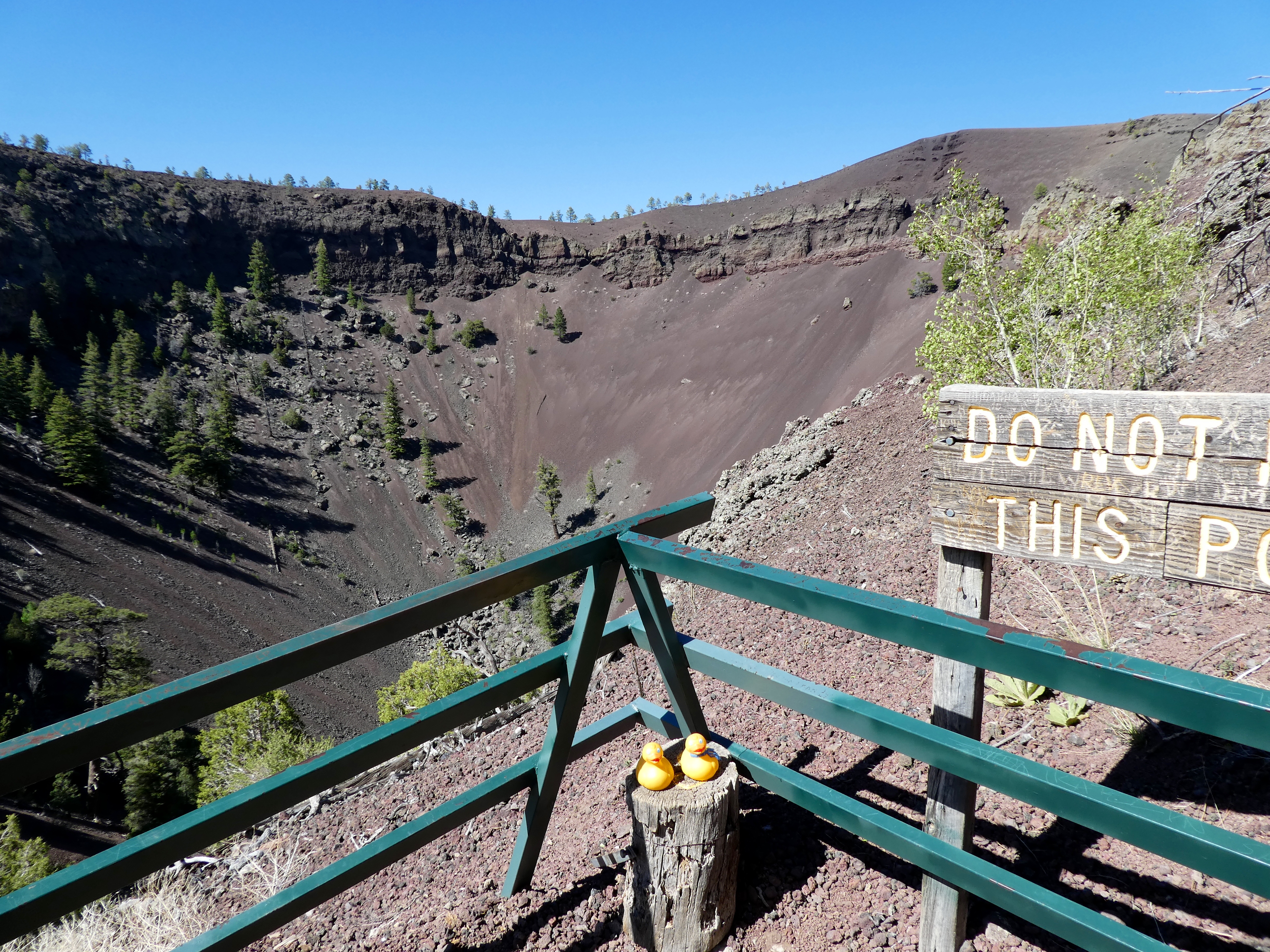
Continue climbing on the path, we reach the top of Bandera Volcano.

At the top looking into Banderas Volcano

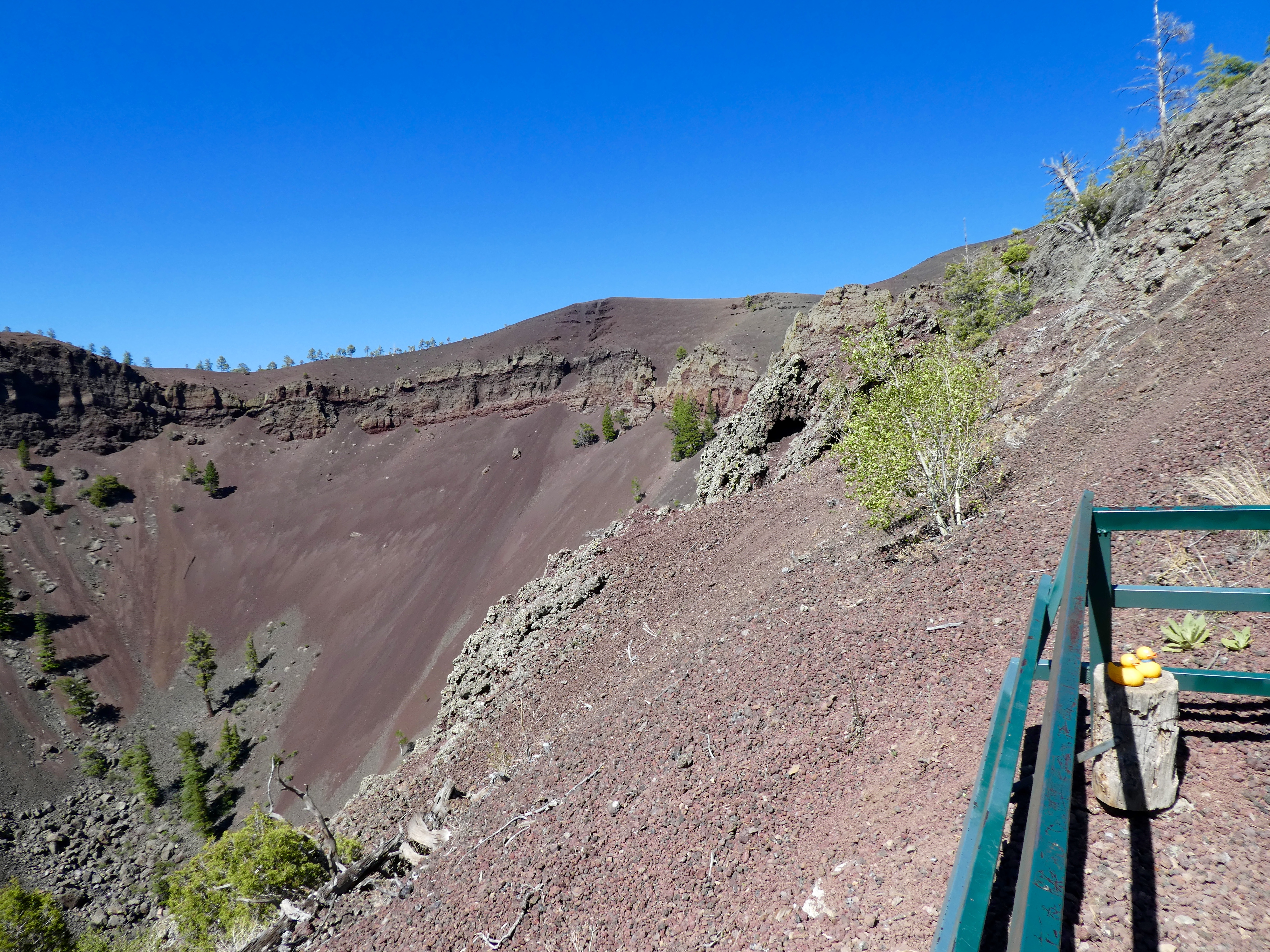
The elevation here is 8,122 feet.   This volcano erupted about 10,000 years ago.   The crater is well preserved.

Looking into Banderas Volcano

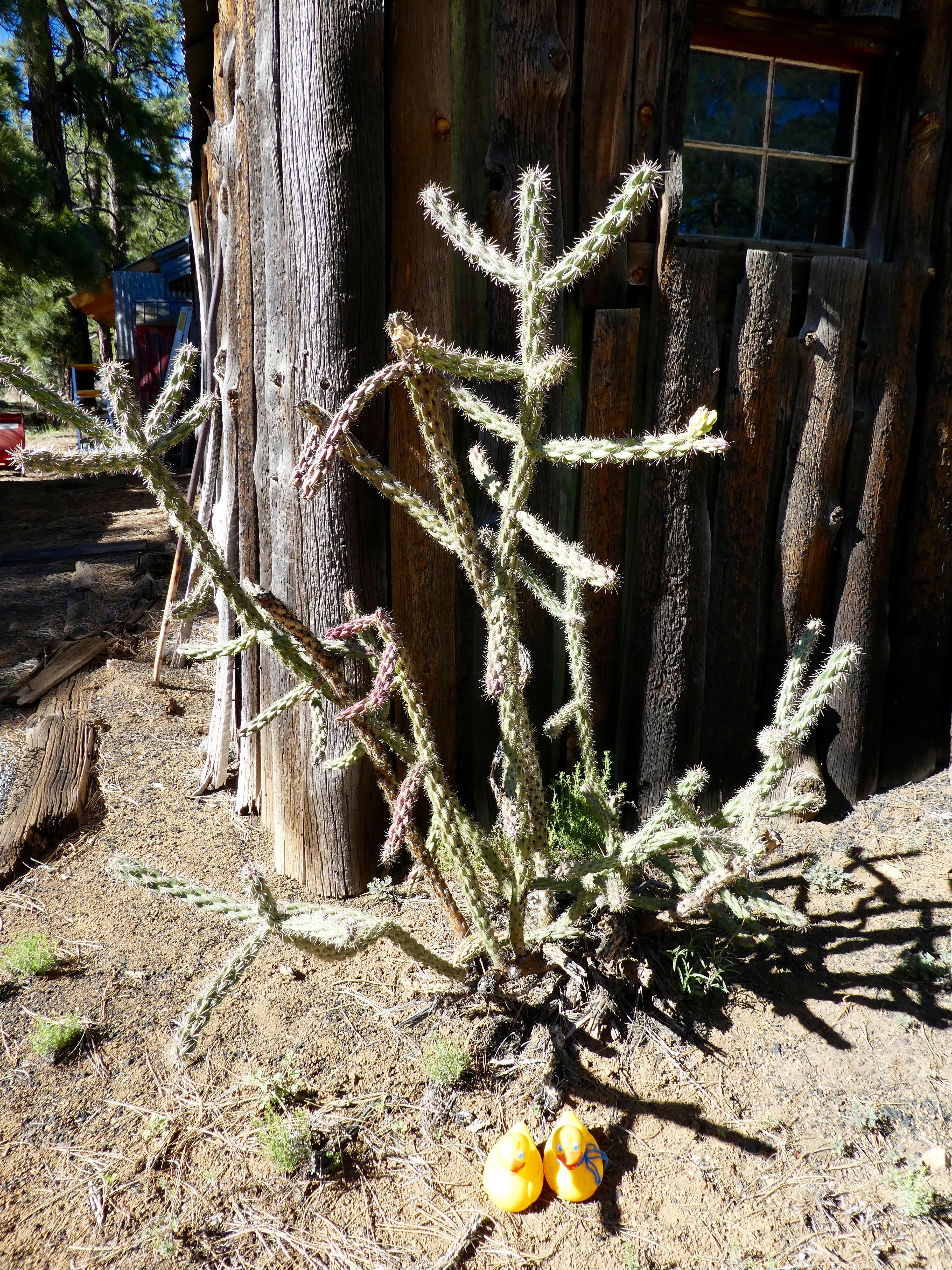
It is about 1,400 feet wide and 800 feet deep.   This is considered a fragile environment as rocks and other items slide into the crater.   On mom’s phone it indicates we climbed 18 flights of stairs to reach the top of the volcano.   The path was gentle so we enjoyed the climb.   Back down near the tourist store, I liked this cactus growing by the old shed.

Cactus near old shed

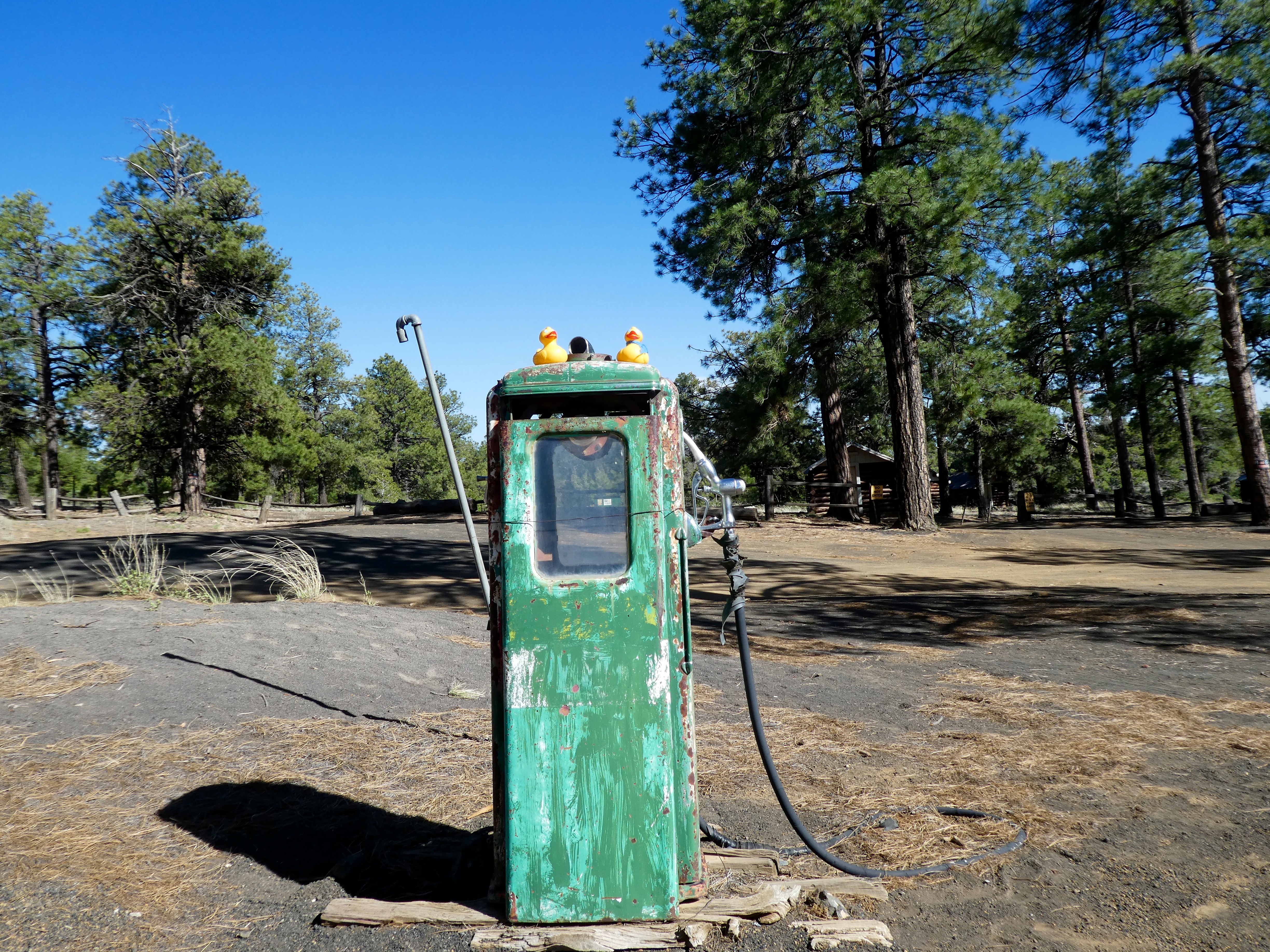
And look at this gas pump.

Old gas pump. They sure look different now.

Today’s gas stations and gas pumps certainly look different.   This is great place to hike and see different things.   For more information visit http://www.IceCaves.com  We think you would enjoy stopping here when you are in the area.  We continue driving west on I-40.   Stay with us to see where we stop next.


Today is National Chocolate with Almonds Day

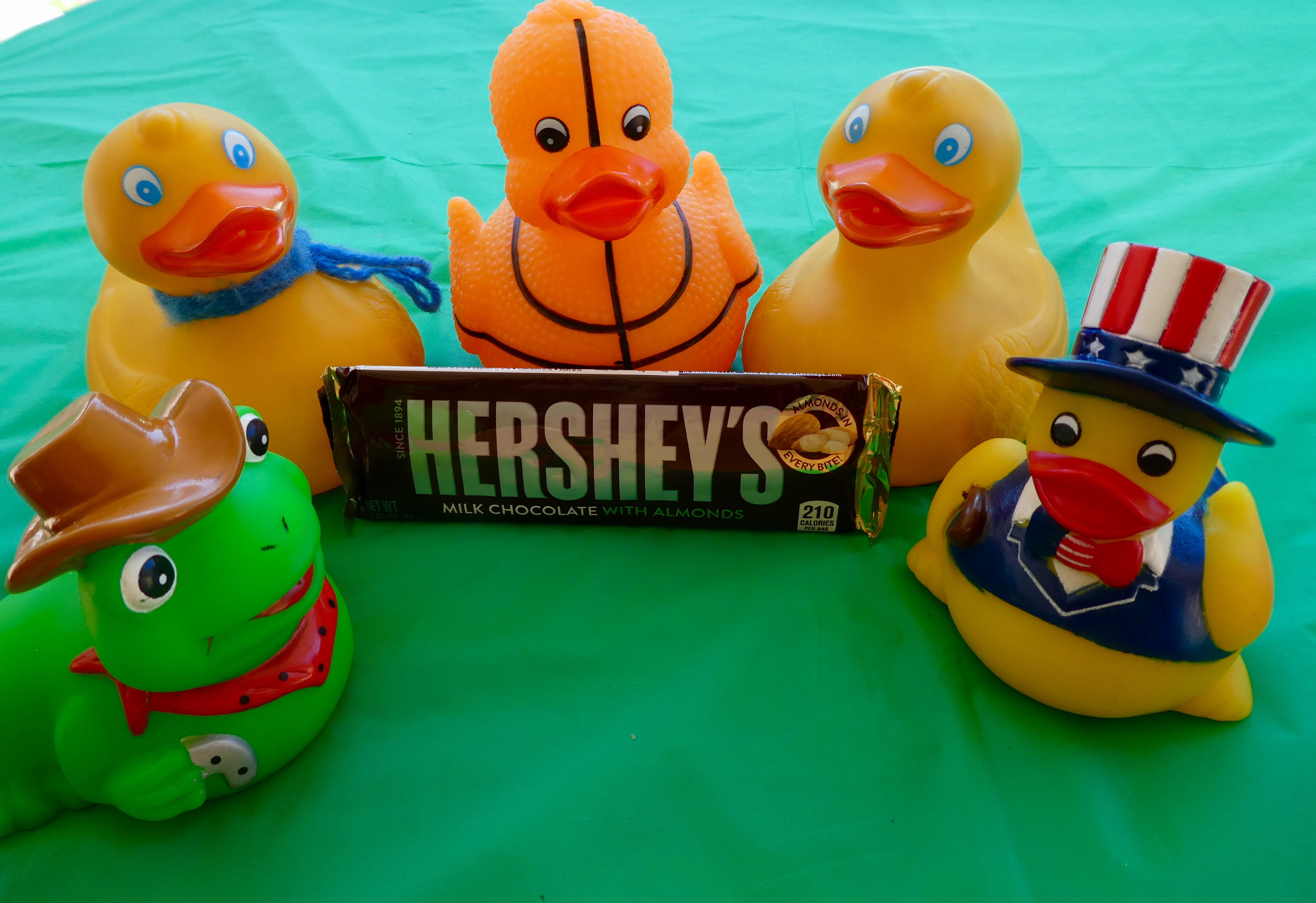
Chocolate with almonds!   This is a great day.   We enjoy Hershey Kisses with almonds slivers, we enjoy whole almonds covered with chocolate, but this is our favorite.

Celebrate National Chocolate with Almonds Day–July 8

We will share this Hershey chocolate bar with almonds with our newest duck family members.   Just so you know, this chocolate bar will not last long.   Neither will the other one mom doesn’t think we know about.   Enjoy this tasty day.   Celebrate July 8, National Chocolate with Almonds Day.   Again, our holiday information comes from http://www.NationalDayCalendar.com

Zeb the Duck Visits the Mountaineering Museum

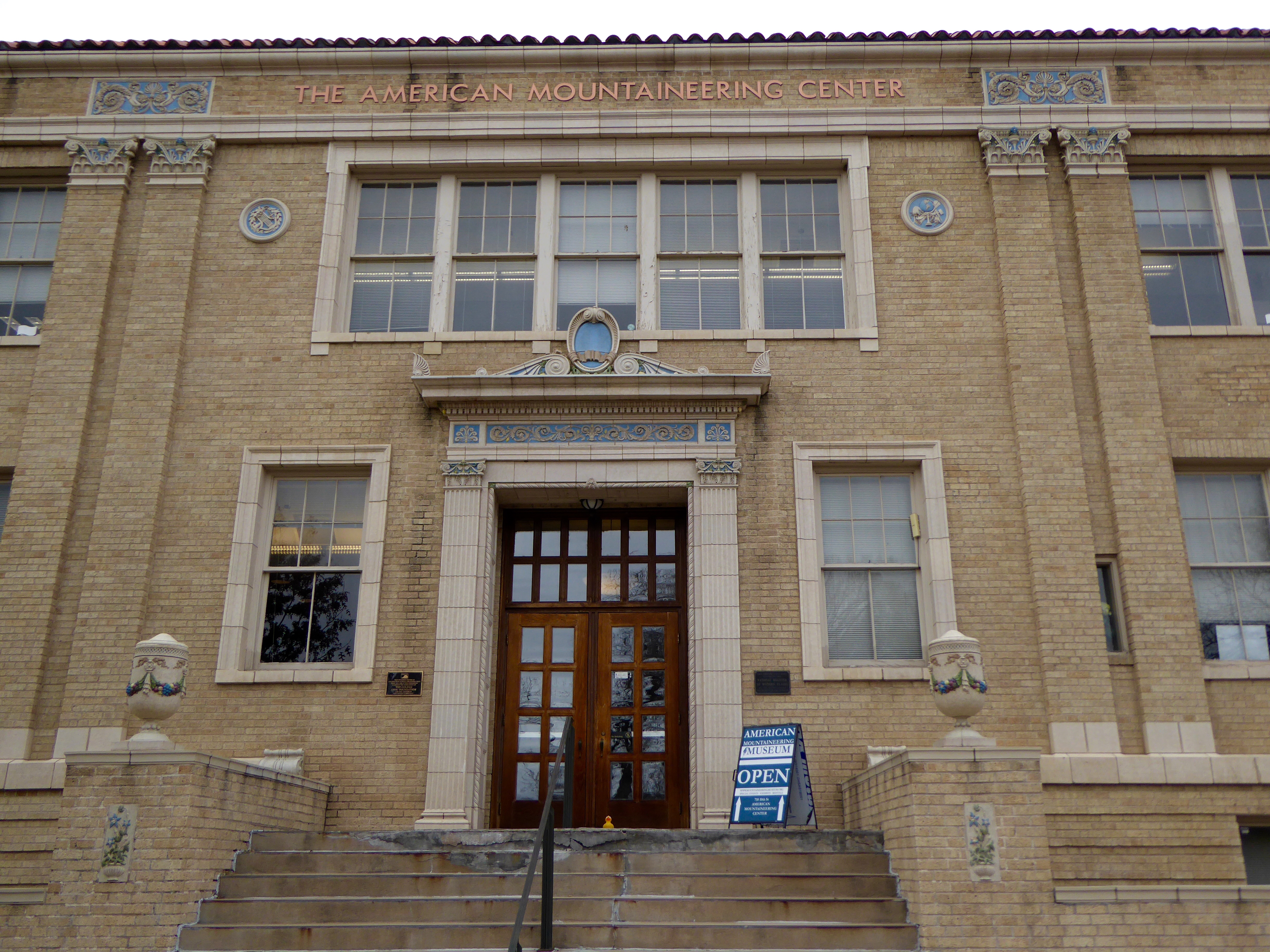
Too cold in the winter, too hot in the summer, too rainy in the spring?   Time to explore the American Mountaineering Center in Golden, Colorado.

Let’s go inside

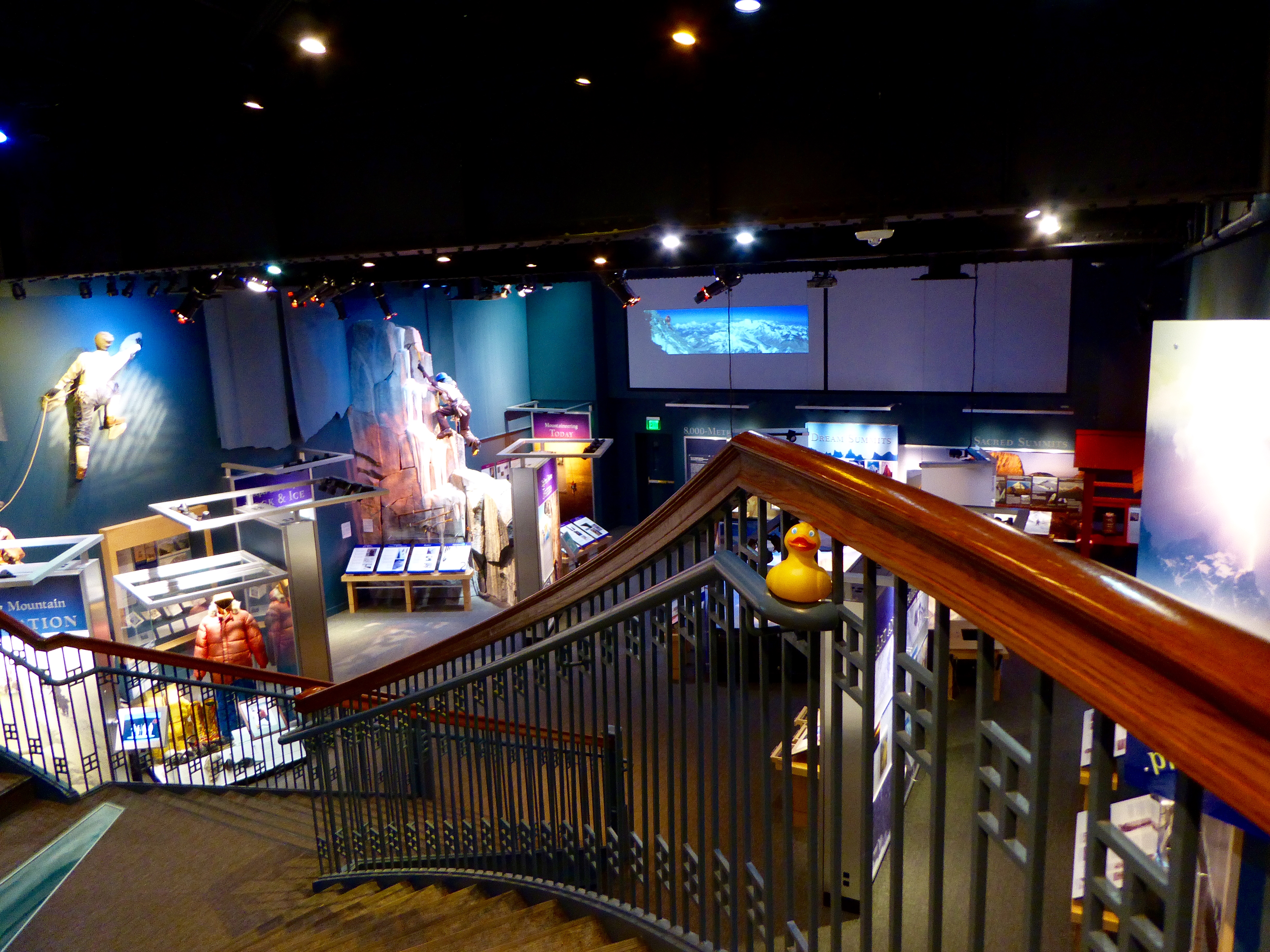
This is the first and only museum in the United States dedicated to mountaineering history.   This center opened in February, 2008.    Inside we paid our fee and gazed at the many displays before us.

So much to see here

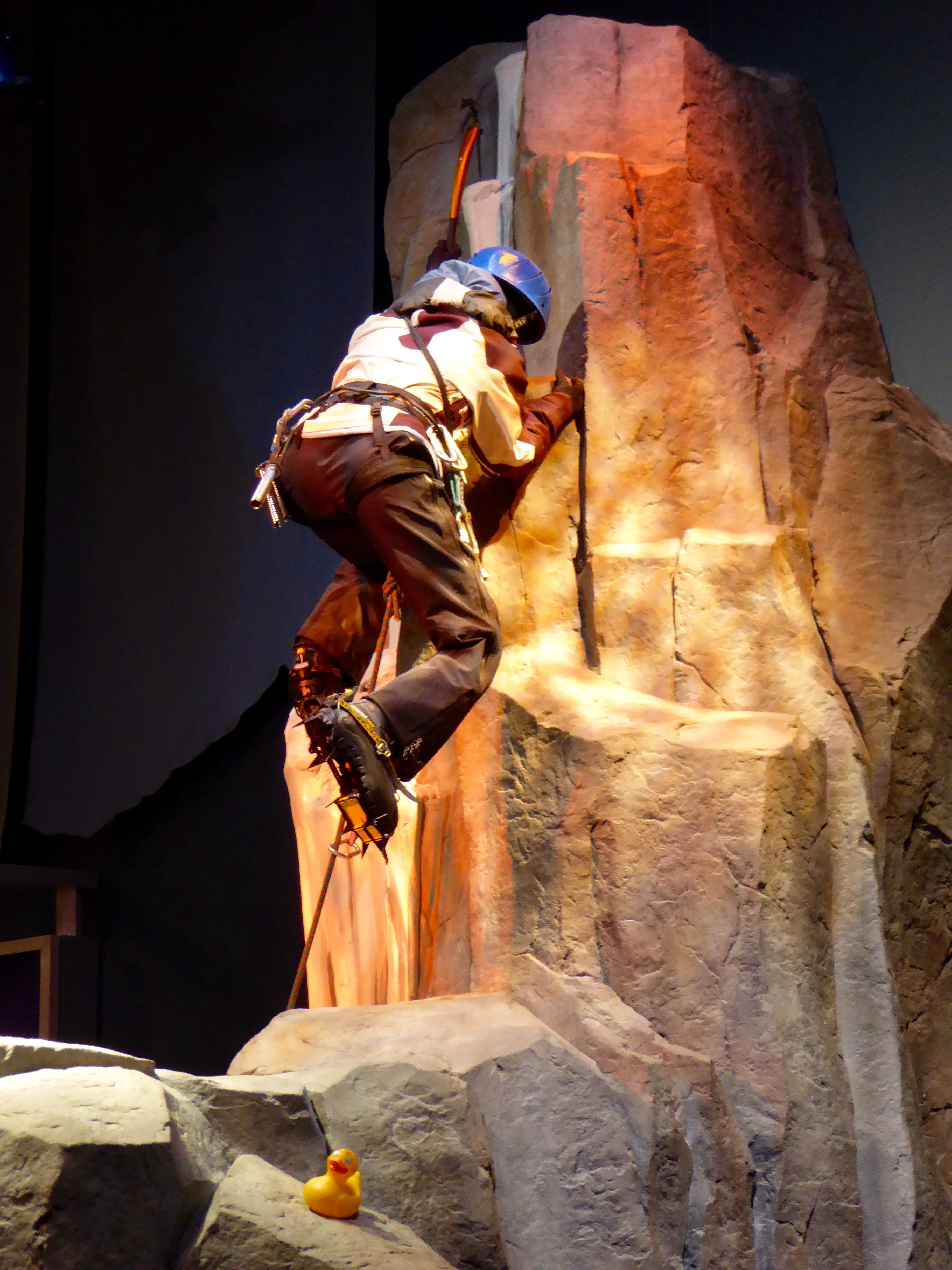
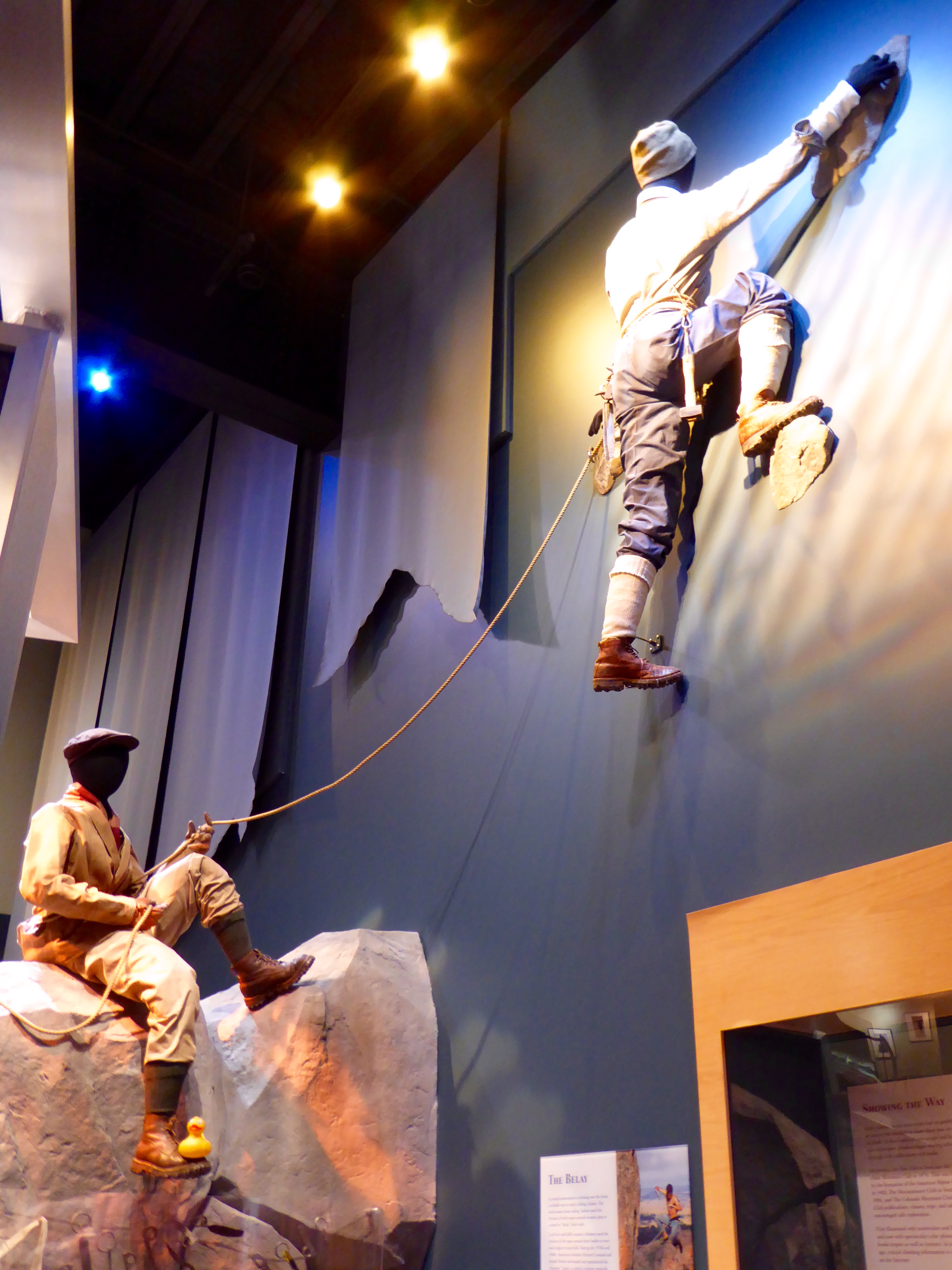
Maybe start with this climber.

Mountain climbing

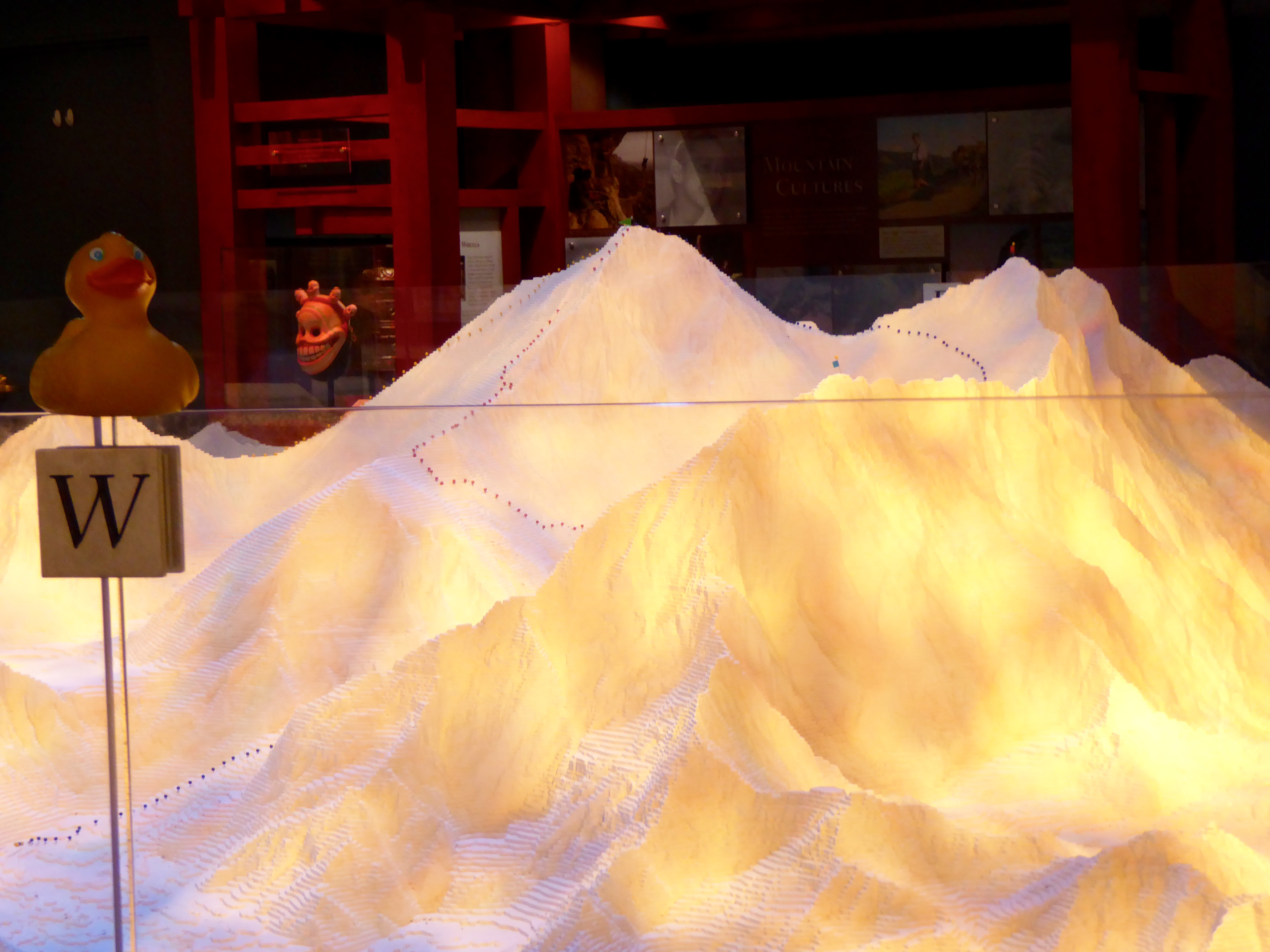
Then to this model of Mt. Everest, the portion above 18,000 feet (5,486 meters).

Mt. Everest–the tallest portion

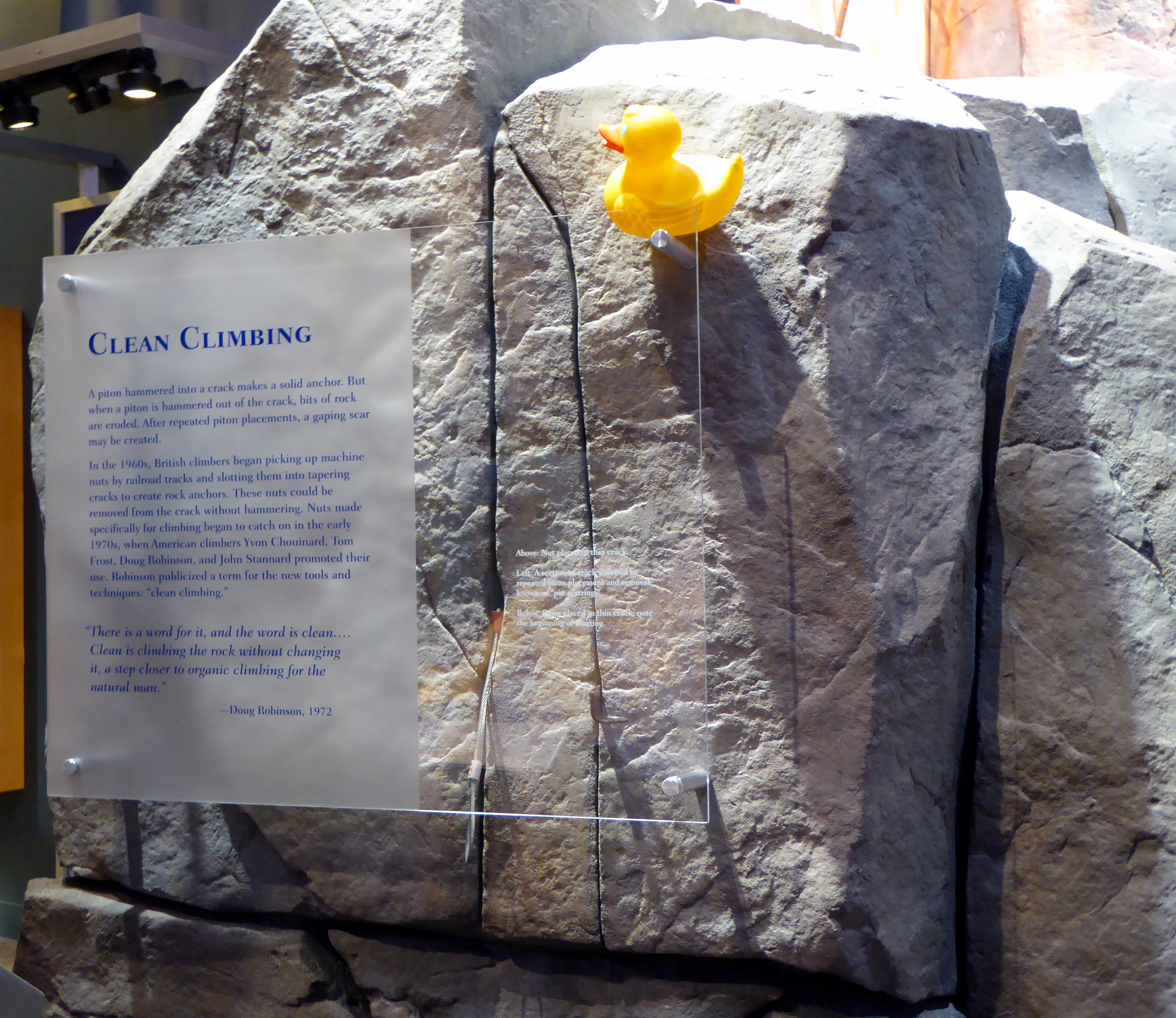
Clean climbing now allows climbers to safely climb without destroying the rock they are ascending.

Clean climbing

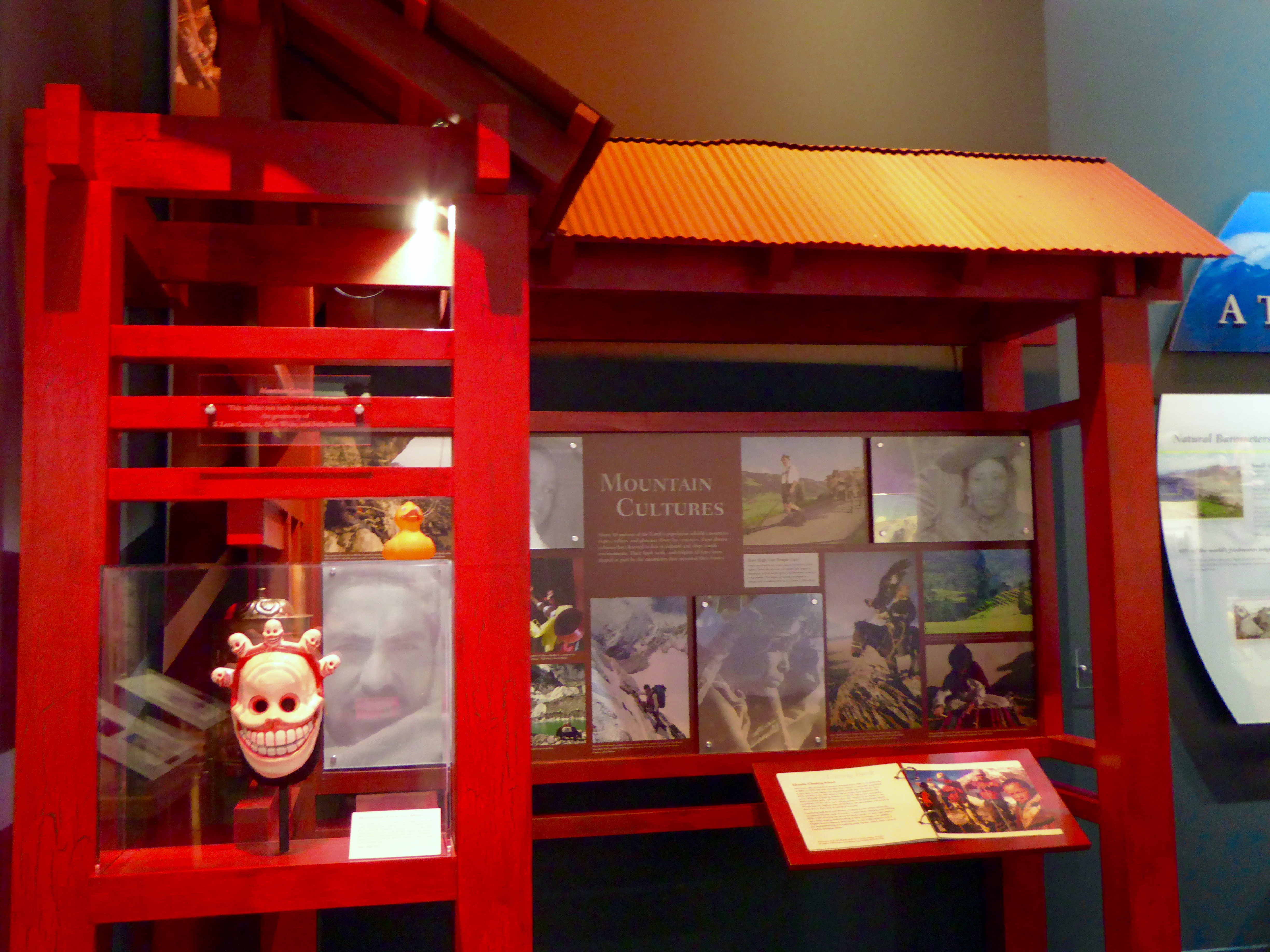
A piton hammered into a crack makes a solid anchor, but when a piton is hammered out of the crack, bits of rock are eroded.   In the 1960’s, British climbers began picking up machine nuts by railroad tracks and slotting them into tapering cracks to create rock anchors.   These nuts could be removed from the crack without hammering.   Nuts made specifically for climbing began to catch on in the early 1970’s.   This is called clean climbing.   Did you know that 10% of the Earth’s population inhabits mountain slopes, valleys and plateaus. Many diverse cultures learned to live in isolated and often hostile environments.   Food, work and religion are all partly shaped by mountains.   This is a Prayer Wheel, often found in the Himalayas.

Prayer wheel

Prayer wheels have existed for at least 1,600 years in Tibetan culture.   Prayer wheels are inscribed with the ancient symbols for a mantra, a prayer that is also chanted or whispered.   Some mantras symbolize each of the 84,000 sections of the Buddha’s teachings.     I, Zeb the Duck, like them.   Another exhibit providing glimpses of mountain cultures.

Mountain cultures

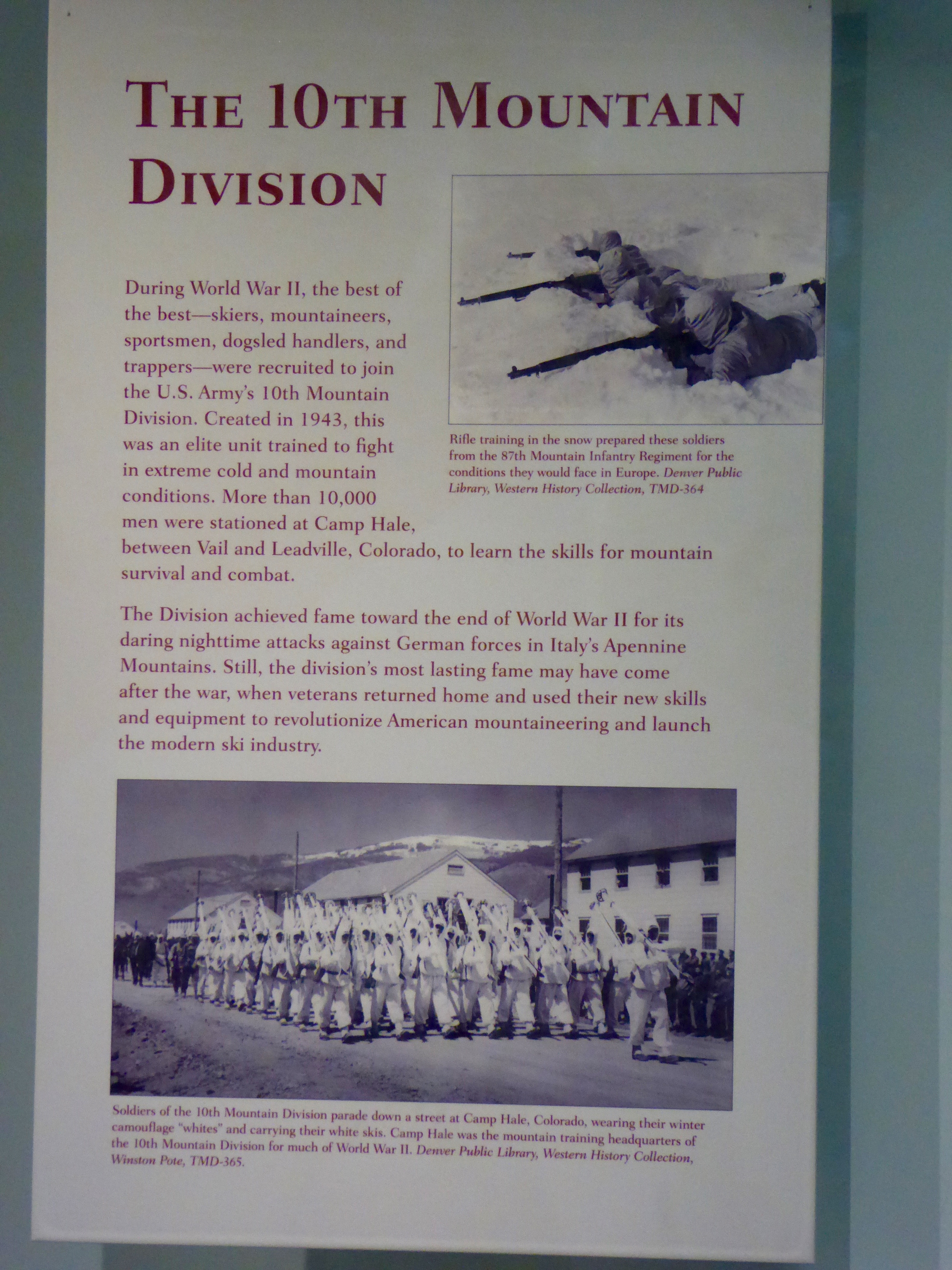
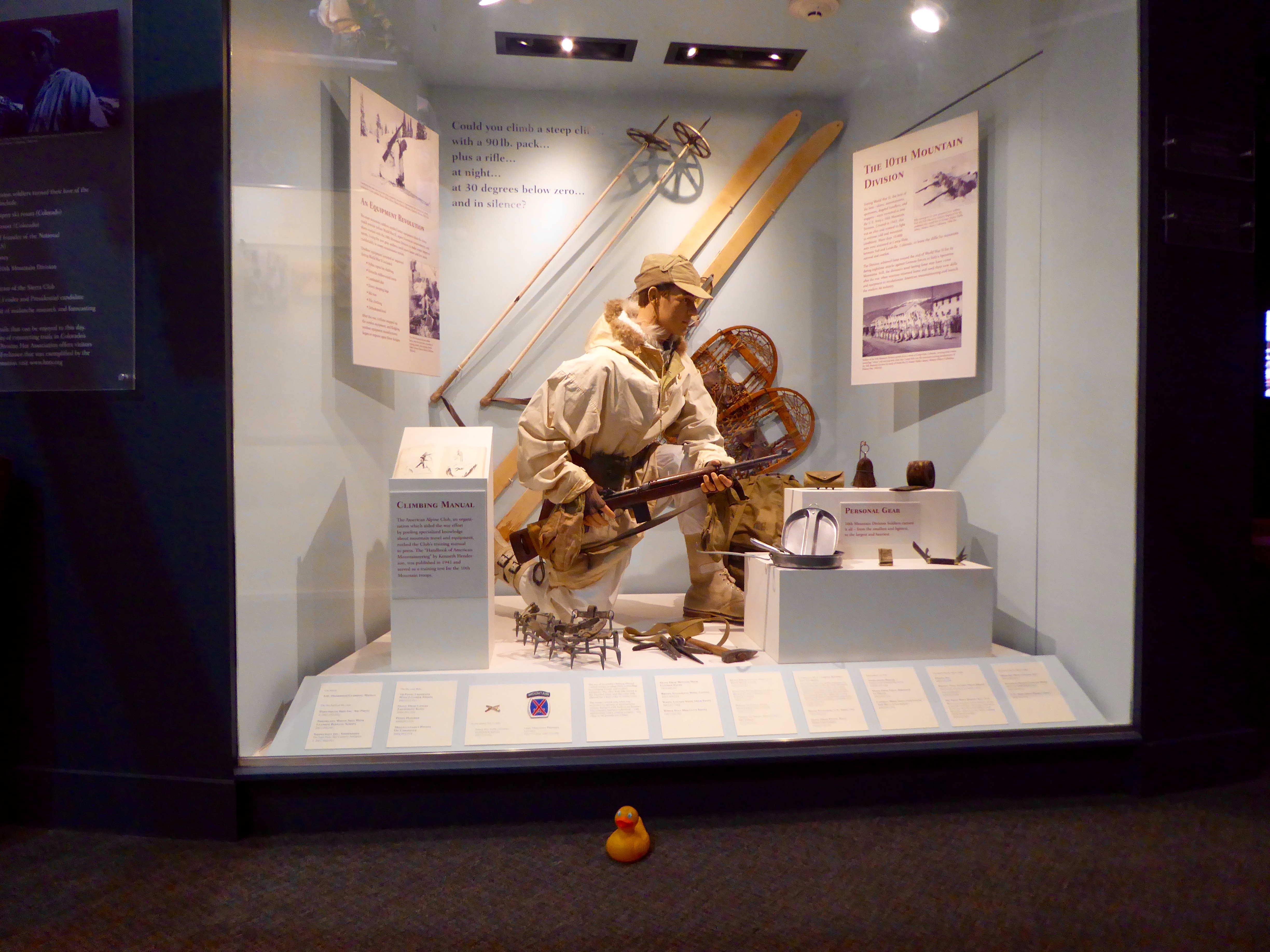
This mask is part of a traditional religious garment worn during Mani Rimdu, a festival performed at the Tengboche Buddhist Monastery in Nepal.   It seeks to destroy demons that would harm human life.   How high can humans live?   Remember the higher the elevation, the less oxygen available in the air.   People have lived up to 2 years at 19,500 feet (5,944 meters).   The highest known permanent settlement is a mining town in southern Peru at 16,730 feet (5,100 meters).   The 10th Mountain Division was very important during World War II.

The 10th Mountain Division.  So important in World War II

A peek at life in the 10th Mountain Division

10th Mountain Division

These men were excellent skiers and excellent soldiers.   As the above sign said, many returned to the Colorado mountains and were vital to the today’s ski industry.   Present day climbers are conquering sheer rock walls such as this.

Climbing a very steep rock wall

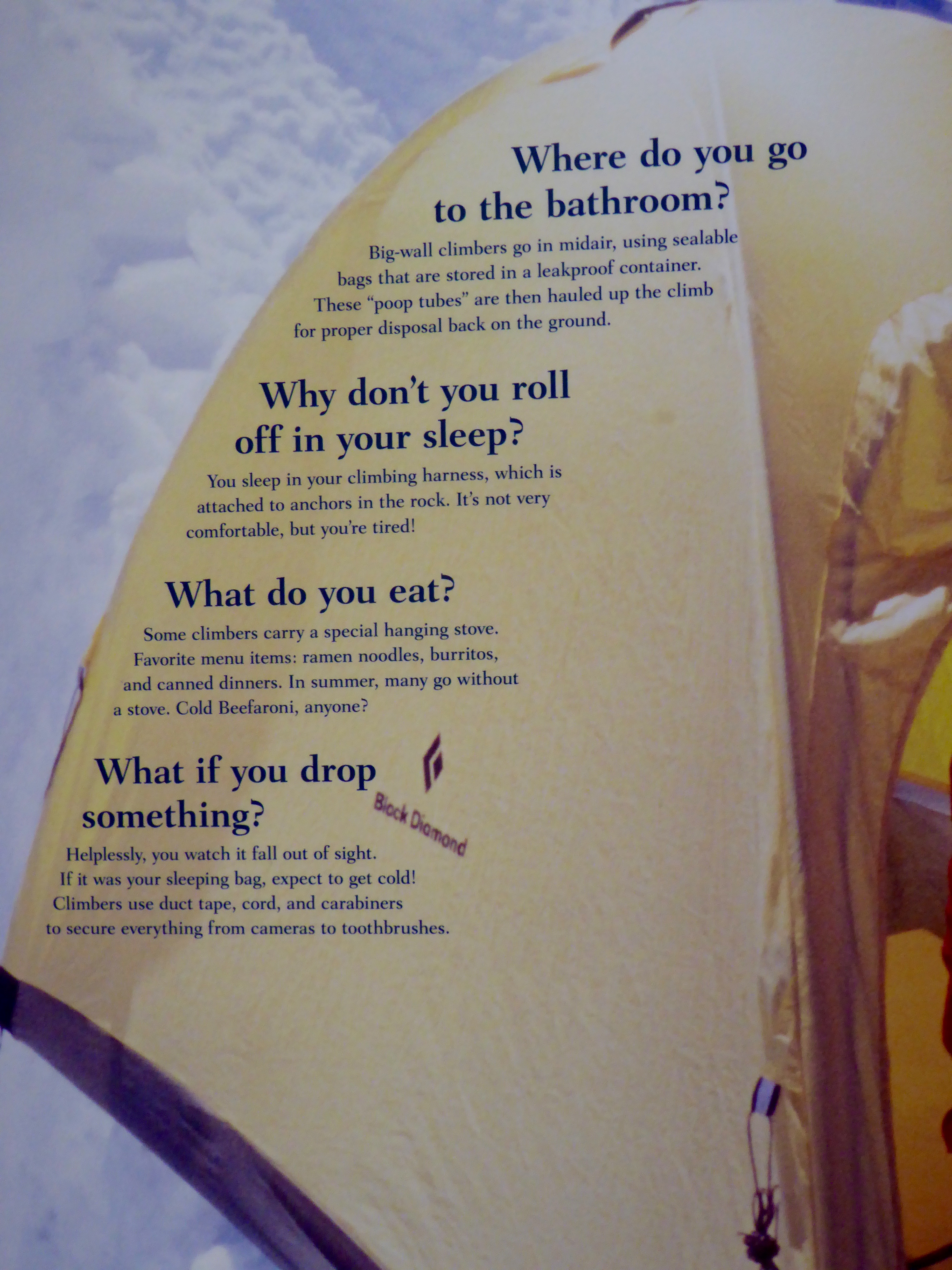
We ducks know that you humans are very curious, so we will tell you.

You wanted to know this

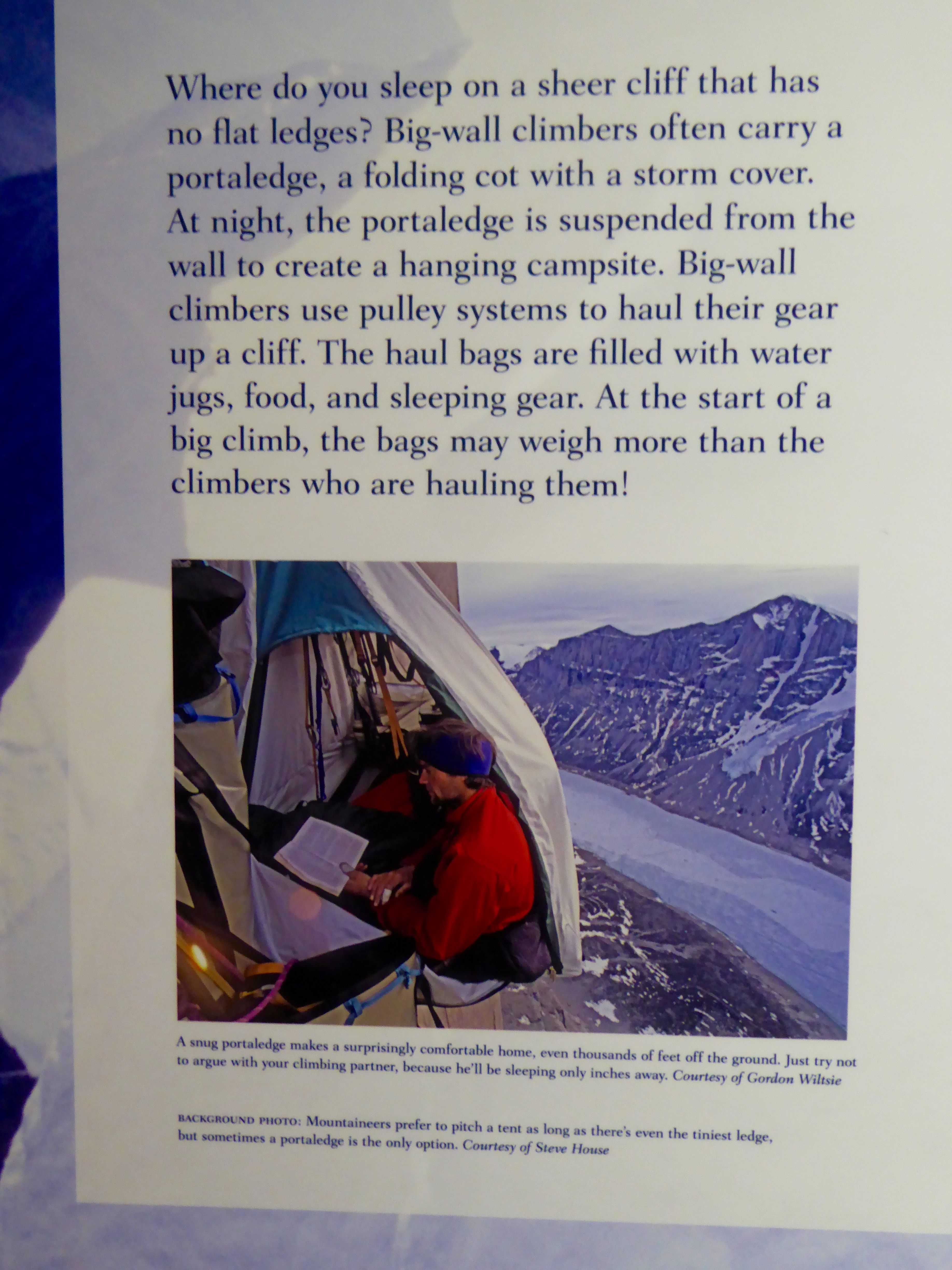
Now about that sleeping…

Satisfying human curiosity

I, Zeb the Duck, am fascinated by these climbers, but I don’t want to try it.   Remember, the higher the altitude, the colder the temperatures.   There is an average decrease of 3.5 degrees F for ever 1,000 feet.  Or decrease of 6.5 degrees C for every 1,000 meters of elevation that you climb.   I am almost embarrassed to say that I like to be warm and I enjoy my comforts.   How about you?  For more information about the Mountaineering Center, visit http://www.MountaineeringMuseum.org

Zeb and Soapy Smith Duck Visit Grand Lake, Colorado and Quacker Gift Shop

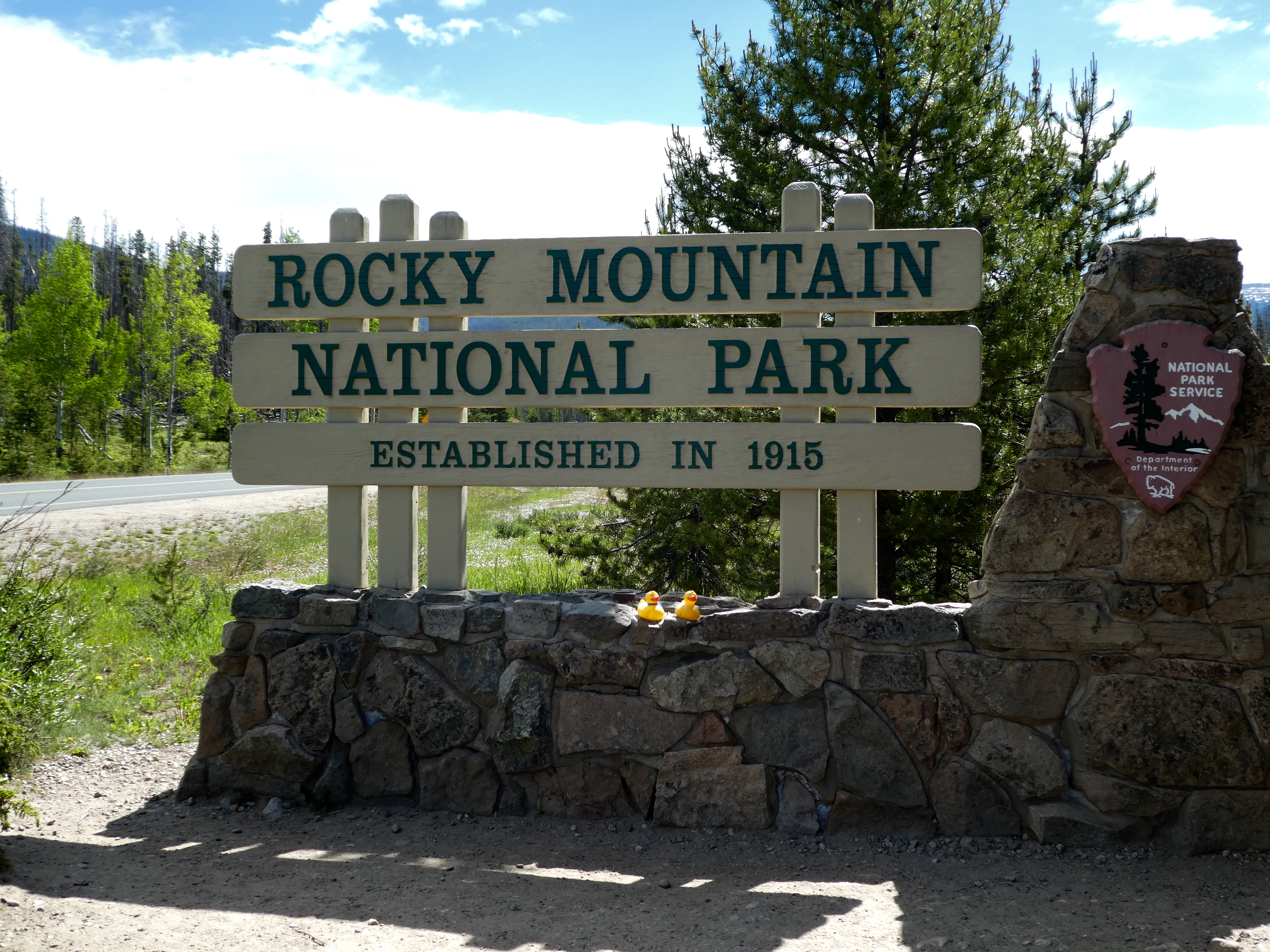
Did we mention that we love our home state of Colorado.   Well, we do.   We even have a special gift shop here.   Grand Lake, Colorado is a lake and a town, located at the western entrance of Rocky Mountain National Park.

Rocky Mountain National Park, west entrance

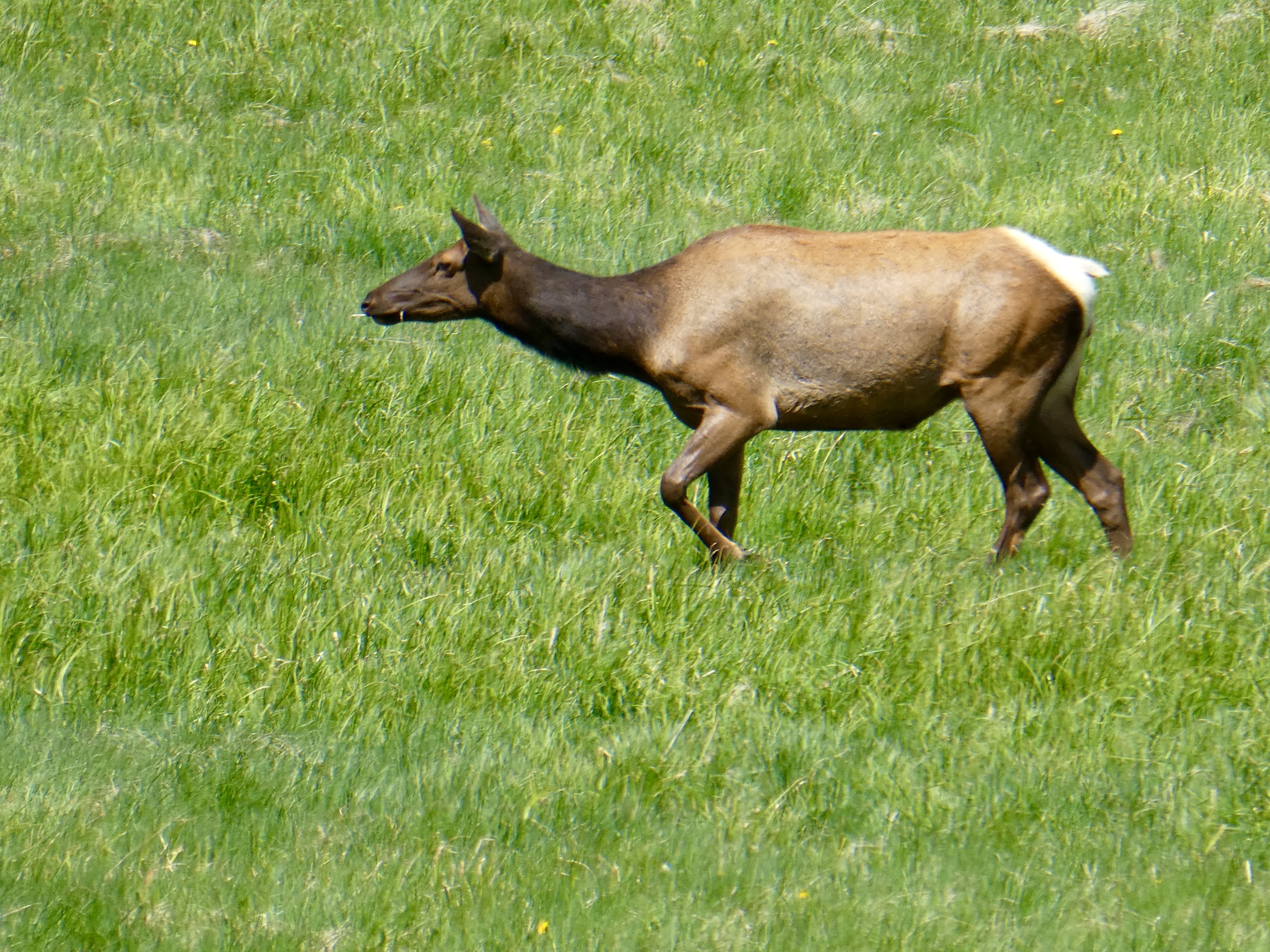
Let’s visit a little of the park.   We can drive through Rocky Mountain National Park, on the highest continuous paved road in the United States.   Trail Ridge Road connects Grand Lake on the west with Estes Park on the east.   But today, we just go a little way into the park.   We want to see some elk.   Here is one.

elk

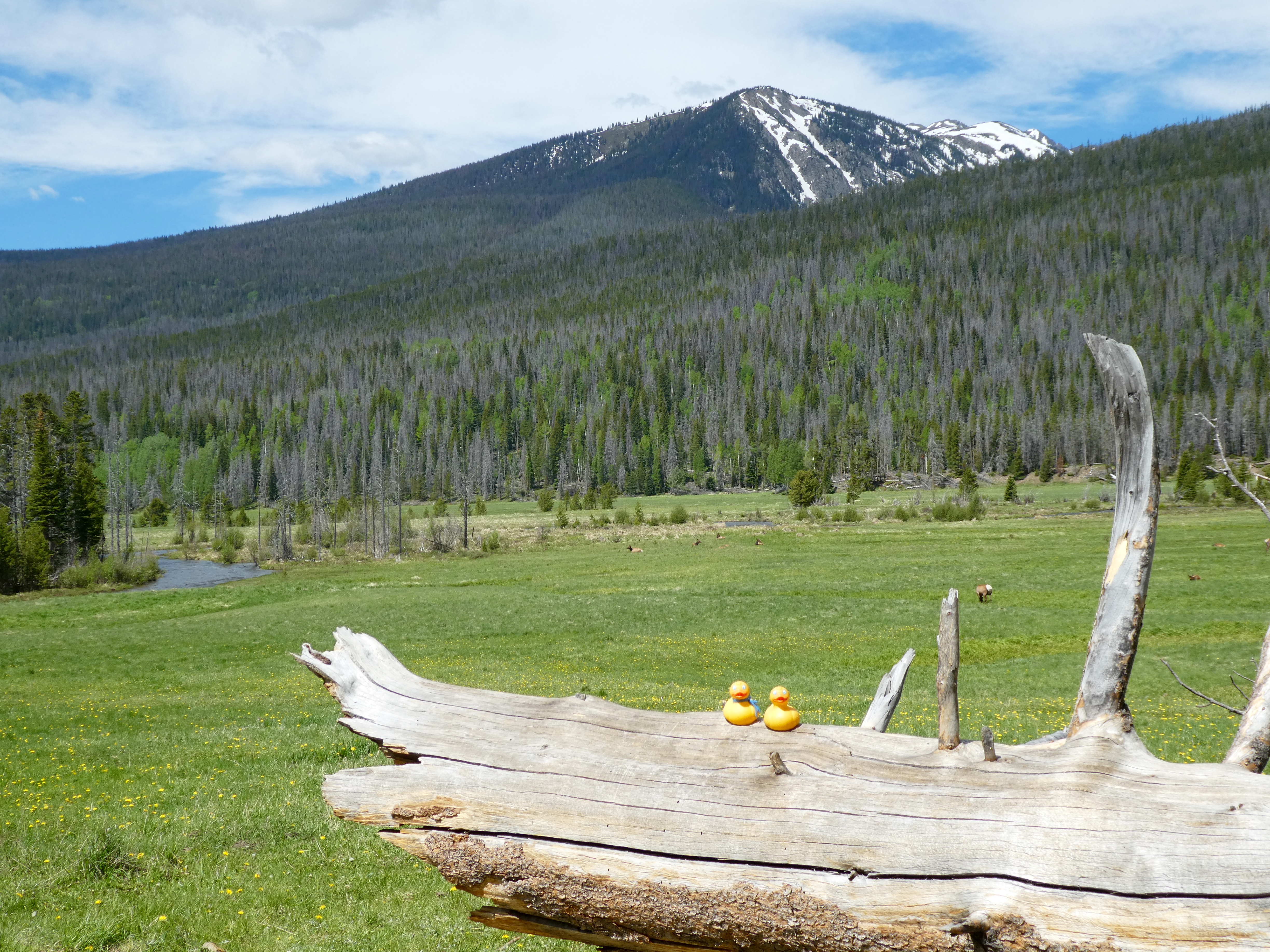
Elk on the move.   We really saw several elk today in several places in the park.   Sitting on this fallen tree, we appreciate our Colorado scenery.

In Rocky Mountain National Park

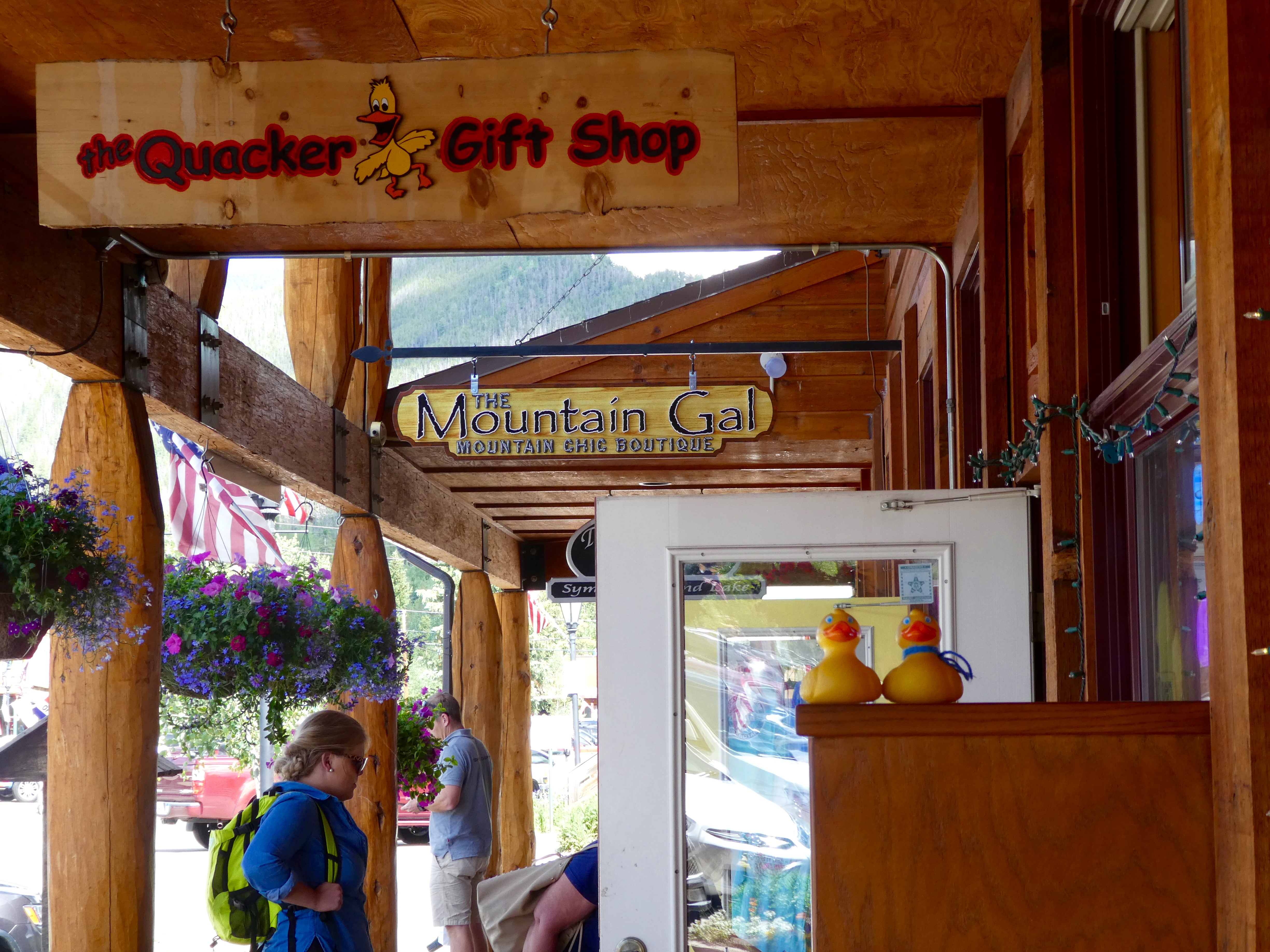
We love our mountains, the meadow, the stream and the elk resting.   But mom, what about our store?   Back in the resort town of Grand Lake, we find The Quacker Gift Shop.

The Quacker Gift Shop.

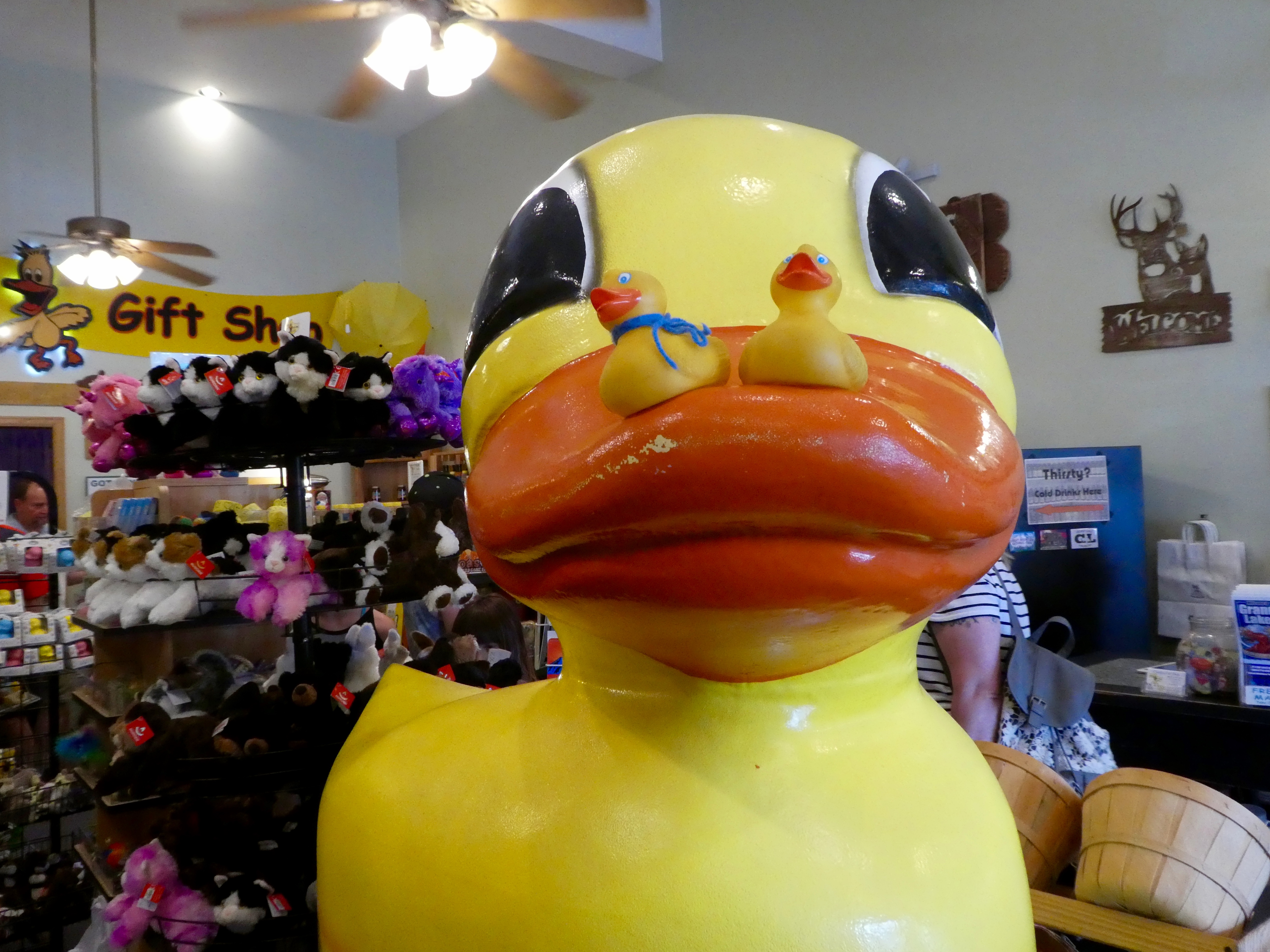
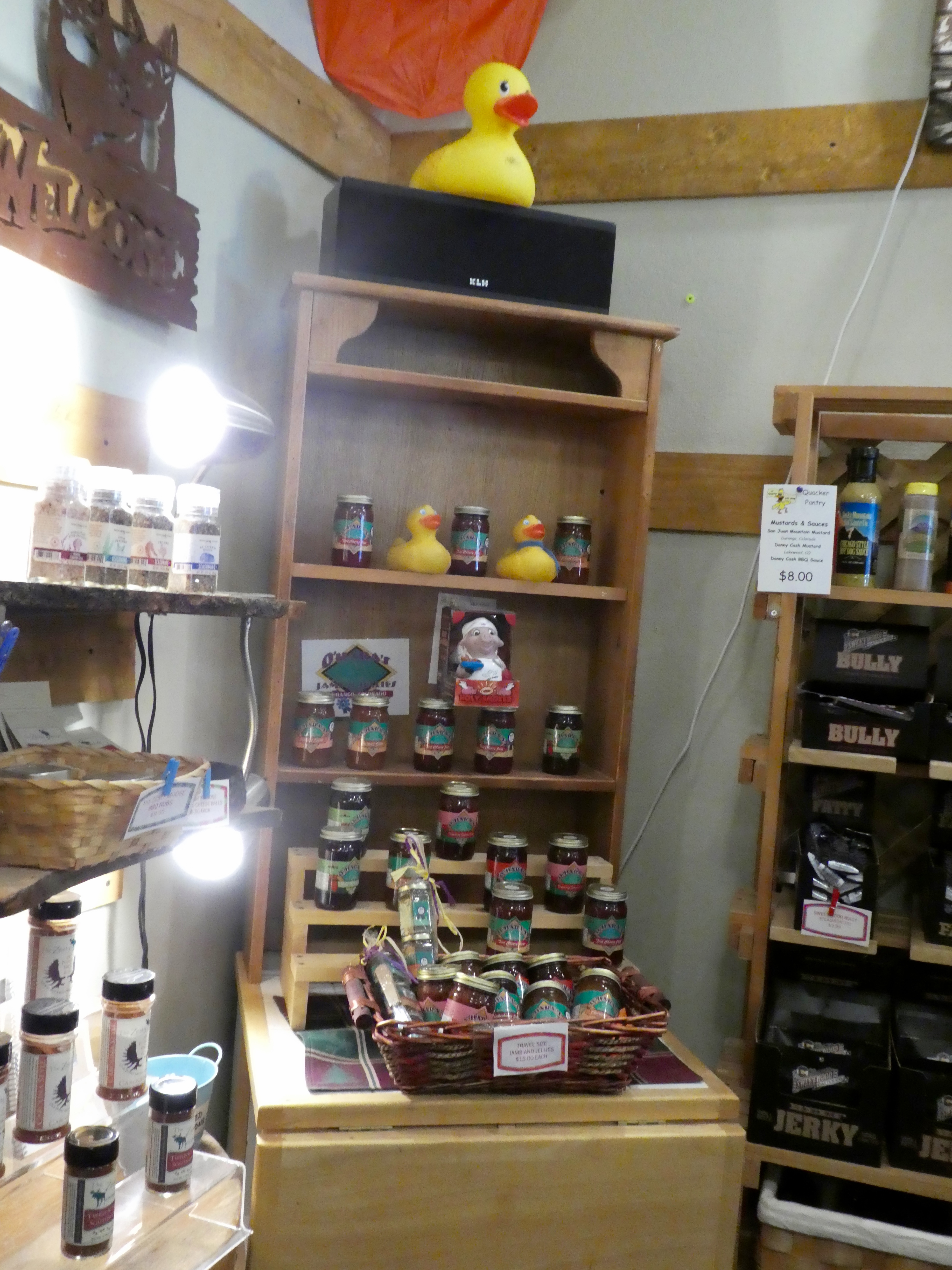
While there are other items available, the main focus of this gift shop is us–rubber ducks!   From the vantage point on the large duck’s bill, we can see much of the available merchandise.

View from a duck bill

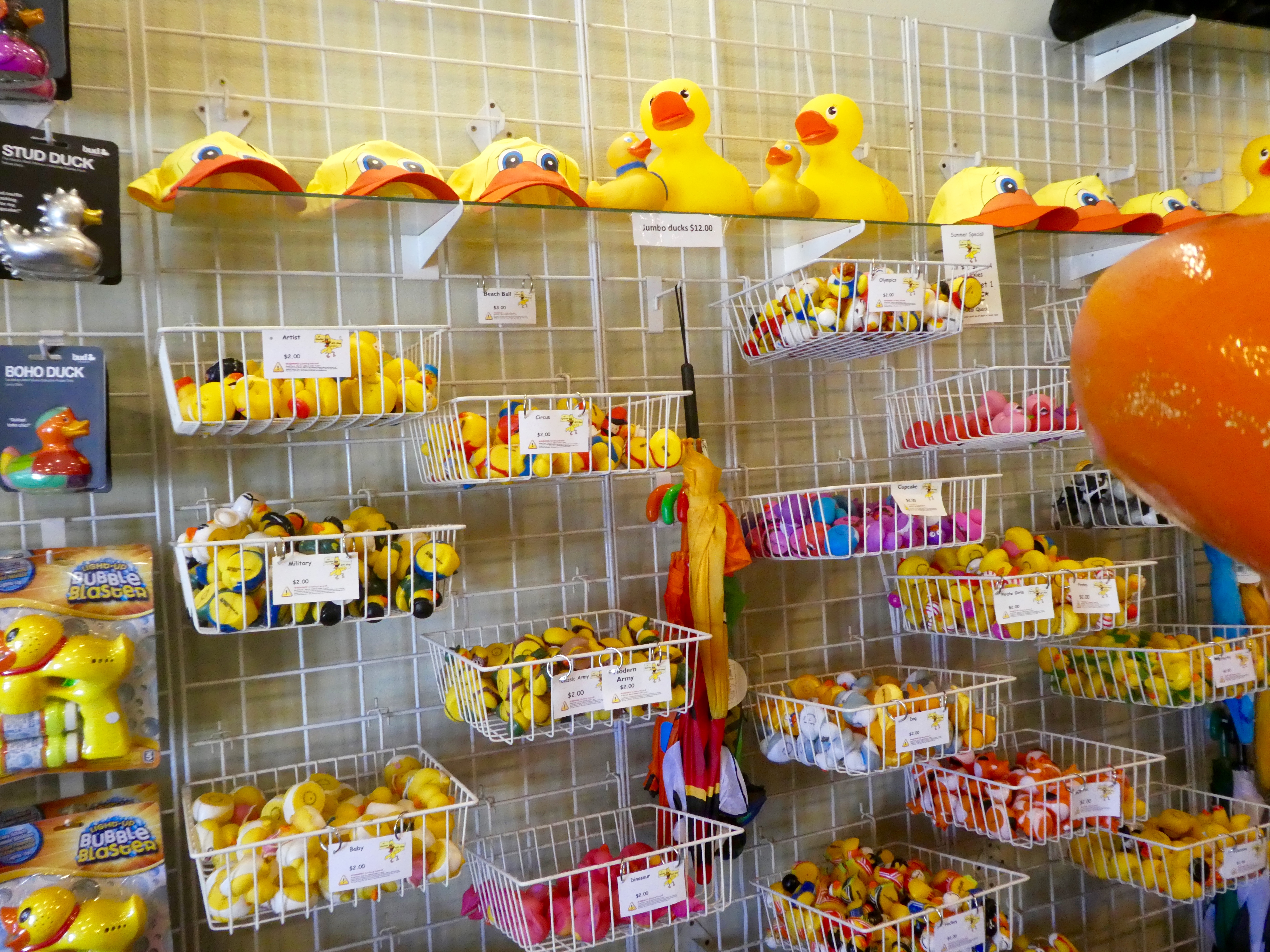
And there is a lot!   Let’s sit on the top shelf by duck caps and the Jumbo Ducks.

Sitting by duck caps and Jumbo Ducks

And still more.

Dreaming of wonderful jam

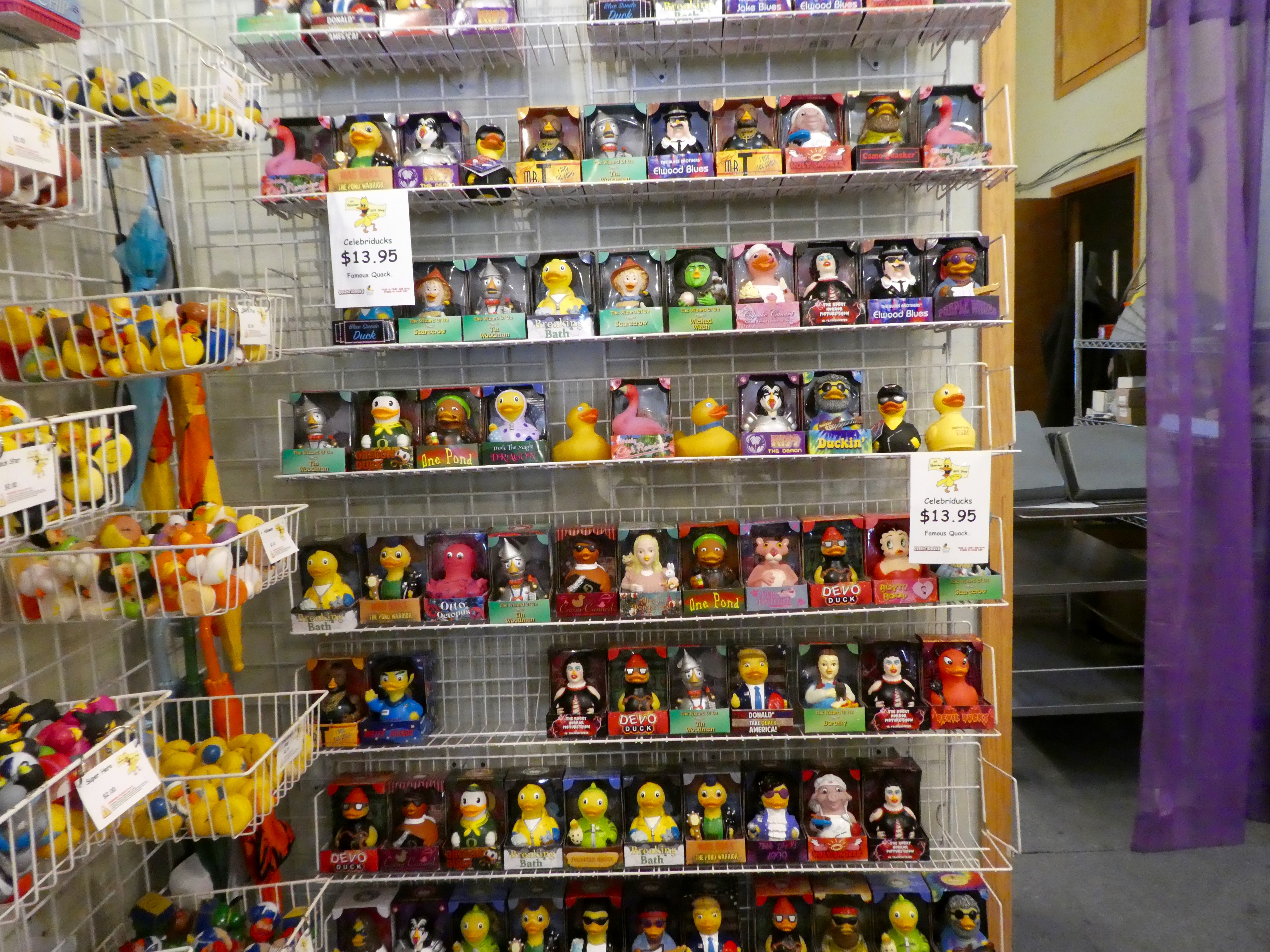
We enjoy this shelf, sitting by locally made jams.   Yummy!  And Celebrity Ducks.

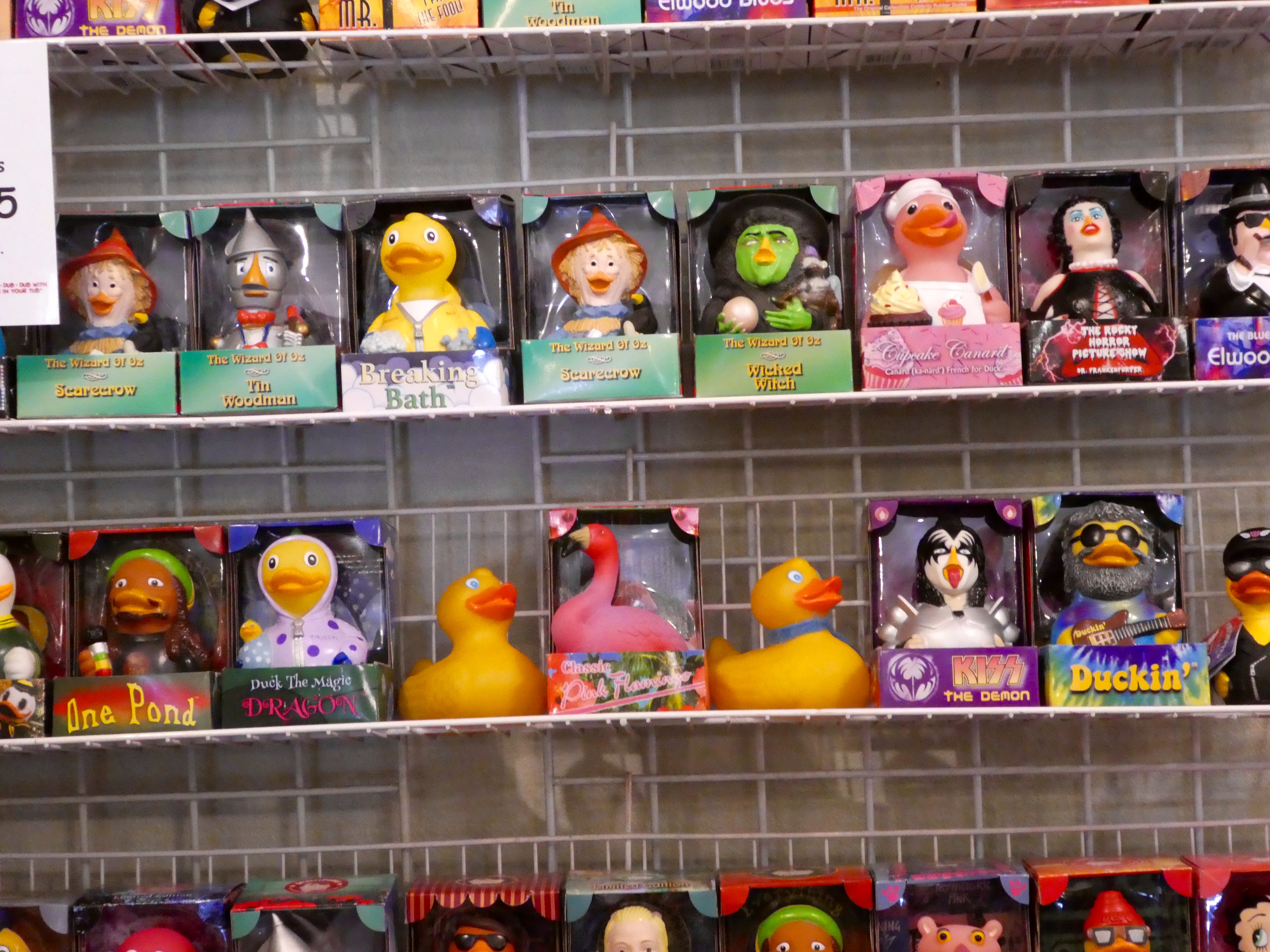
Celebrity Ducks, and us

So many.   Sitting by the pink flamingo, we are near ducks from The Wizard of Oz, a KISS duck and so many more.

Are we celebrity ducks?

Of course some new ducks came home to join our family.

The newest members of our duck family

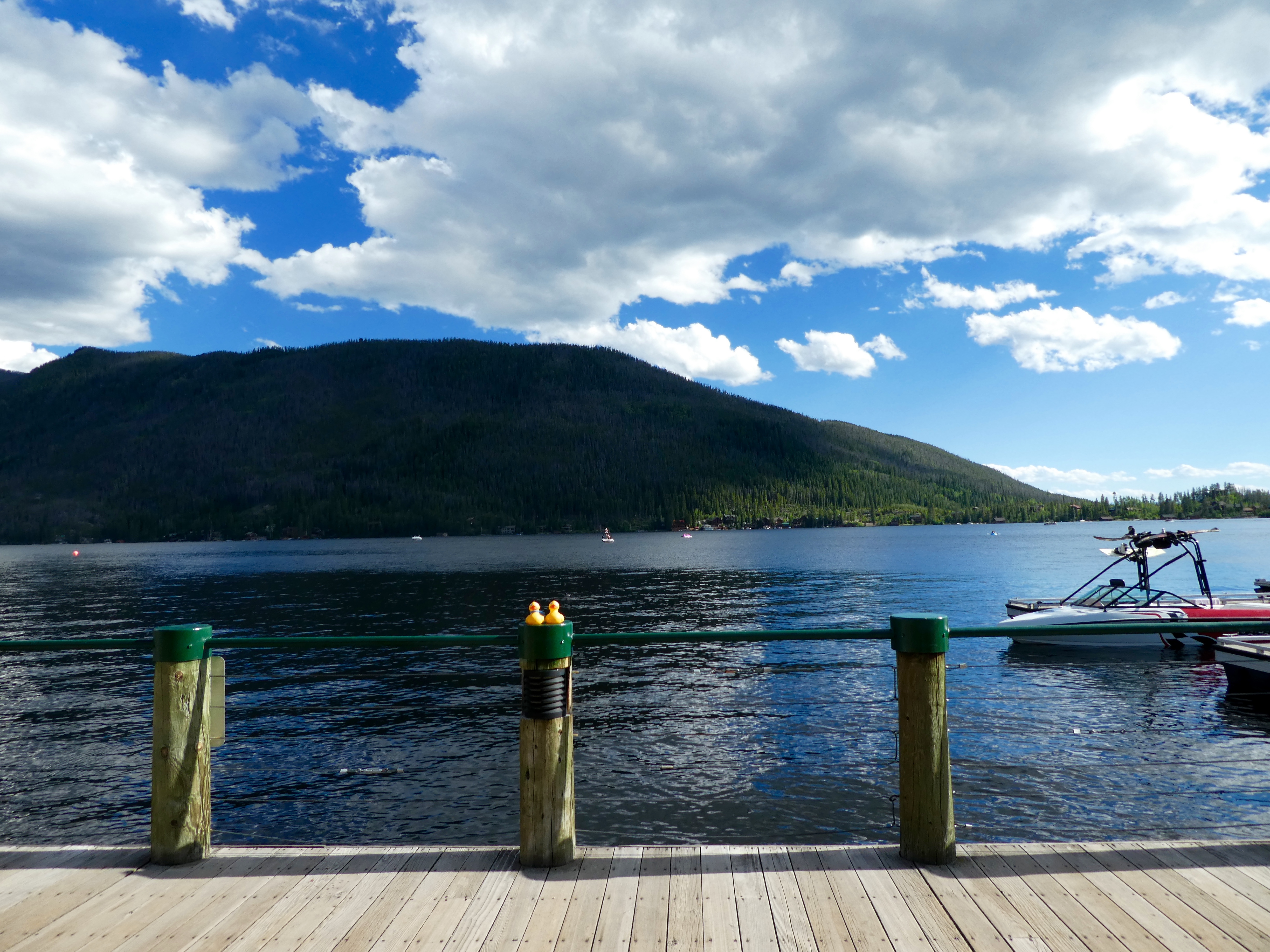
The moms purchased fresh fudge also.   After lunch at The Hub, the fudge was sampled and appreciated.   Grand Lake is a town located on Grand Lake, the largest natural lake in Colorado.

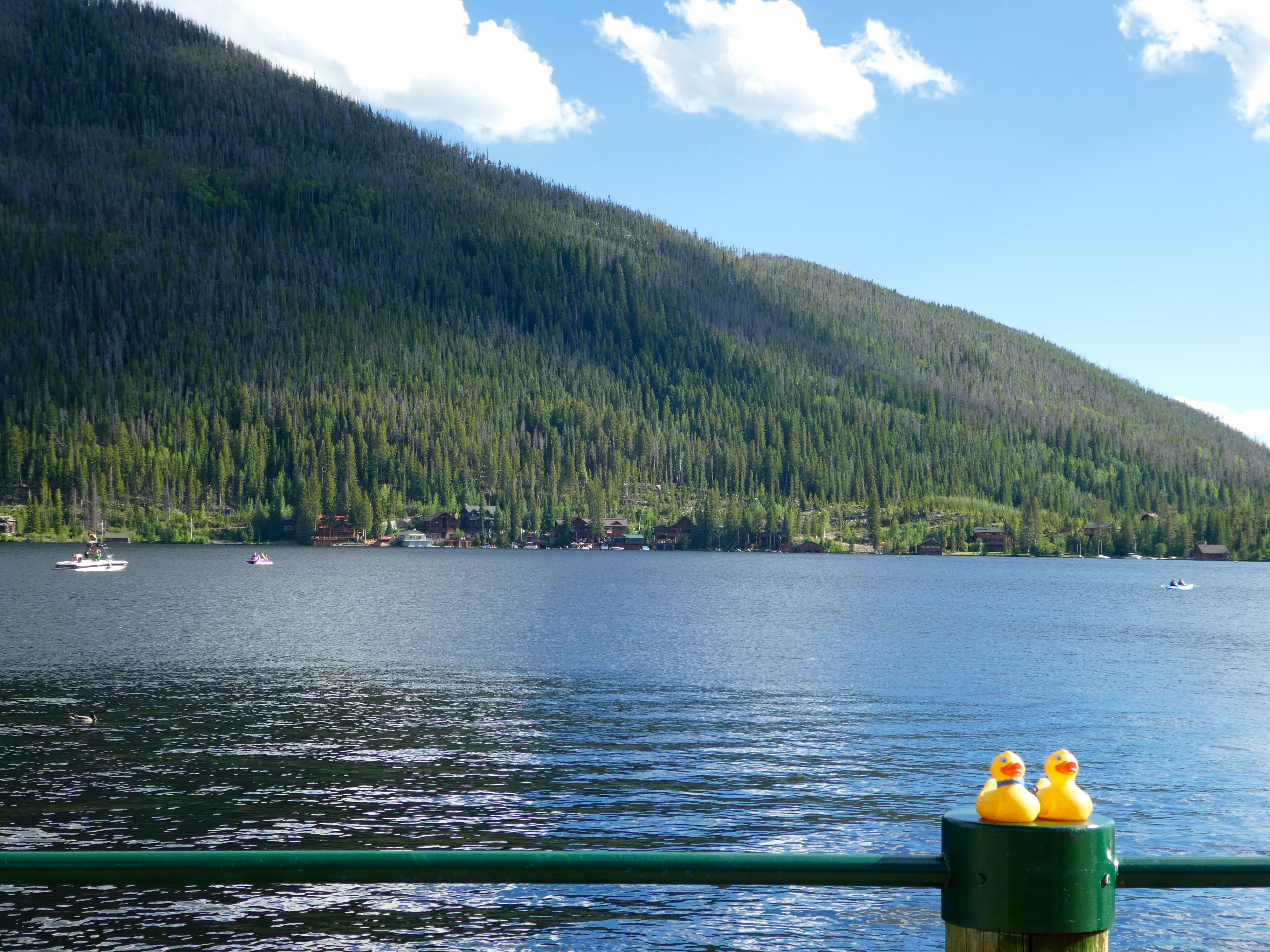
Grand Lake

Isn’t the lake pretty?  Grand Lake was formed by glaciation about 30,000 years ago.

Grand Lake

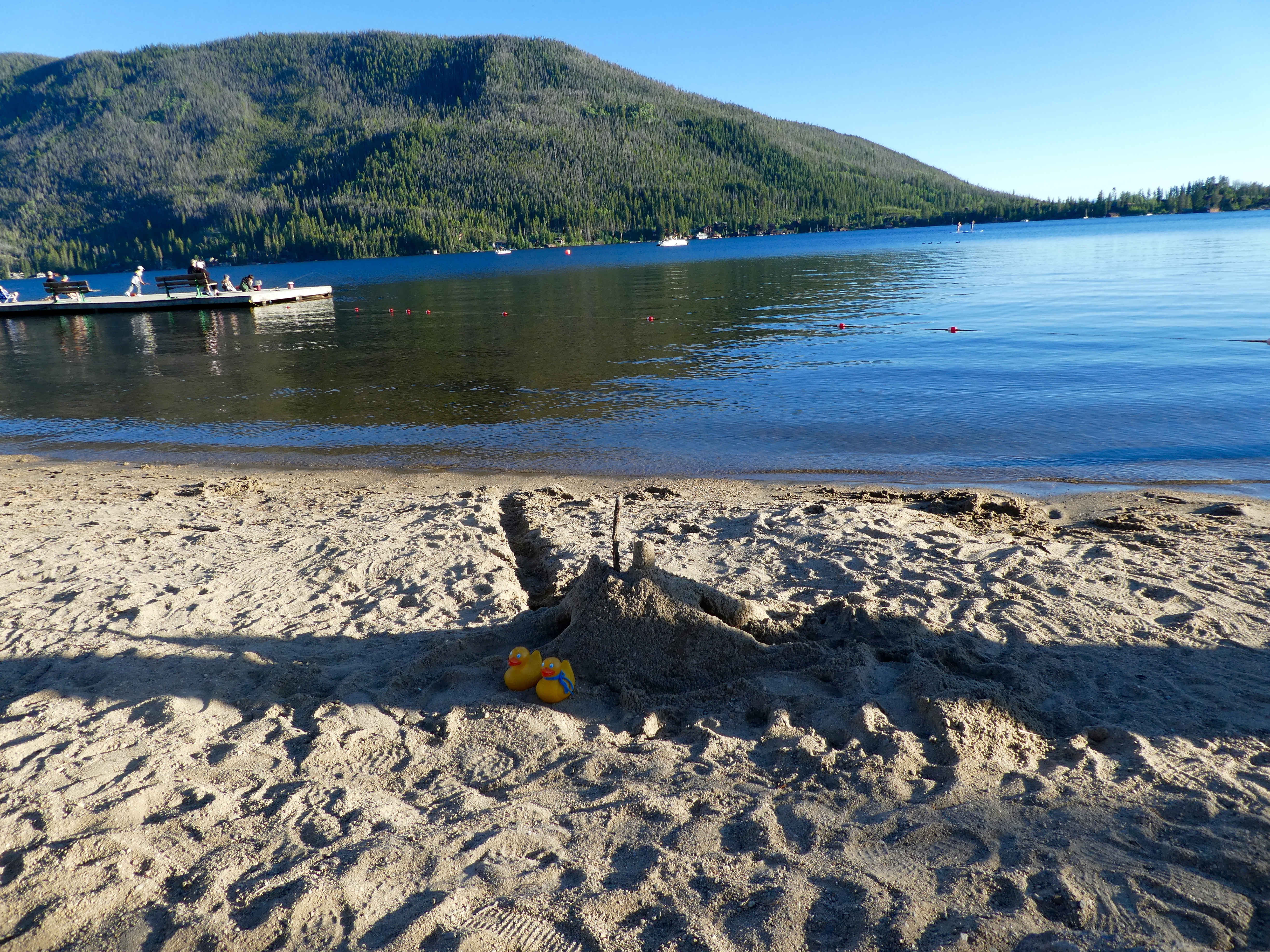
Glaciers are gone and we have a beautiful recreation area.   On the beach some children built a sand castle.

Beach at Grand Lake

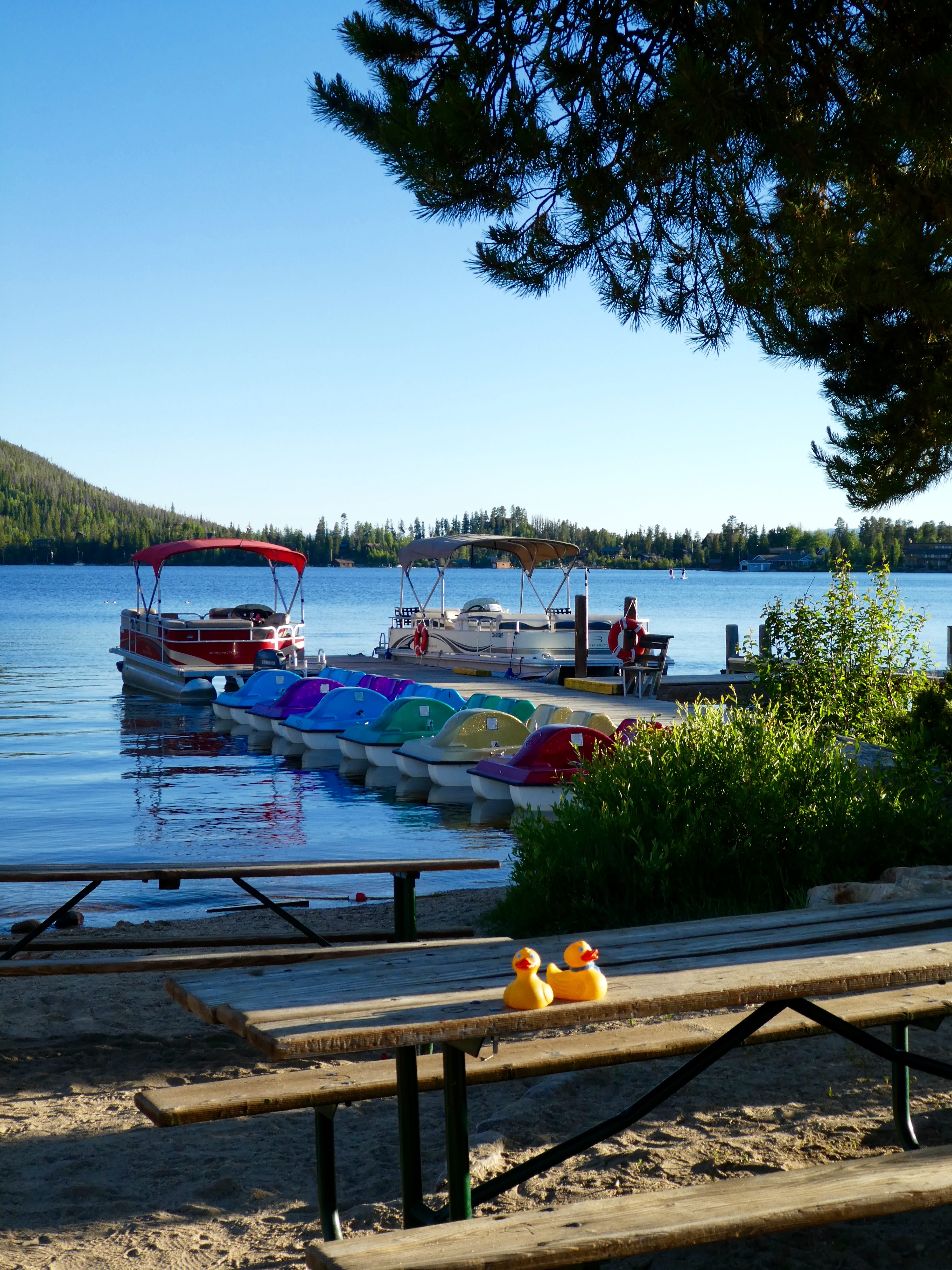
The swimming area is clearly separated from the boating area for everyone’s safety.   And boats.

Boats available at Grand Lake

Boats can be rented by the hour.   Maybe next time.   We didn’t allow enough time to fully enjoy Grand Lake.   Boat tours are also available.   We will be back here.   Grand Lake has long been known as the headwaters of the Colorado River.   And the mighty Colorado River carved the Grand Canyon, one the top natural wonders of the world.   Grand Lake is about 2 hours from our home near Denver.   We can come for a day, a weekend or a week.   But, we will be back here often.   We ducks must revisit the gift shop dedicated to us and rubber ducks everywhere.

Happy Independence Day USA 2017

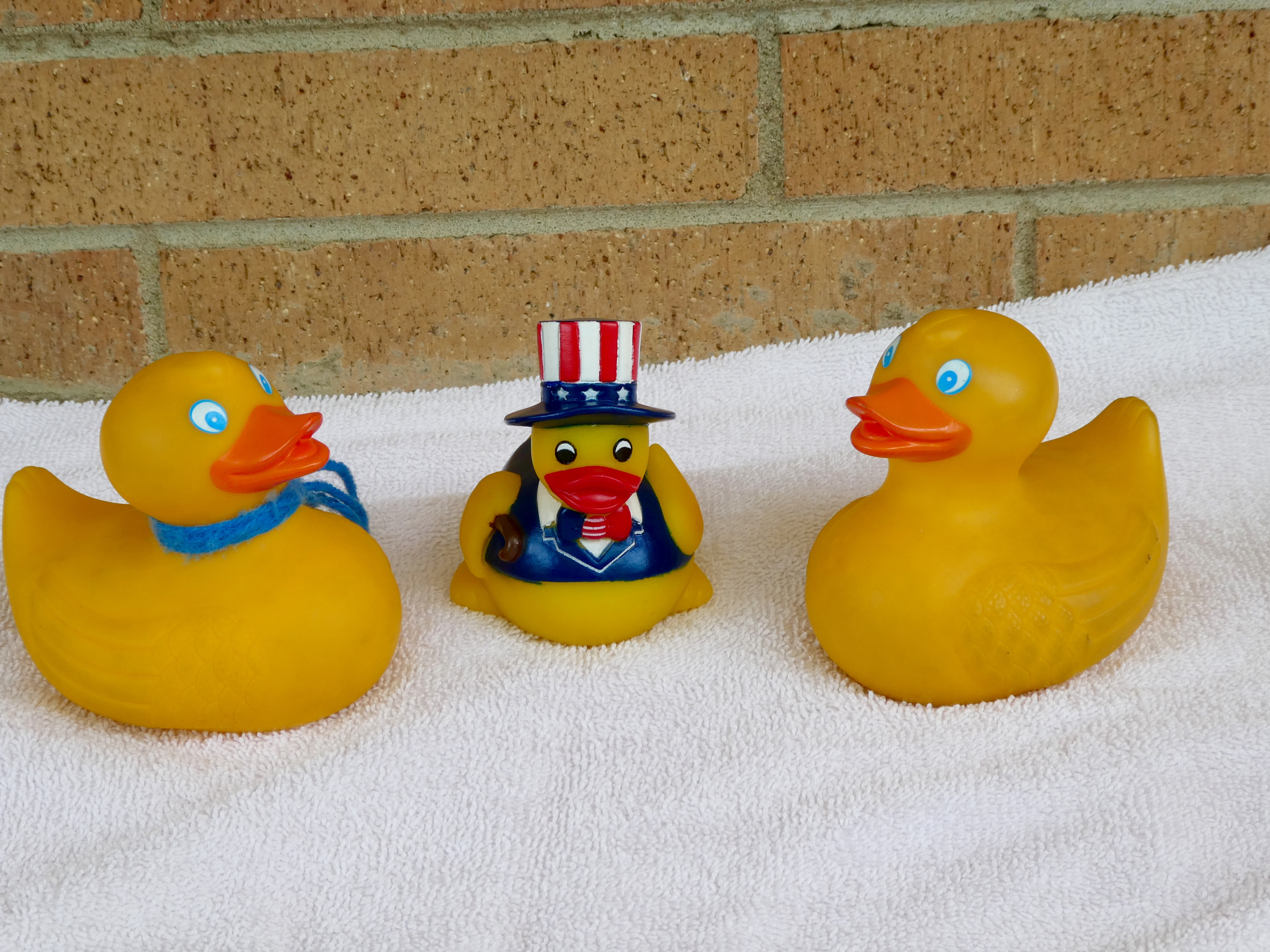
Today, the 4th of July, is Independence Day in the United States.   We were a British colony, but in 1776 the Declaration of Independence was ratified and the United States of America declared themselves independent.   After a war with Great Britain, and many discussions by the American leaders, our government was formed and the United States of America was an independent country.   Of course, like all countries, we had difficulties, but we Americans are forever grateful to our founding fathers, our freedom, and our way of life.   We introduce you to our newest family member, Independence Duck.

Independence Day Duck

On this day Americans, human and ducks, watch parades, attend fairs, have picnics, cook outside, visit the mountains, visit the beaches, go camping, and enjoy our families, our friends and our freedom.  And when darkness arrives, there will be many magnificent fireworks displays.

Fireworks behind statue of liberty

People across our country will be giving thanks for our way of life and celebrating our independence.

From Shutterstock

The Vikings Come to Denver

The Vikings are here.   The Museum of Nature and Science in Denver has a special exhibit on the The Vikings.

Let’s learn about the Vikings

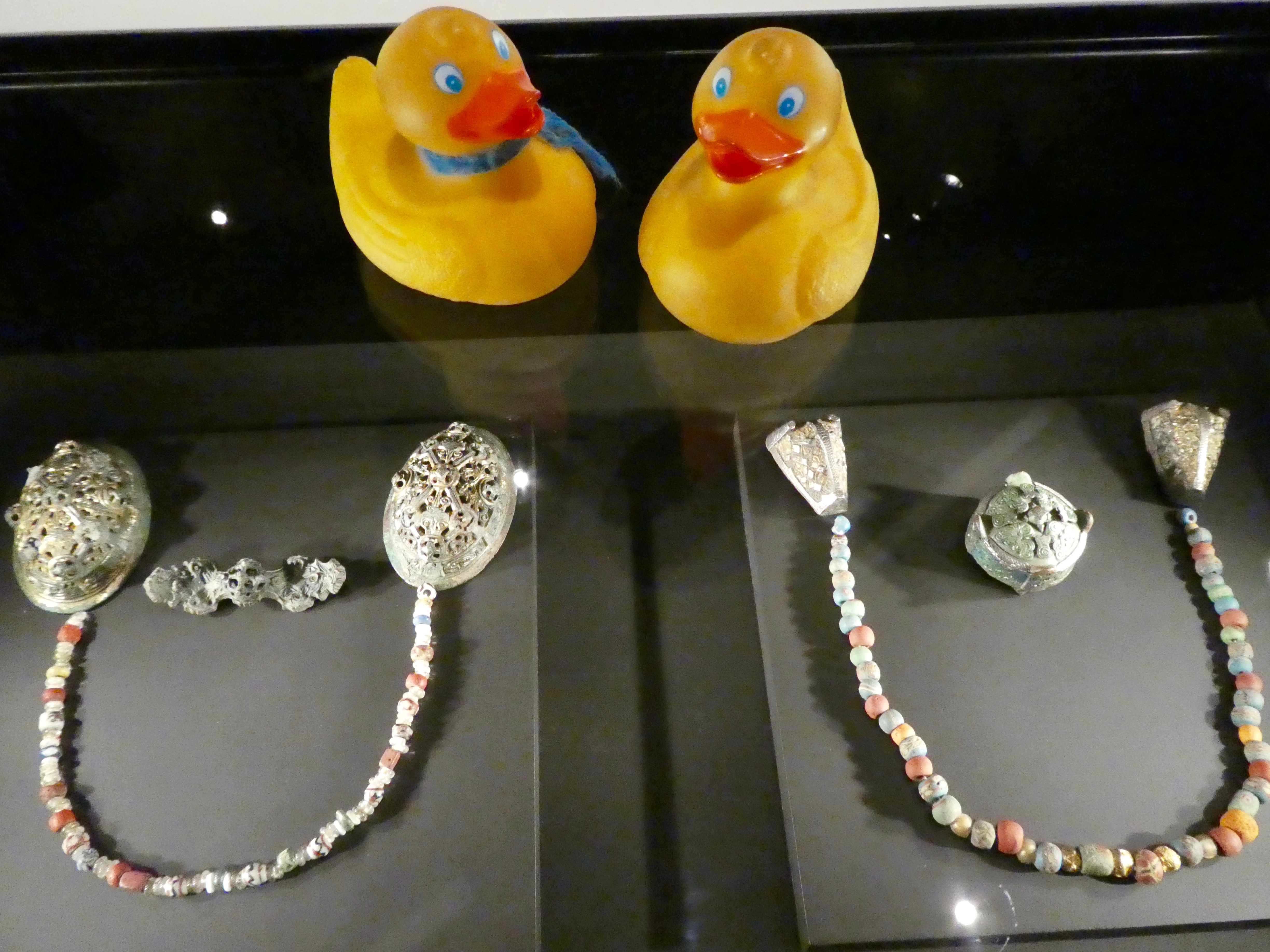
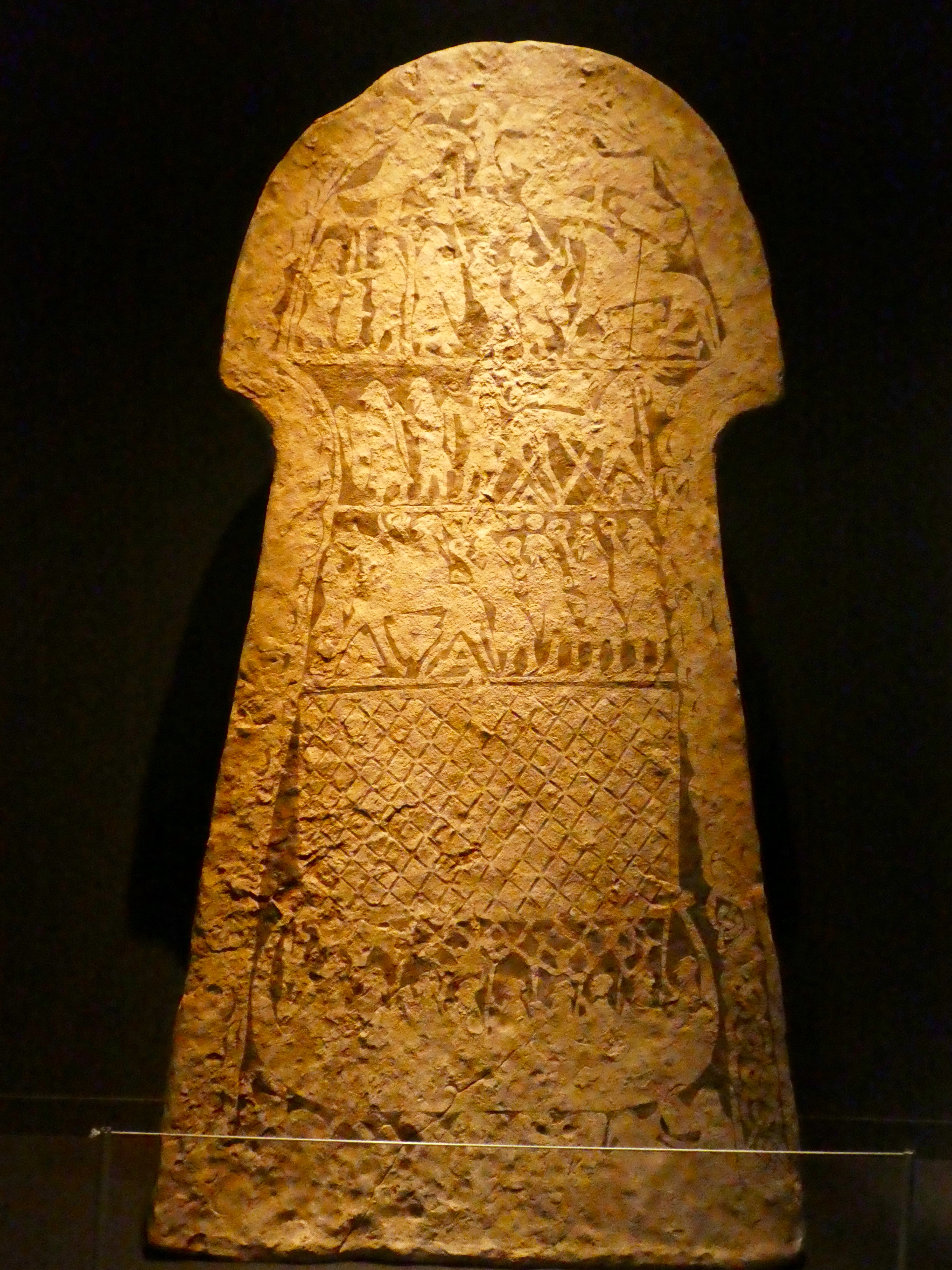
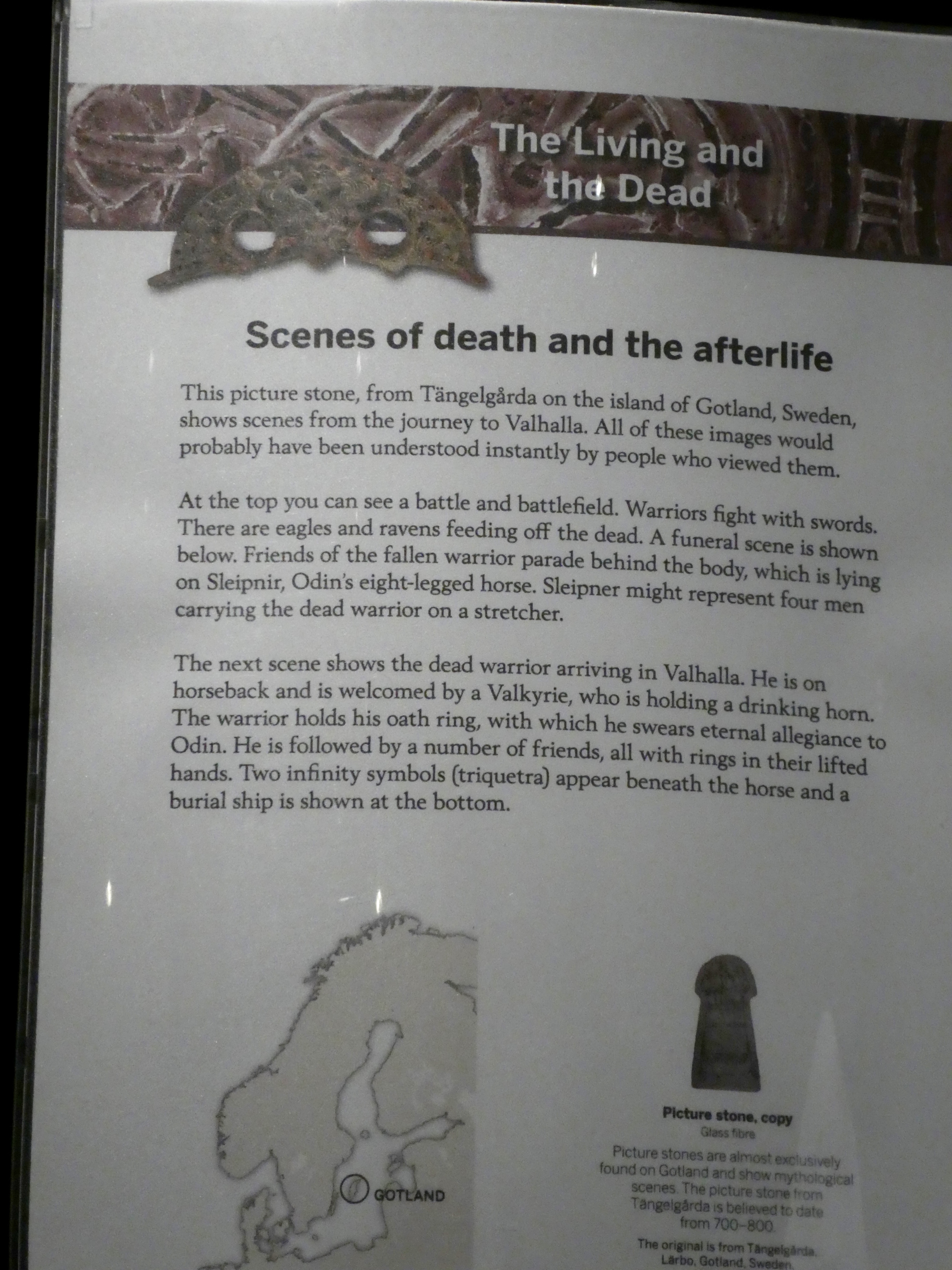
Zeb the Duck and Soapy Smith Duck went to this exhibit.   We learned and saw so much.   We actually went twice.   It really is good.   Who are the Vikings?   The people that lived across Scandinavia were not a unified group.   There were warriors, explorers and merchants, but most were farmers.   The word Viking was used for an activity.   Someone was out on a “viking.”  That could be a commercial trip or a raid.   Much jewelry was on display.
Jewelry

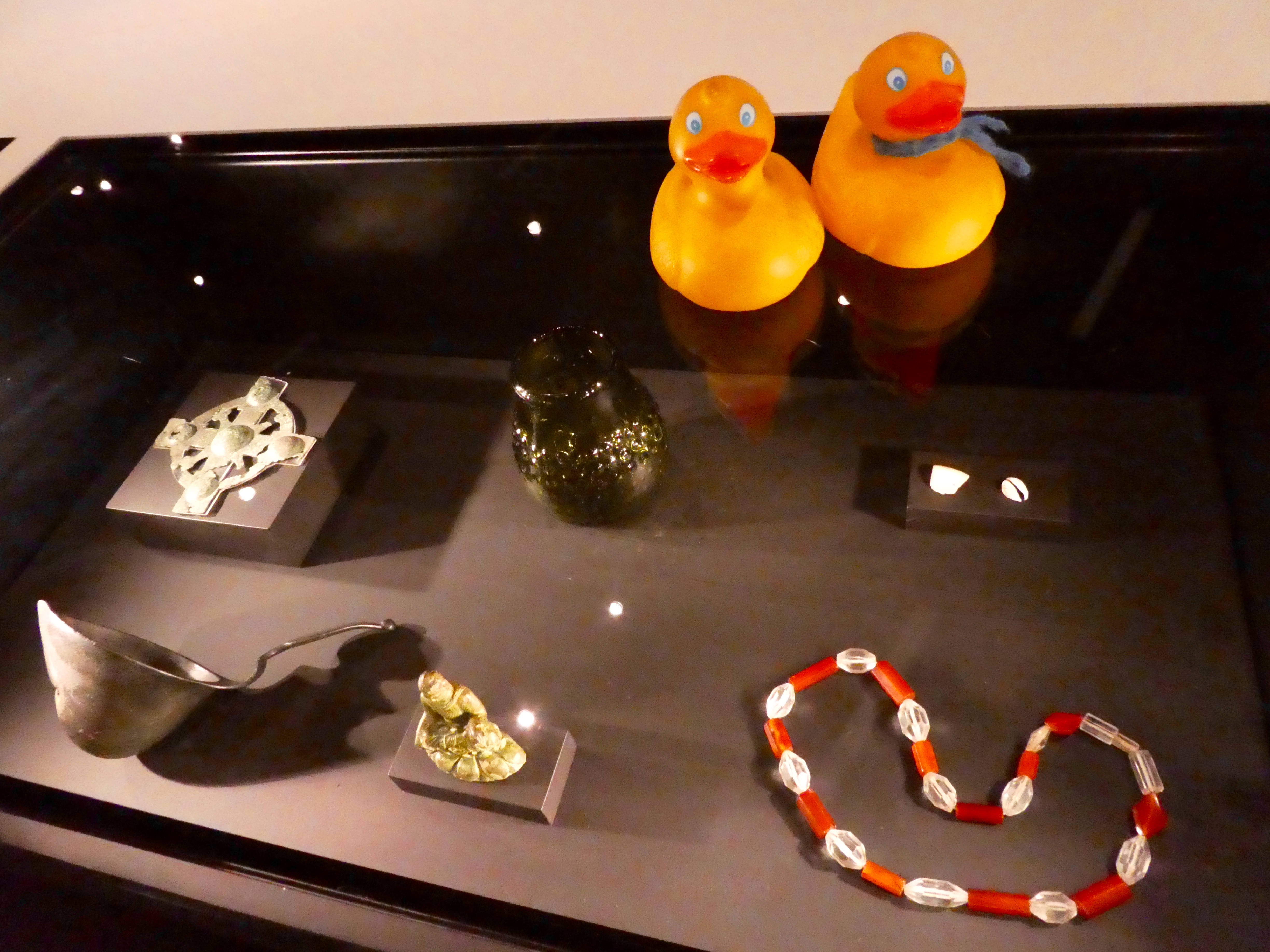
Different styles seemed to be from different regions.  Also many items were brought back from raids or commercial trips.   These items are from afar.

From many places

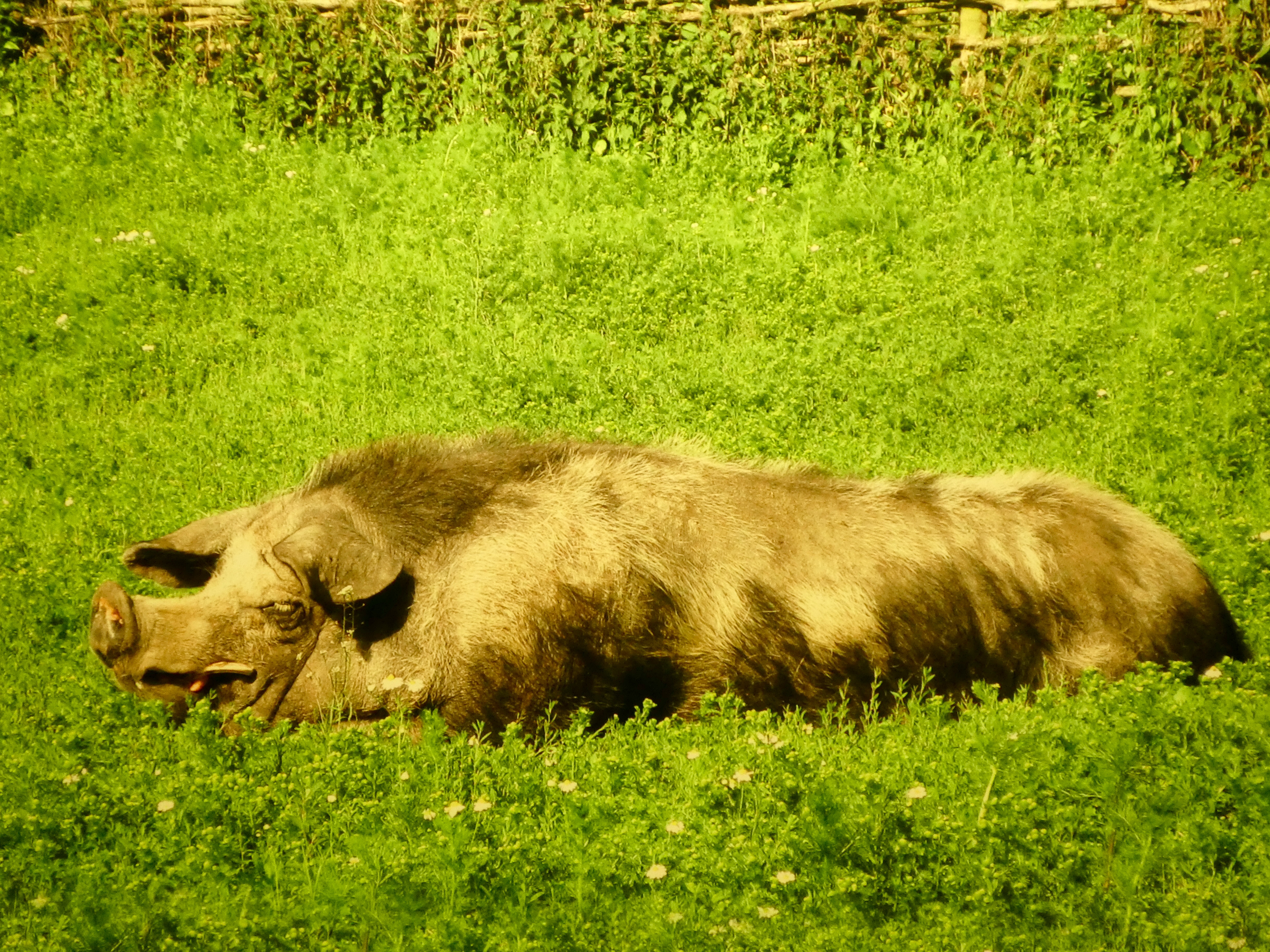
The cross has Irish origins, the cowrie shells are from the Red Sea while the red and white beads are from the Black Sea area.   The ladle was used during church ceremonies.   As we mentioned most people were farmers and this pig, or boar, was a great source of meat.

Boar living on a farm

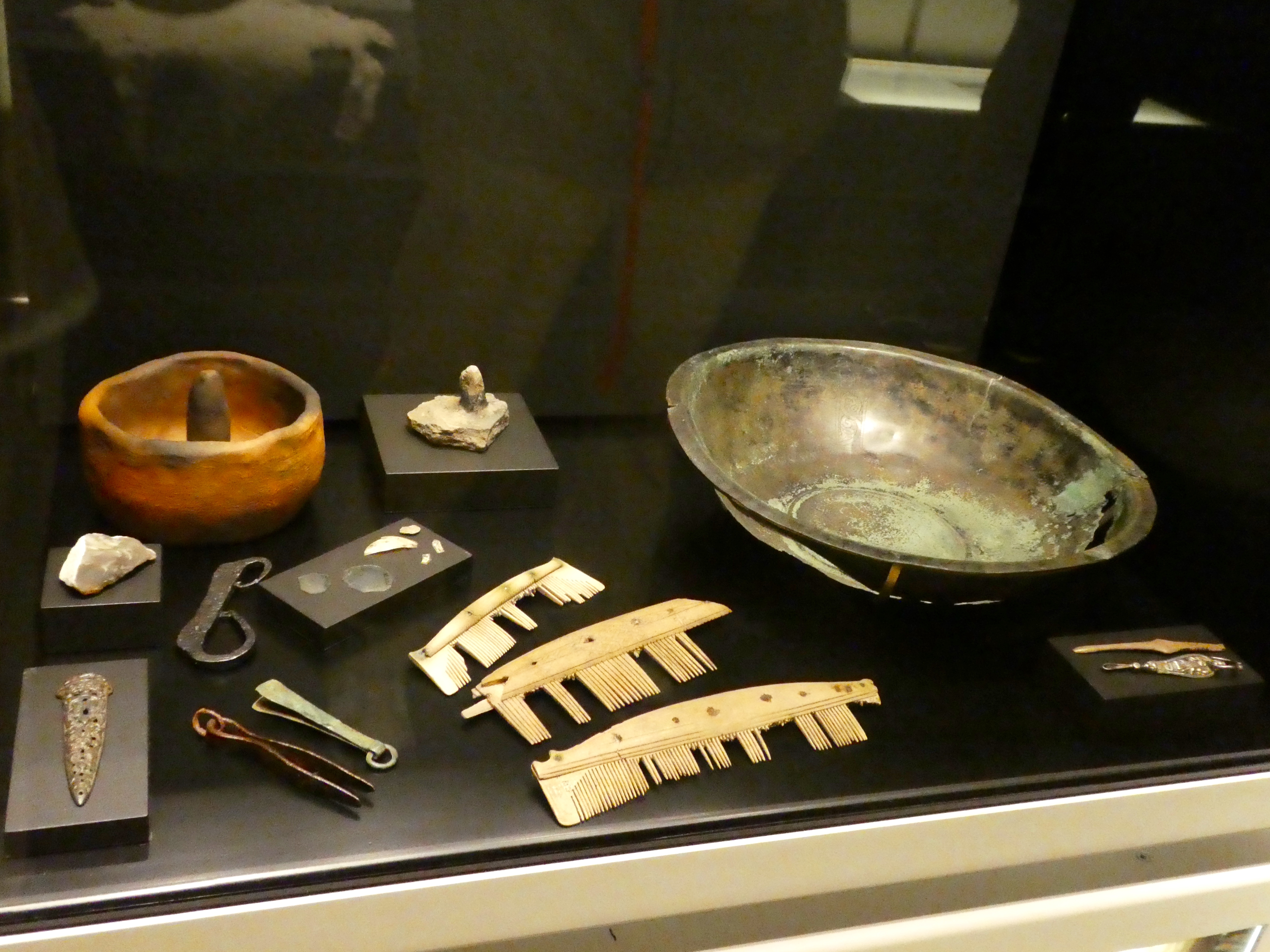
These people seemed to care about personal appearance, as these grooming items were found.

Grooming items

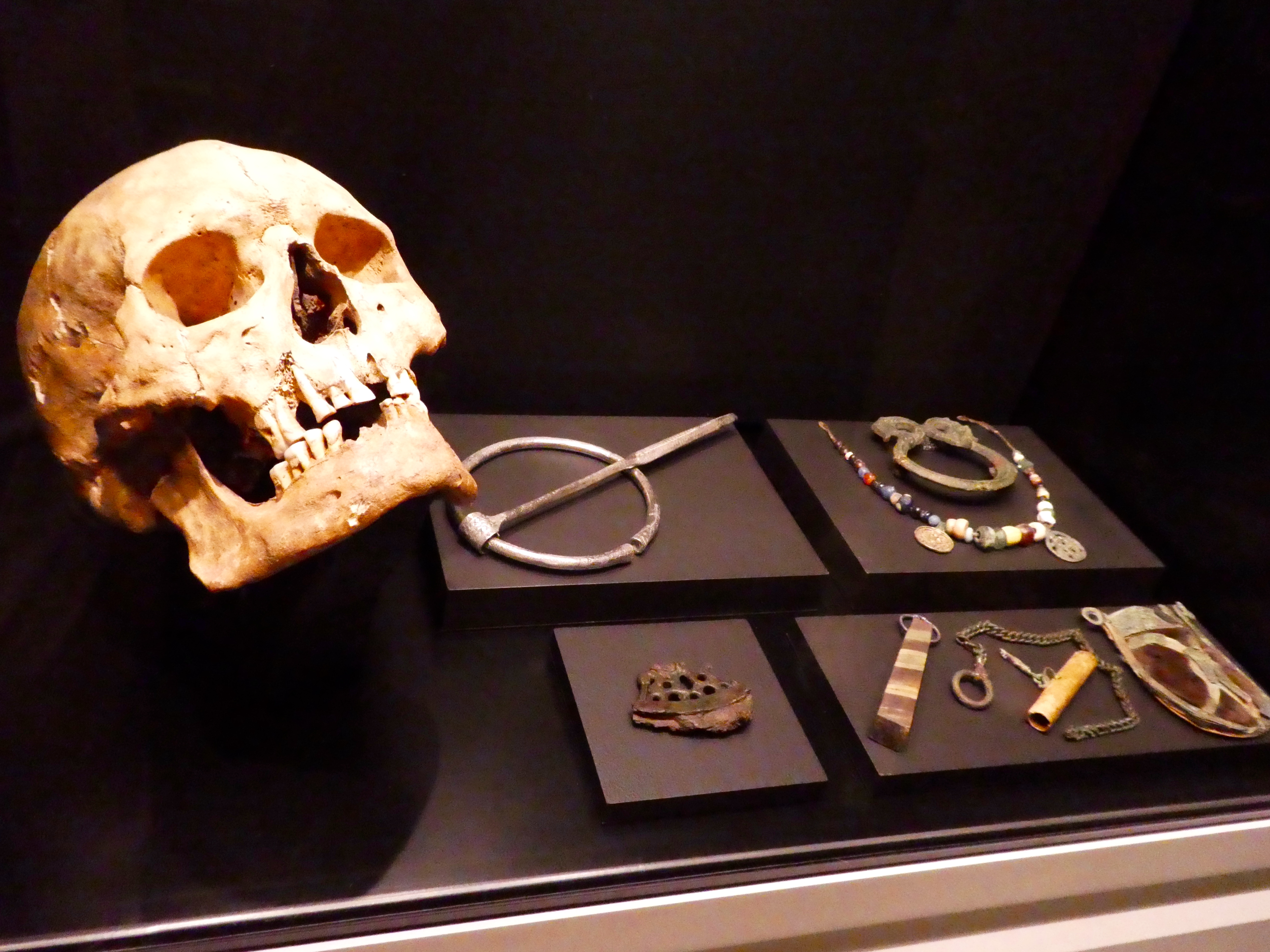
Many items were found in graves.

Buried with important items

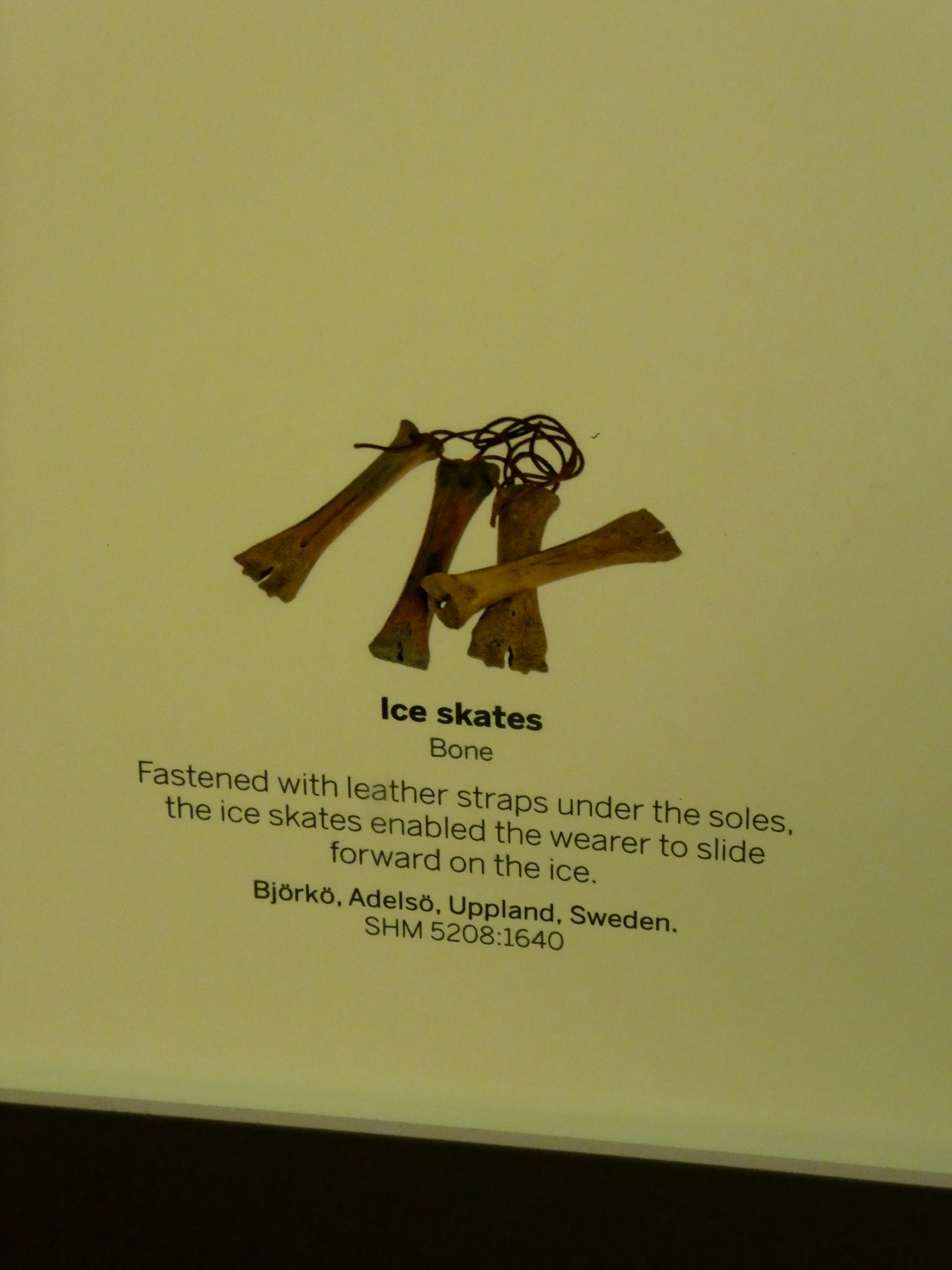
A male was buried with these favorite items.   The Scandinavia area has very cold winters.   Early ice skates were functional, but much different than those we use today.

Early ice skates

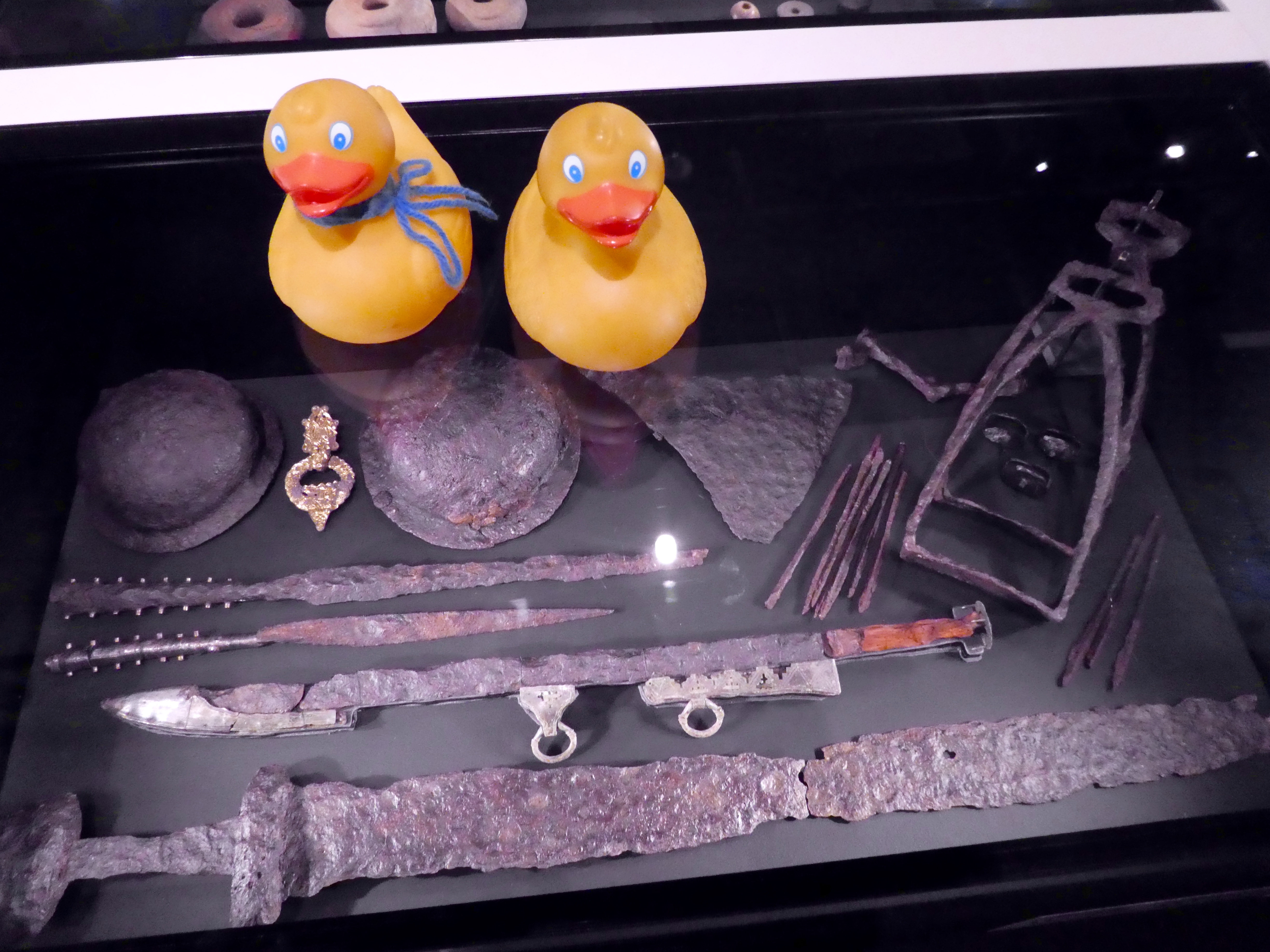
Here is what was found in the tomb of a warrior in Birka.

Preparing for battle

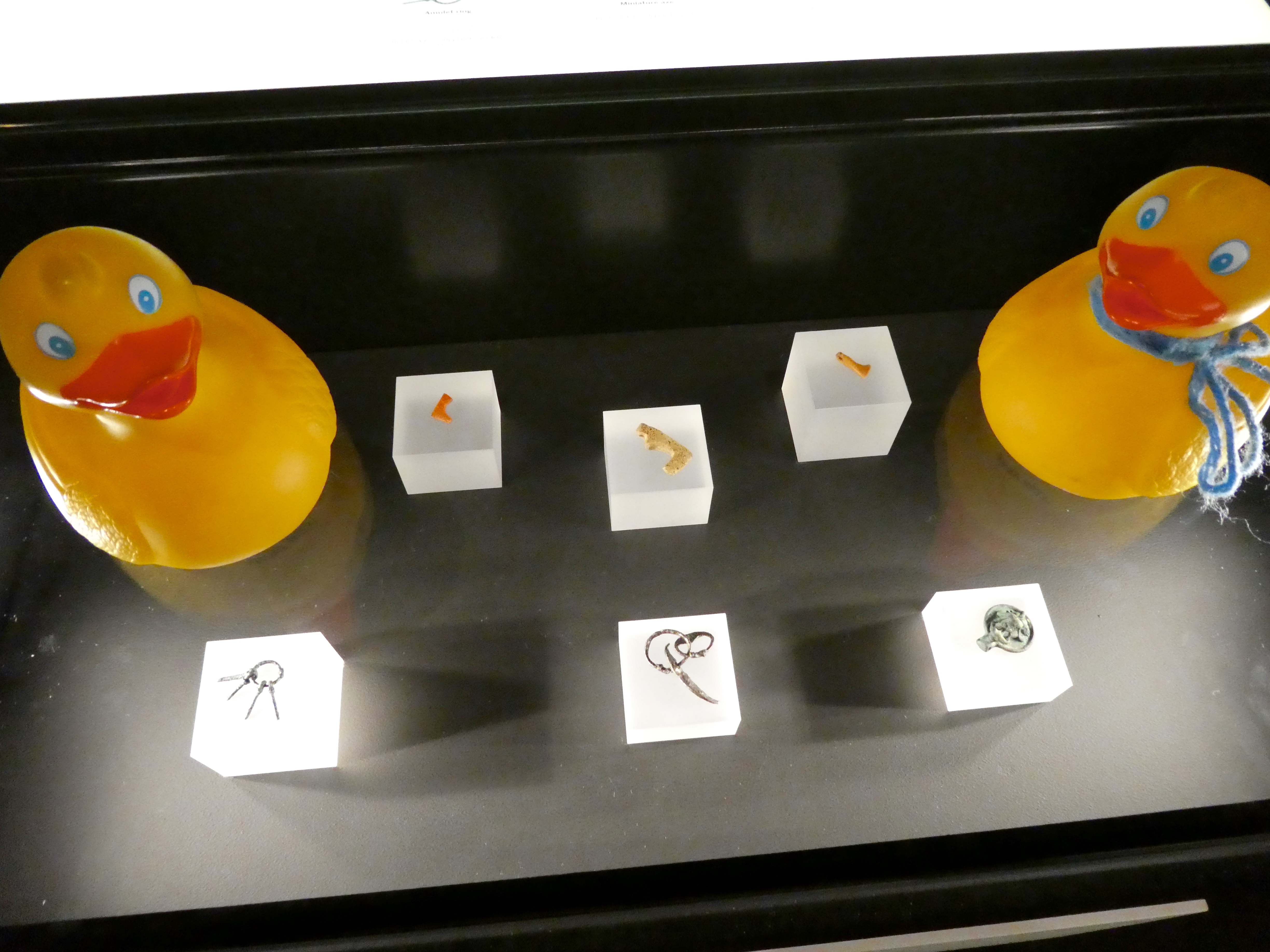
Some people were buried with amulets.

Amulets

Amulets guaranteed the gods’ protection.   Runes were iconic symbols from the Viking age.
Rune tells a story

This one tells a story.
The story

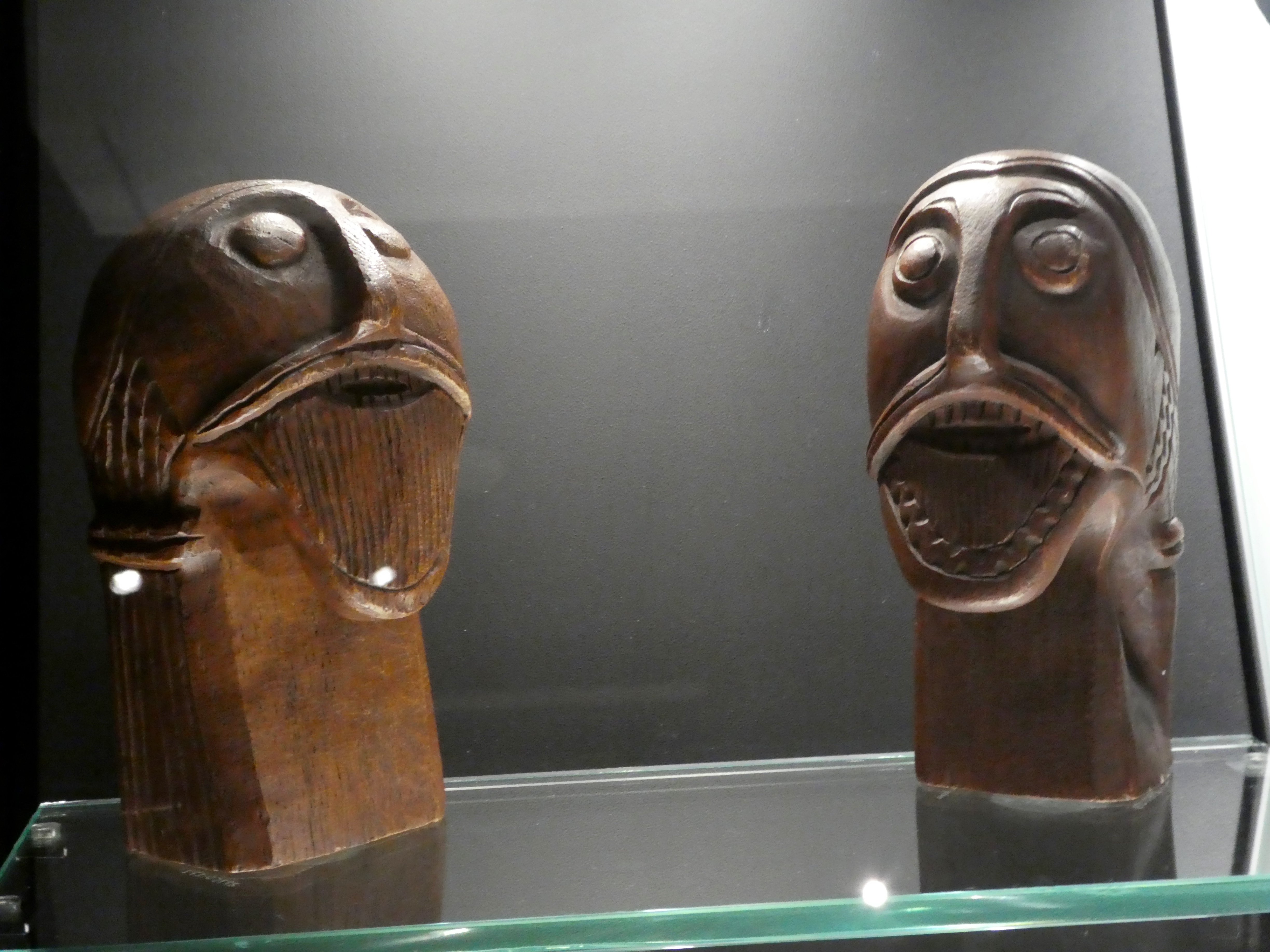
The Vikings expanded their world.   Some wooden figures were brought back.

Brought home

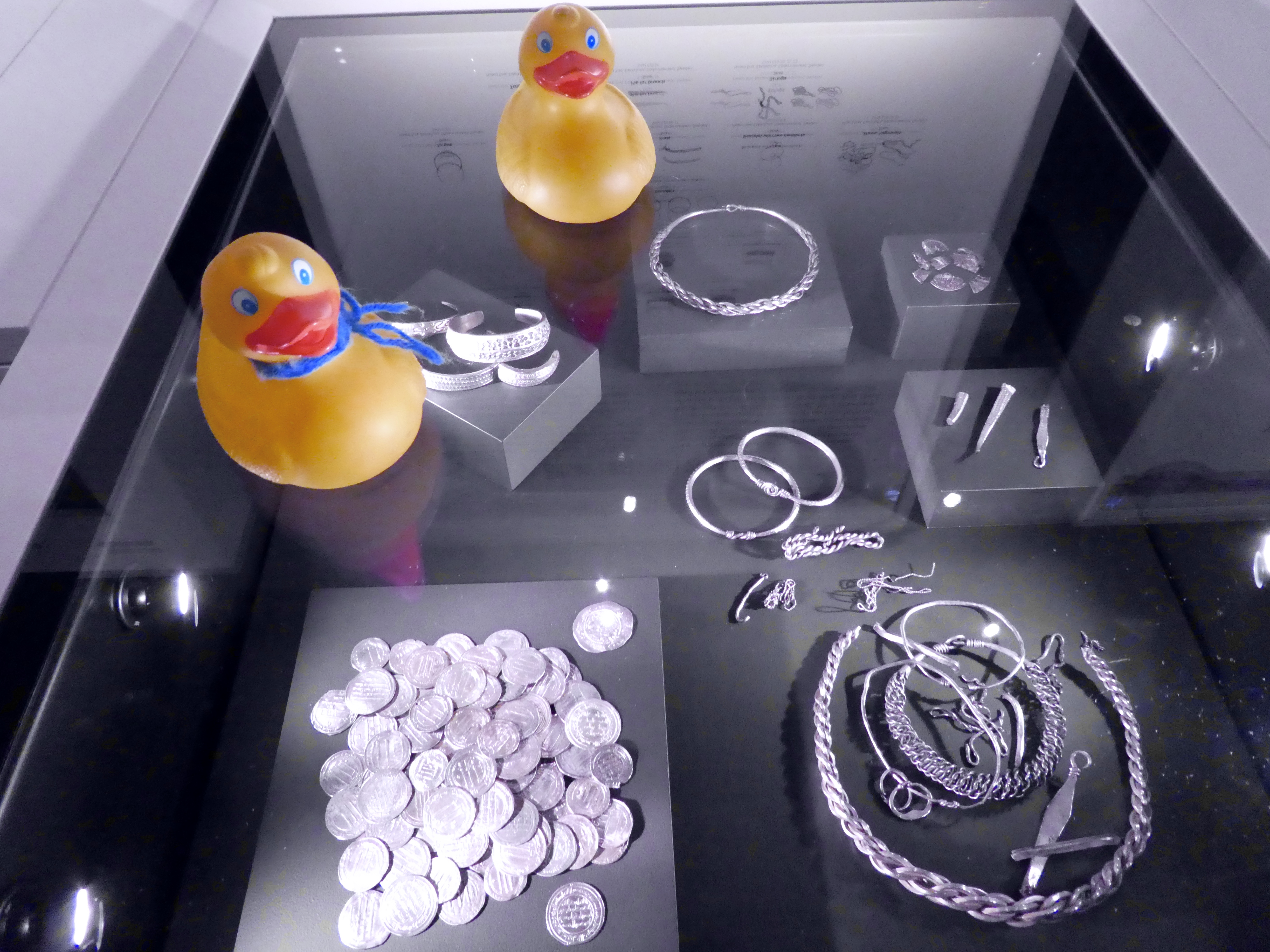
There was much silver.

Silver

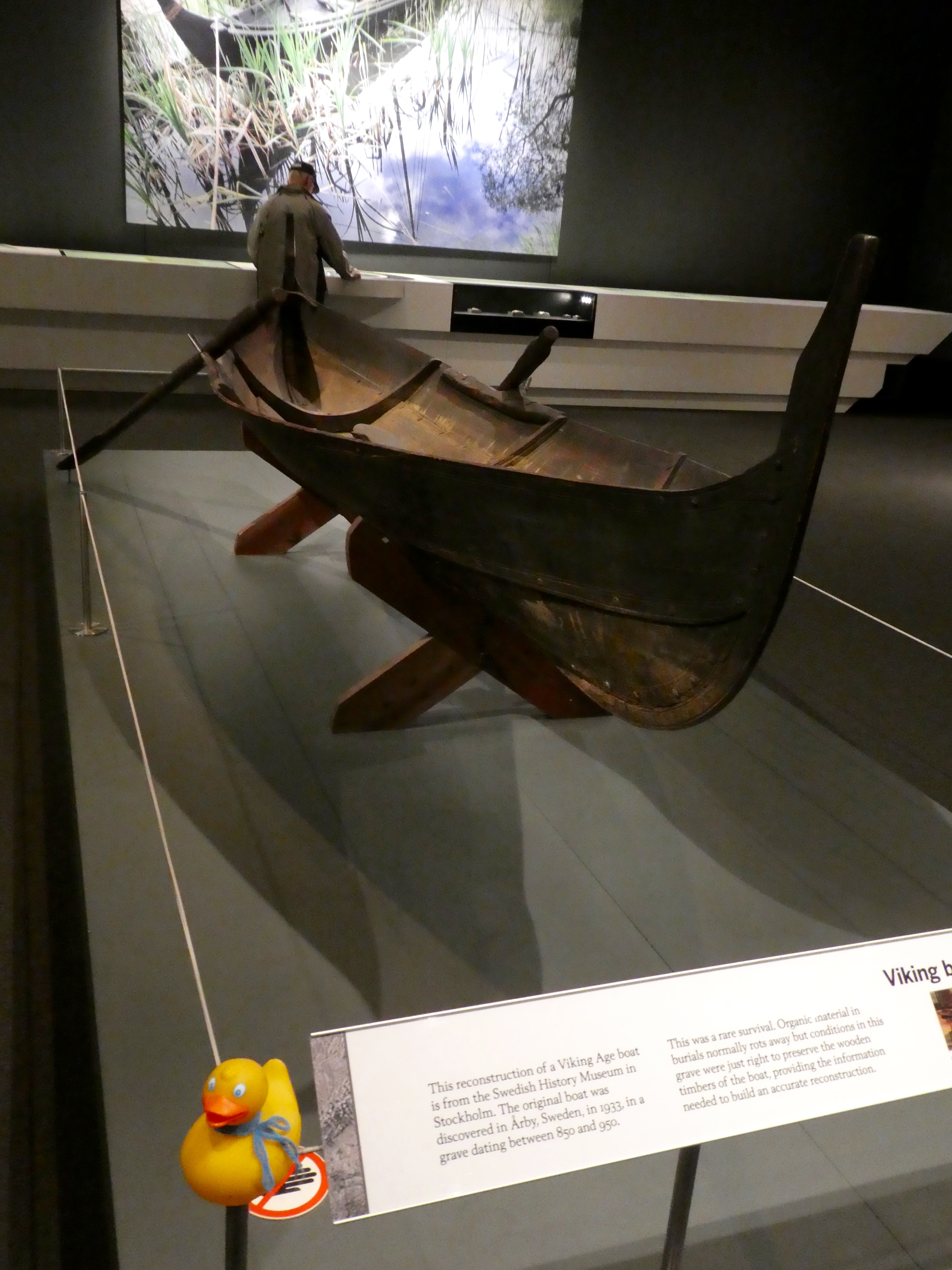
Some from raids and some was payment for traded goods.   Much silver was melted for jewelry.   Some was kept for local purchases.   Many merchants had scales so pieces of silver were broken off bracelets or other jewelry for payment.   This is a reconstruction of a small Viking boat.

Smaller Viking boat

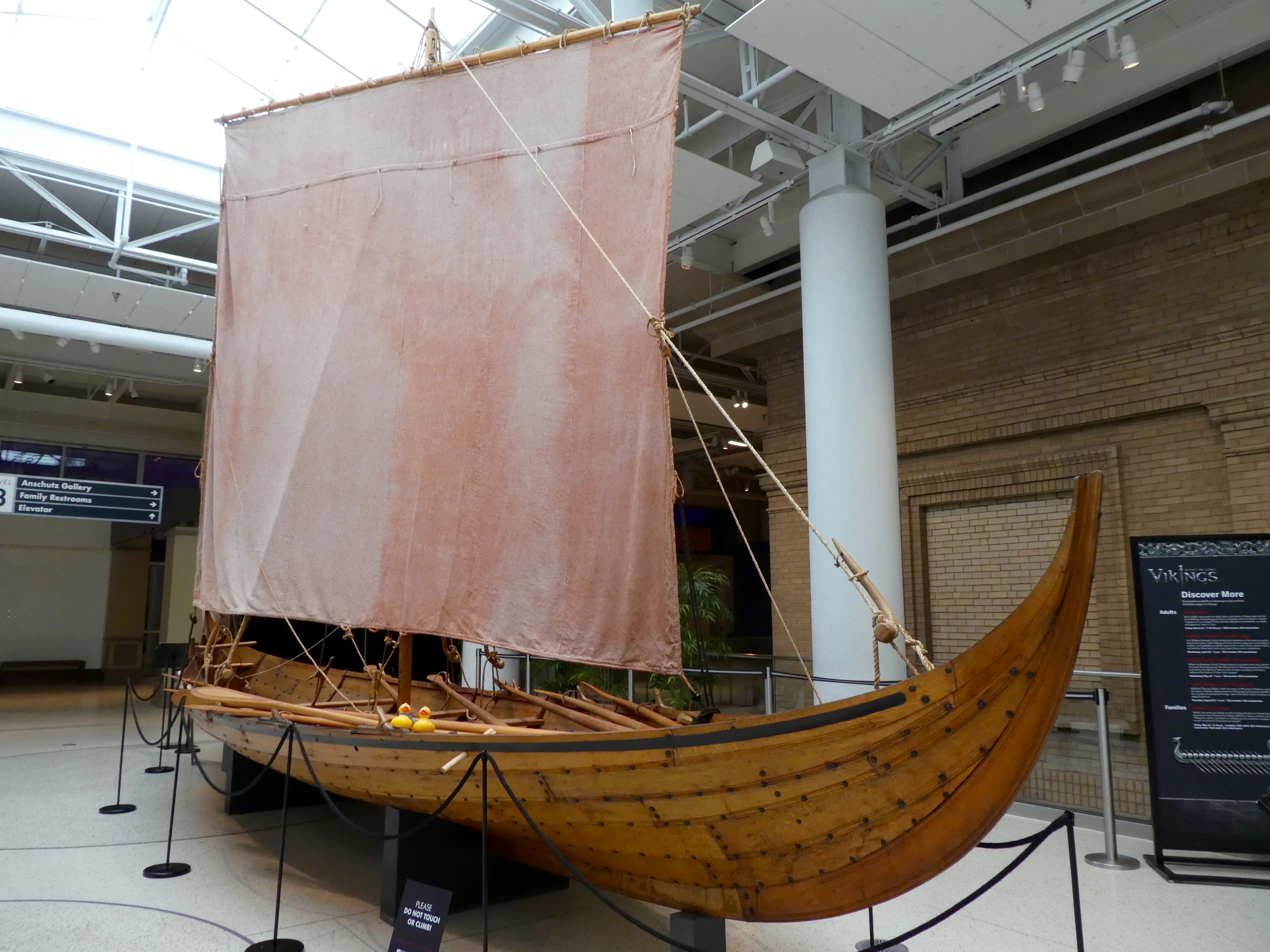
After leaving this exhibit, this reproduction of another Viking ship caught our attention.

Viking ship

This exhibit will be at the Denver Museum of Nature and Science from March 10 through August 13, 2017.   We hope you see it here or when it comes to your city.

Abu Dhabi, Dubai and Muscat–We loved them all!

Back home, we are remembering some of the wonderful experiences we enjoyed in Abu Dhabi, Dubai and Muscat.   Sheikh Zayed Grand Mosque in Abu Dhabi was beautiful.

Front of Sheikh Zayed Grand Mosque. Photo from Wikipedia.

And we, as non Muslims, were able to go inside to see the largest carpet, largest chandelier and the grandeur of this mosque.   The fish market was fun and I, Zeb the Duck, got a fish.

fish market for a snack

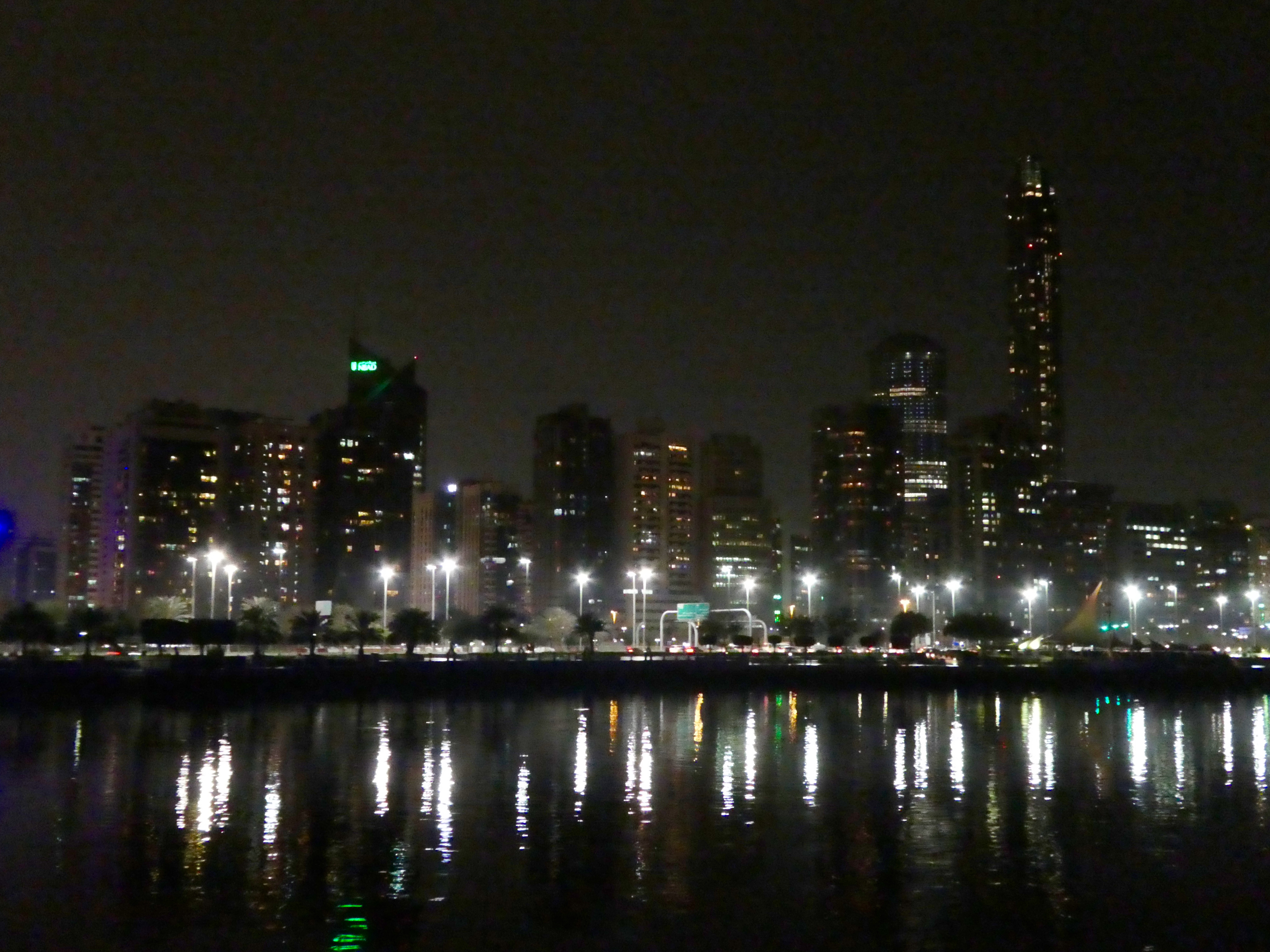
An evening boat ride, dinner included, showed us old and new on the Abu Dhabi sky line.

Abu Dhabi skyline

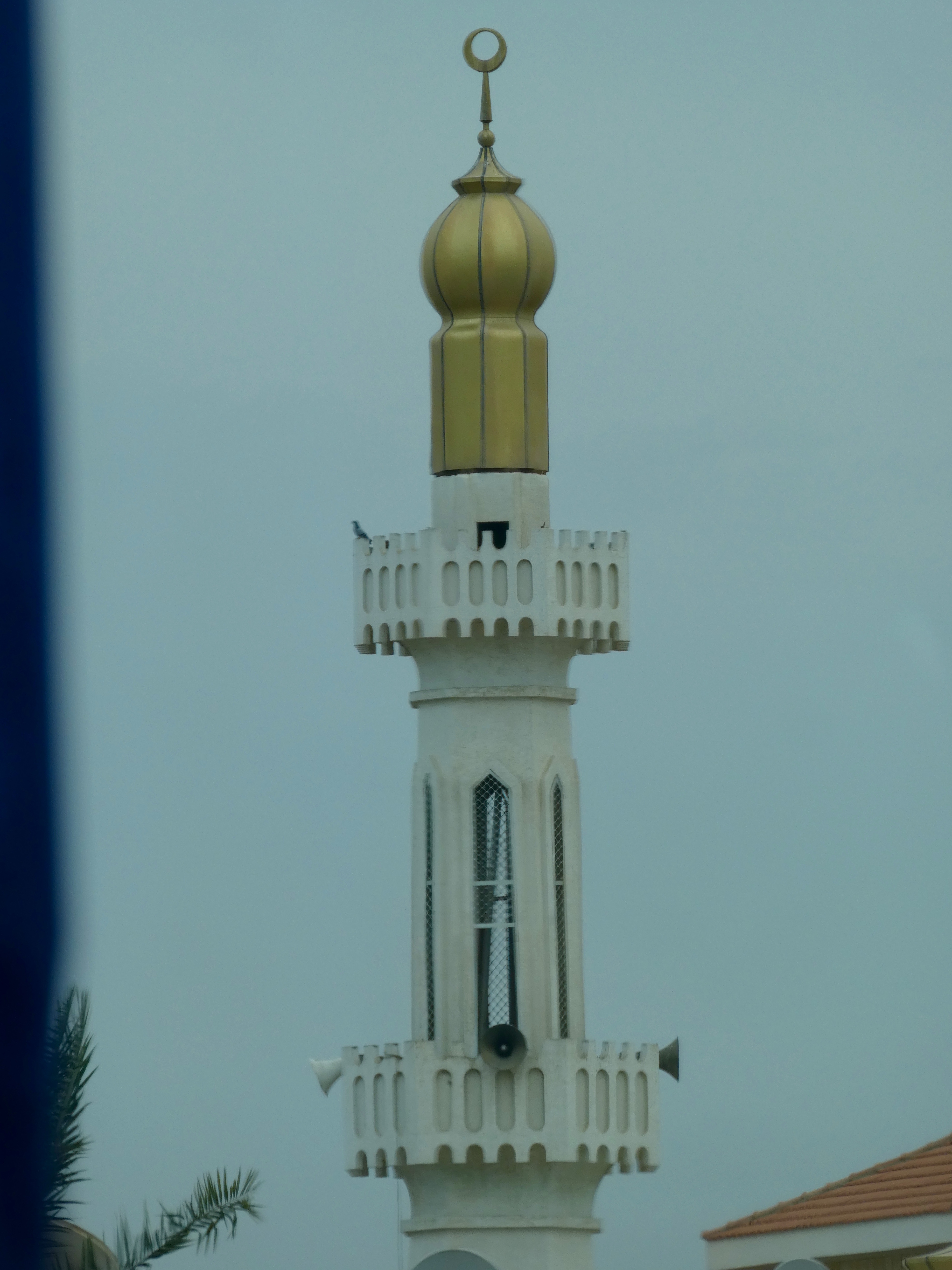
A common sight, and sound, throughout our Middle East adventure, the minaret of a mosque with a speaker for the call to worship.

Minaret of mosque with speakers

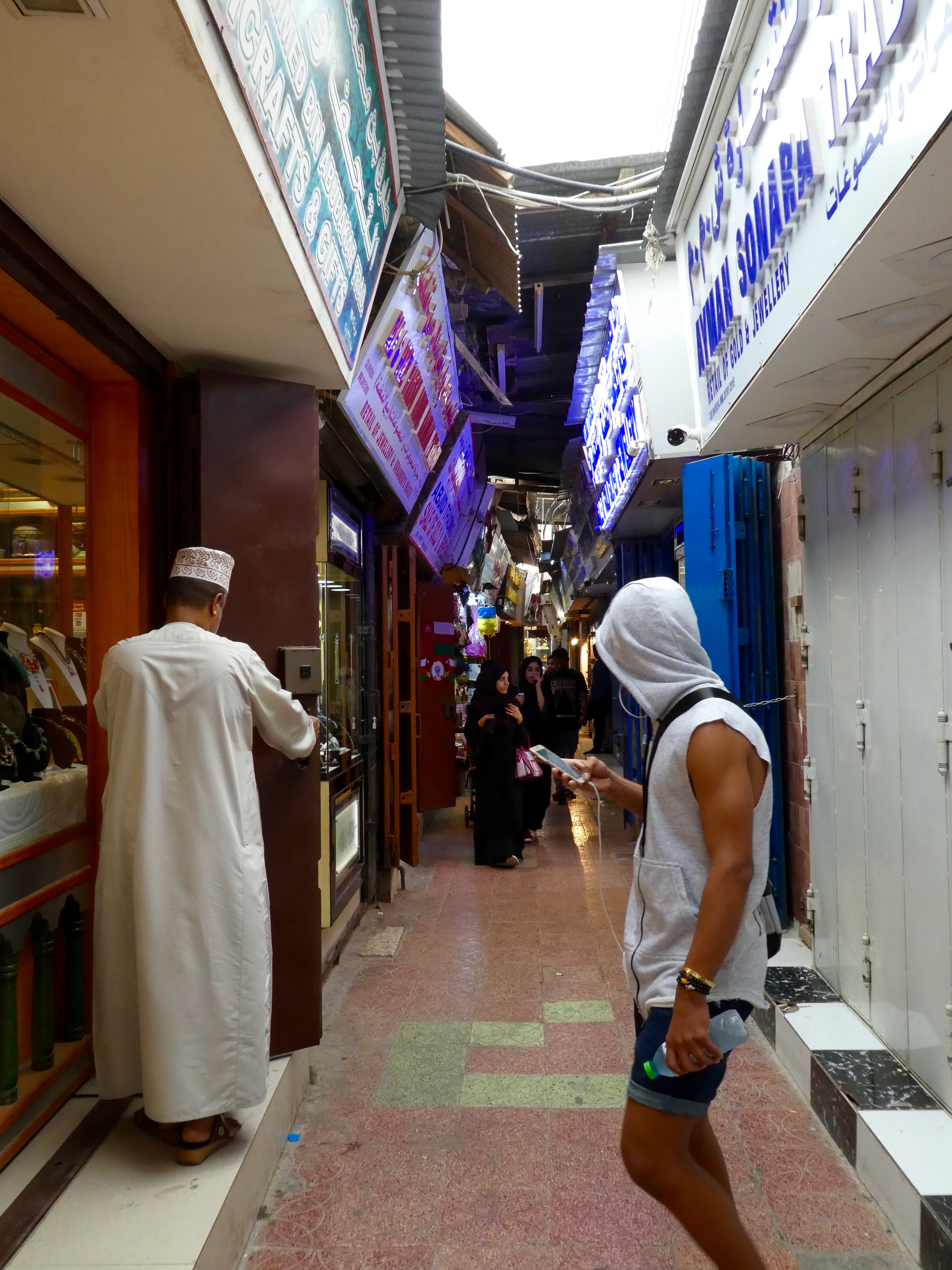
We gave up a free day in Abu Dhabi to experience a little of Muscat, Oman.   Here we saw some old and some new.   Muscat is a few thousand years old.   We loved wandering through the souk.

We explore the souk

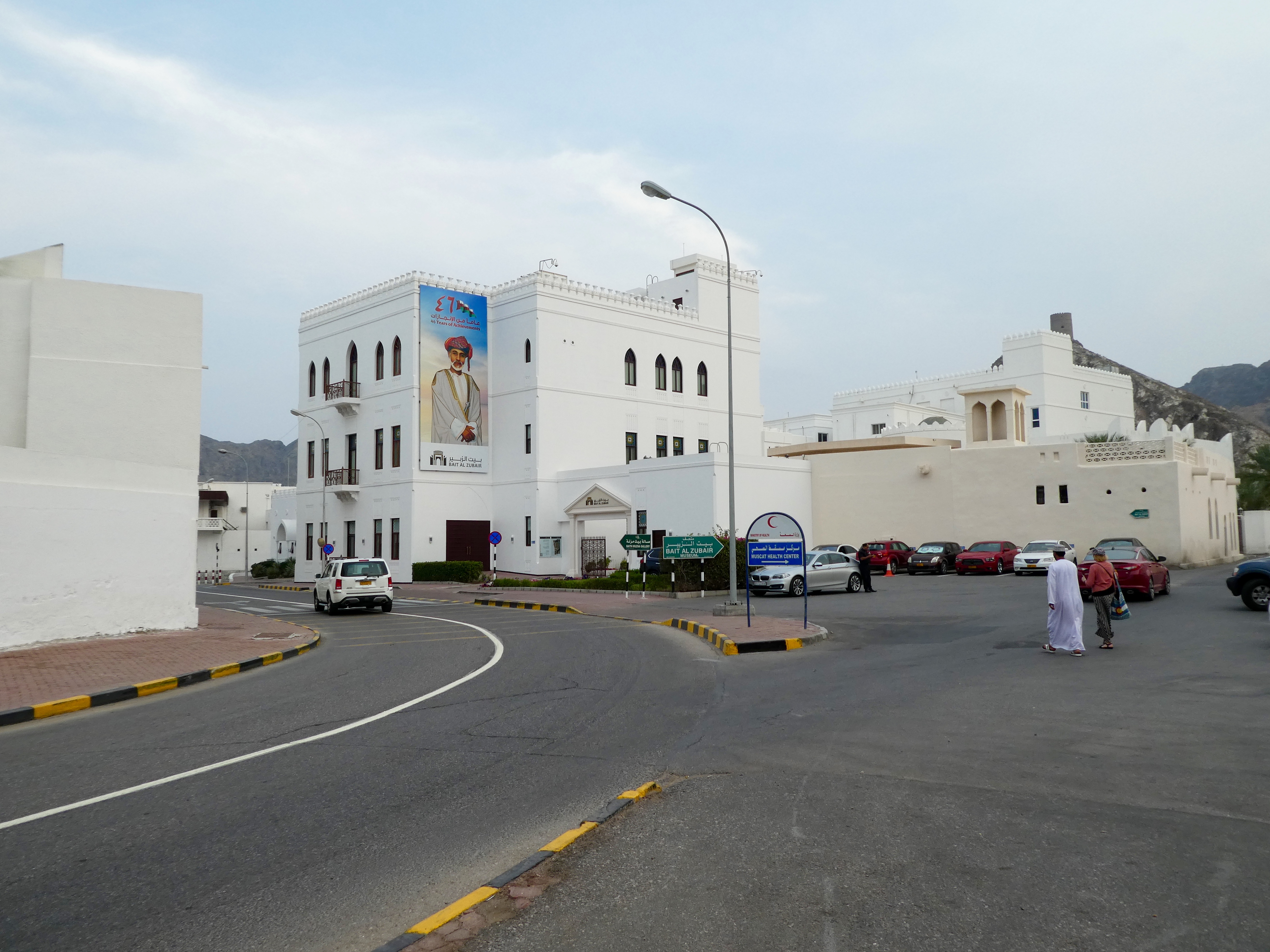
Driving through Muscat, we appreciated the absence of too many cars and the accompanying car noises.

Driving through Muscat, Oman

Here, our guide shows some of the new:  The Royal Opera House of Muscat, Oman.

Our guide in Muscat, Oman

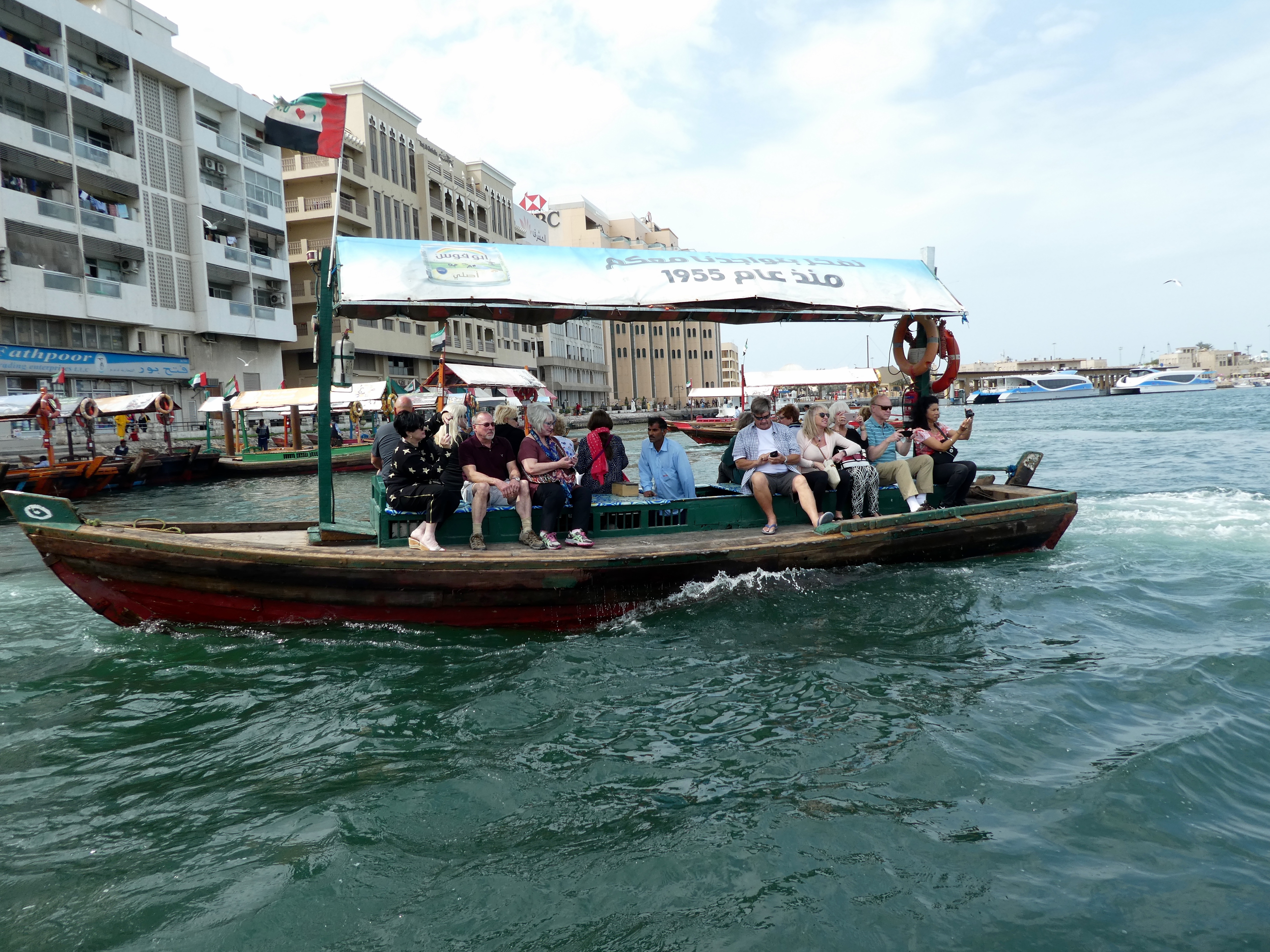
Back to the United Arab Emirates, in Dubai we rode a traditional boat, or dhow, to cross Dubai Creek.

Tourists crossing Dubai Creek on Dhow

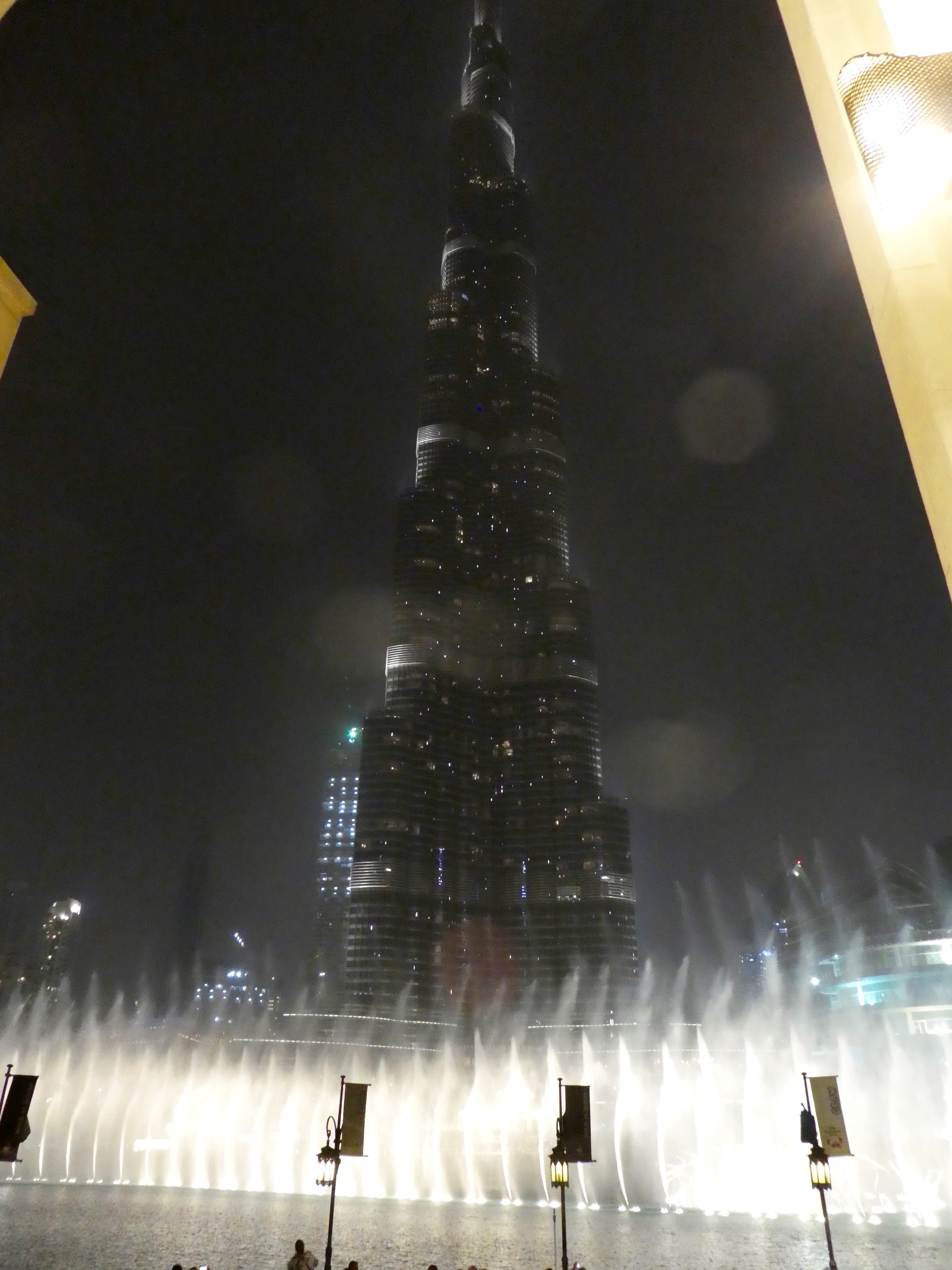
We admired Dubai Fountain with Burj Khalifa, the world’s tallest building, all connected with Dubai Mall.

Burj Khalifa behind Dubai Fountain

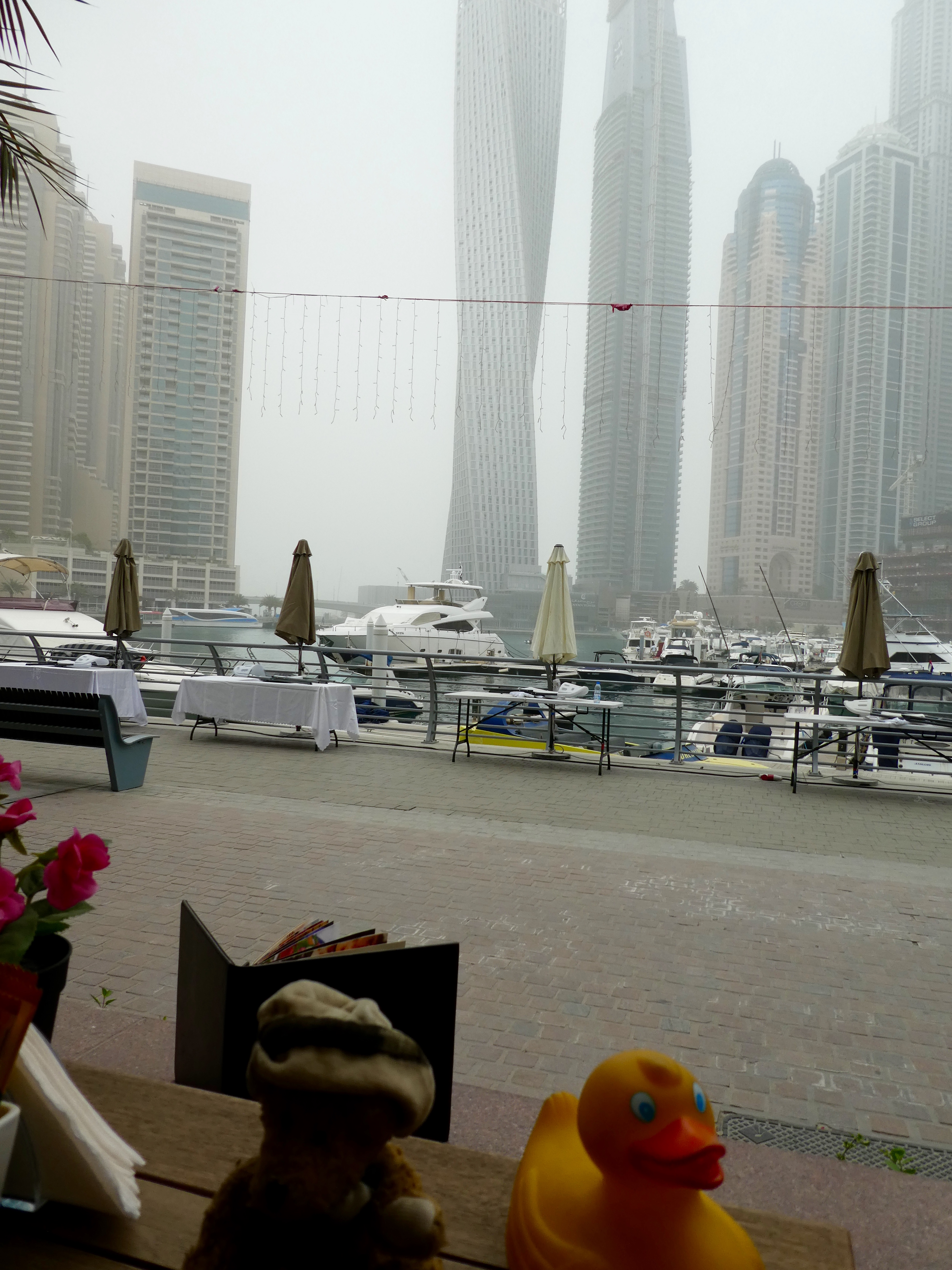
Dubai Marina was bustling, but still relaxing for our lunch stop.

Dubai Marina from Salsa Restaurant

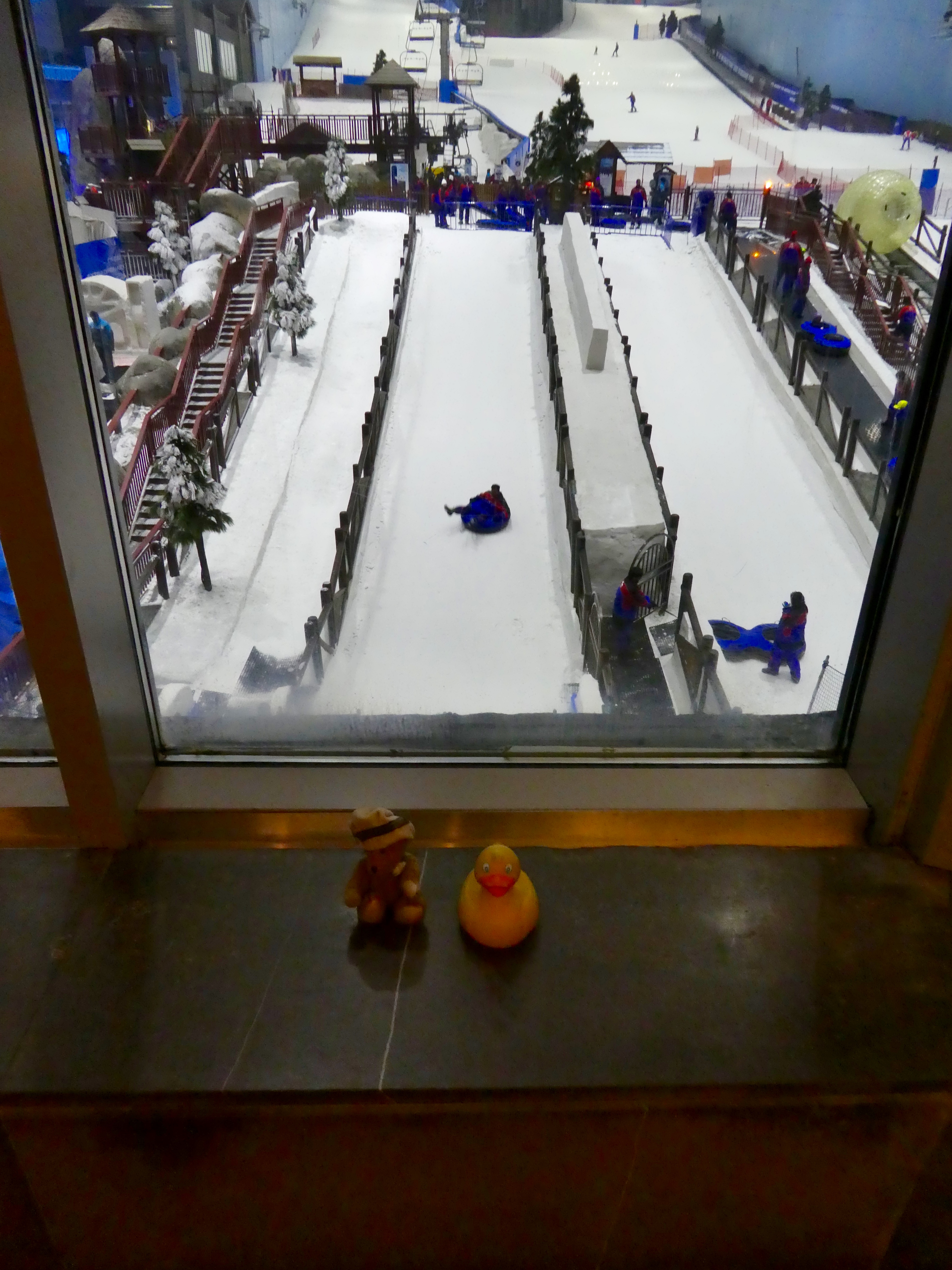
Mall of the Emirates provided indoor snow skiing and tubing on snow, in additional to fabulous dining and shopping.

Skiing and tubing

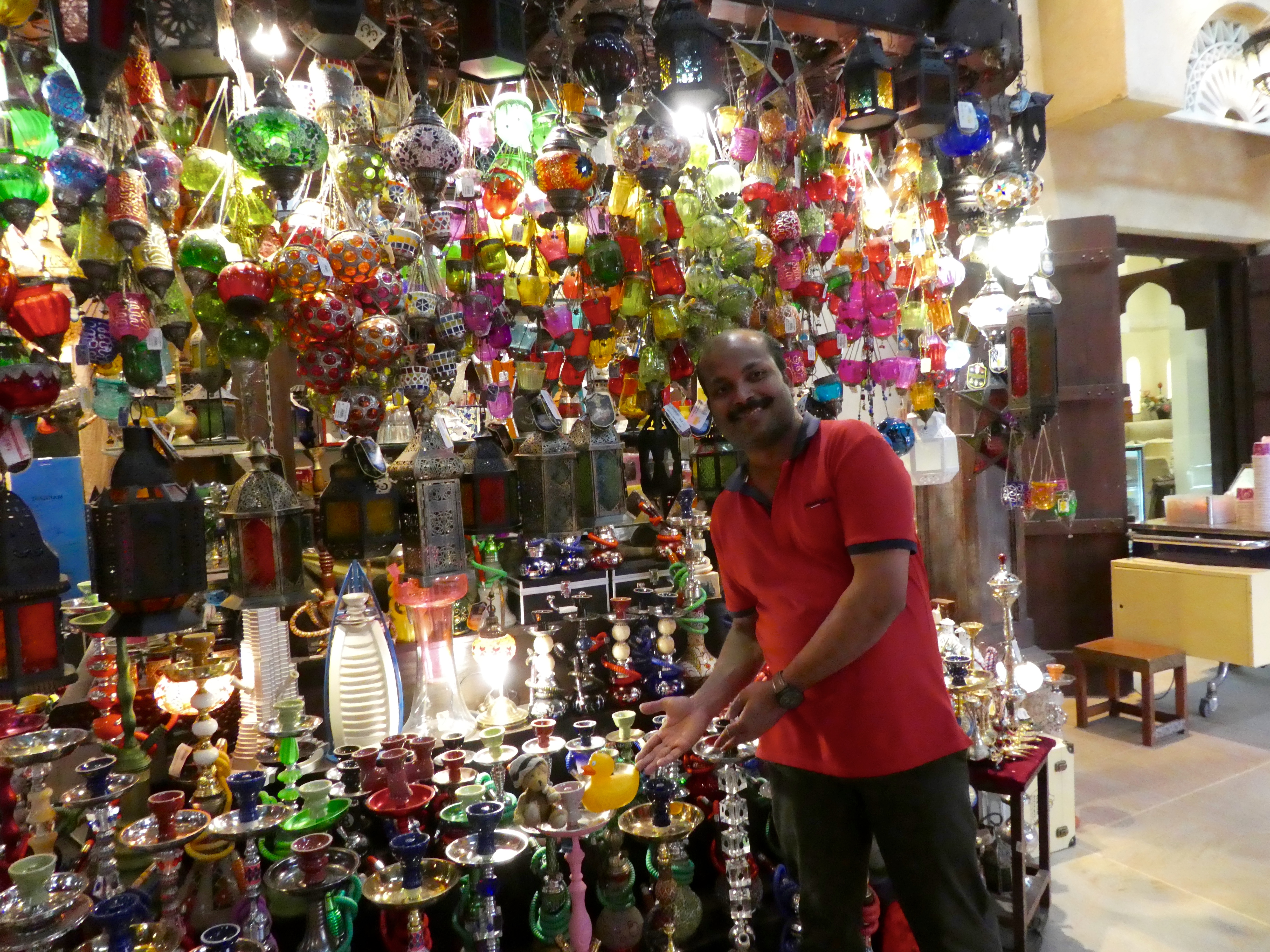
Souk Madinat Jumeirah was a modern souk.

I love meeting new friends

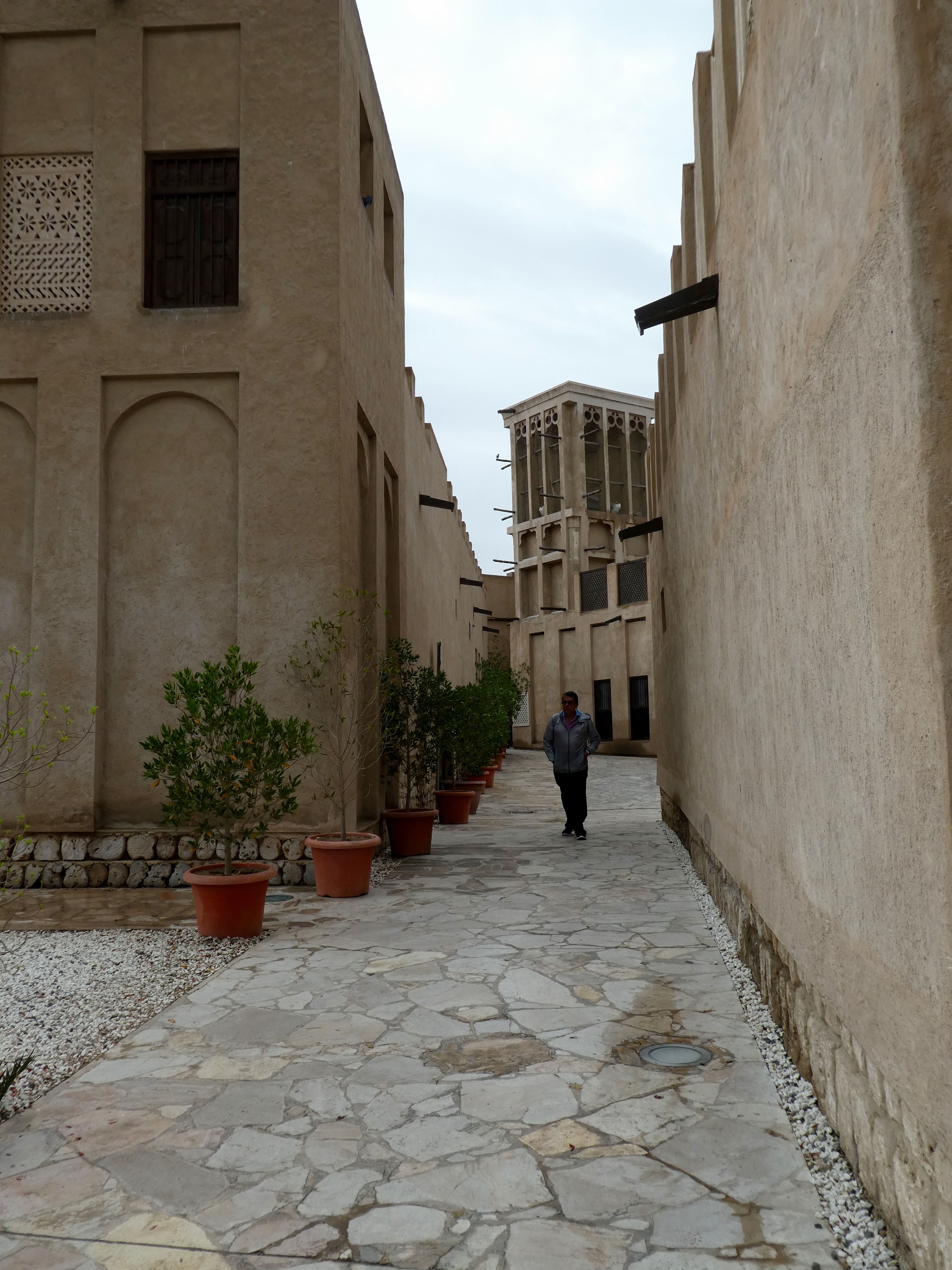
The narrow alley of Bastakia Heritage Area showed life before oil and oil money forever changed Dubai.

Narrow alley walkways

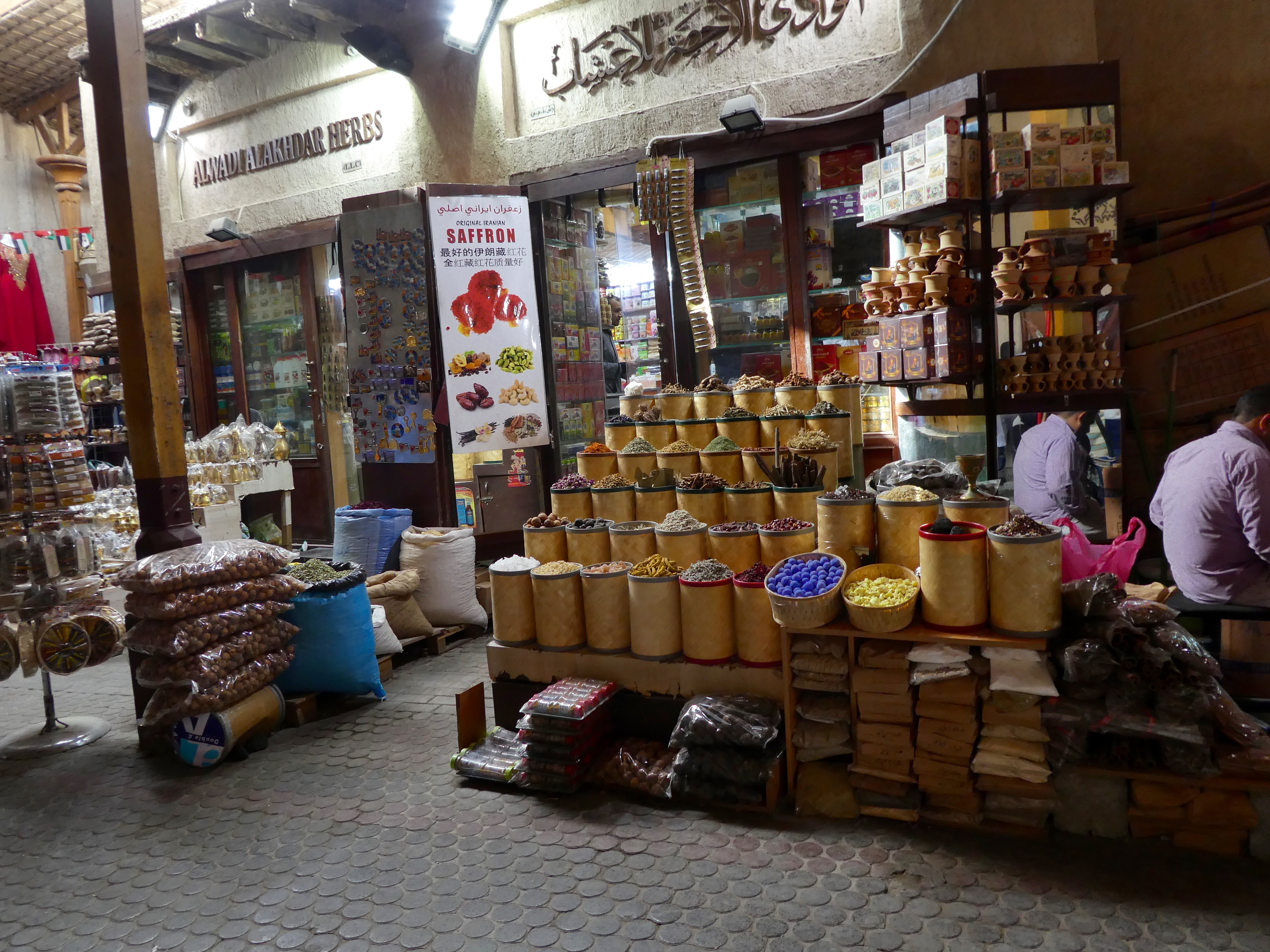
Aromas from the spice souk will be with us always.

Spice souk

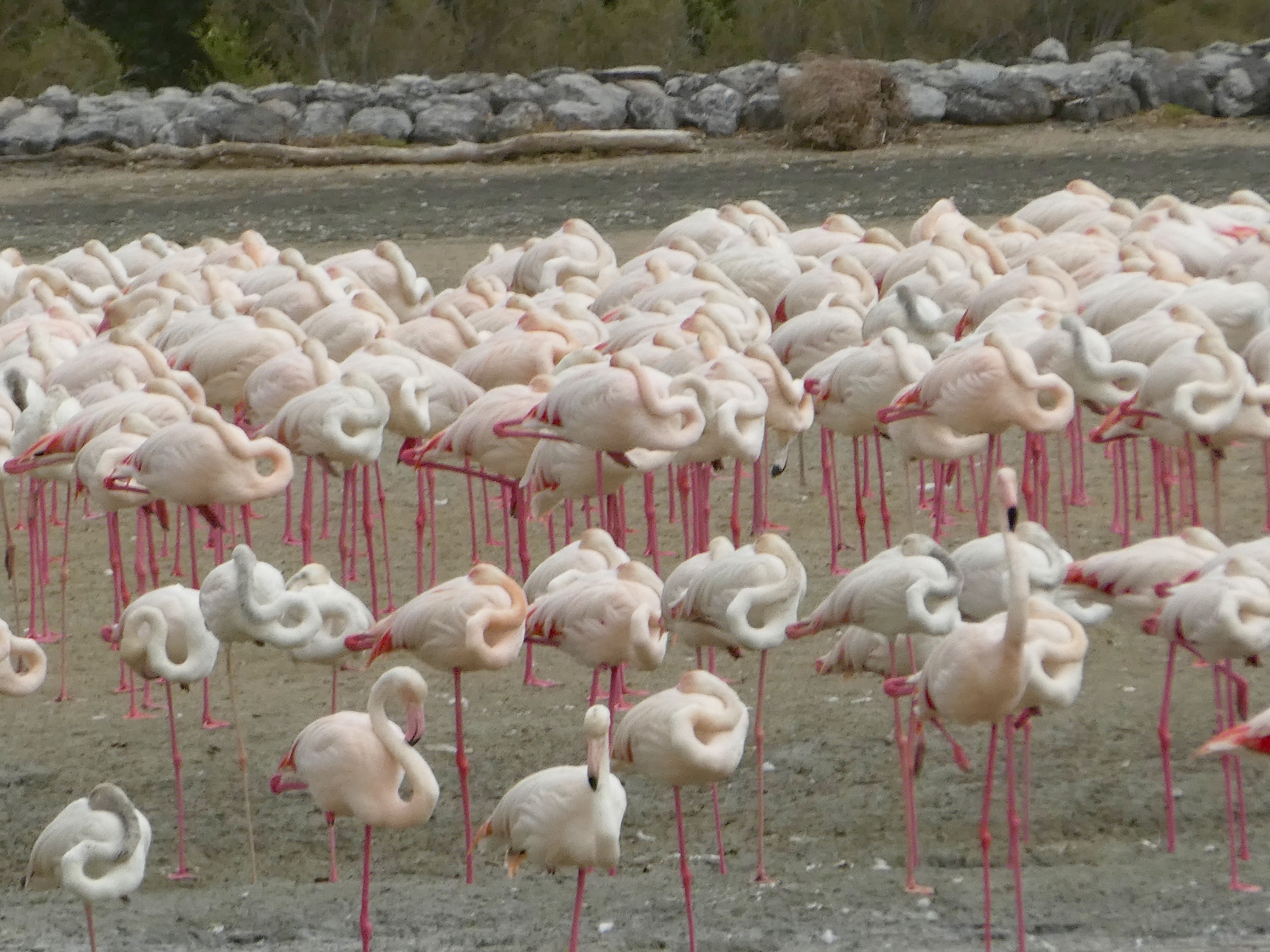
Of course we loved the animals.   The unexpected flock of flamingos were wonderful to see.

Some are looking at me

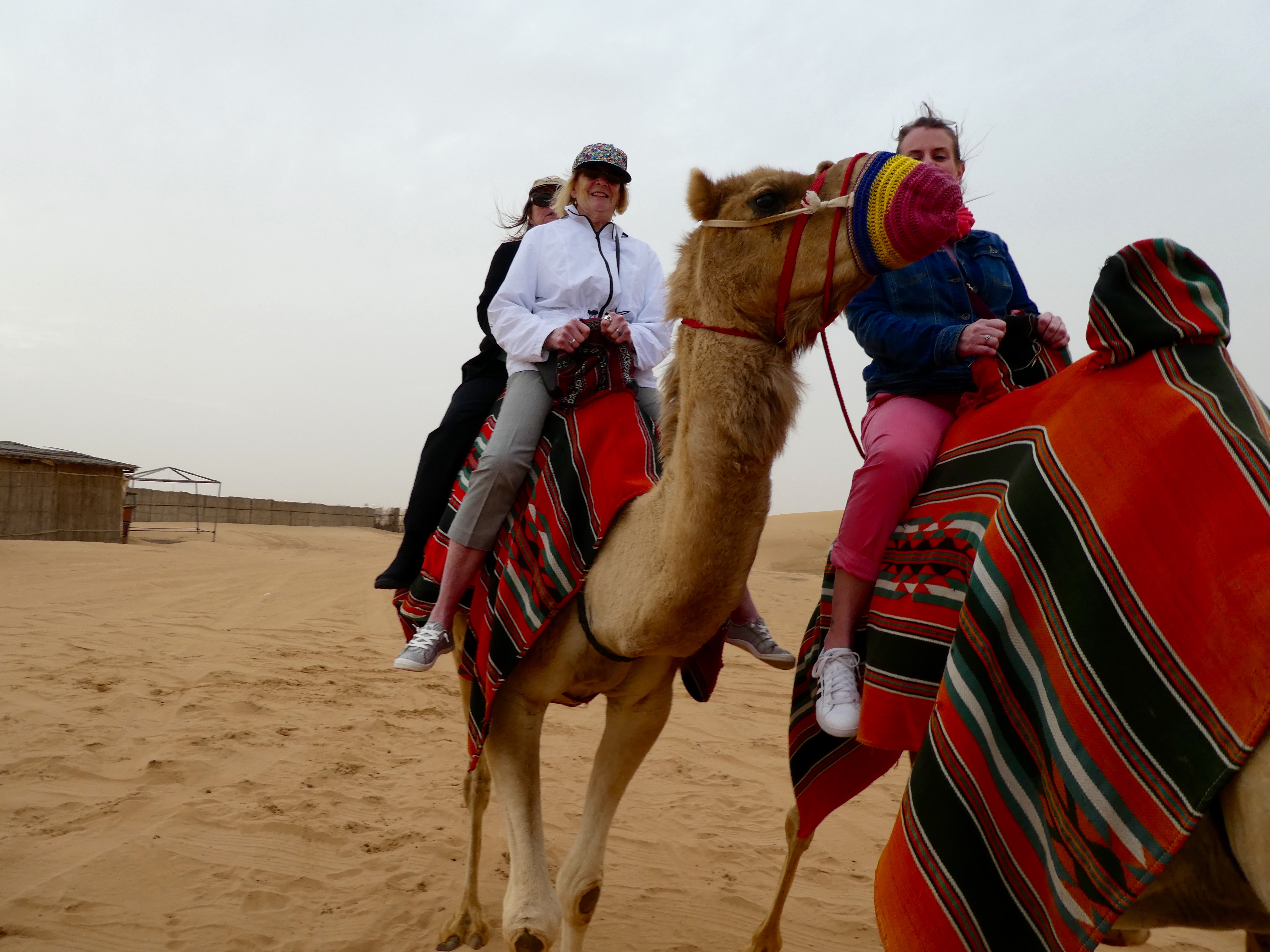
And riding the desert native, a camel, made our trip even more memorable.

Our camel is friendly

Of course we will never the gold souk with those huge gold necklaces and gold hats.   But our fondest memories are of the kind, welcoming people we met.   Our trip was a tour through http://www.SmarTours.com.   We have taken tours from them previously.   This was Deluxe Dubai and Abu Dhabi.   The day trip to Muscat, Oman, was not connected to SmarTours.   Chanel’s mom made separate reservations for us and we loved our day in Oman.   We hope you visit Abu Dhabi, Dubai and Oman soon.   We loved it.