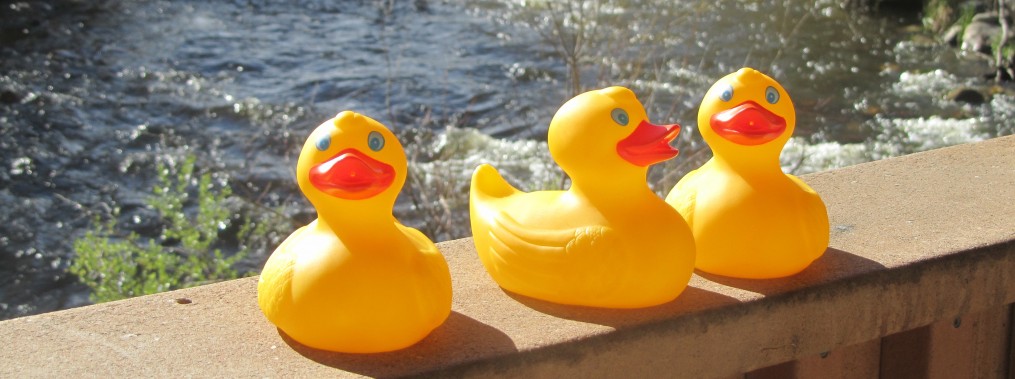
Teslin Tlingit Heritage Center with Colorado Traveling Ducks

Here in the Canadian Yukon Territory, we discovered a Heritage Center and it is located on beautiful Teslin Lake.   The Yukon is beautiful!   Let’s stop and explore the Teslin Tlingit Heritage Center.

Teslin Tlingit Heritage Centre

It was cool and cloudy, so the walk to the entrance is rather dark.

Walkway to enter Heritage Center

But we loved these totem poles.

Totem Pole

If you have visited southeast Alaska, you may have seen some items from the Tlingit Indians.   There are many totem poles in Ketchikan, Alaska and other Alaskan towns.   Entering the Heritage Center, we stopped to look in the gift shop.   They have many beautifully made items, but we wanted to see the exhibits here.

Great masks

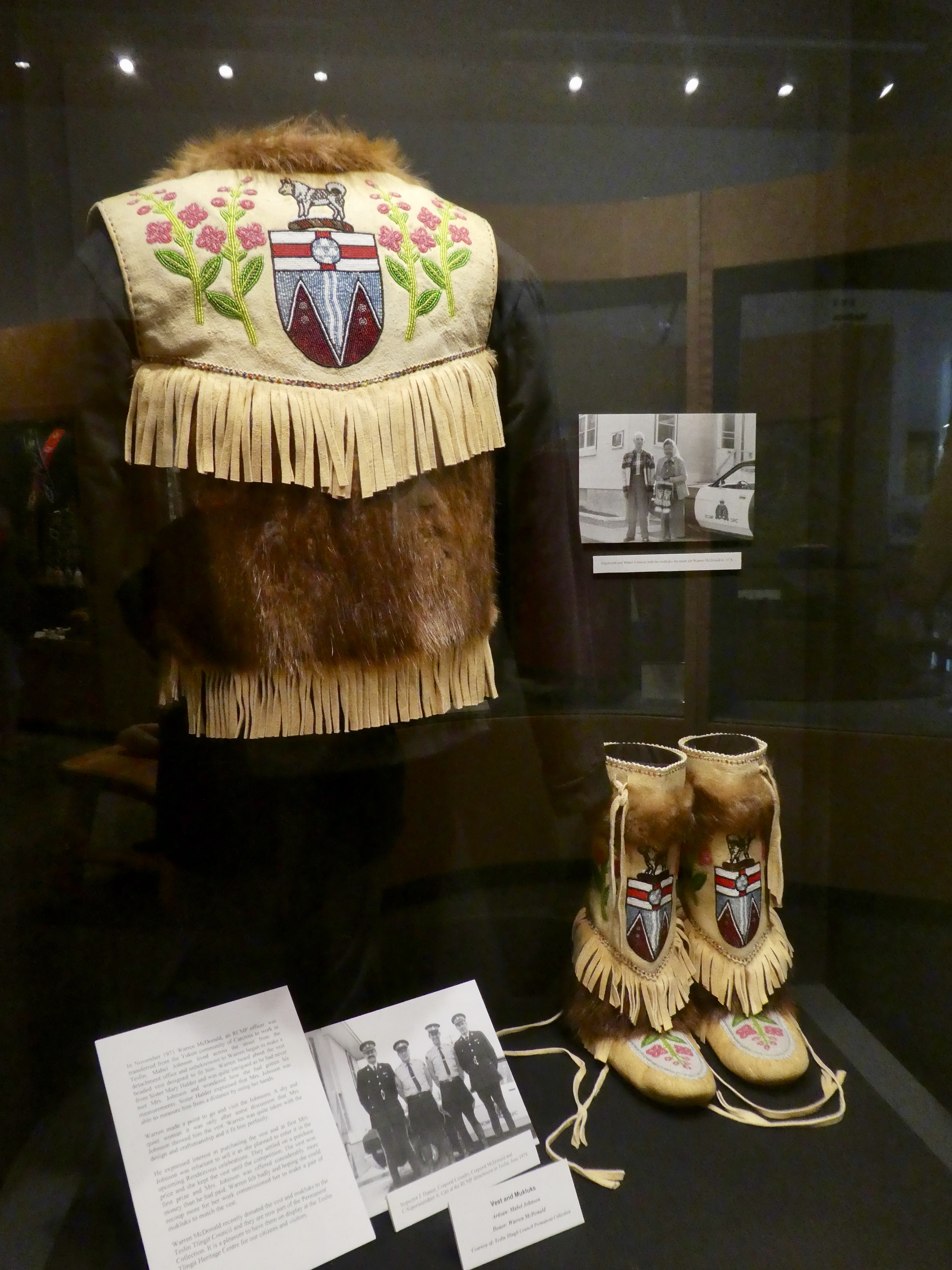
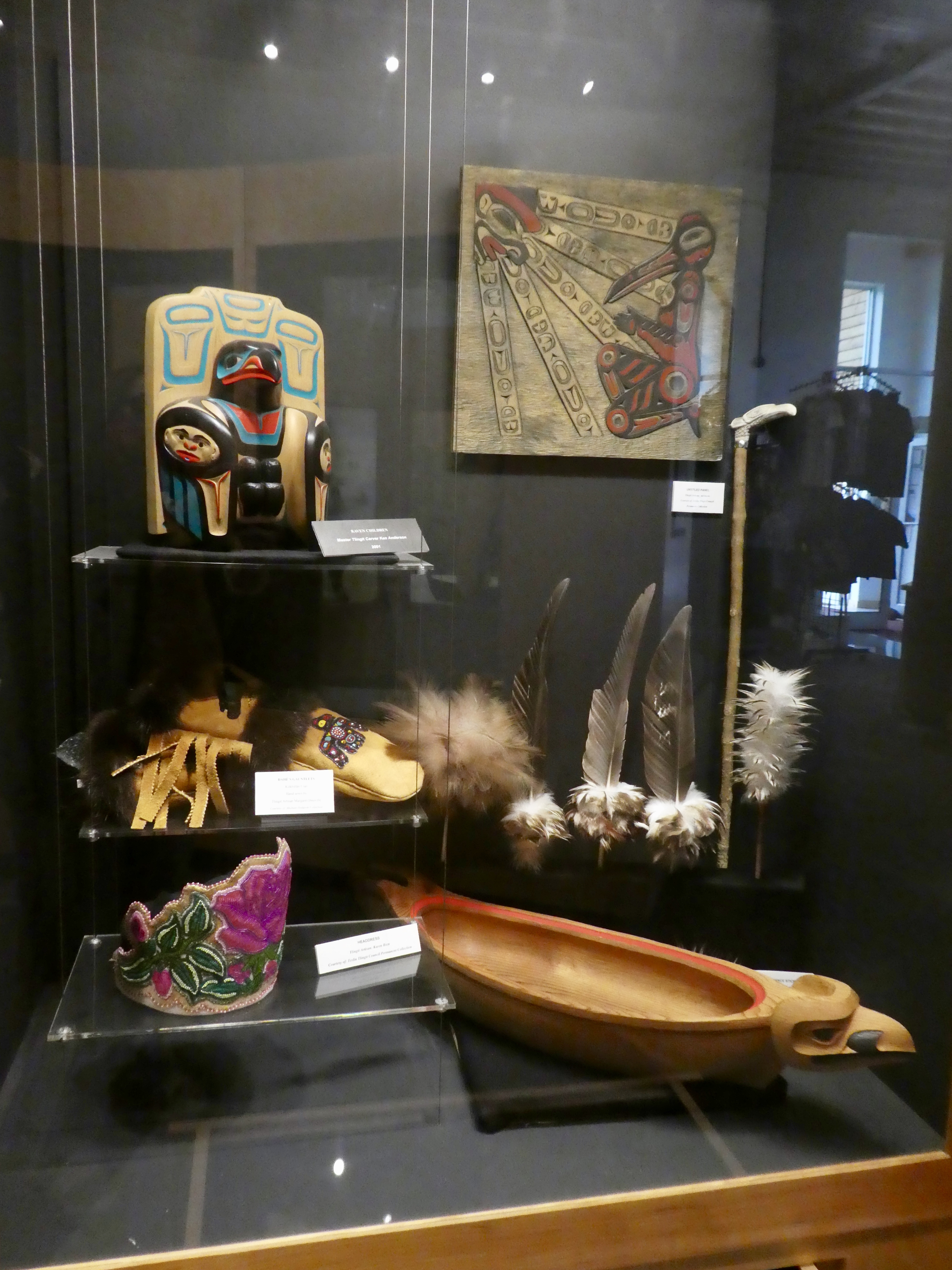
These masks are fantastic.   Remembering that -40 temperatures are common, we really liked the furs.

Such beautiful work. Love the boots

We would love those boots in our Colorado mountains.   Of course, other items are also needed.

All made carefully by hand

Things must be hand made.   No nearby shopping mall.   There were so many fascinating exhibits and we hope you visit here.   But the setting of the Heritage Center is breath taking.

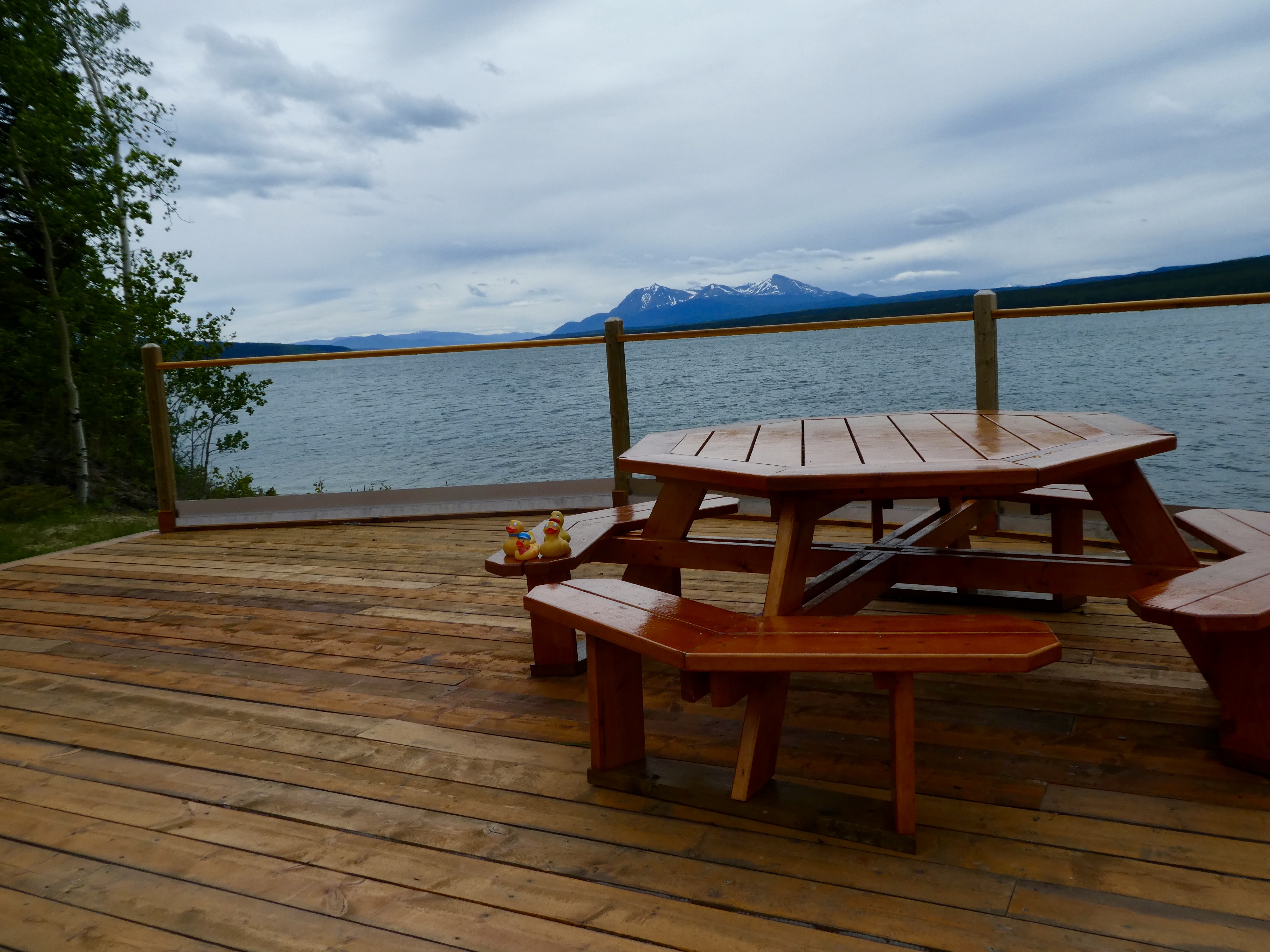
Picnic anyone?

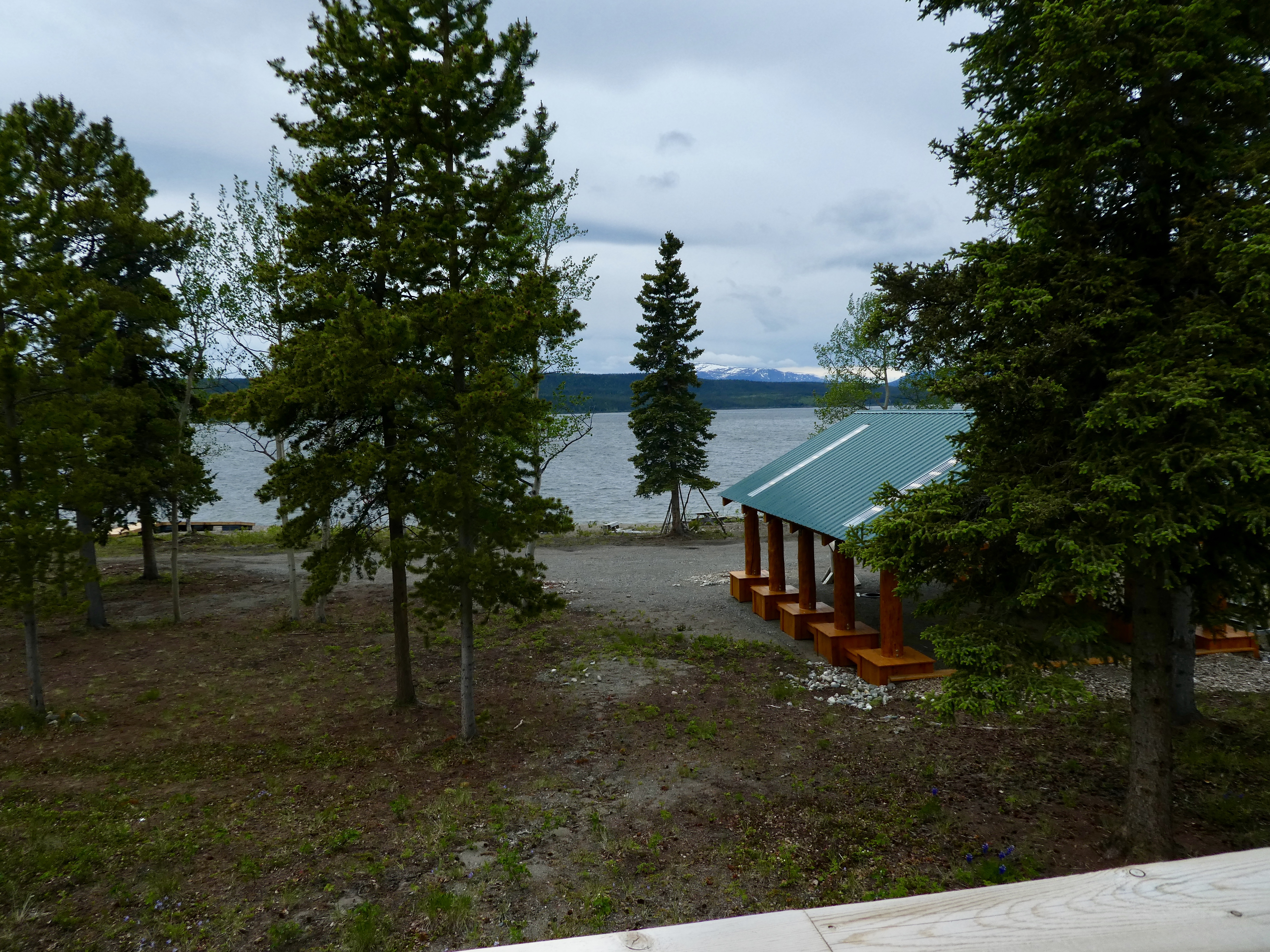
From the back of the center, you can access the lake and enjoy a picnic.   Or just sit and admire the view.   The view from the side is equally beautiful.

Another picnic area by Teslin Lake

And the building has beautiful large windows for year around viewing.   We love these canoes.

Canoes

Aren’t they large and attractive?   Too bad no canoe rides for us today.   So many picnic tables and areas here.

So many picnic areas

This is perfect and so many people can enjoy the lake and the beautiful Yukon views.   Ducks and humans are so in awe of the beauty of nature here in the Yukon.   A few miles south of Teslin Tlingit Heritage Center is Nisutlin Trading Post and Motel.

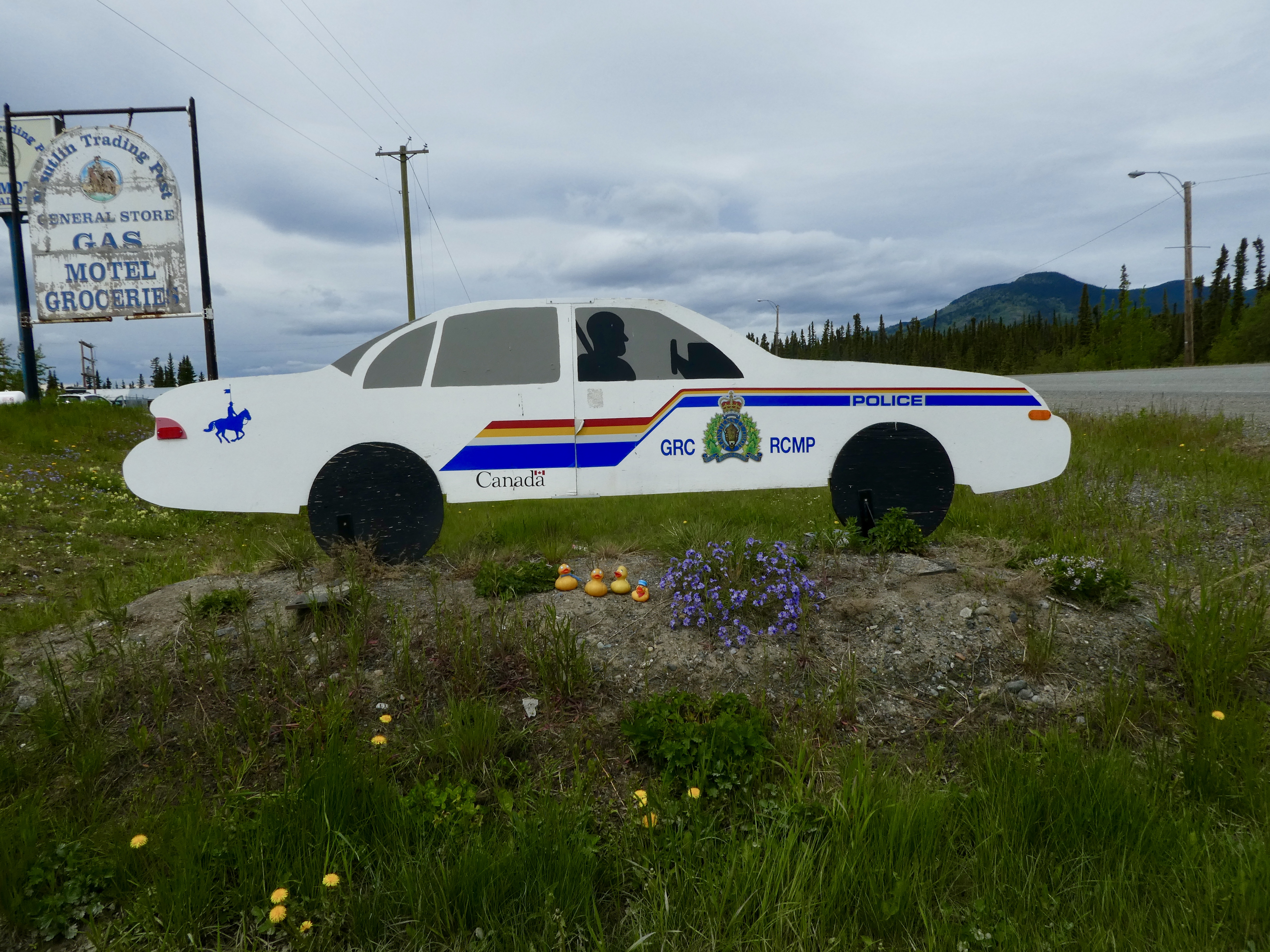
Police car. Officer looks so real

Of course, we, like most drivers on the Alaska Highway, stop for gas at every gas station.   You never know if the next one is open or if it has gas.   This police car is great and the officer looks so real from the road.   No speeding here.   We loved our time outside today, but our favorite Canadian was enjoying a snack along the road.

Happily eating

We saw a bear about every day and we always pulled over to watch them eat and admire them.   This drive is beautiful.   And both relaxing and invigorating with the incredible Yukon scenery.

Yukon Transportation Museum with Colorado Traveling Ducks

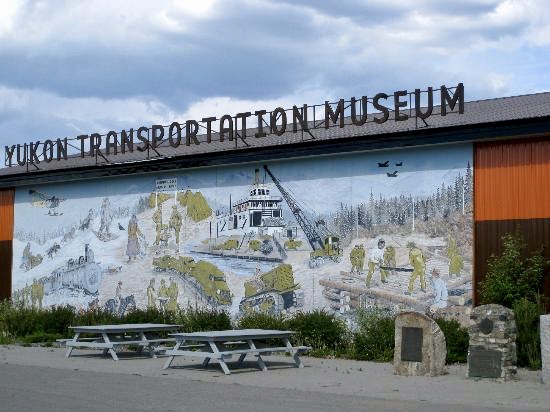
A short walk and here we are at the Yukon Transportation Museum.

Yukon Transportation Museum in Whitehorse

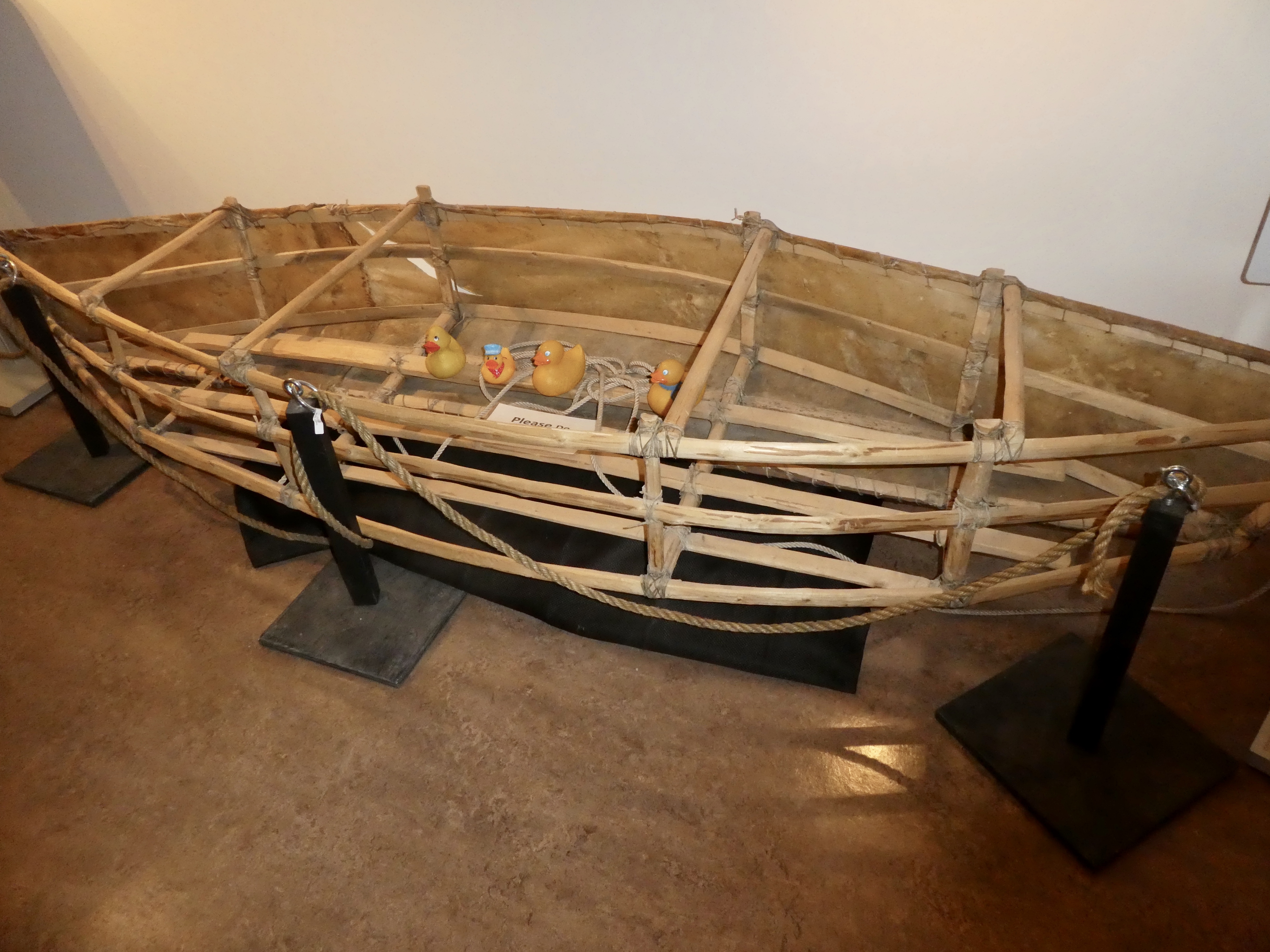
After paying our admission fee, we wandered through the gift shop.   Soon you will see what we bought.   Focusing on transportation here, we immediately were attracted to this canoe.

A canoe. Introducing Yukon Duck

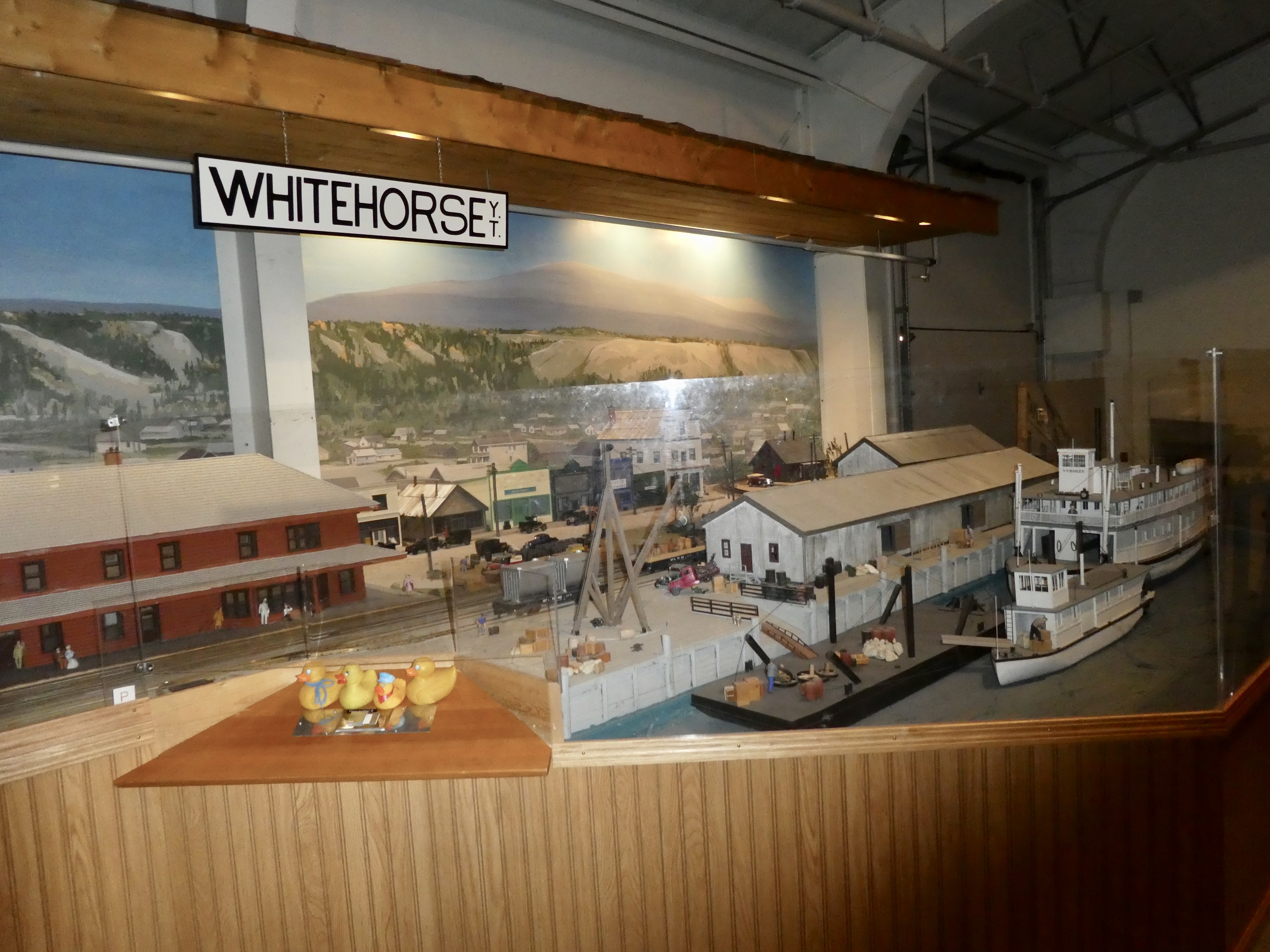
Yes, there are now 4 Colorado Traveling Ducks.   Our newest addition is an engineer for the train, but we call him Yukon Duck.  During the Klondike Gold Rush of 1898, the train connected Whitehorse on the Yukon River with Skagway, Alaska.

Train between Whitehorse, YT and Skagway, Alaska

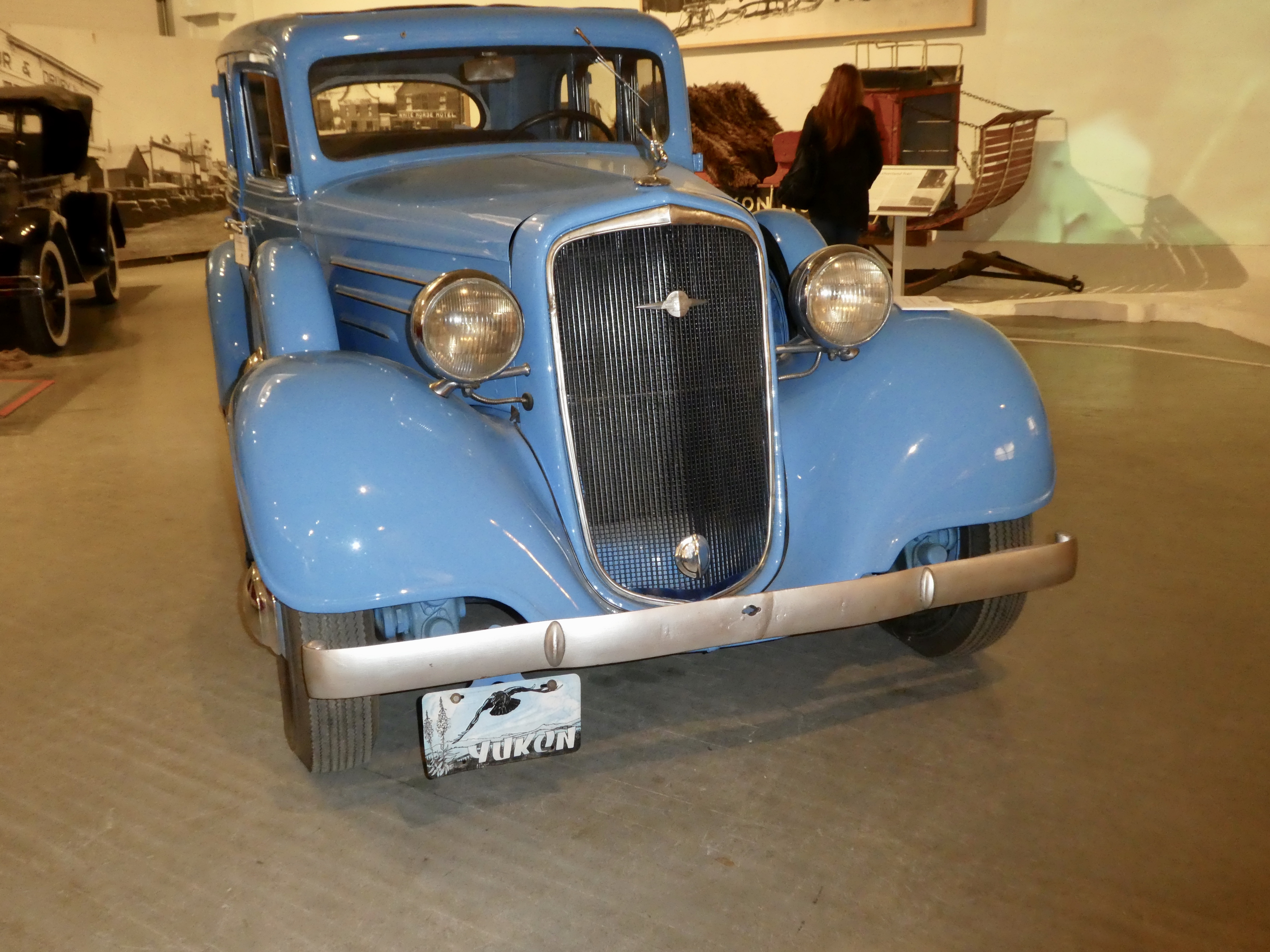
Skagway is a little over 100 miles away and is a seaport.   Miners needed to get supplies and gold was often shipped out of Alaska.   Here is an early car for the Yukon Territory.

Early car

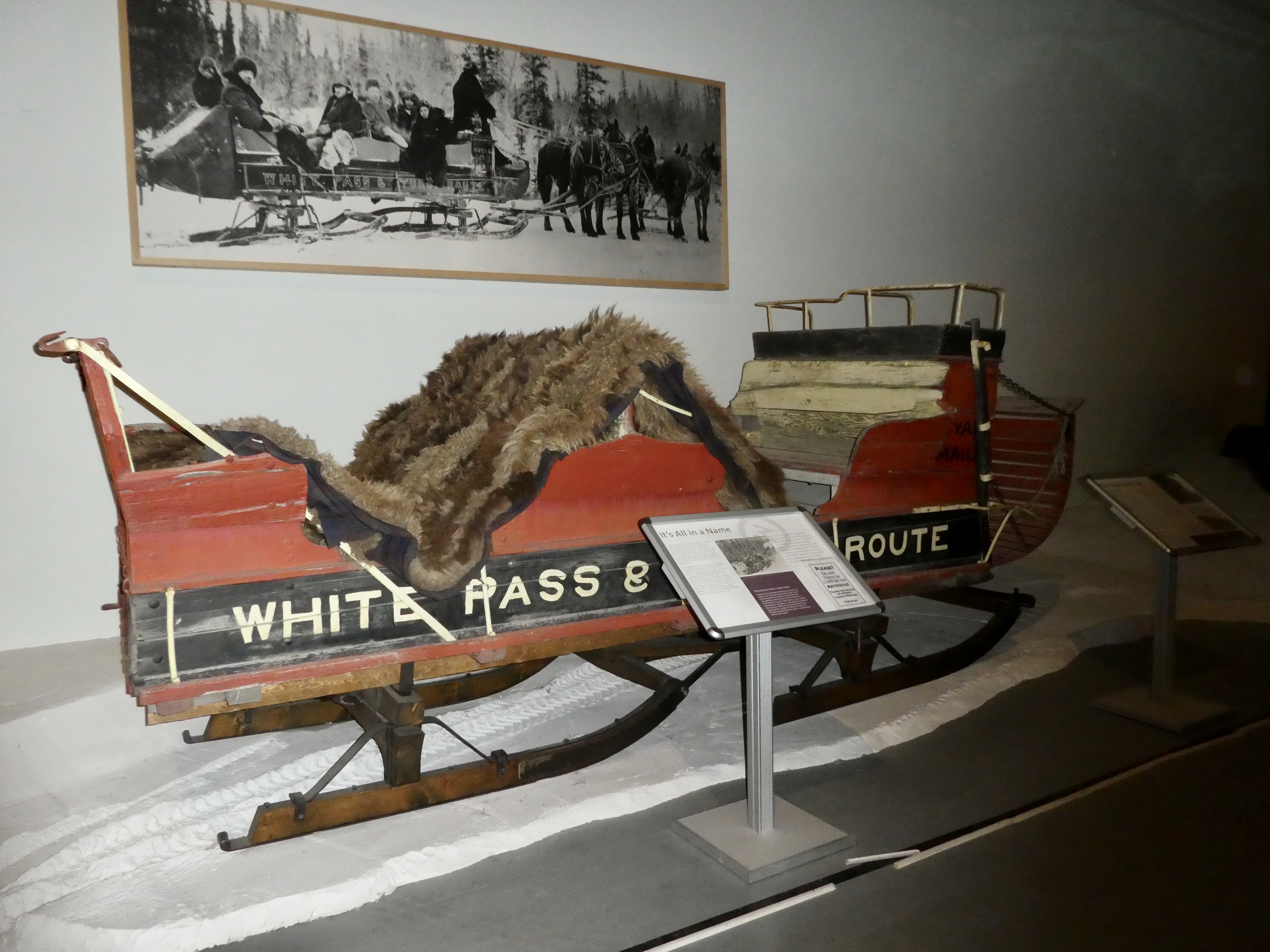
Most of the year it is winter here, so travel was done by sled.

Sled for traveling

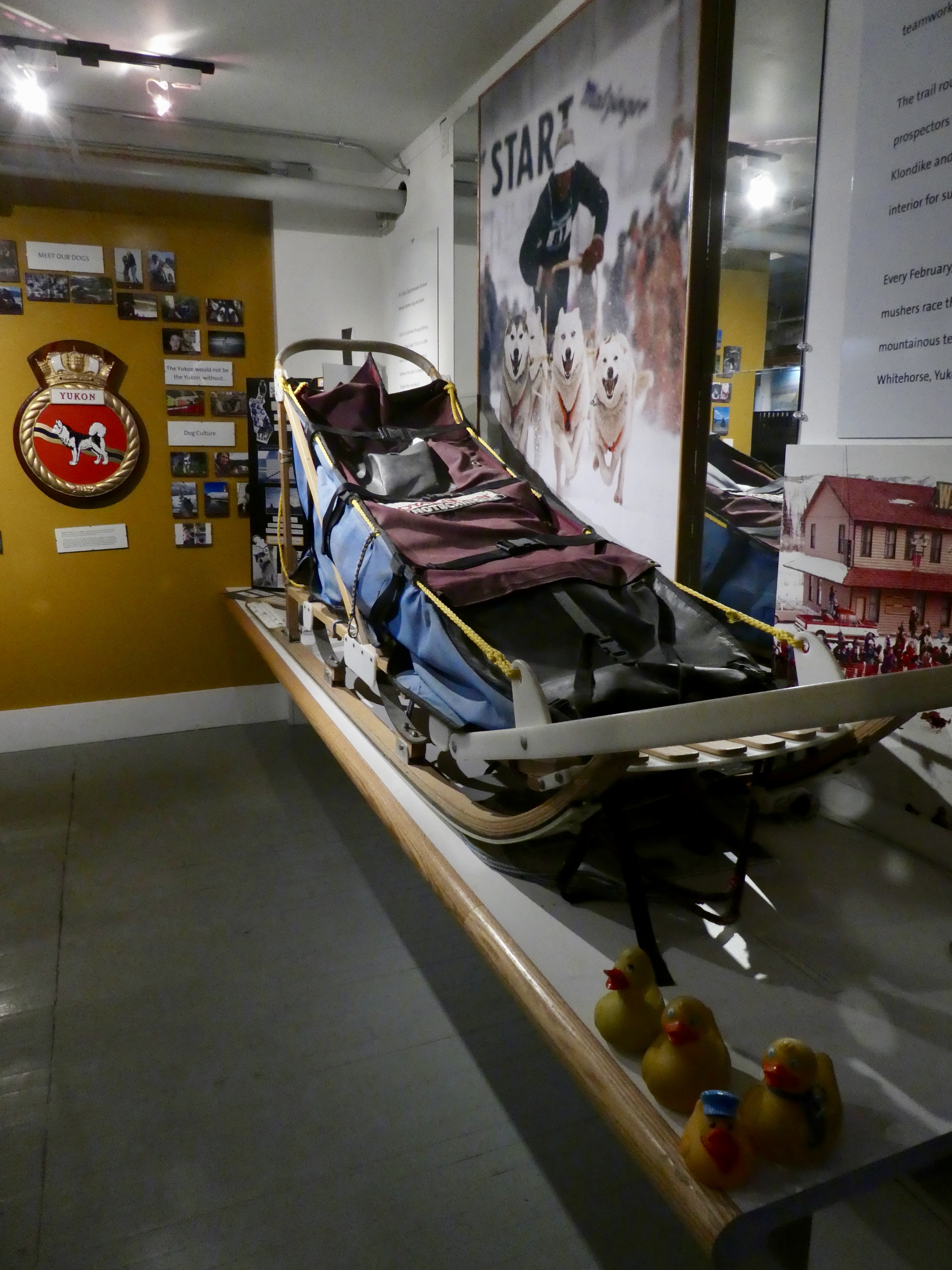
Conditions were not safe for travel if the temperature was -40 (the same temperature for F and C).   How to know if it was too cold?  A bottle of Perry Davis Pain Killer was placed outside by the window.   If the bottle became frozen, it was “too damn cold for man or beast.”  We ducks don’t want to be out when it is -40.   There is more than one famous dog sled race in the area.   This sled is from the Yukon Quest.

Sled for Yukon Quest

The race is between Whitehorse, YT and Fairbanks, Alaska.  The starting point alternates between Whitehorse and Fairbanks each year.   Spectators can see the beginning one year and the finish the next.   This exhibit was something new to us.

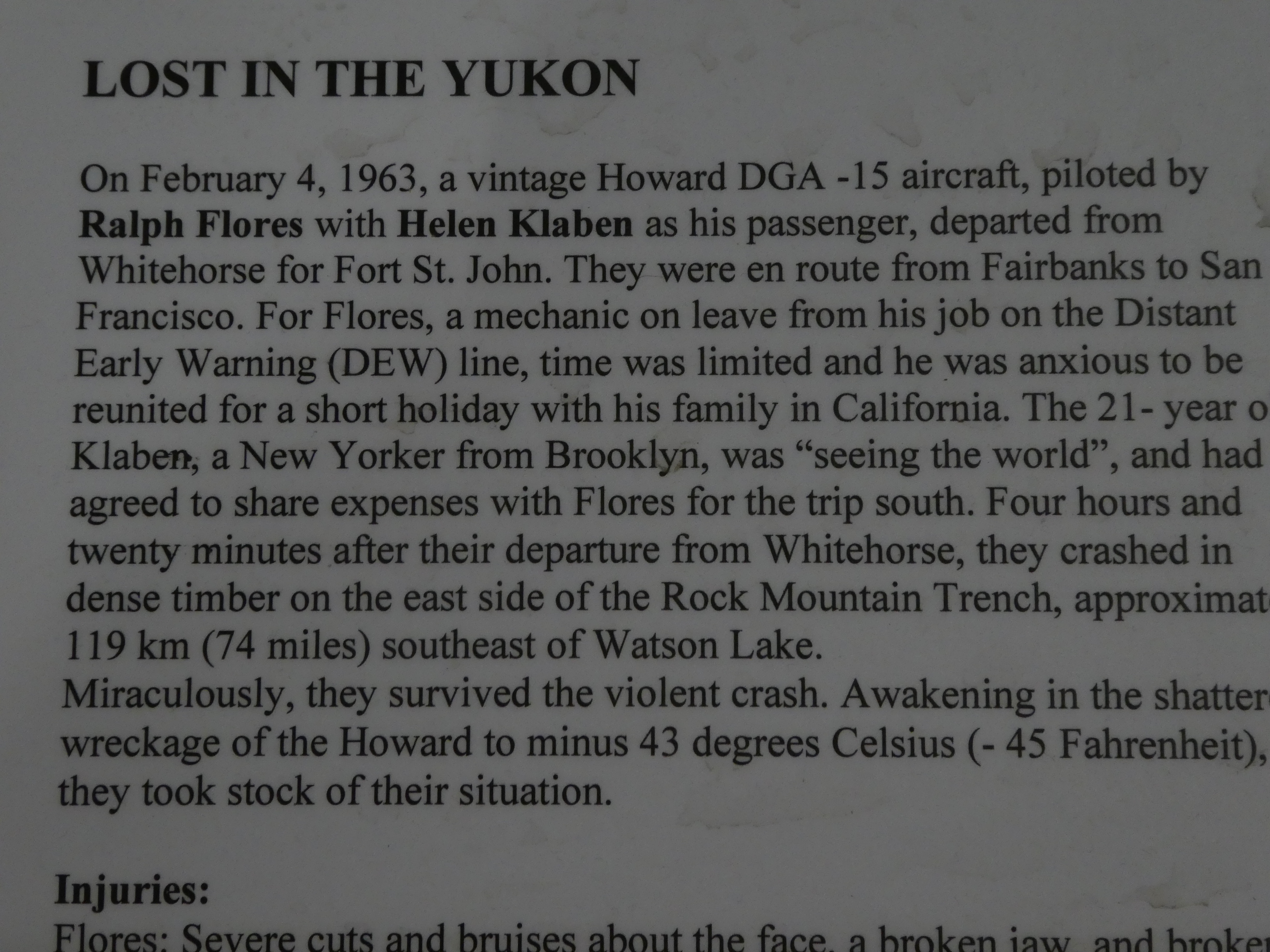
Lost in the Yukon

Lost in the Yukon was about a plane crash in 1963 and a great survival story of two people.  These two, Ralph Flores and Helen Klaben survive for 49 days.   They endured painful injuries, starvation, weeks of -40 or colder, and the long dark Yukon winter.  In March, Ralph stomped SOS on a frozen snow covered swamp.   The SOS was seen and they were rescued March 26, 1963.   In 1975 Helen wrote a book about the survival titled, “Hey, I’m Alive”  A movie was also made in 1975.   Maybe we will watch it this winter??  In the airplane hanger, we admired many airplanes.

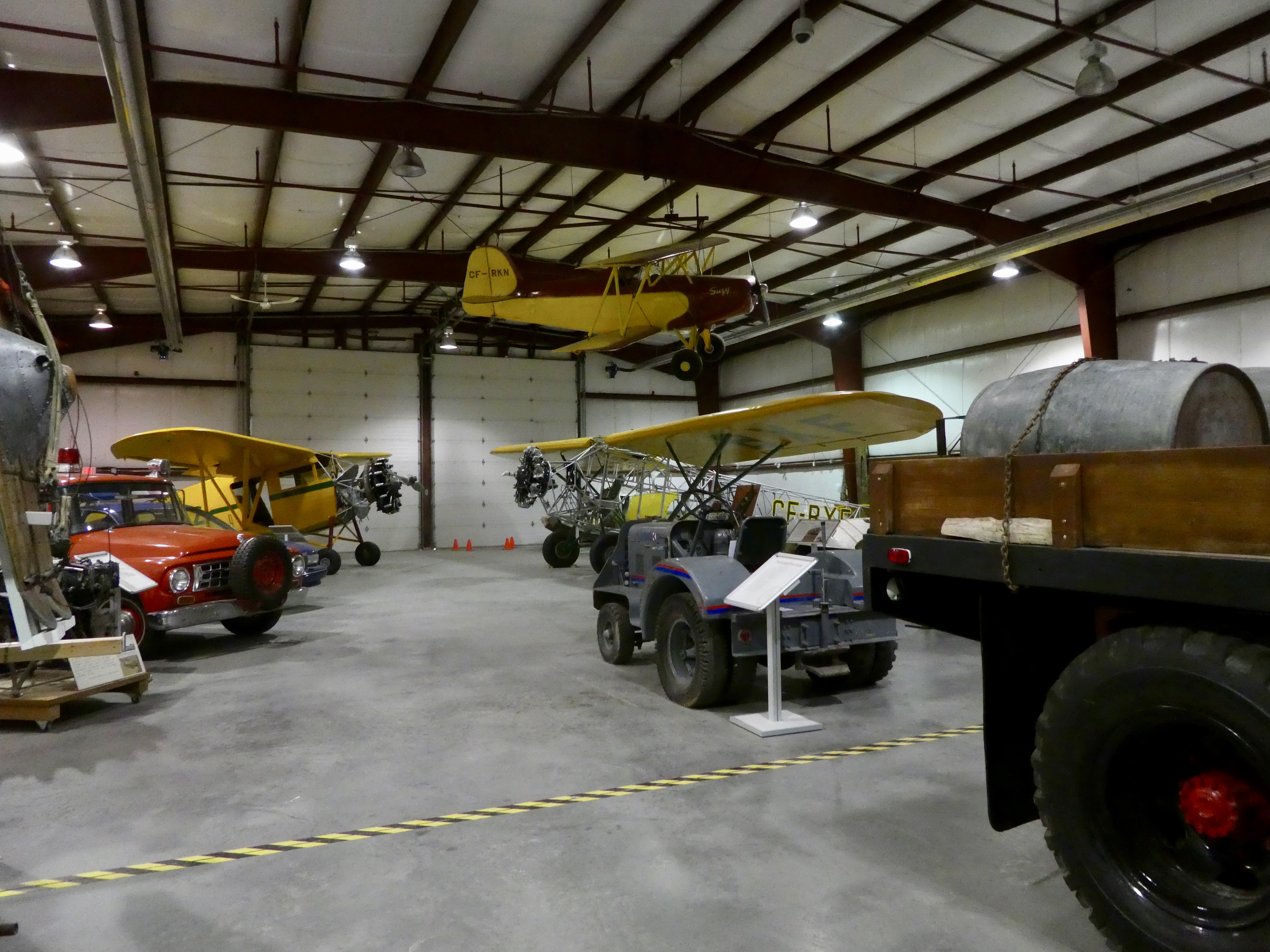
Planes in Yukon Transportation Museum

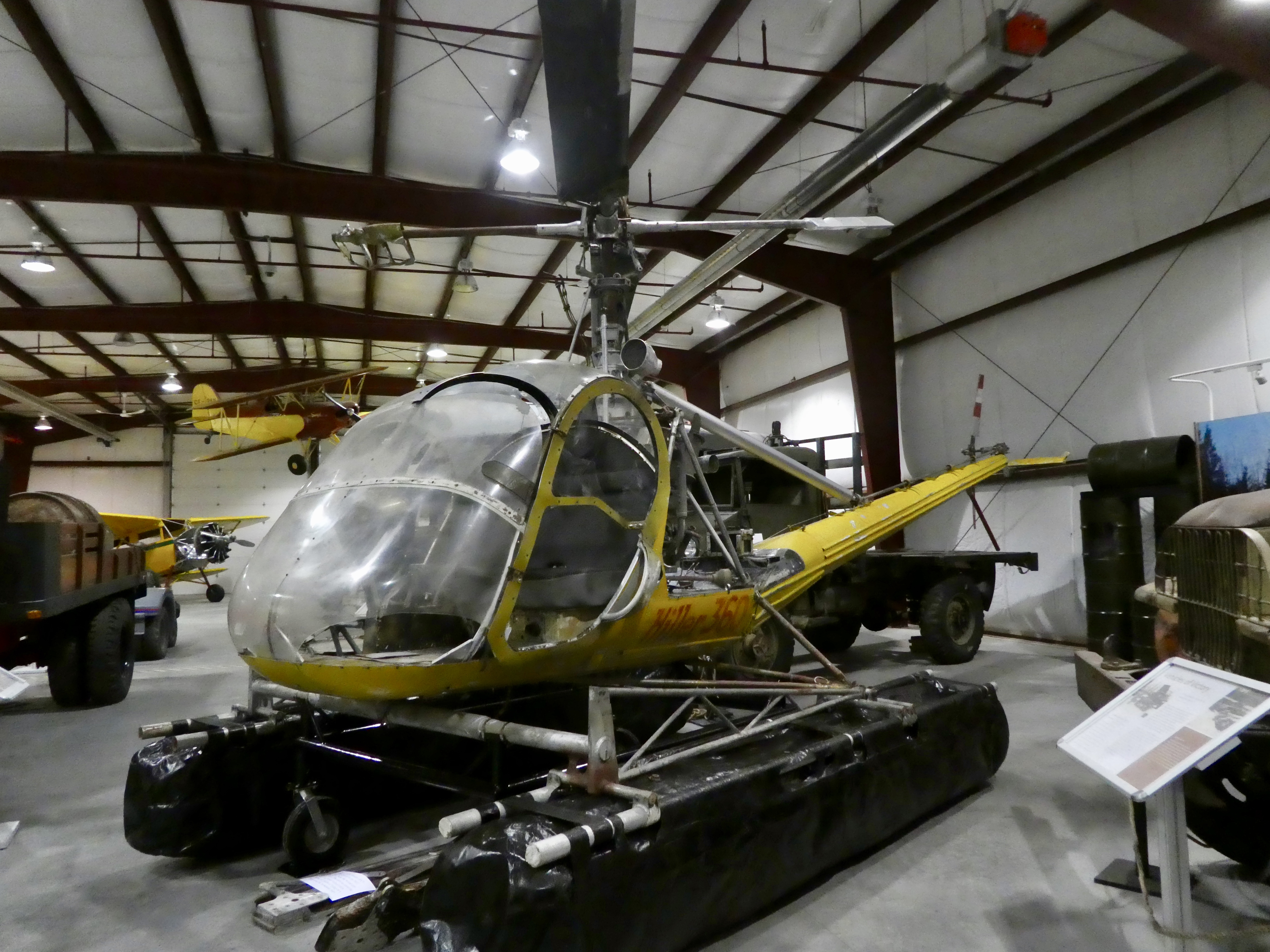
Flying is often the only way to travel in the far north.   We liked this helicopter, also.

Helicopter. Yukon Transportation Museum

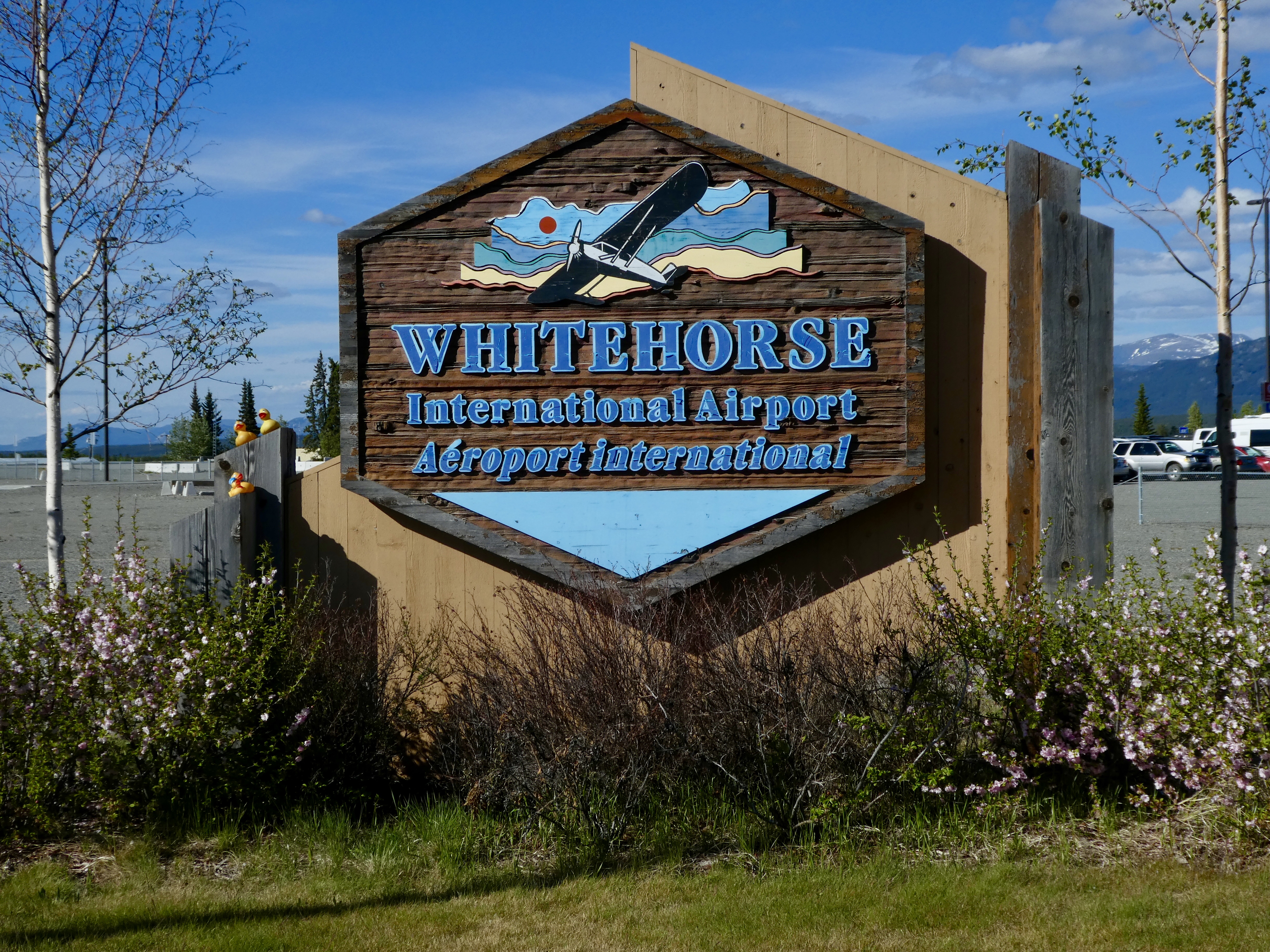
The Yukon Transportation Museum is next to Whitehorse International Airport.

Whitehorse International Airport

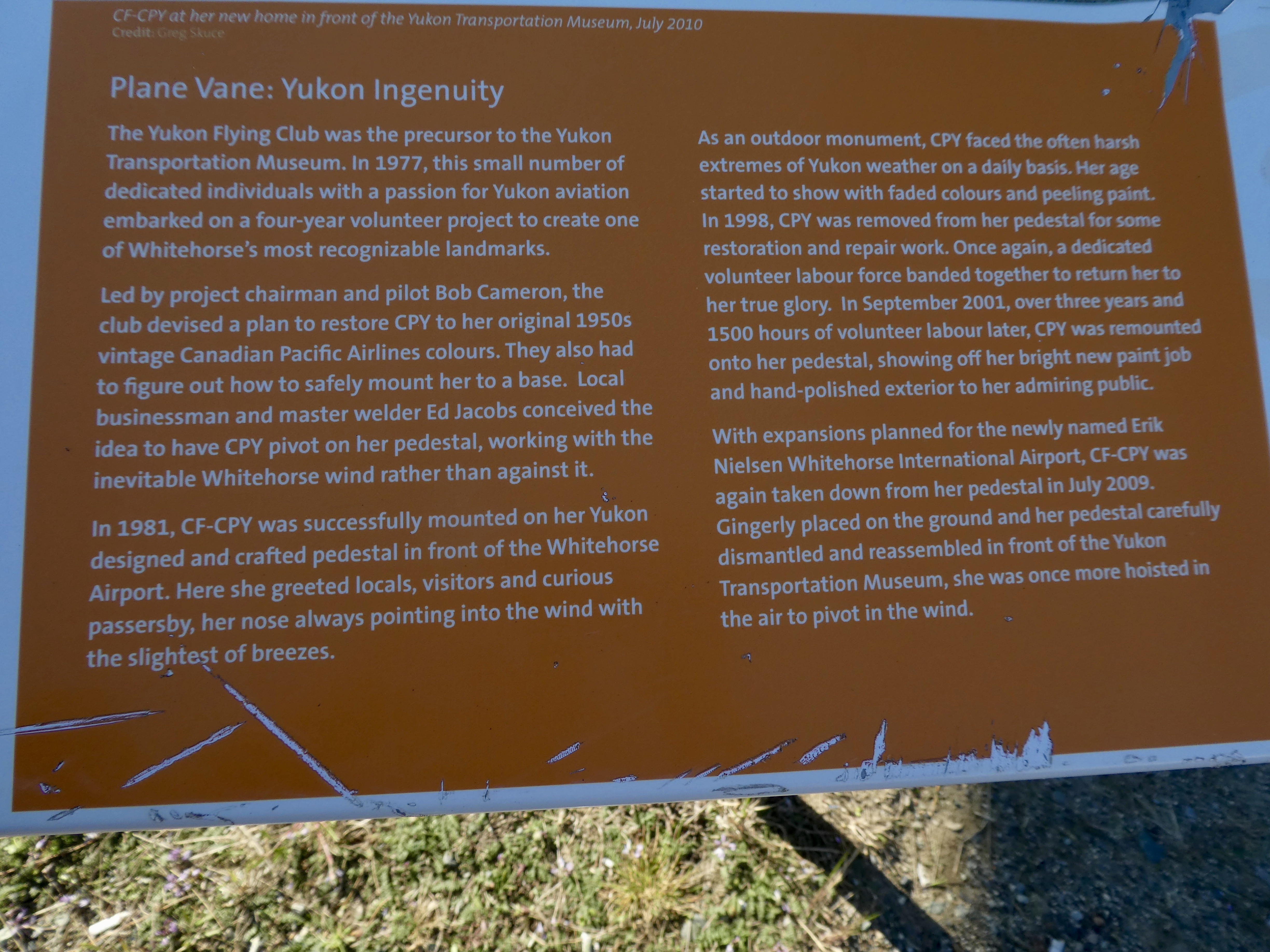
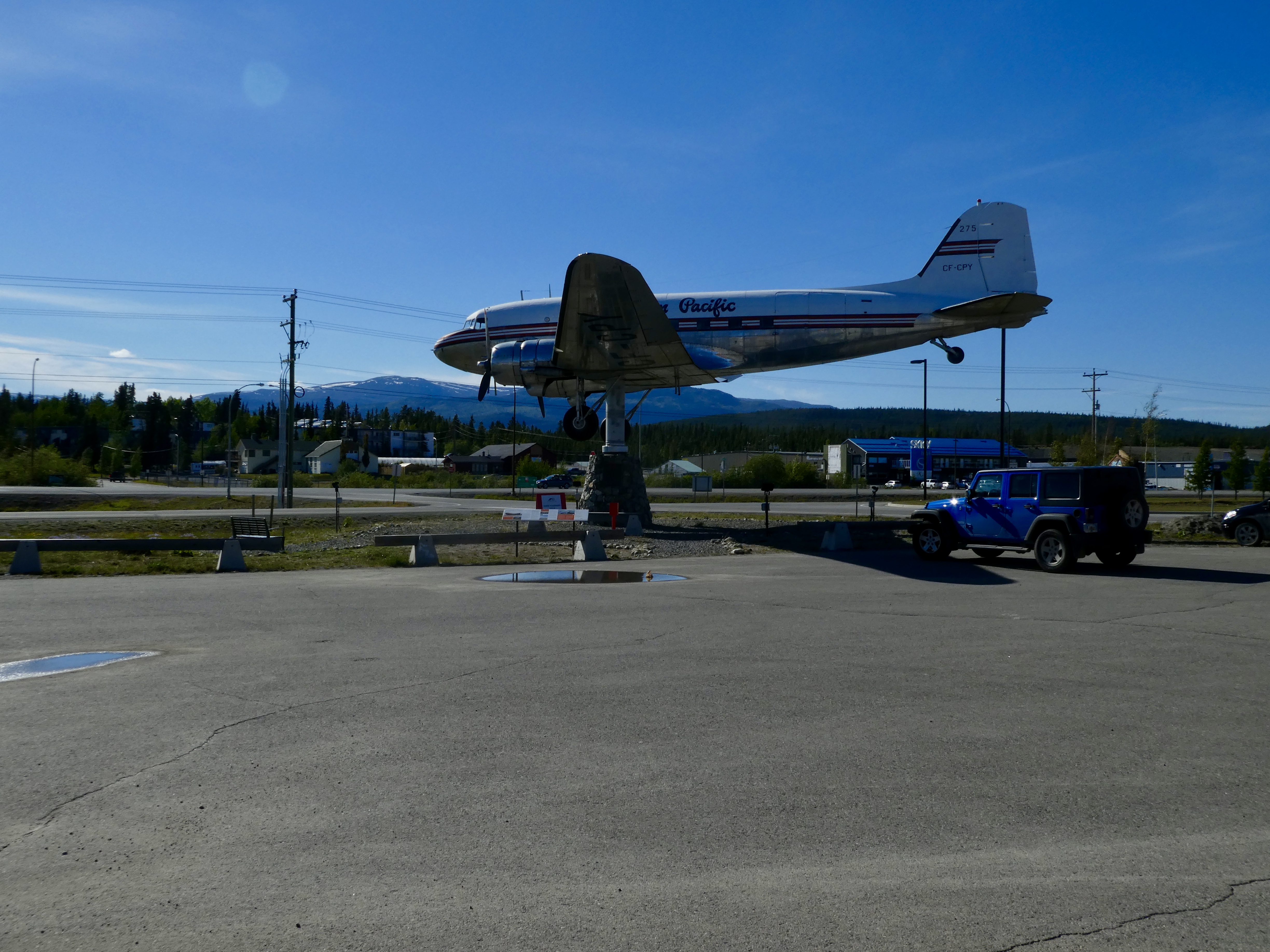
We we impressed by the Plane Vane.

Plane weather vane

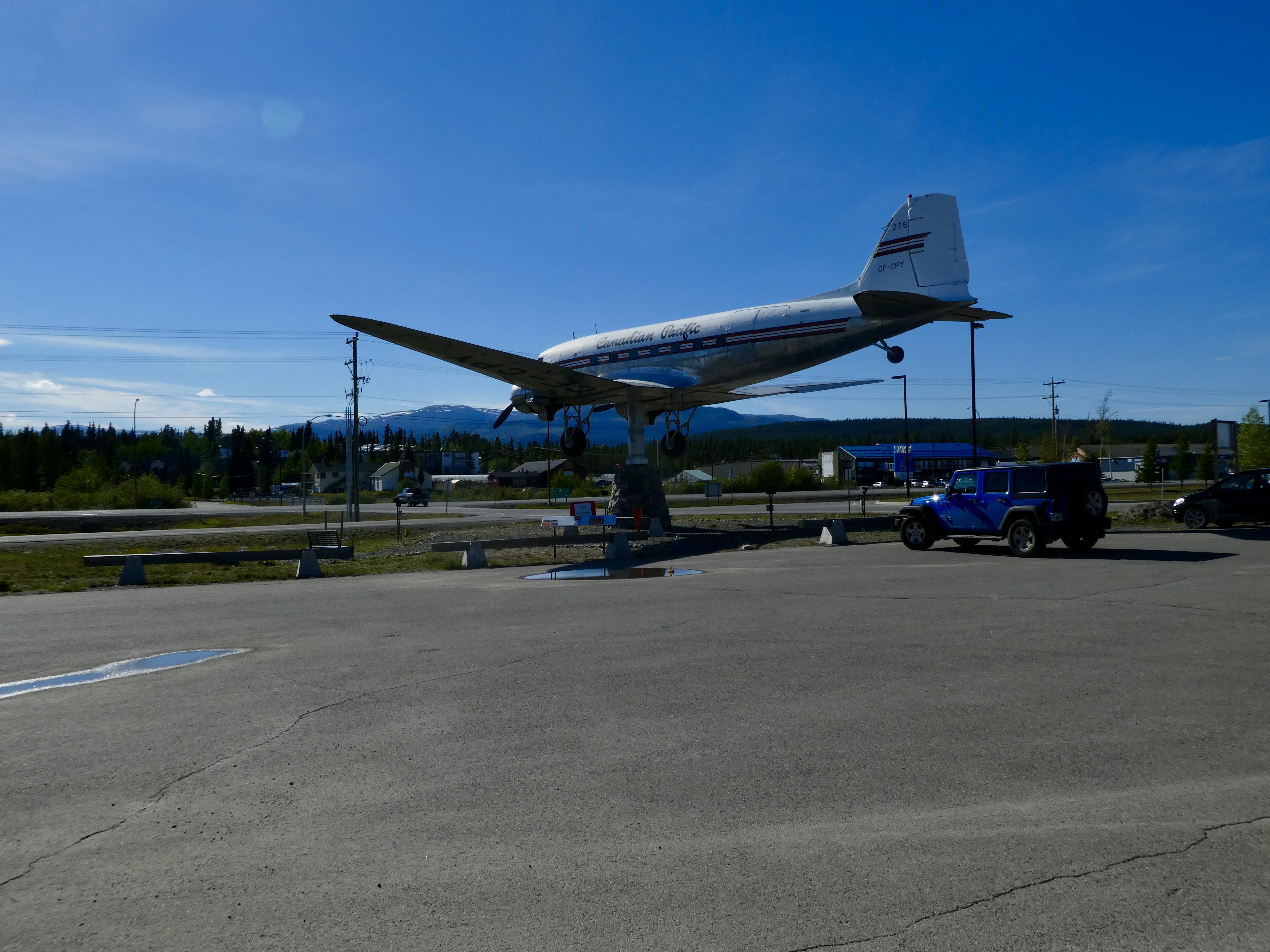
This sign explains it best.   A real plane with a long history and now a weather vane.   We want to show you that it really does move.   It was not very windy the day we visited, but you can see from these 2 photos that the plane did move.

Side view of plane


Wind moved plane

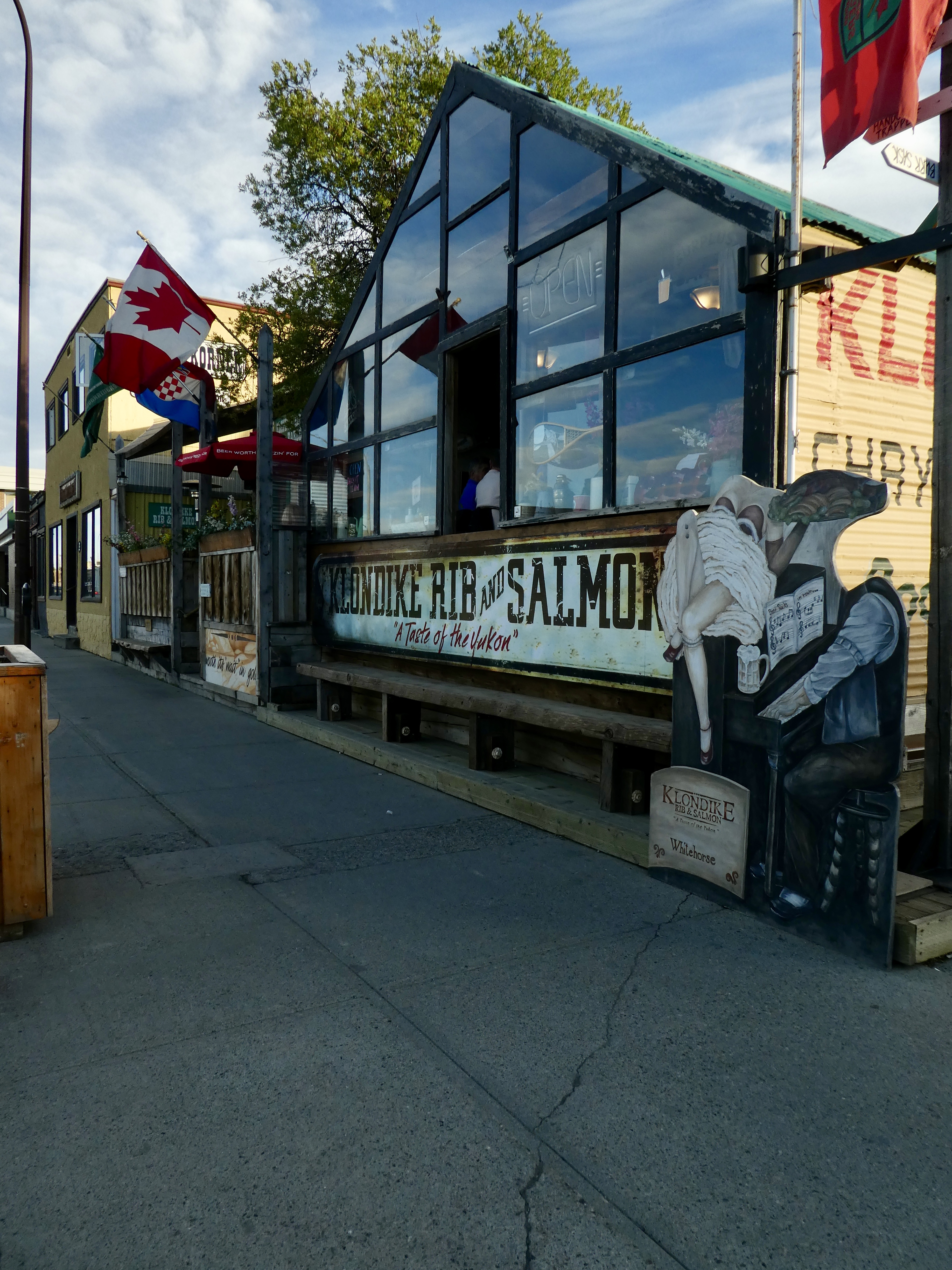
According to http://www.RoadsideAmerica.com   this is the world’s largest weather vane.  We are getting hungry.   After a great day in Whitehorse, it is time for dinner.   Klondike Rib and Salmon restaurant is next to our hotel.

Klondike Rib and Salmon

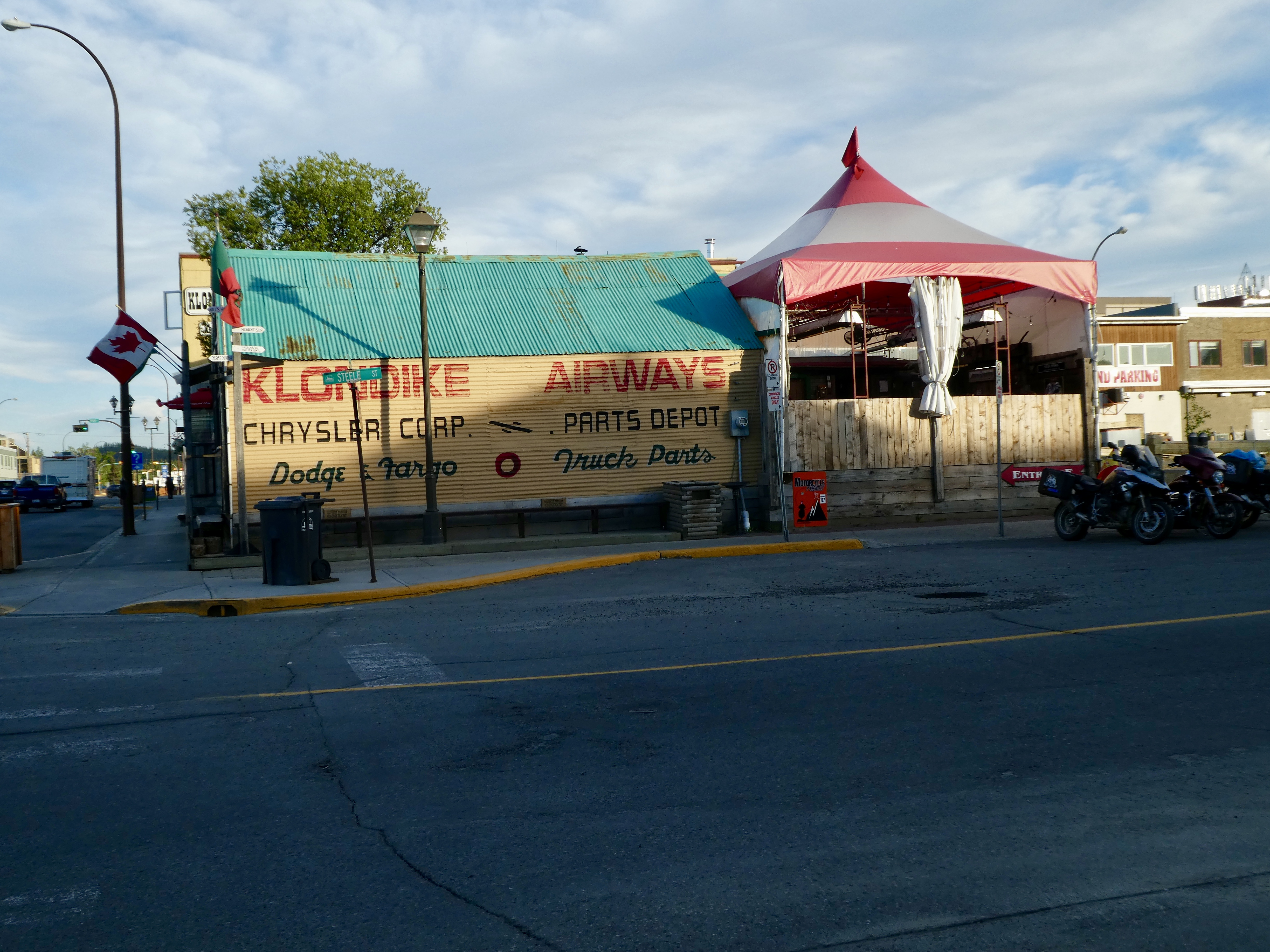
The reviews were great and the food was fantastic.   The humans ordered salmon and also halibut.   Both were very fresh and cooked to perfection.  Humans and ducks loved it.   The restaurant is housed in the 2 oldest operating buildings in the Yukon Capital.   The menu had a history of the building.  The dining room was originally opened as a tent frame bakery called, MacMillian’s Bakery around 1900.   The main building was Klondike Airways, a mail and flight business.   In the 1930’s the building was used as a carpentry shop and coffins were constructed for a mortuary in downtown Whitehorse.   Today we have this Quaint Little “Northern Klondike Theme Restaurant.”  With winters of -40, this little wall tent buttons up in the fall and goes into hibernation each year until Mother’s Day.  We ducks like menus that tell us about the restaurant, so this is a favorite with us.

Klondike Rib and Salmon tent area

There really is a tent area of this restaurant.   Great in the summer, but too cold in the winter.  This was a great day in Whitehorse, and we welcome Yukon Duck to our duck family.

Whitehorse Museums with Colorado Traveling Ducks

We are still in Whitehorse, Yukon Territory.   We love it here.   This morning we wandered around town, found a grocery store and purchased snacks for our room.   Yep…Humans and ducks love to snack.  Now we are heading to Yukon Beringia Interpretive Center.

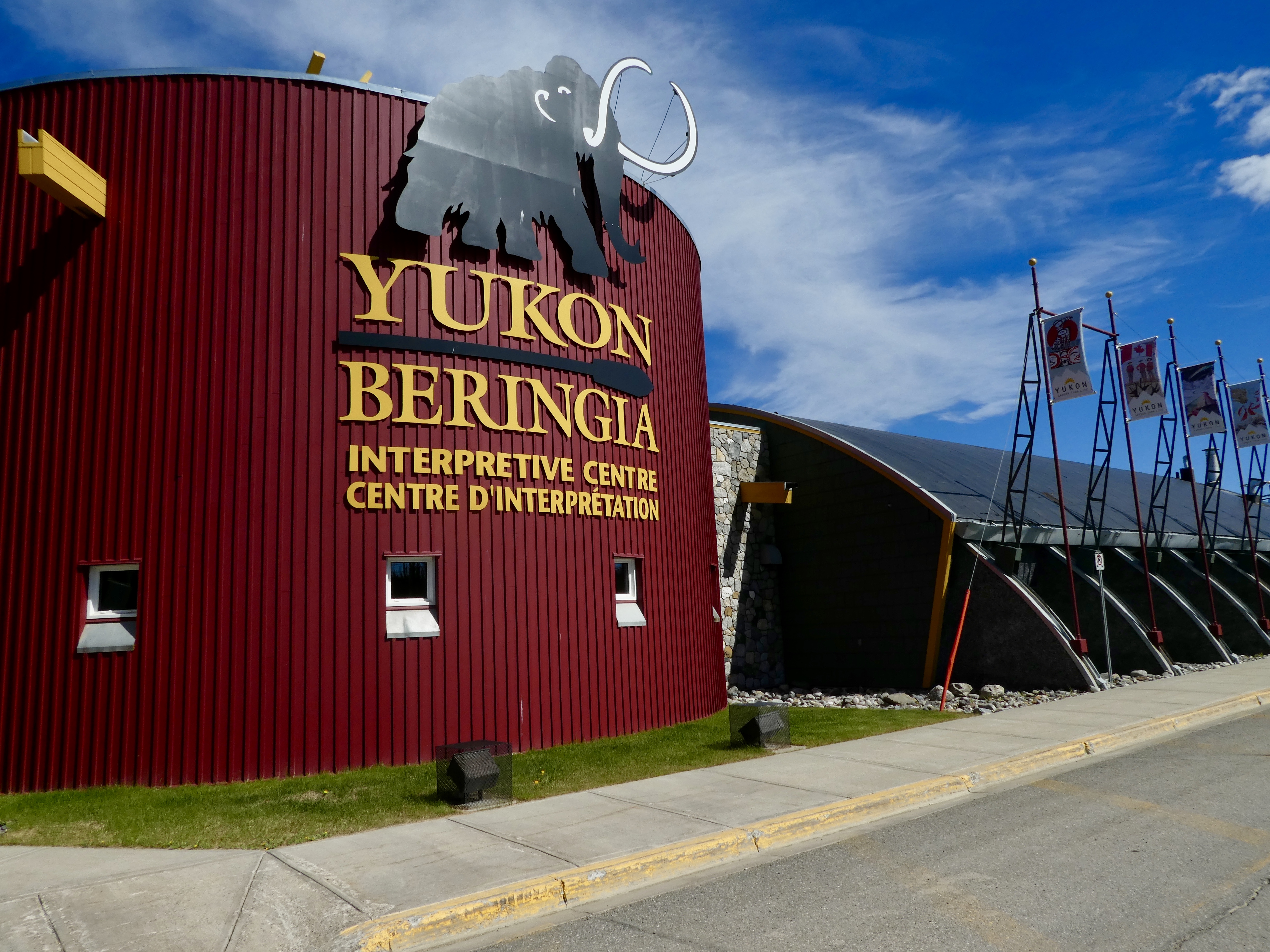
Yukon Beringia Interpretive Center

This is a great cultural and historical place.   We didn’t go inside, we just looked at and admired the vast outdoor exhibits.   Never enough time to do everything.  Meet Woolly Mammoth.

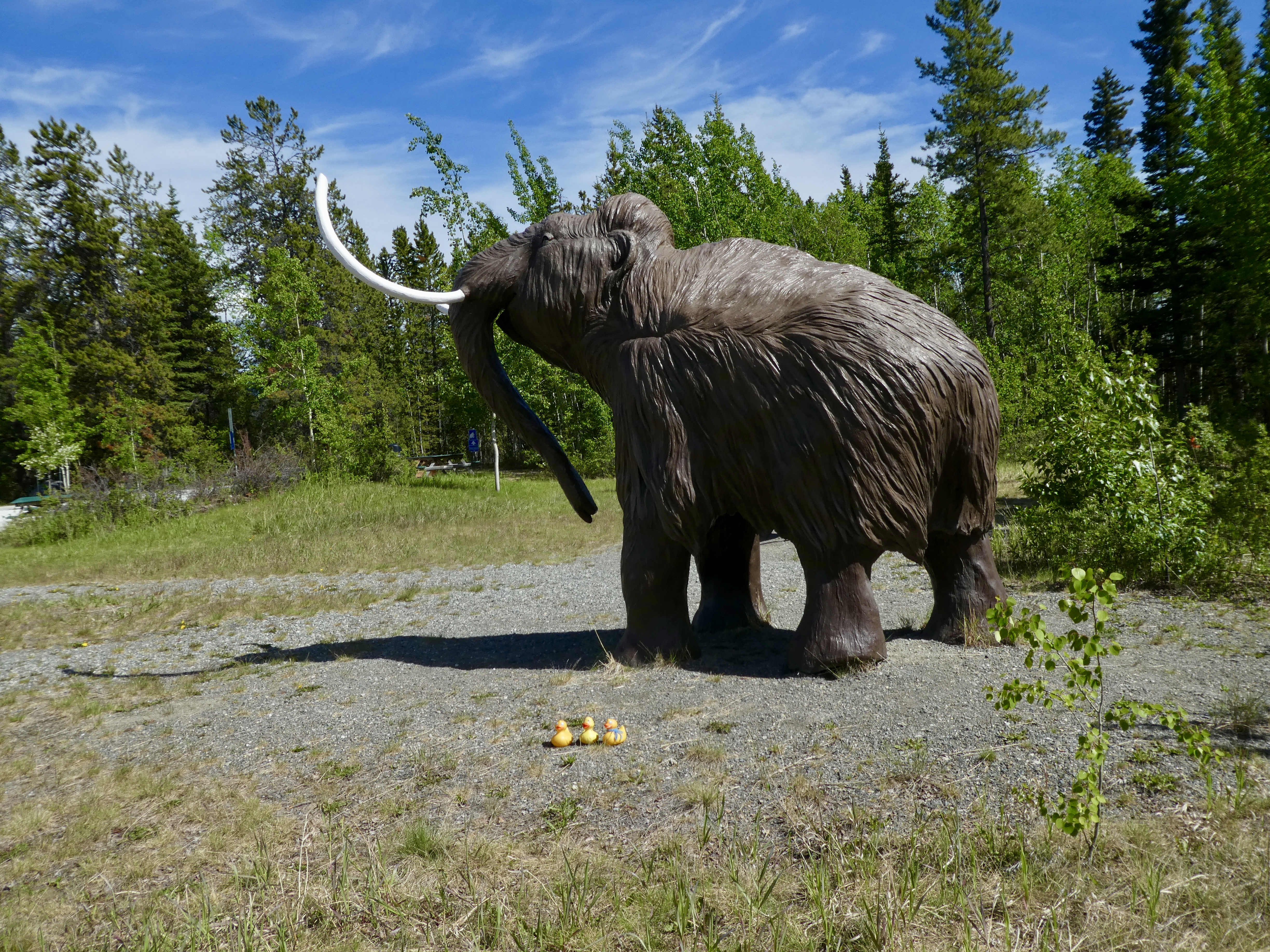
Woolly Mammoth

He used to live here.   Doesn’t he remind you of a shaggy elephant with smaller ears?   I think so.   Oh look.

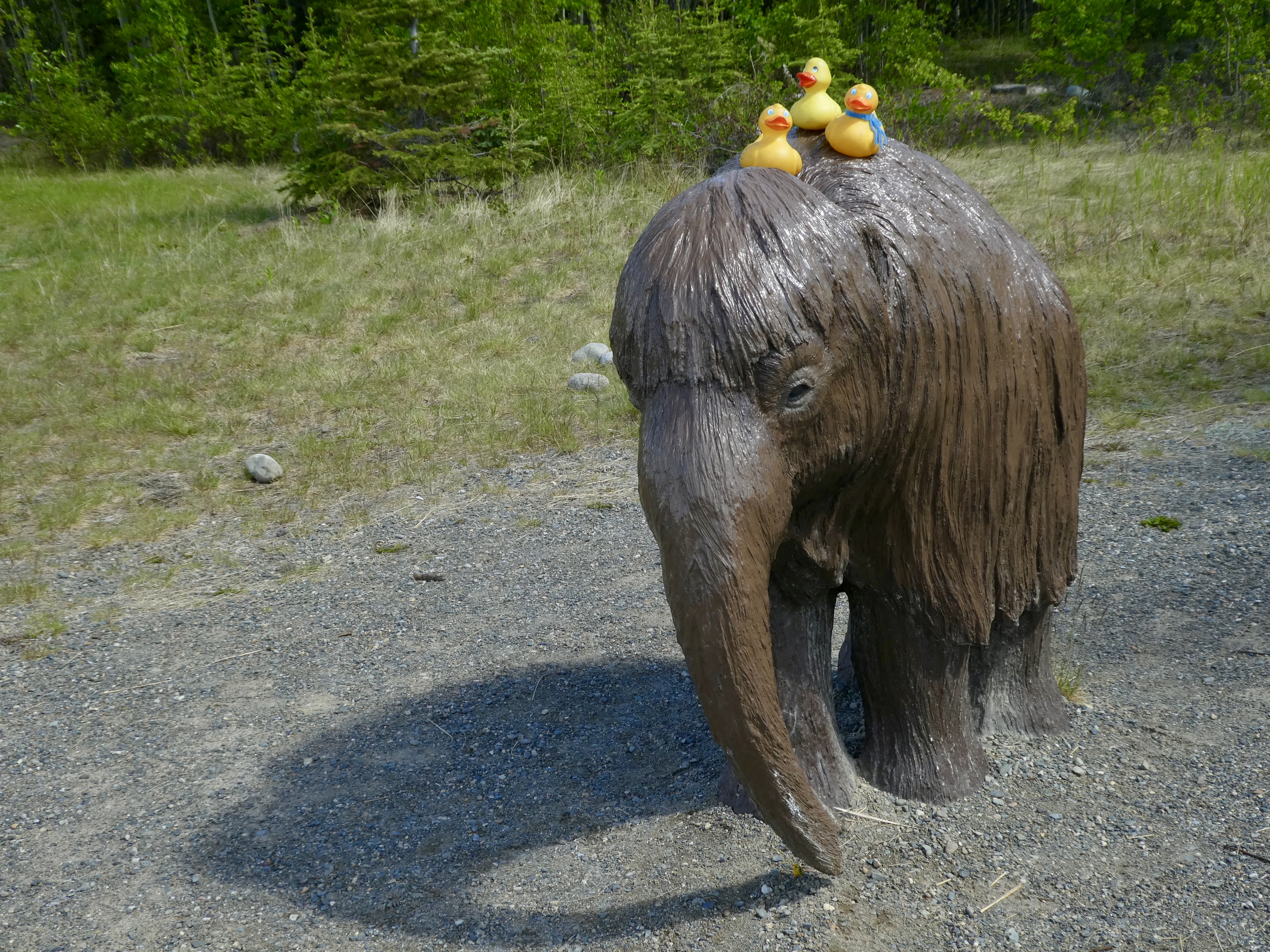
Young Woolly Mammoth

This Woolly Mammoth is closer to our size.     Can we go for a short ride little Woolly Mammoth?   Apparently not.   The sign says carcasses of Woolly Mammoth have been discovered here.  Carcasses, complete with hair, skin and internal organs have been preserved in the Beringia permafrost.   These giant animals lived here tens of thousands of years ago.   They survived periods both hotter and colder than today’s temperatures.   This is the biggest beaver we have ever seen.

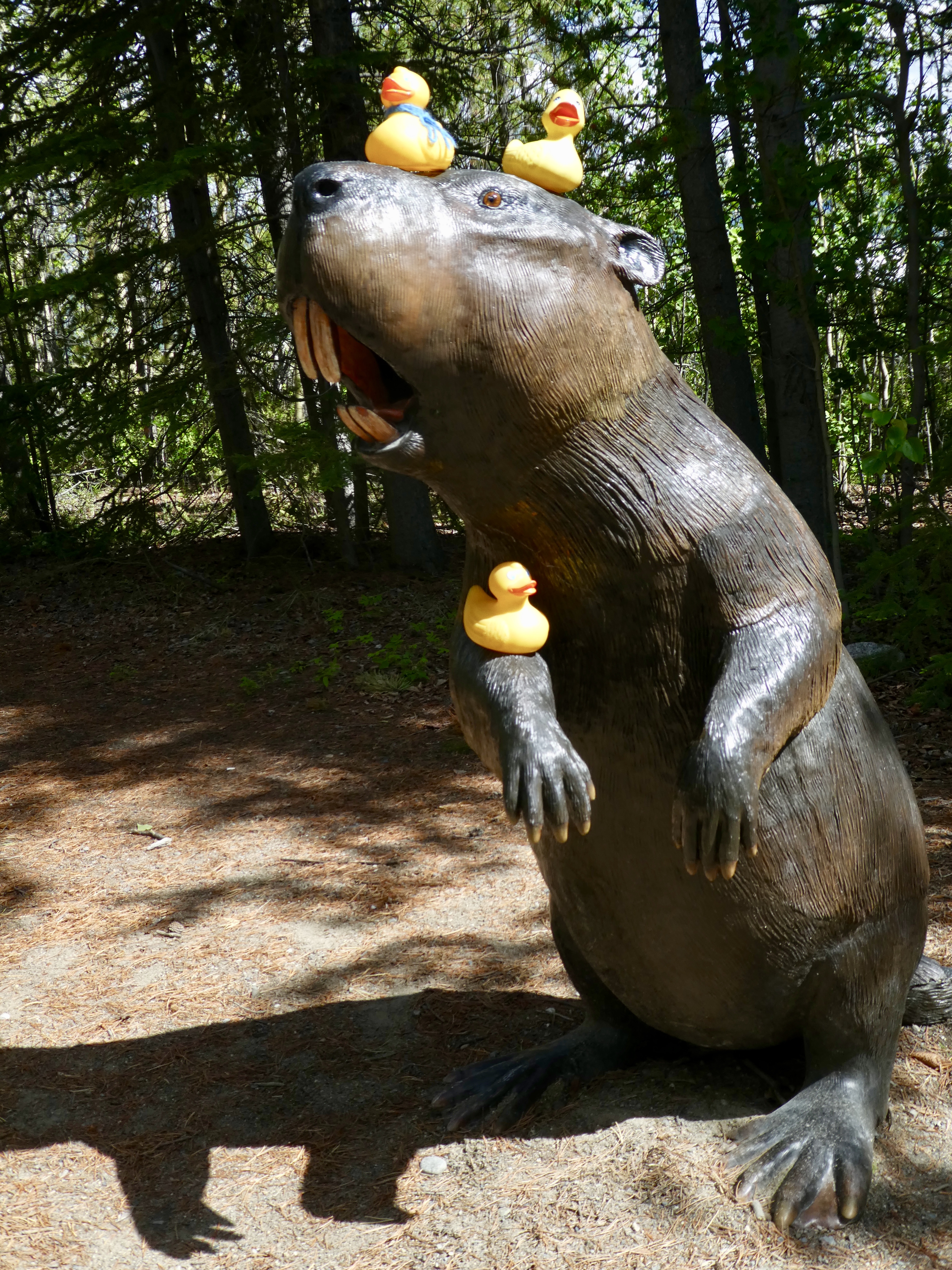
Giant Beaver

These giant beavers lived in the Yukon’s Old Crow basin region.  They were 8 feet (2.5 meters) tall and weighed 480 pounds (218 kilos).   These giant beavers roamed this area 130,000 to 60,000 years ago.   Now what is this?

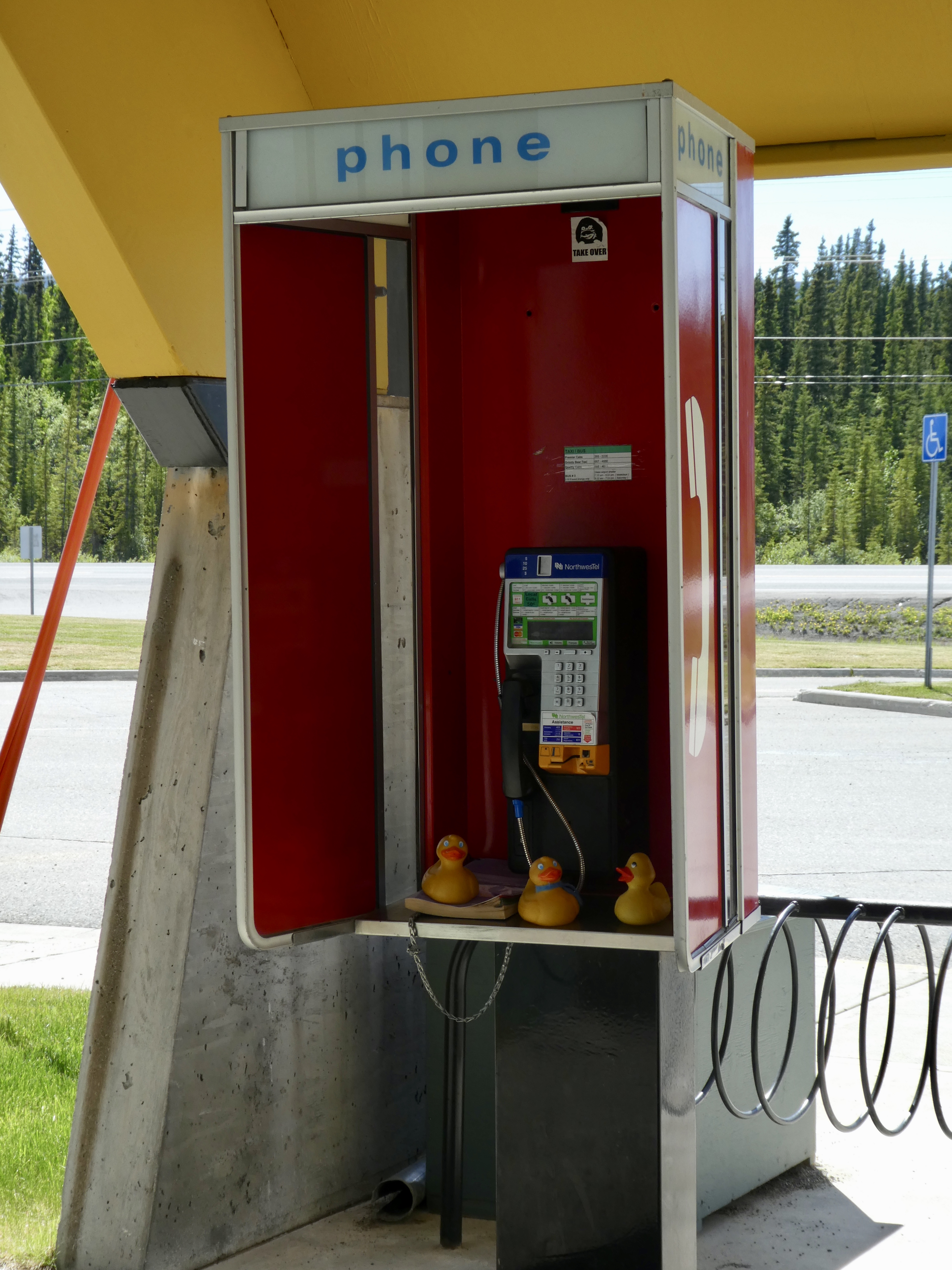
Pay phone

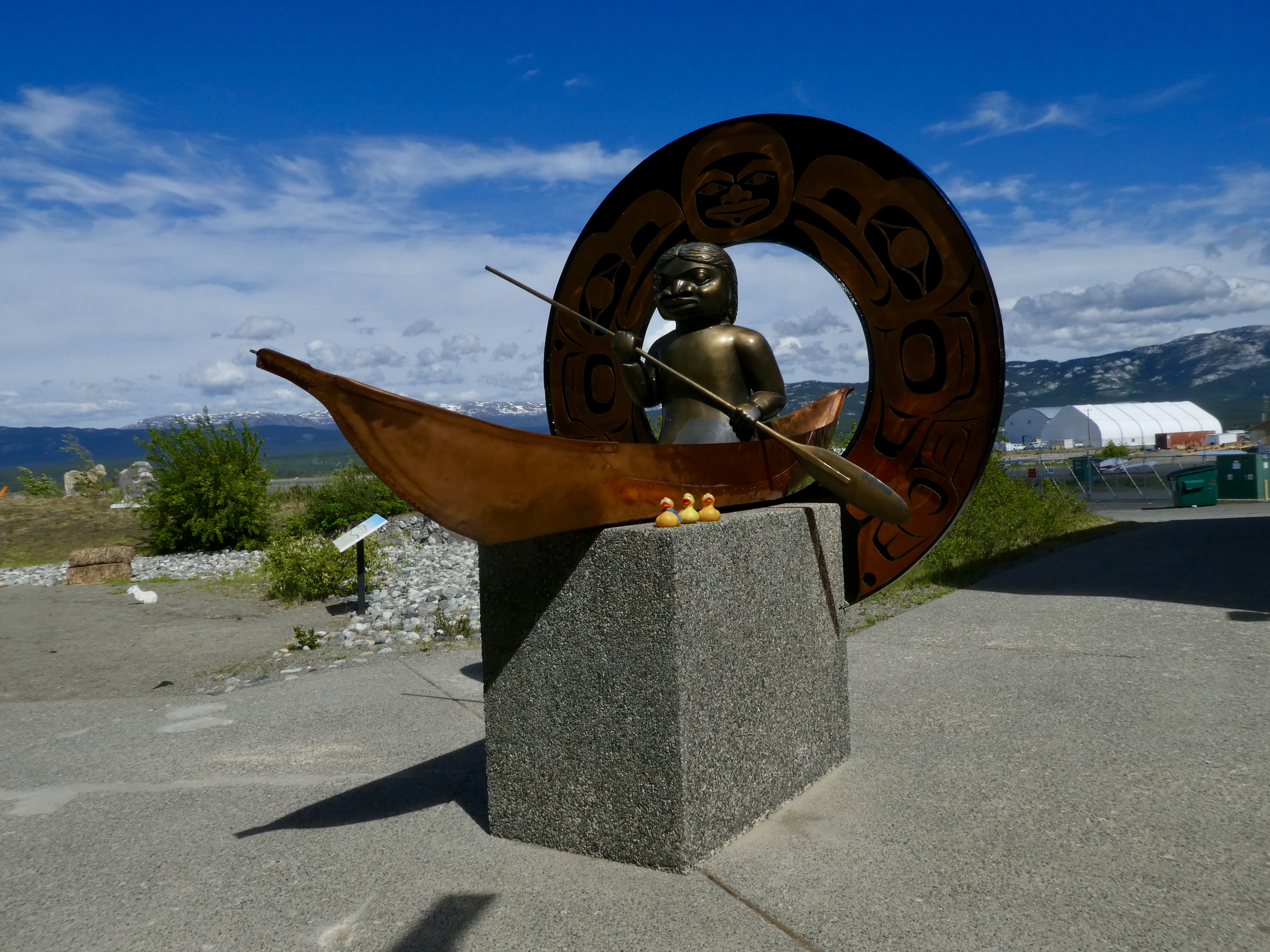
A pay phone?   Once very popular and common in the United States, it is rare to find a pay phone at home.   Now most people carry a cell phone.   We like to see phone booths.   Here is an Eskimo in his canoe, or kayak.

Eskimo

The common way to travel the Yukon River and other bodies of water during the summer when the water is not frozen.   OK, what other animals formerly called this Beringia area home?

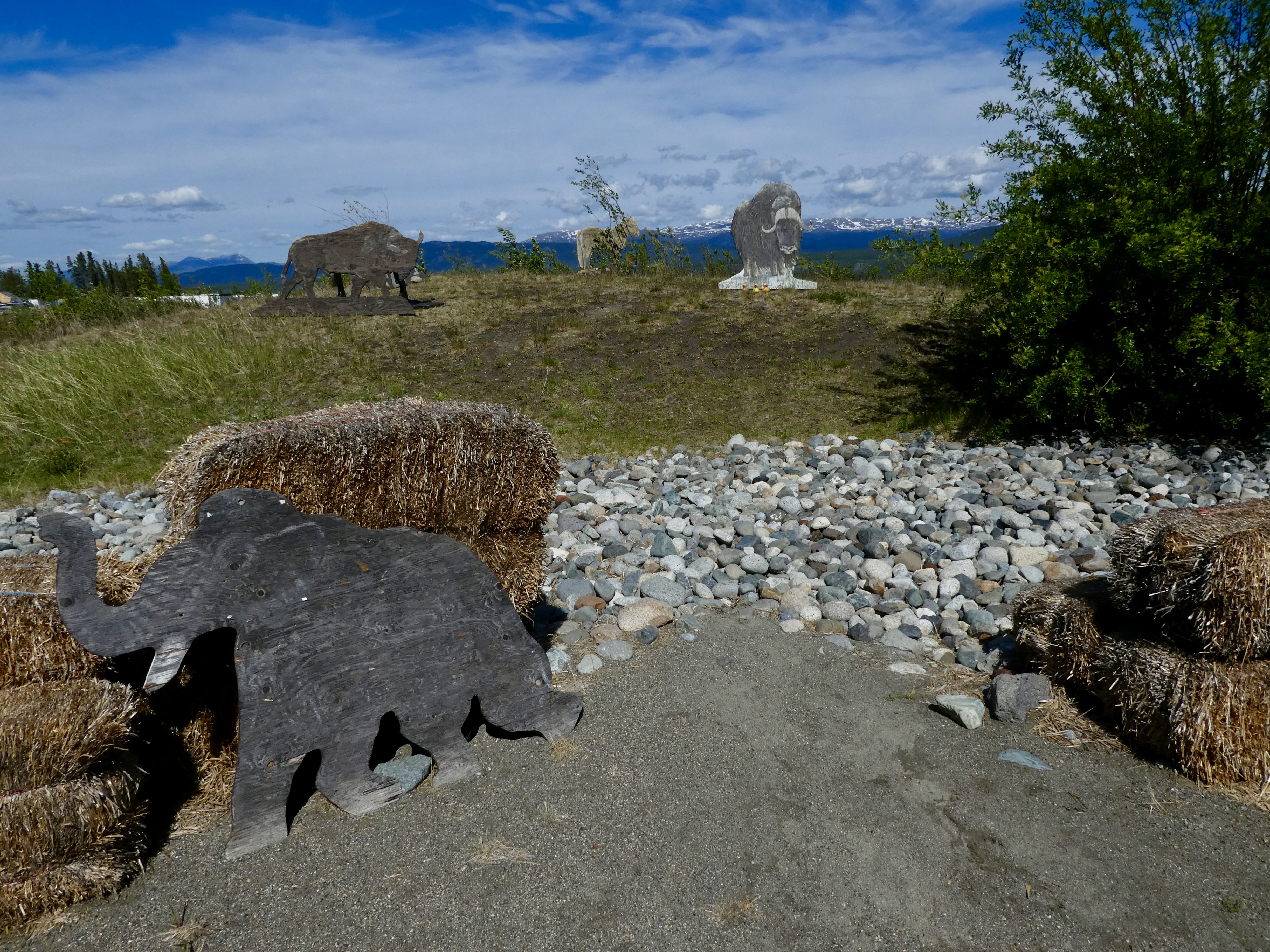
Statues of former residents

We recognize this musk ox.  We ducks are in front of him.  He resembles Africa’s Cape Buffalo.   Notice that these animals all need heavy skin and thick coats to survive the brutal Yukon winters.   We like seeing animals.   There are many signs here explaining the permafrost.   The ground never thaws a short distance from the surface.   One result is surface water cannot penetrate the permafrost, so the soil above permafrost is quite wet.   If the permafrost does melt, due to natural weather or human actions, the melting permafrost causes the ground to be unstable.   This place makes us think about so many new things.   Also, signs show how to read the story of climate change in riverbank layers.

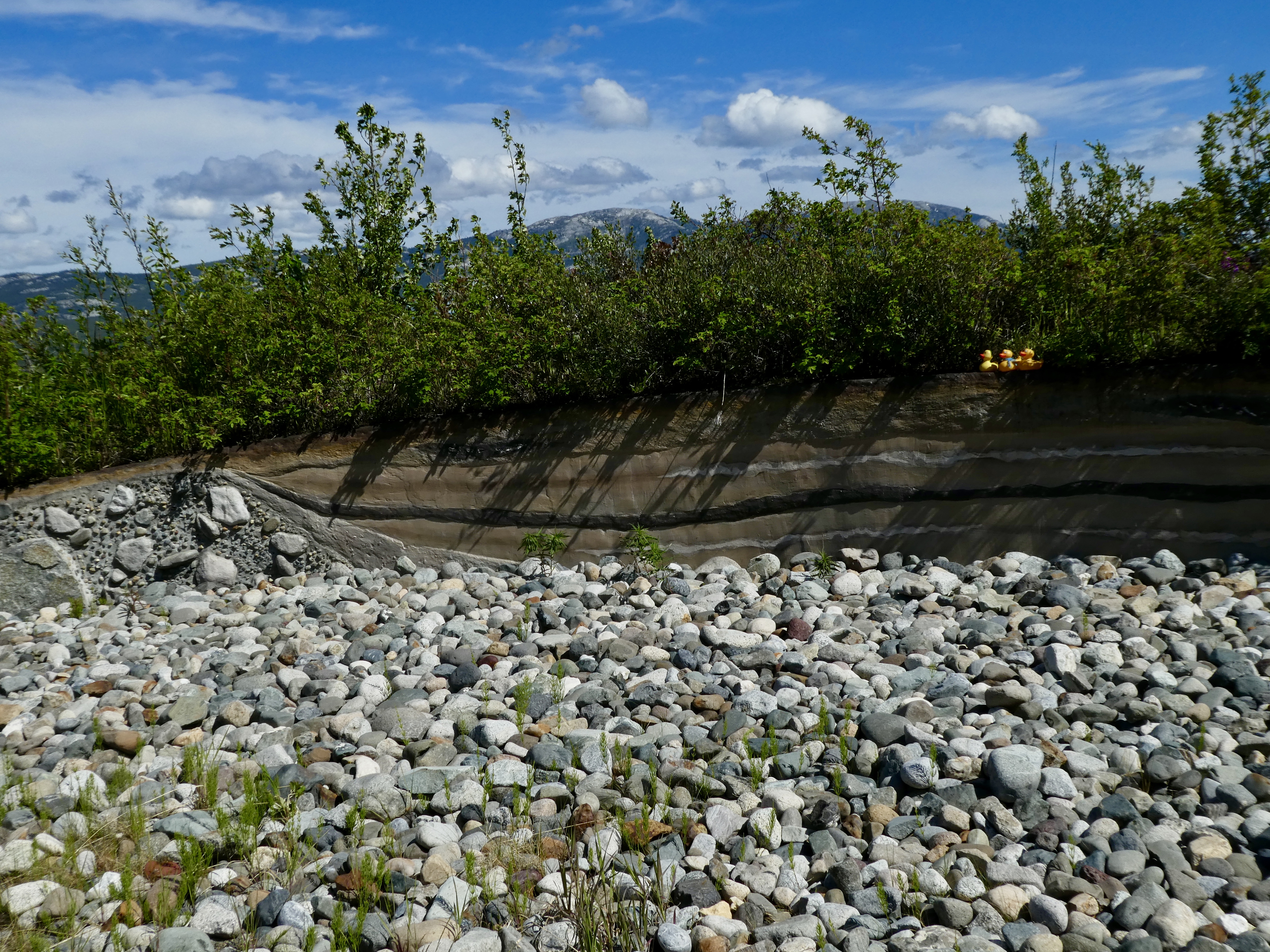
Riverbed layers of earth

We can see several layers in this riverbank.   These are natural layers, not things cemented together.   So much to learn.   So little time.   We are now headed to the Yukon Transportation Museum.   We will show you what we find next time.

Whitehorse, Canada with Zeb, Soapy and Eider Duck

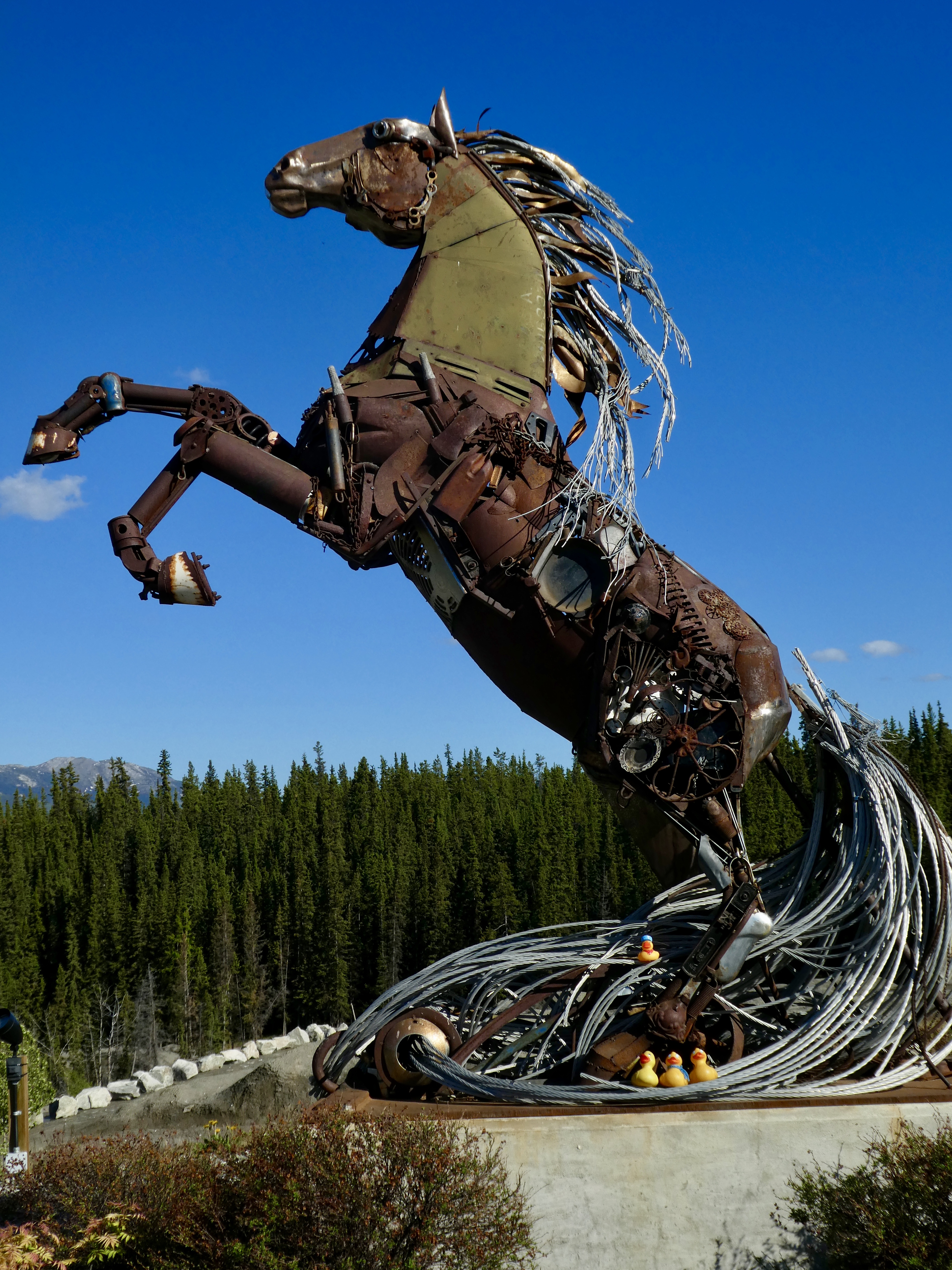
Canada’s Yukon Territory is huge, beautiful, and certainly not crowded.   We love it!   We are entering Whitehorse, the capital of Canada’s Yukon Territory.   Look at this welcome horse, the Whitehorse Horse.

The Whitehorse Horse

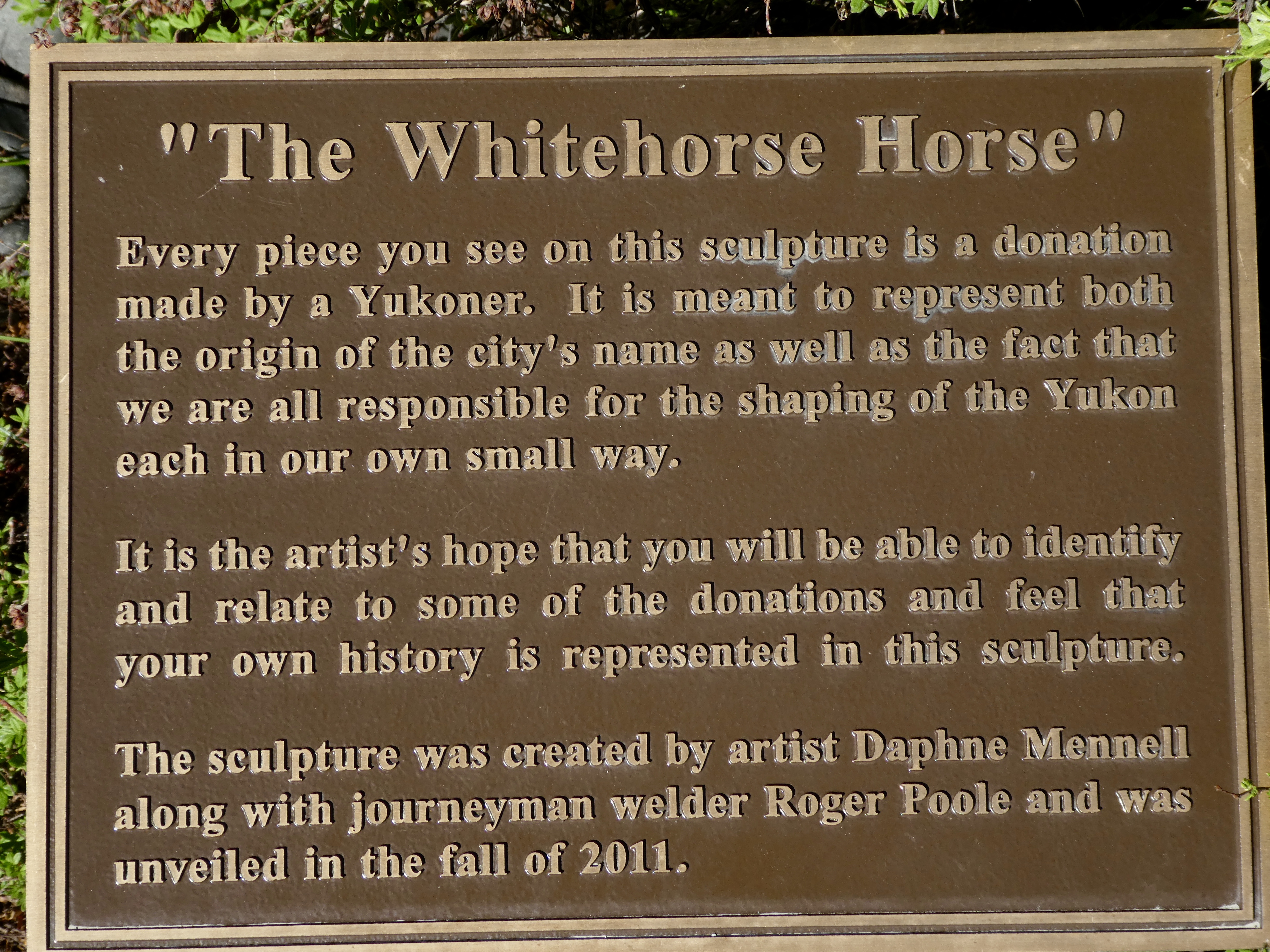
What is this made from?   What is the story behind this horse?

About that horse…

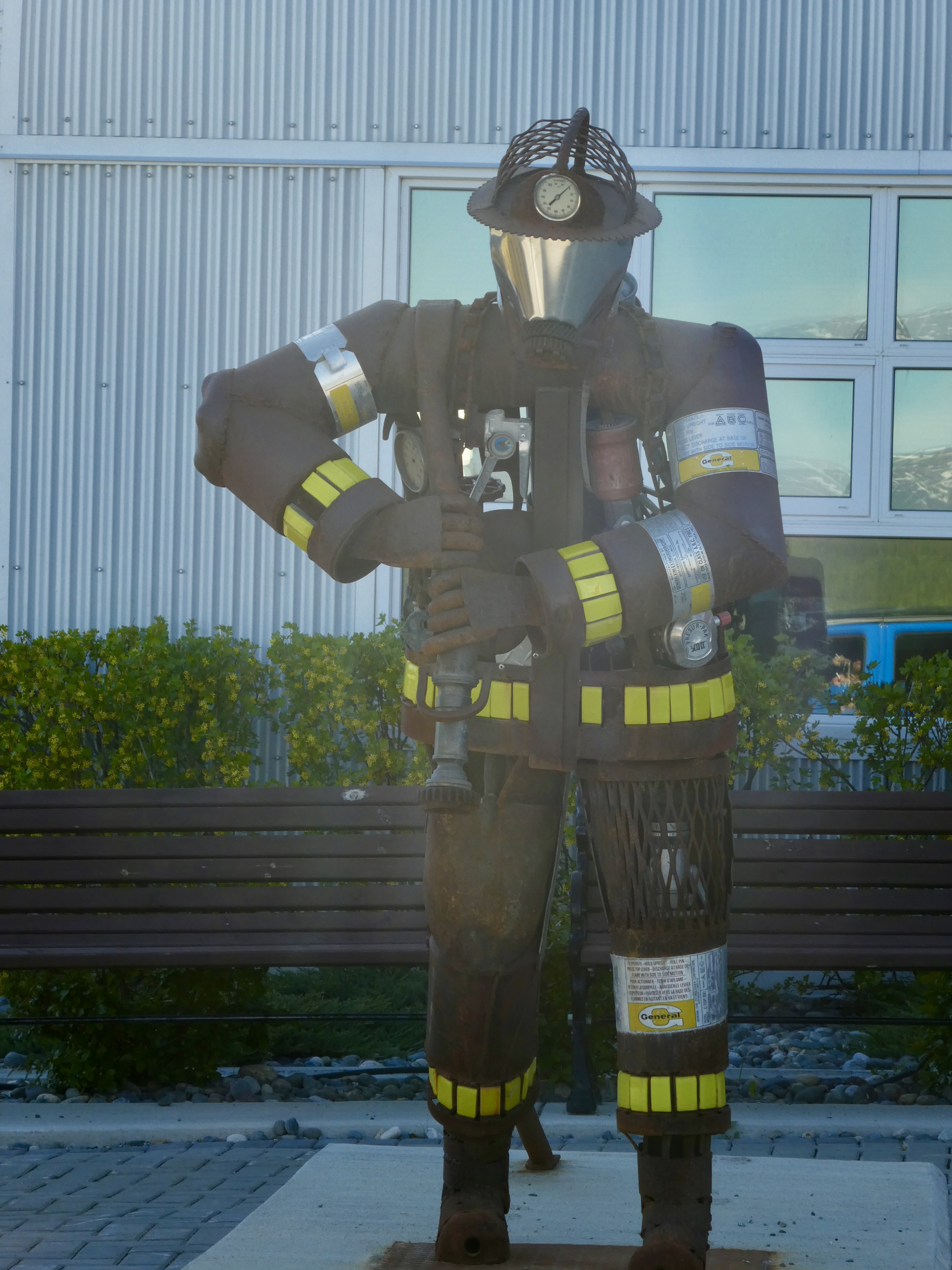
Now you know.   A contest winner and we have a great horse.   This is near the Pubic Safety Building in Whitehorse.   We like the fireman.

Fireman

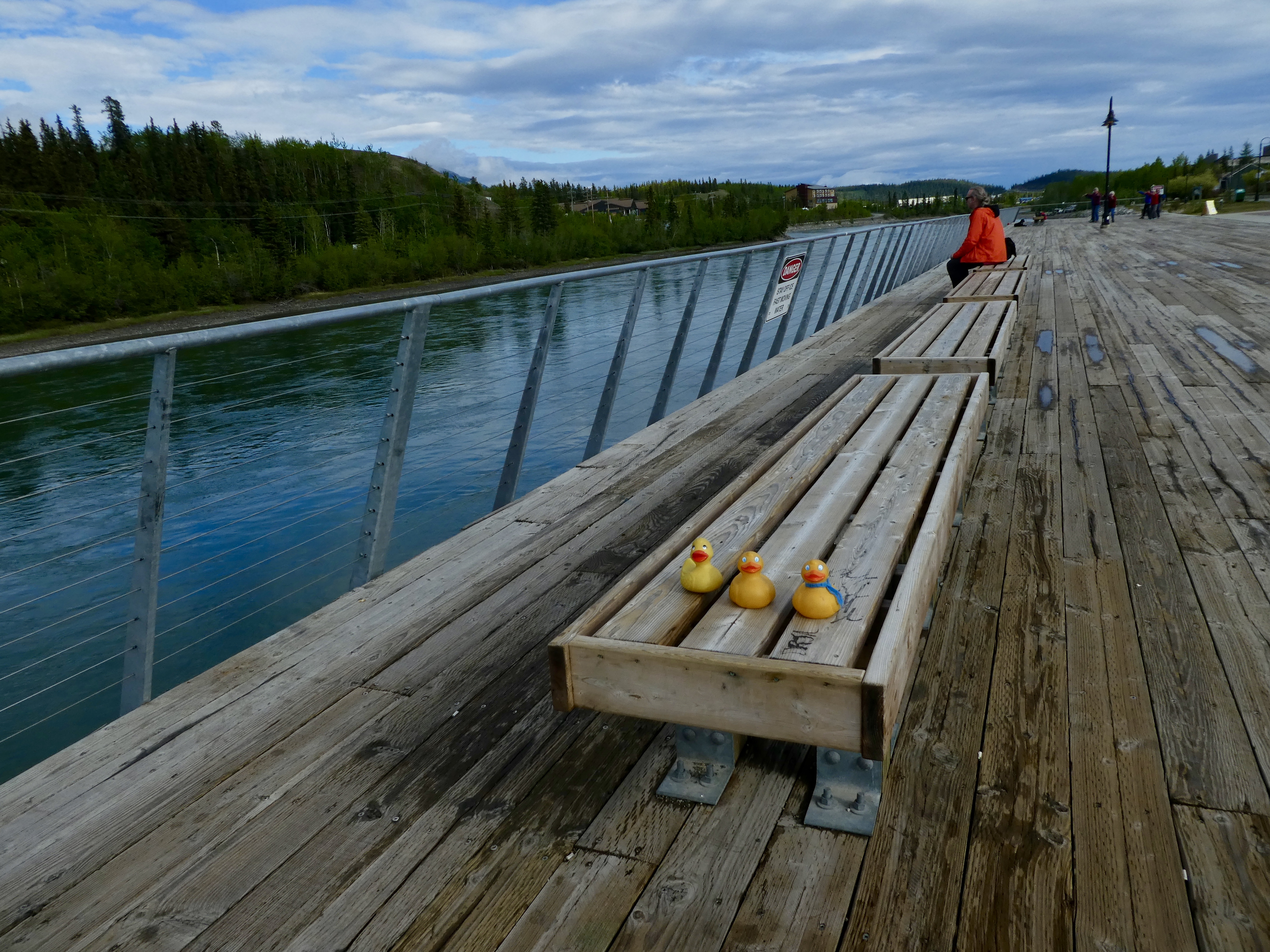
Safety is important.  We found a hotel right downtown, so we could walk to the Yukon River.

By the Yukon River in downtown Whitehorse

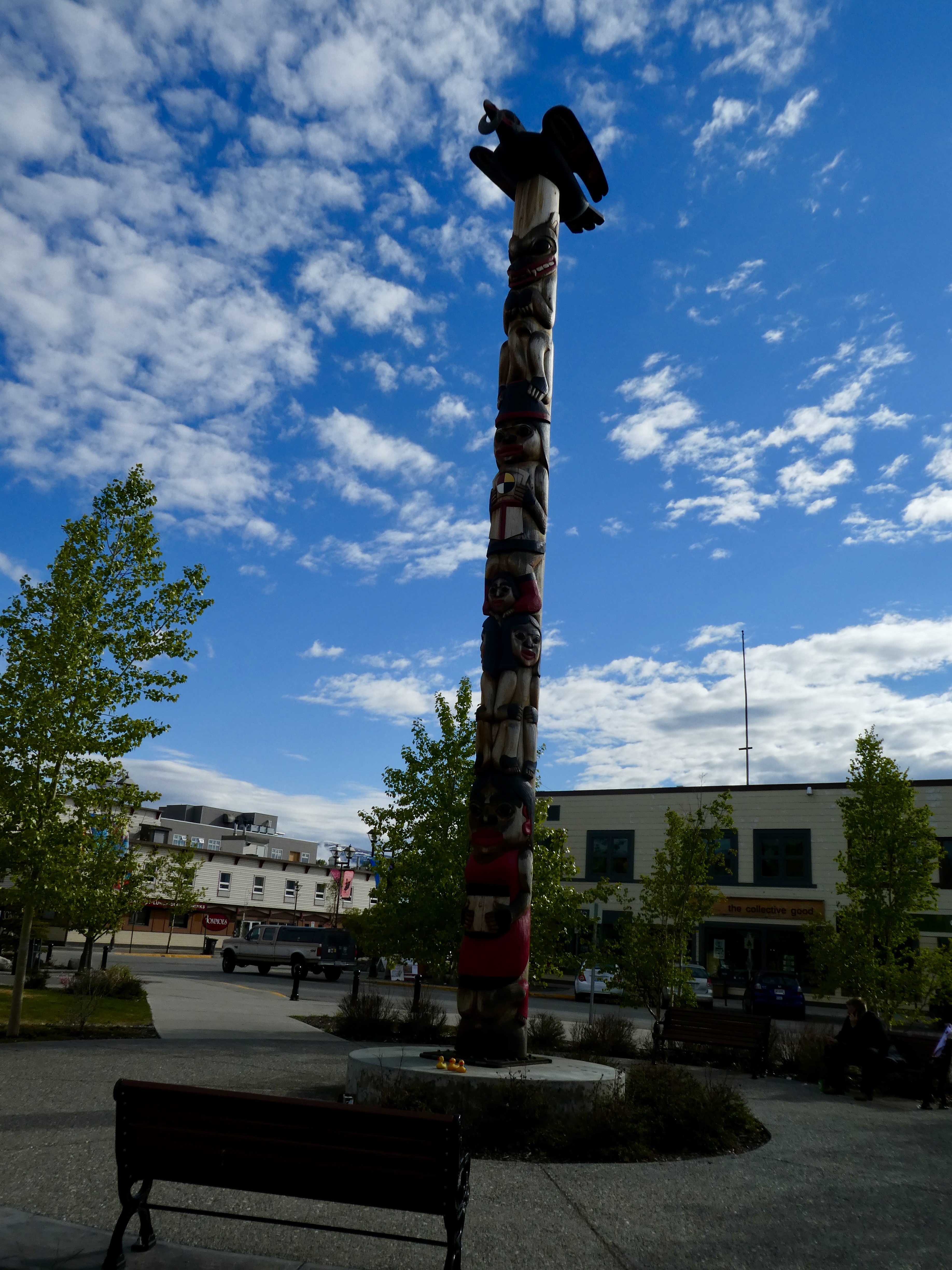
Near our bench, we marveled at this giant totem pole.

Tall totem pole

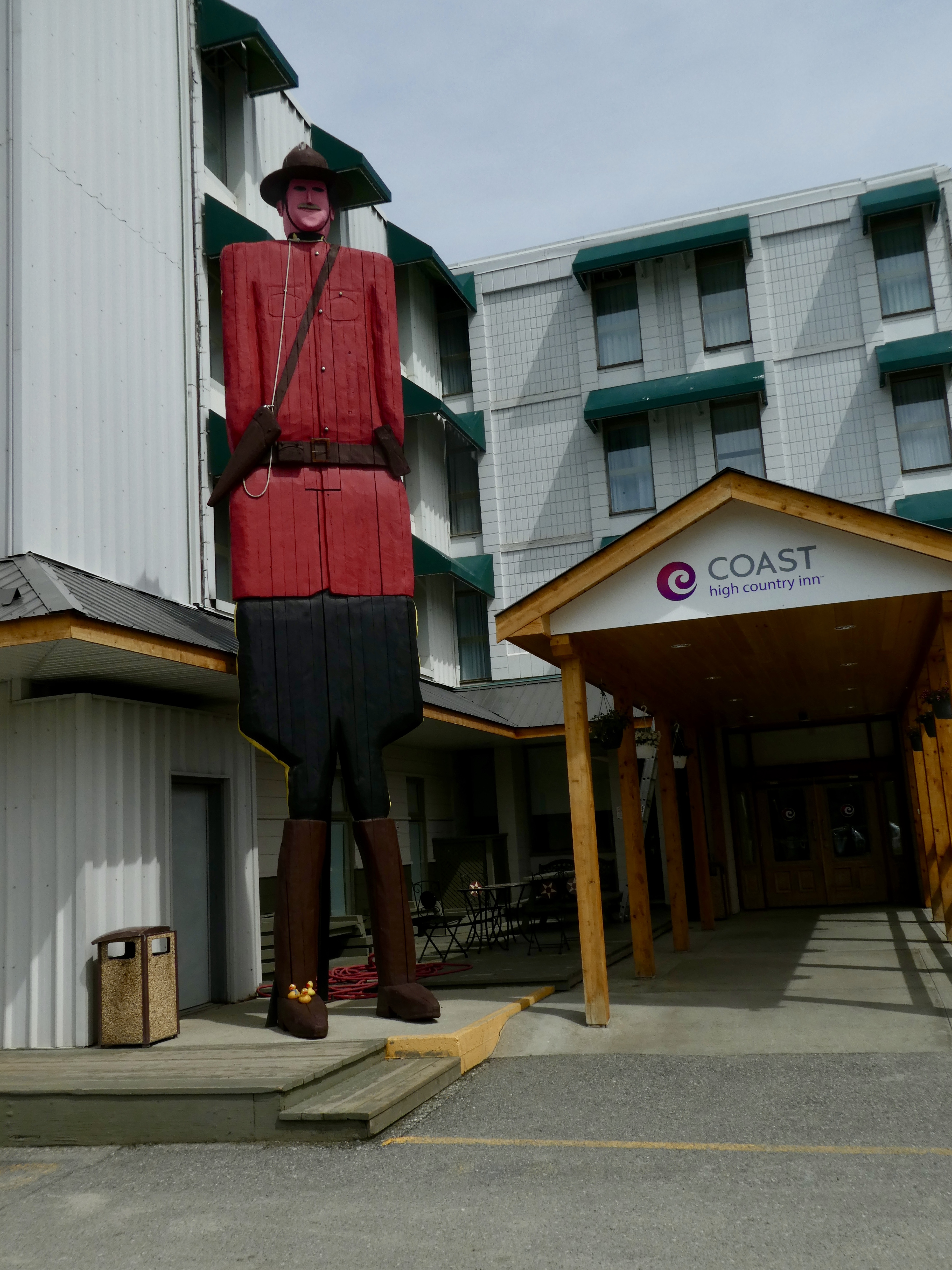
Walking a few blocks, we smiled at this taller than life Canadian Mounty.

Canadian Mounty. Larger than life

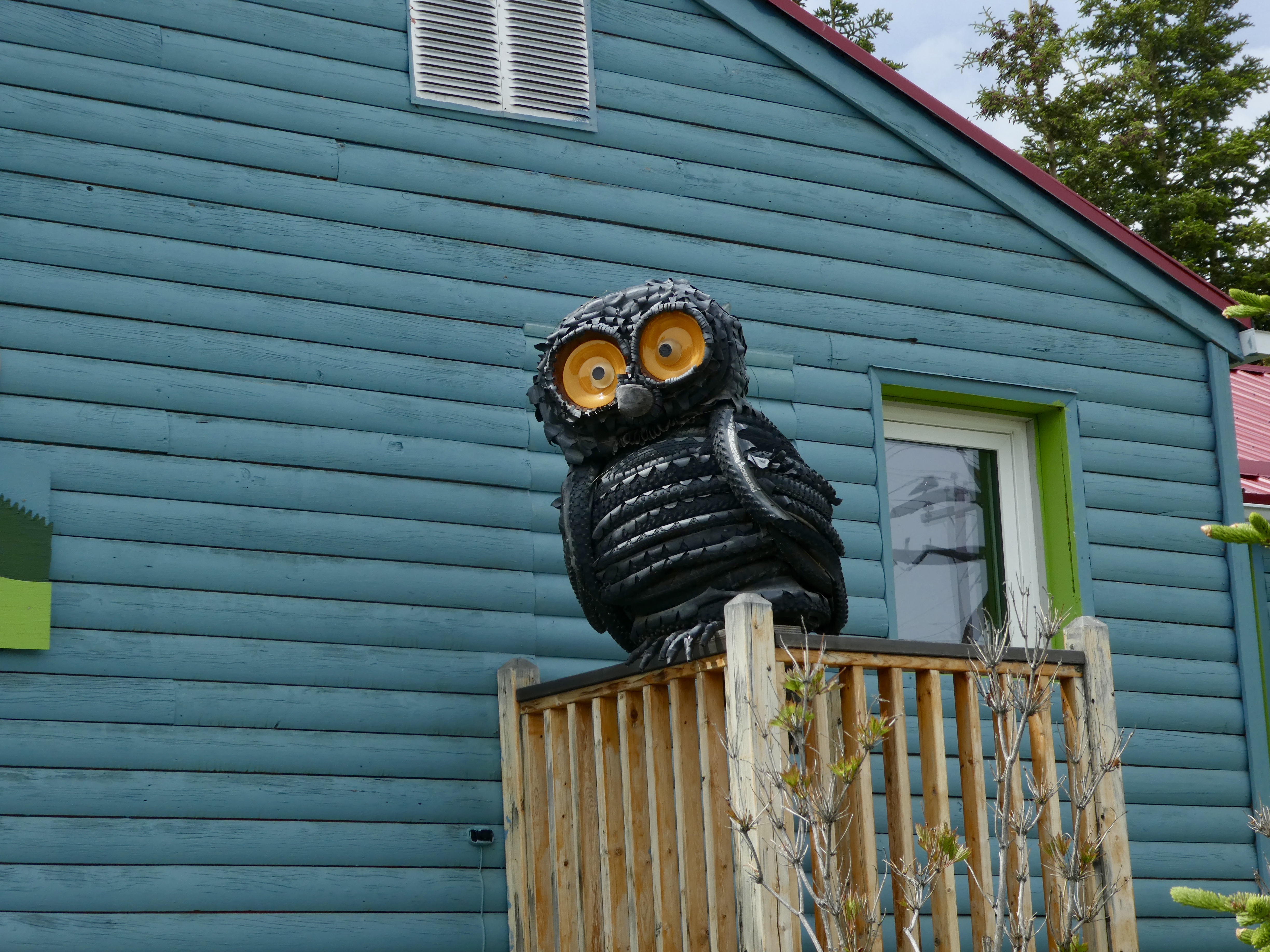
Could be a surprise if you stayed in a room on the third floor, looked out your window in the morning, and saw this Mounty’s head by your room.  But we liked him.   Carving wood must be popular here.   This owl is wonderful.

Watchful owl

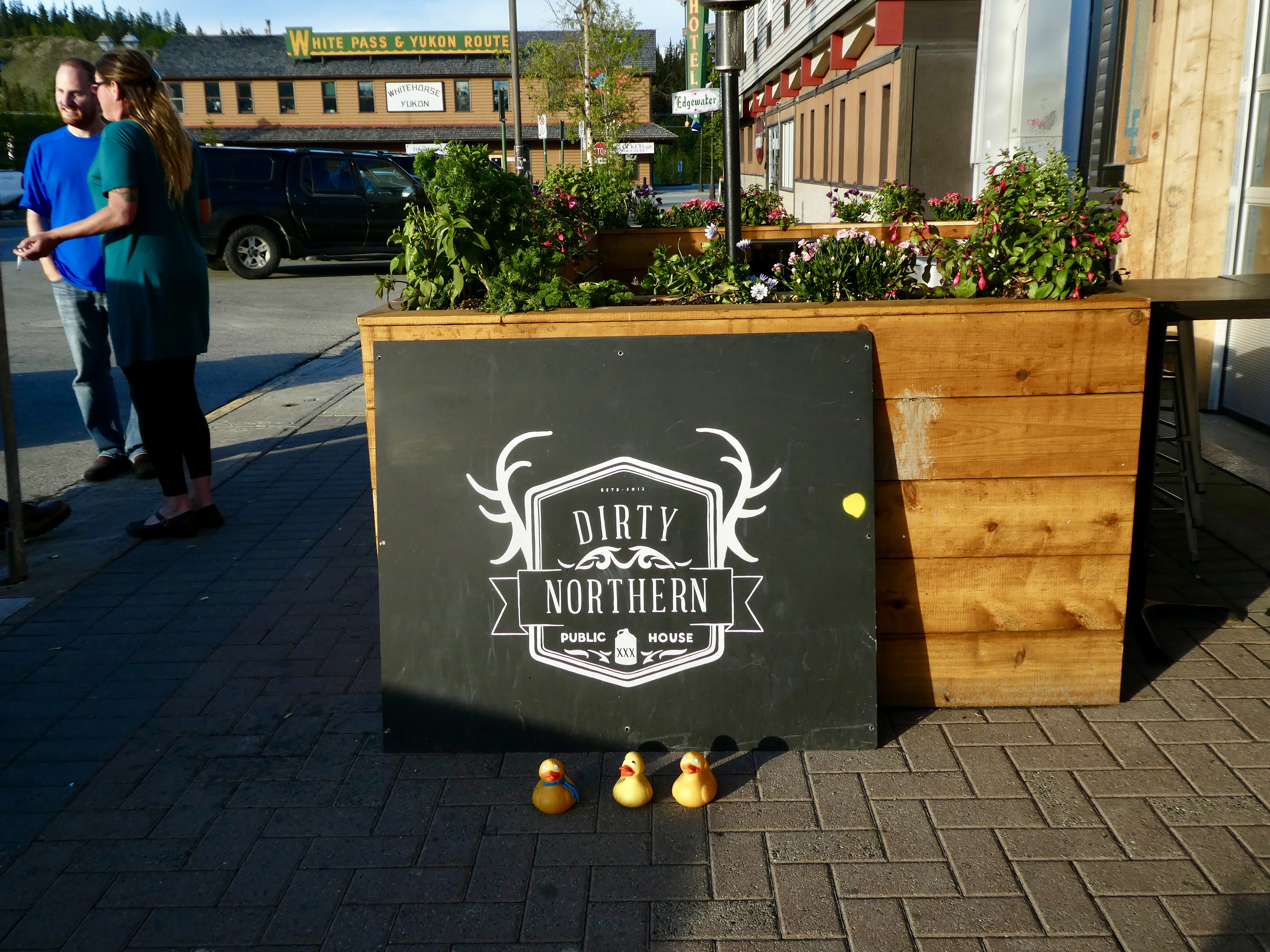
Don’t you just love it?  We heard this was a highly rated restaurant, so we tried Dirty Northern Public House.

Dirty Northern Public House. Great dinner here

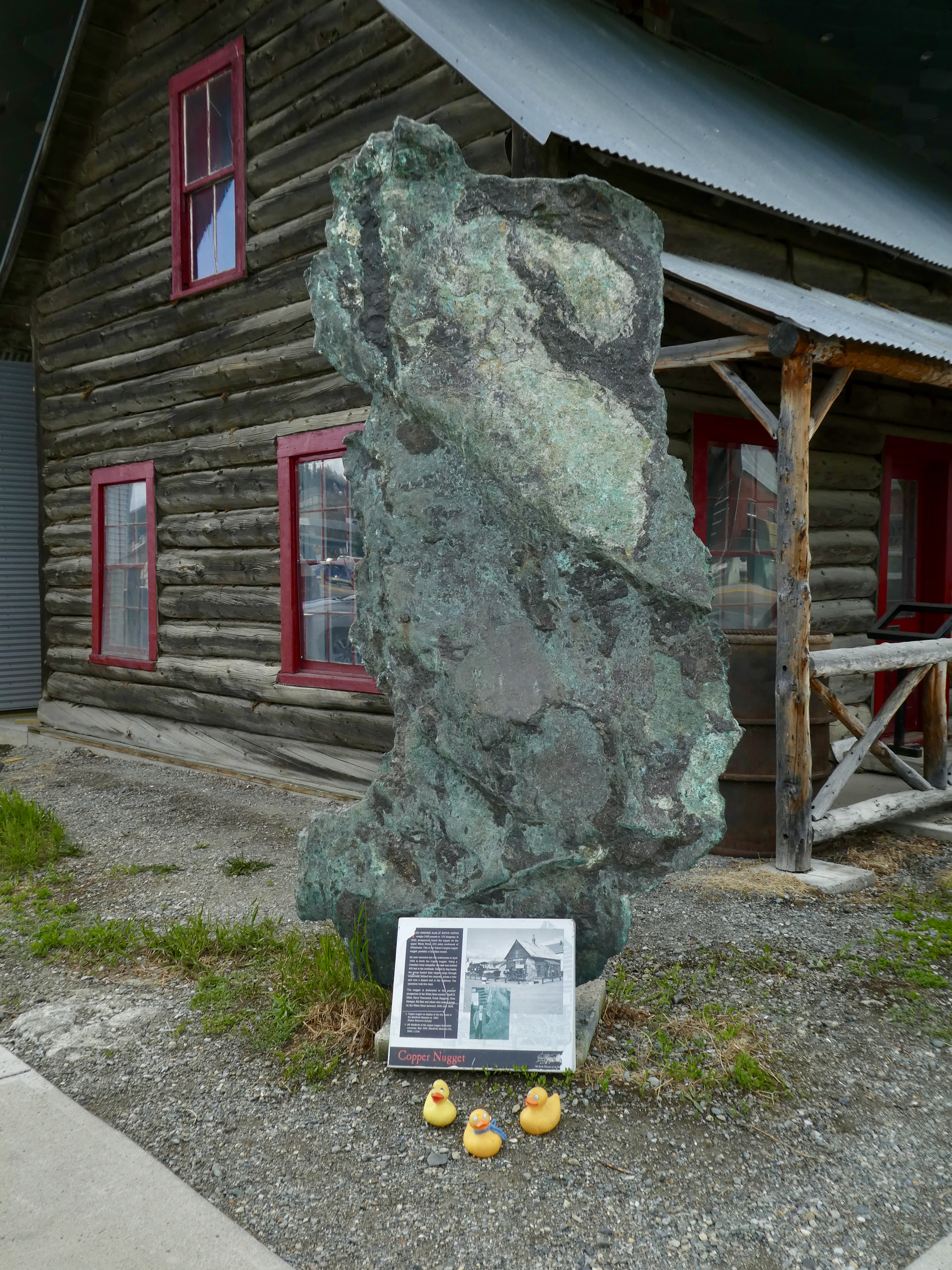
The decor was so northern woods, the service great, people were friendly and delicious food.  We were so happy we ate here.   Maybe you will try it also when you’re in Whitehorse.  Walking back to our hotel, we could not miss this slab of native copper.   This weighs 2,590 pounds, or 1,175 kilos.

Slab of Native Copper. 2,590 pounds!

Discovered in 1905 in the upper White River, 250 miles NW of Whitehorse, this is the Yukon’s largest copper nugget.   The sign says it is possibly a Canadian record for the largest copper nugget.  We, ducks and moms, liked Whitehorse and we all agreed that we wanted an extra day here to explore more.   Guess we better tell our hotel we want to stay another night.   Yes!  We like Whitehorse.

Enjoying the Alaska Highway in the Canadian Yukon

On the road again.   We are on vacation, so there are no alarm clocks and no early morning rush to leave.   Shortly after leaving Beaver Creek, Yukon Territory, we saw one of the stars of our trip.

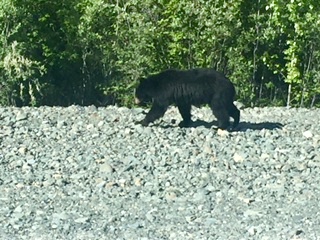
Bear along the road

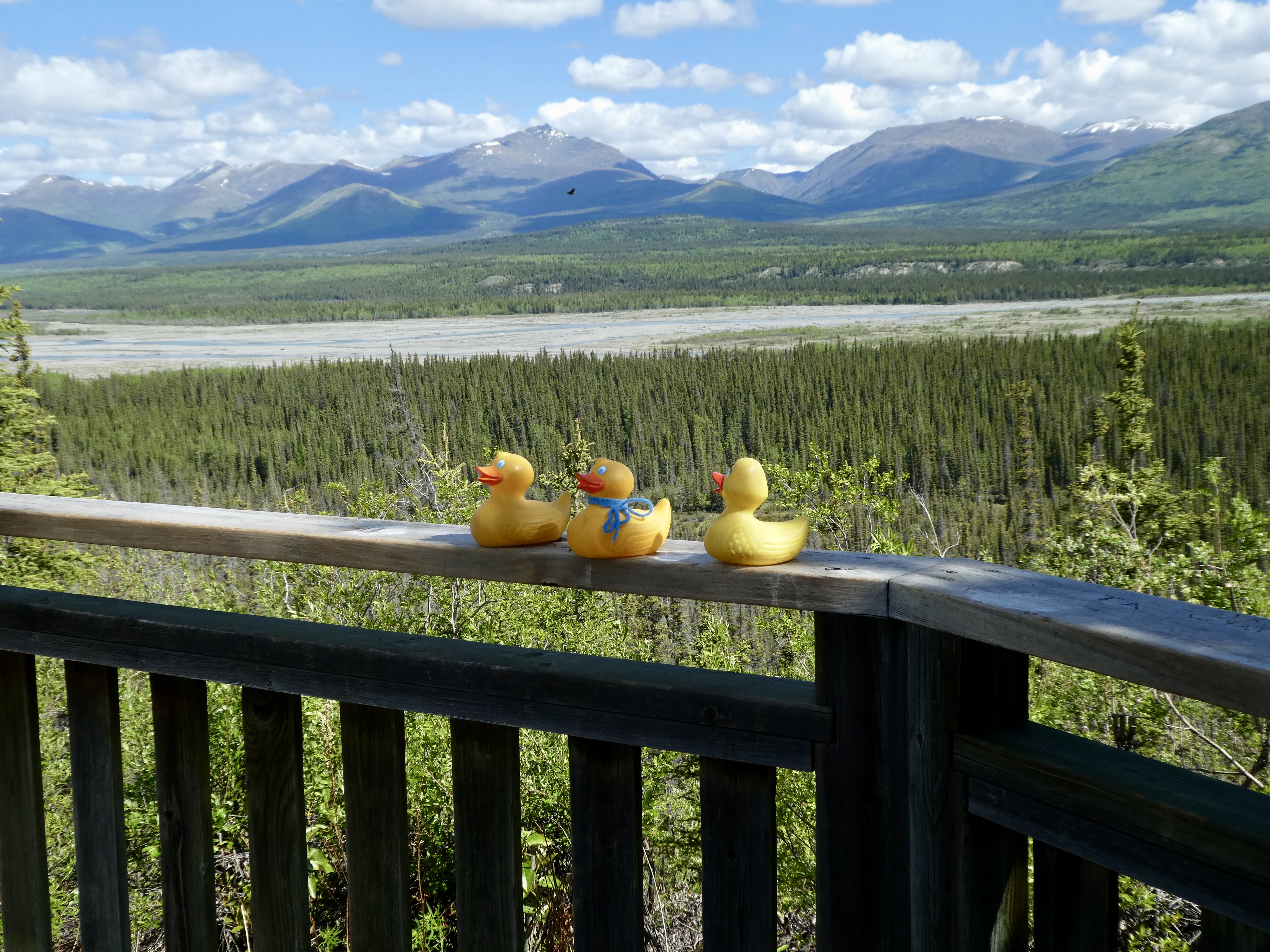
This bear was walking along the side of our road.   Our moms said he is a rock star.   He knew we were there, of course, but he did not look at us.   We stopped the Jeep and watched him walk at a steady pace, completely ignoring us.   He would get pretty far ahead of us, we would drive to him, and never an acknowledgement.   We just loved him.   Later, this rest area caught our attention.   This is Kluane River View point.

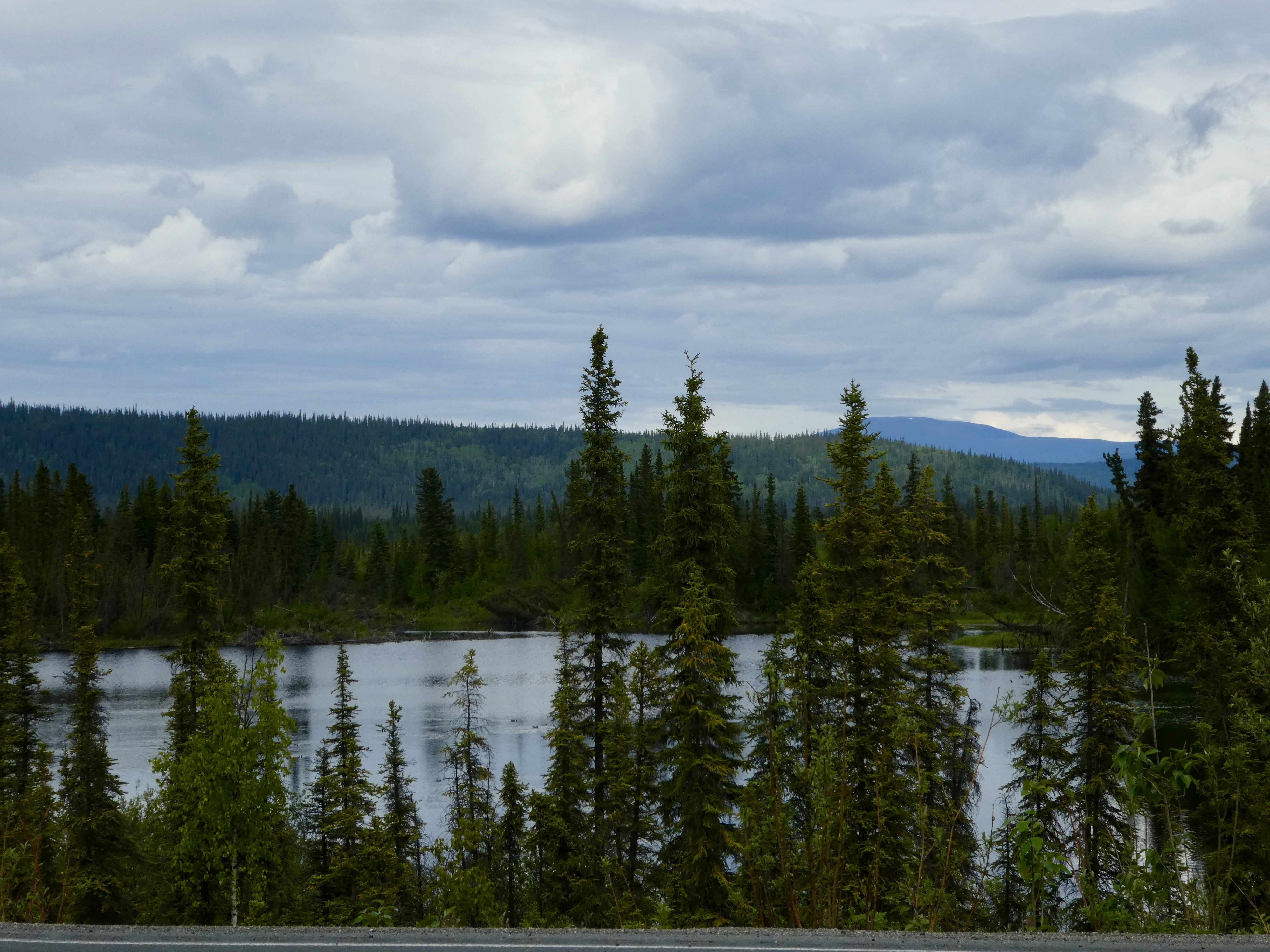
So pretty

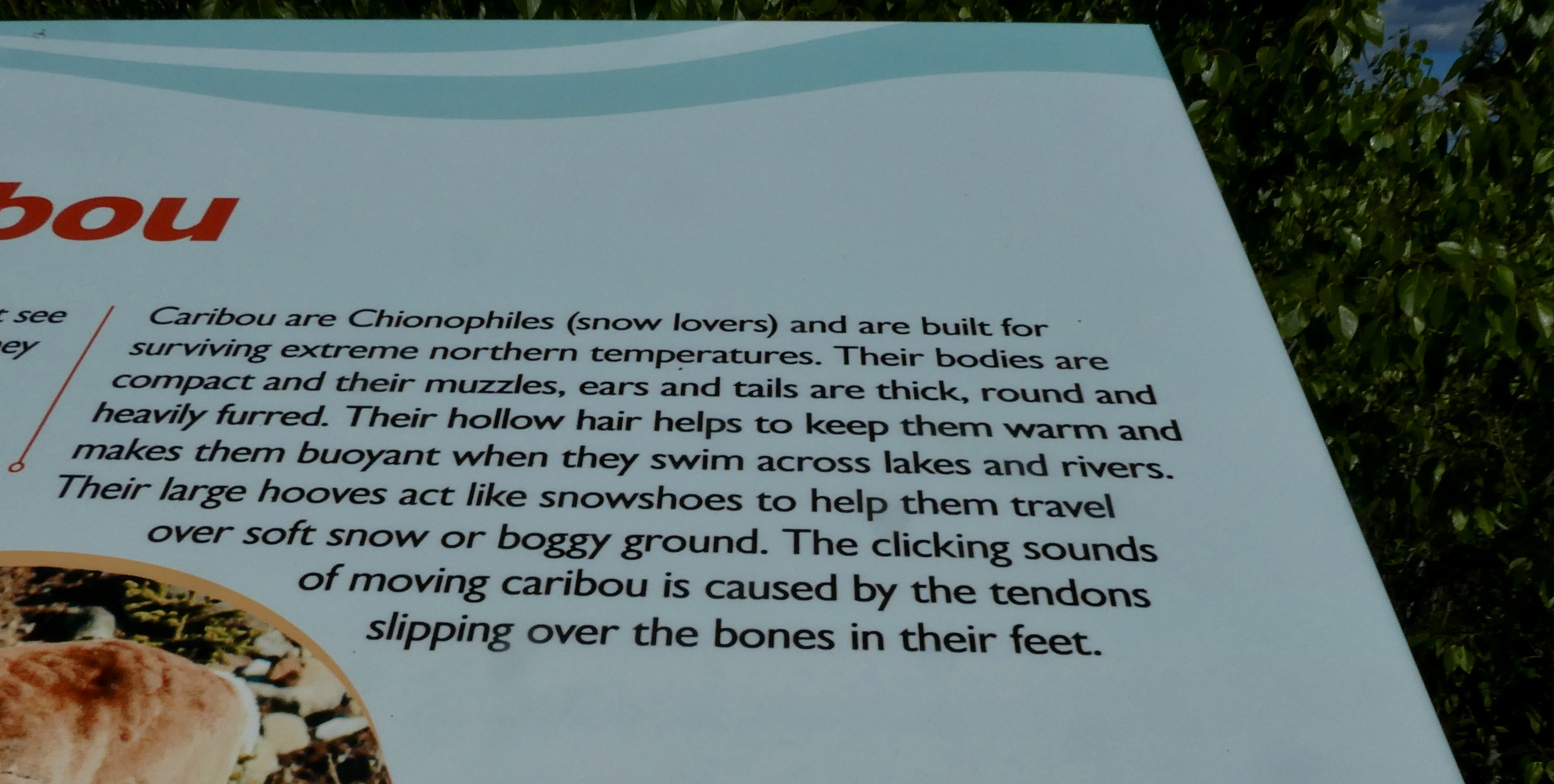
Stop to admire the river was so necessary.   Also at this stop, there was a sign about caribou.   Caribou are similar to reindeer, but these were some facts we did not know.   Be sure to read the last sentence.

Sign says it better than mom

Moving tendons make that much noise???  Amazing.   Lake Kluane also made us stop.

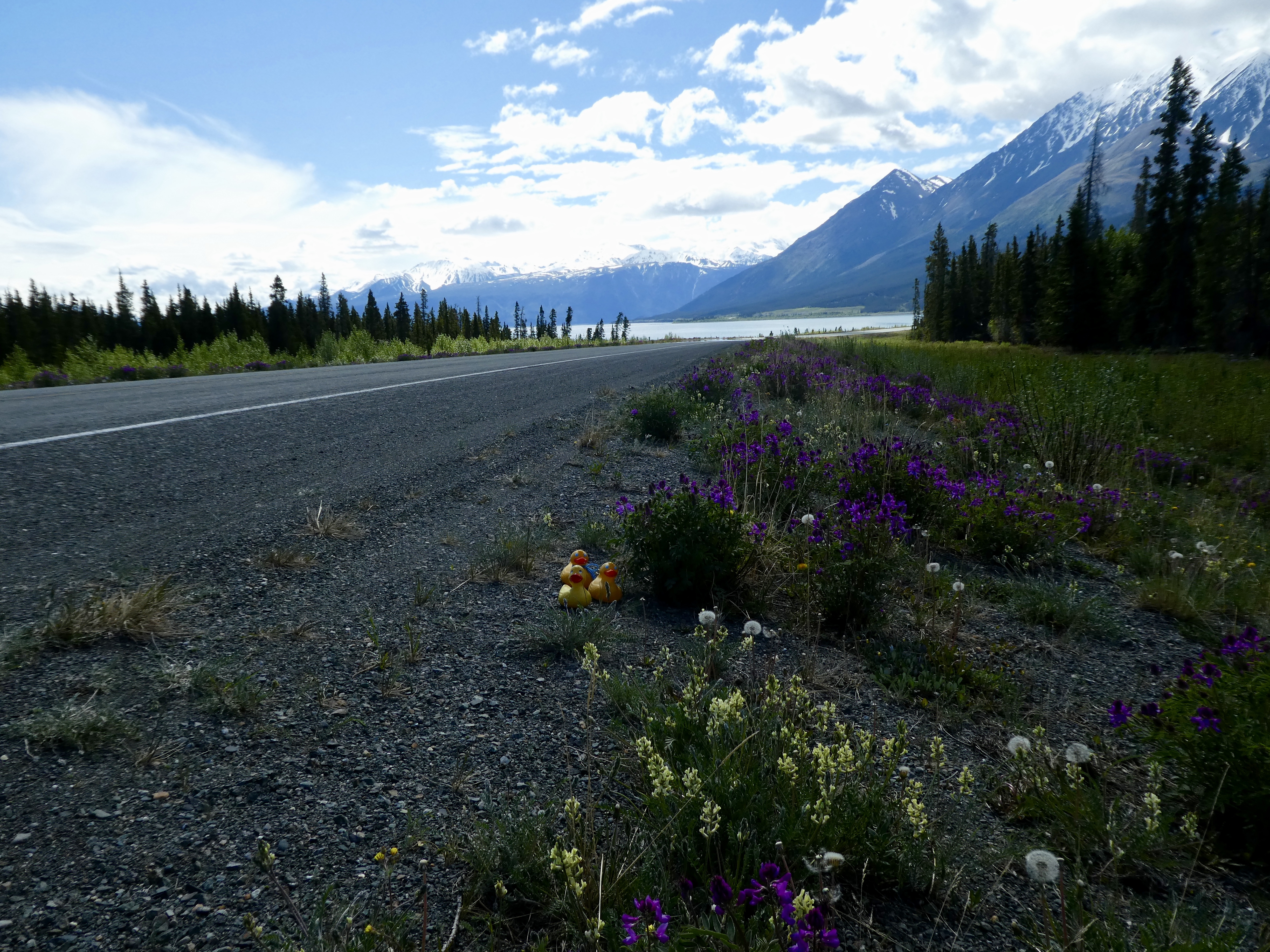
Kluane Lake

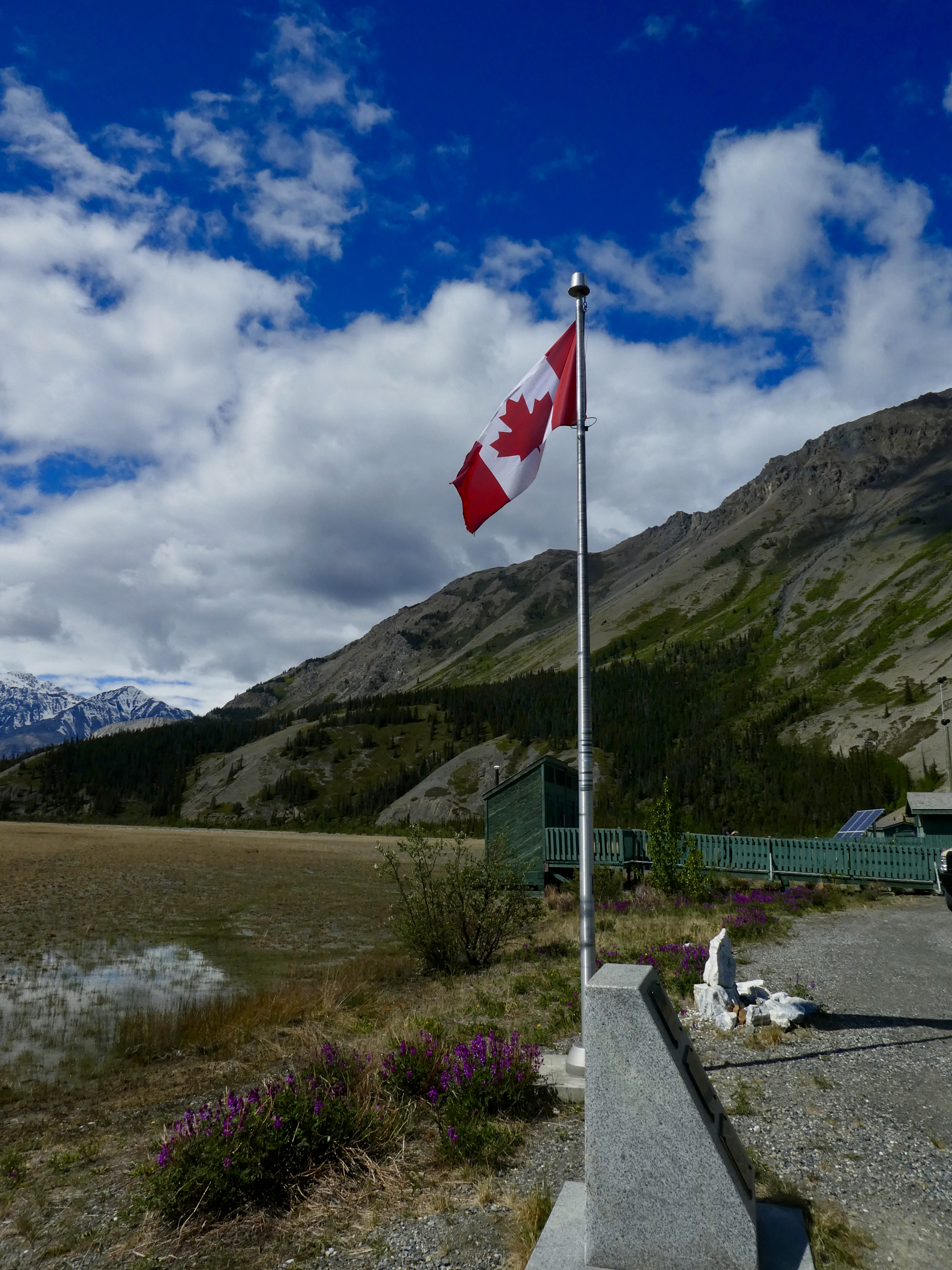
This road trip is about seeing unspoiled nature, with very few other humans around.   So we stopped often.   Later, a small building with a nearby huge Canadian flag waving in the breeze.

Canadian flag

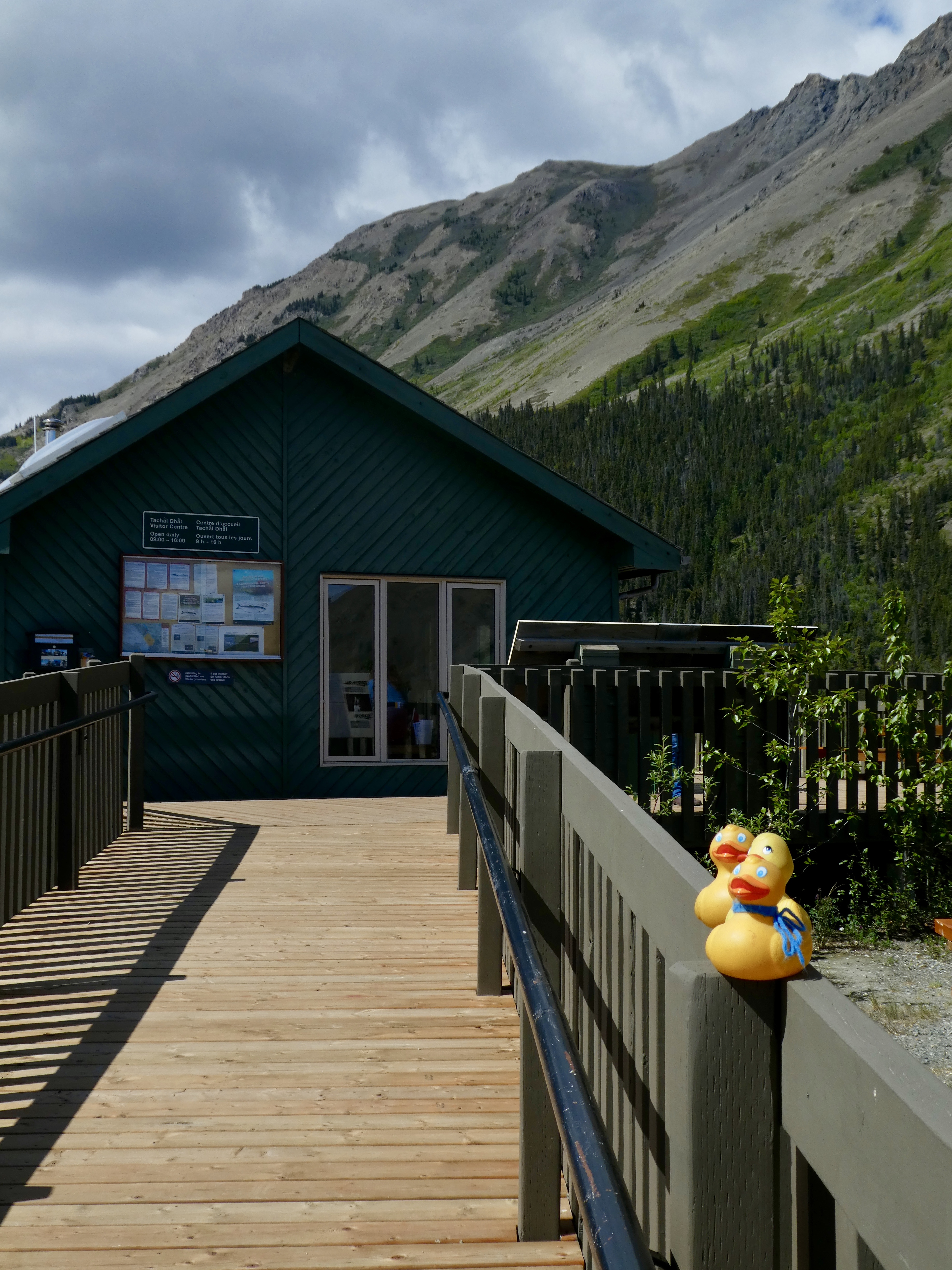
Of course entering the building was another must do for us.

Tachal Dhal Visitor’s Center

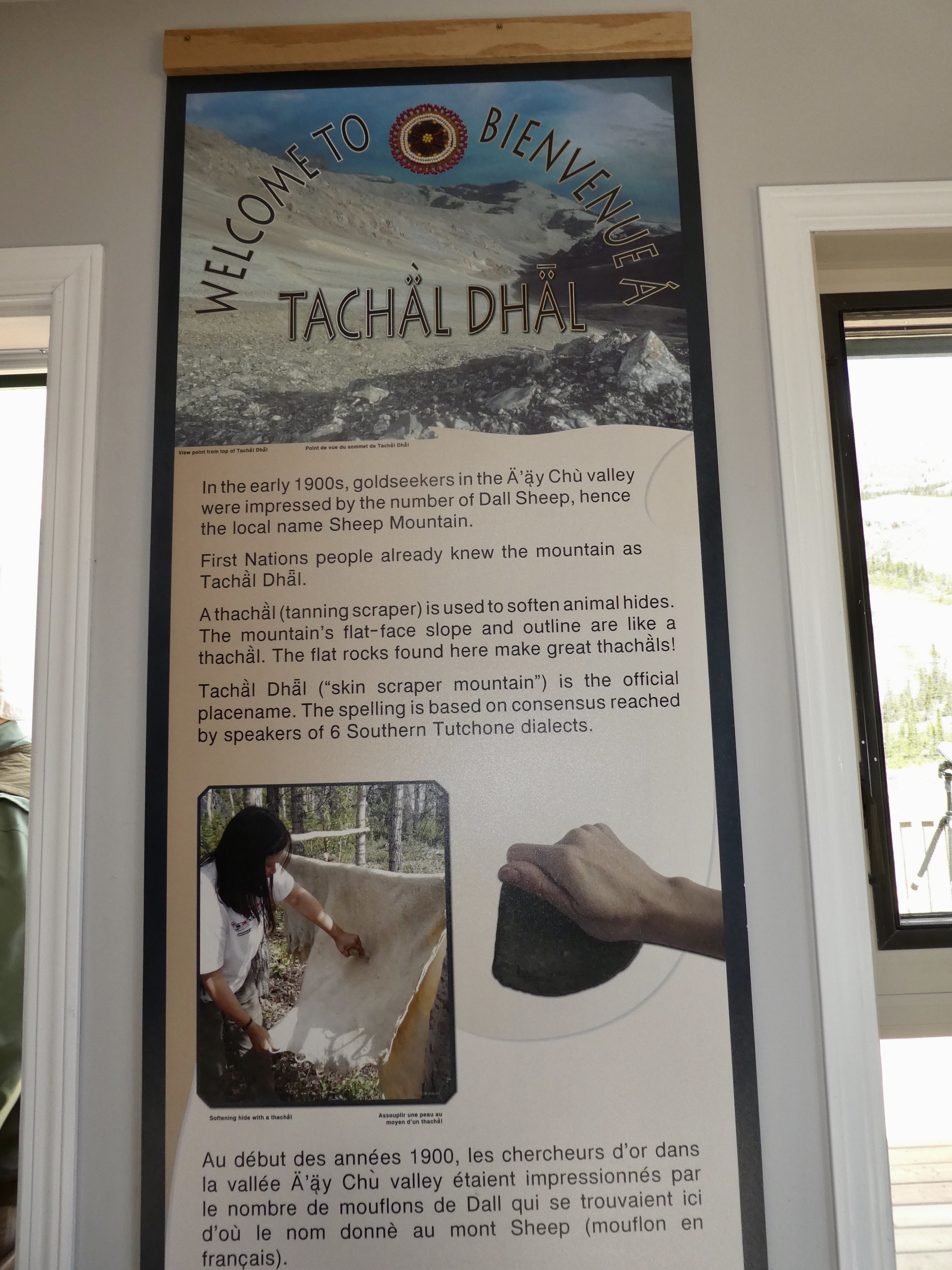
This is Tachal Dhal, or Sheep Mountain.   Again, the sign says it best.

Sheep Mountain

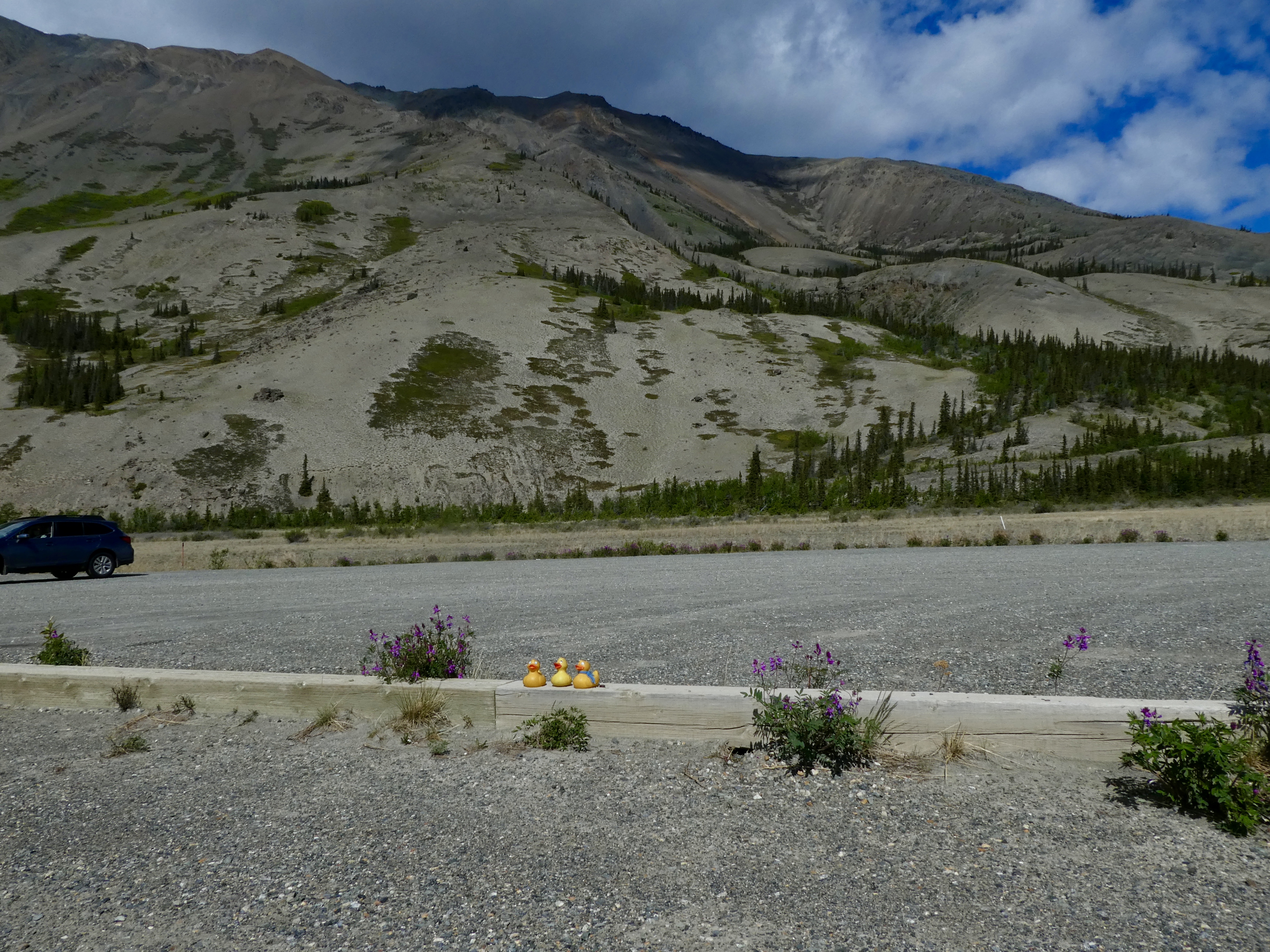
We love to watch Dall Sheep, but it was not to happen today.   The lady at the center, said it was getting warm enough (but still need jackets for humans) that the sheep moved to the other, higher, mountains.   We looked.

Sheep Mountain

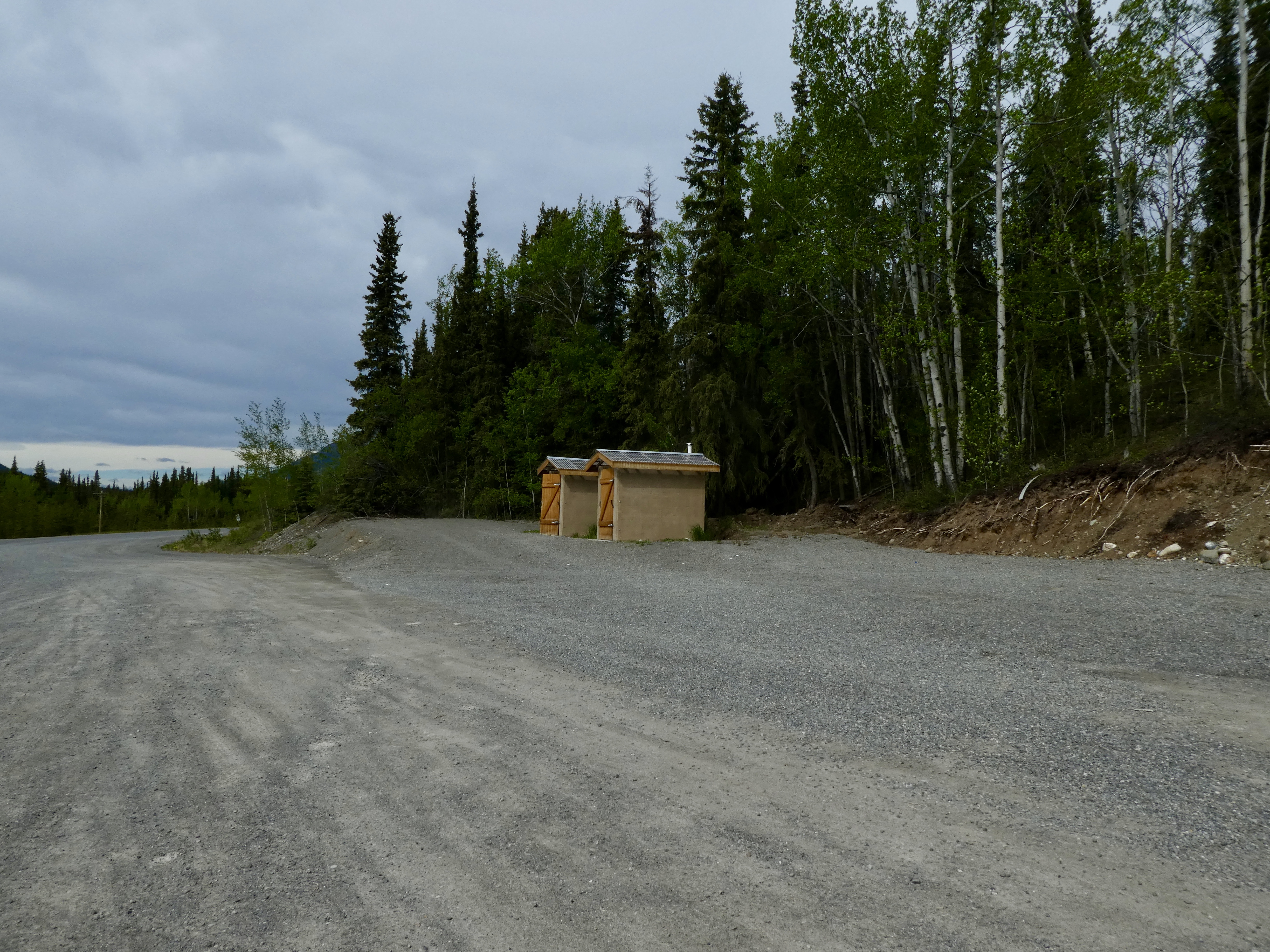
Nice mountain, but no sheep here today.   Did you notice that the sign is written in English and in French.   That was the normal for most signs we saw in Canada.   Driving through unspoiled scenery with very few other cars is peaceful and beautiful.   But, you can guess, this was one of the most welcome sights along the road.

Always a welcome sight

And all were very clean and well maintained.   Thanks Yukon Territory!

Driving the Alaska Highway with the Colorado Traveling Ducks

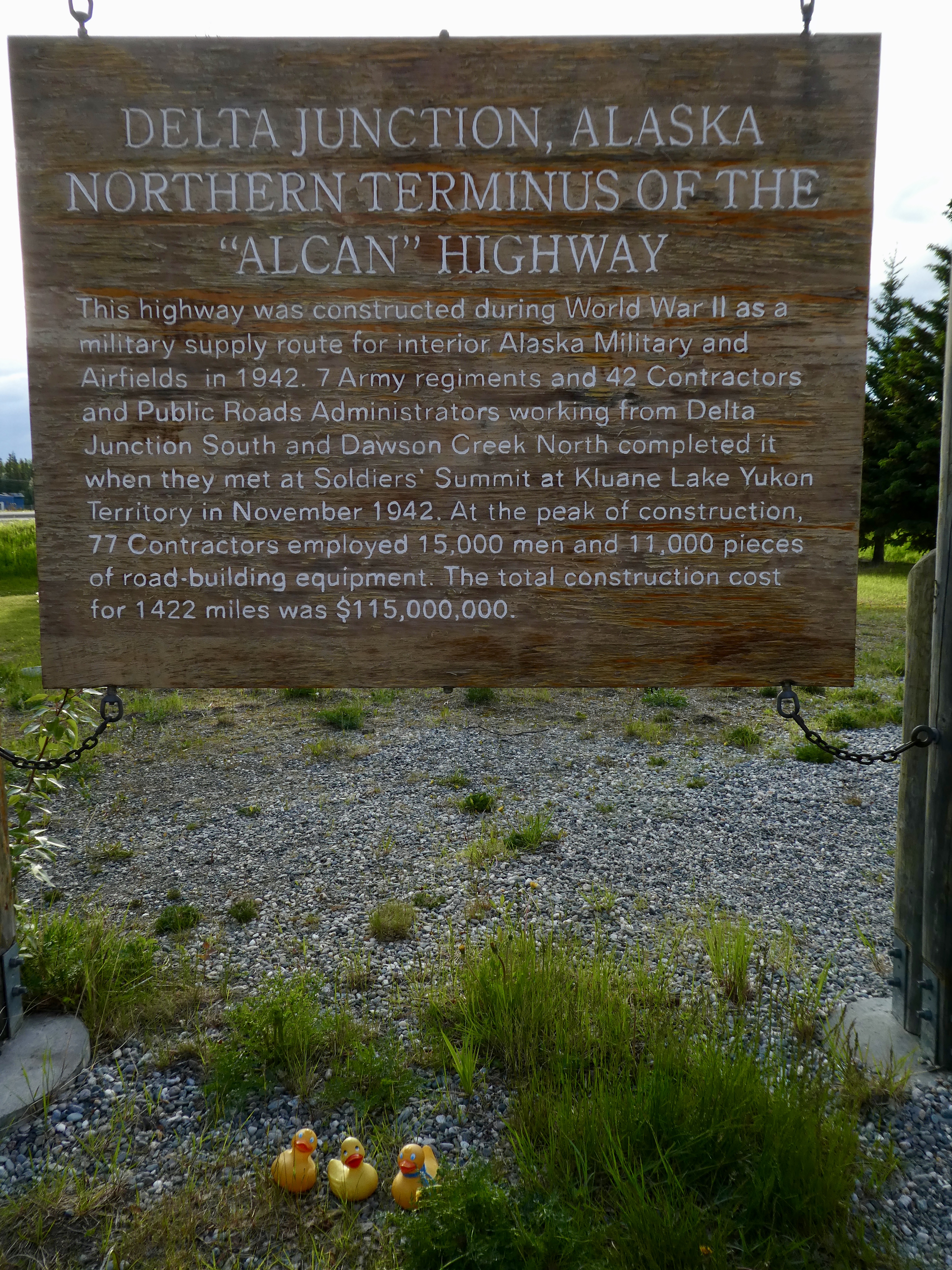
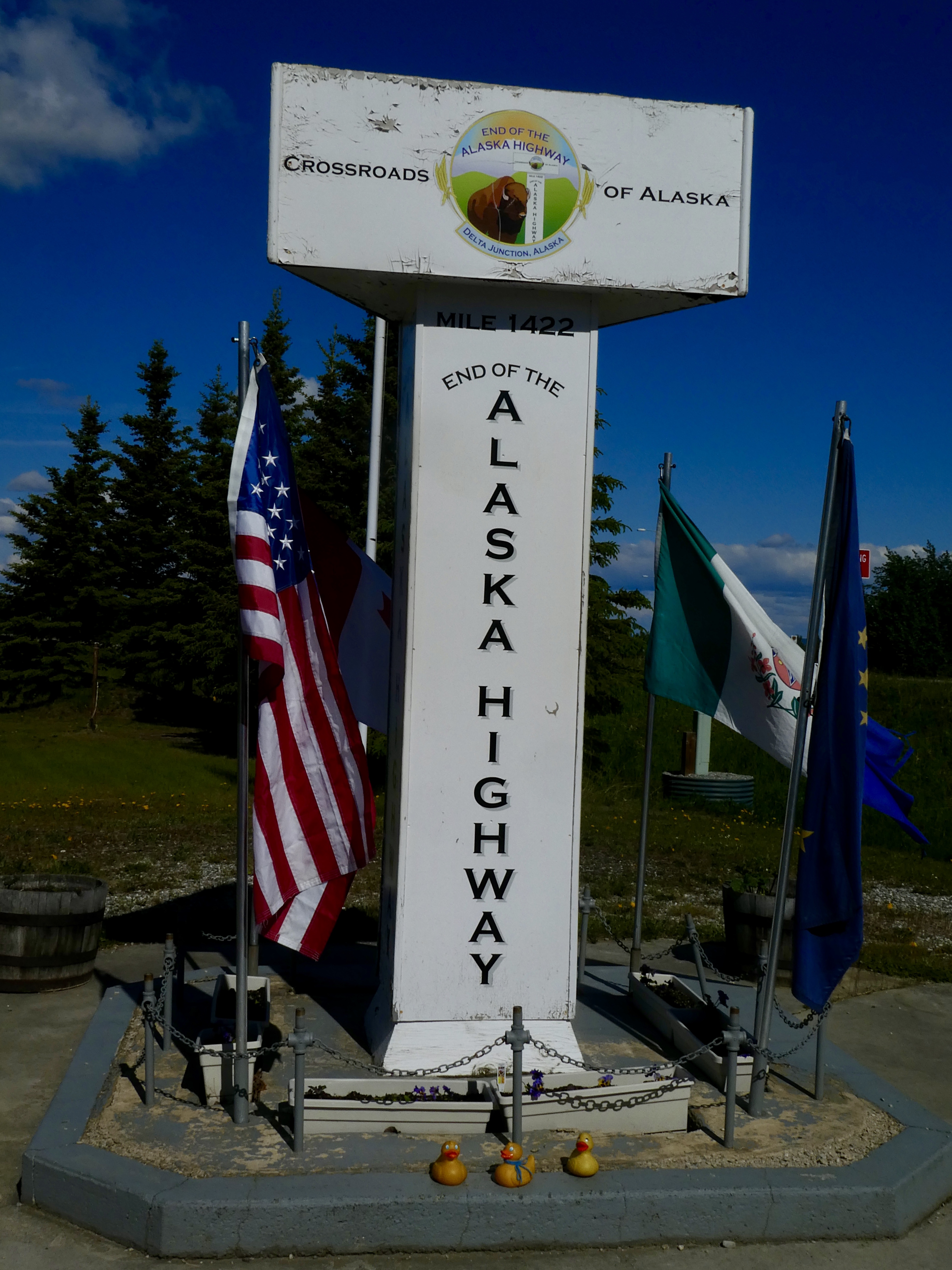
Ready to drive the Alaska Highway?   Here, in Delta Junction, Alaska, the Alaska Highway, or Alcan (Alaska Canada Highway) officially ends.

Alaska Canada Highway

But for us, it is just beginning.

Ready to start on Alaska Highway

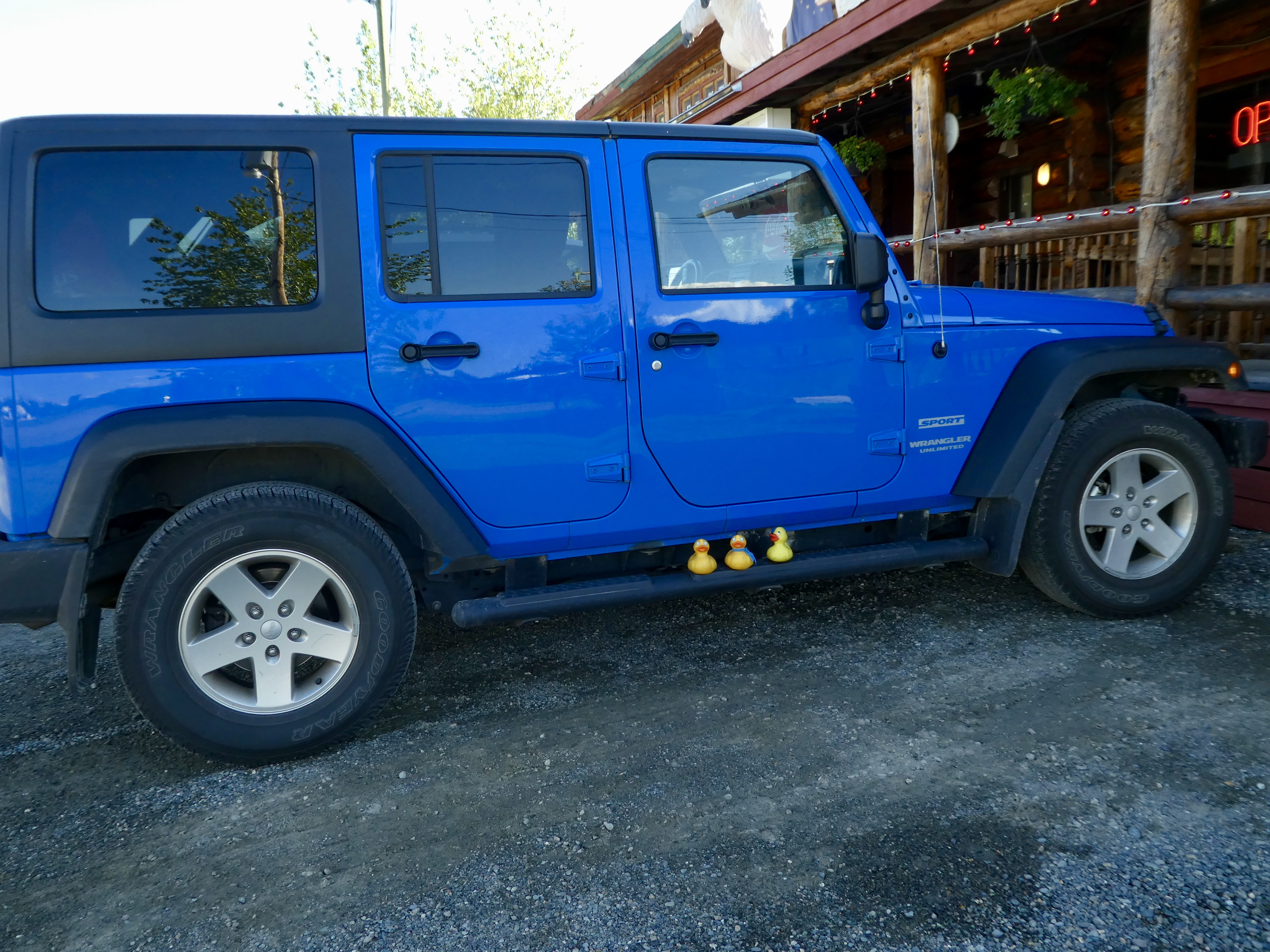
We bought this blue Jeep from Eider’s dad’s estate near Fairbanks.  Now we are driving it home to Colorado.   Yesterday Eider and I took Soapy and his mom to Santa’s House and then to the Knotty Shop.   This morning our first stop is the Visitor’s Center in Delta Junction.

Welcome Center and gift shop

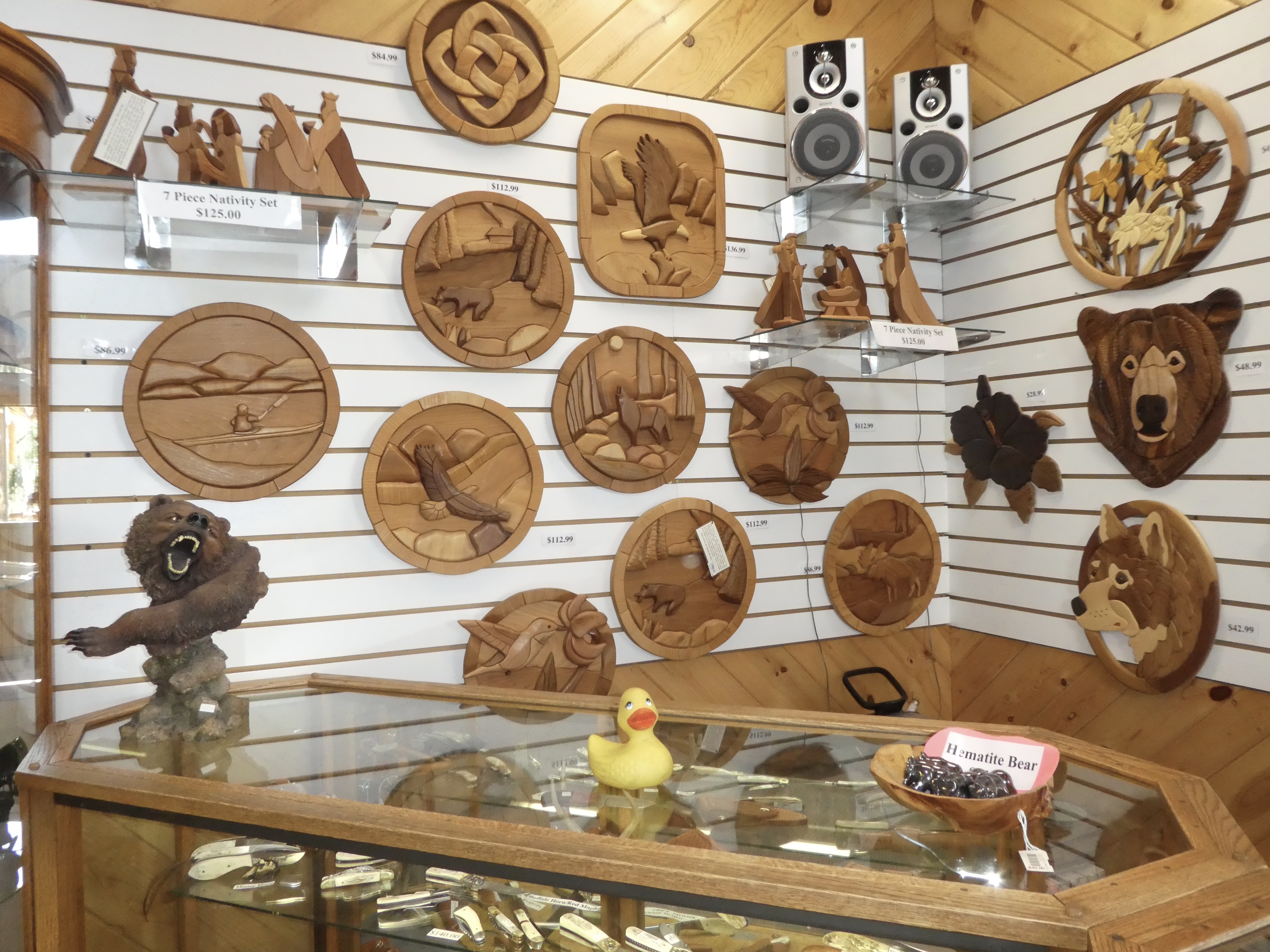
Those are gold dredge buckets in front of the building, by the flower pots.  This is also a gift shop.   Great wood plaques.

Lots of wood

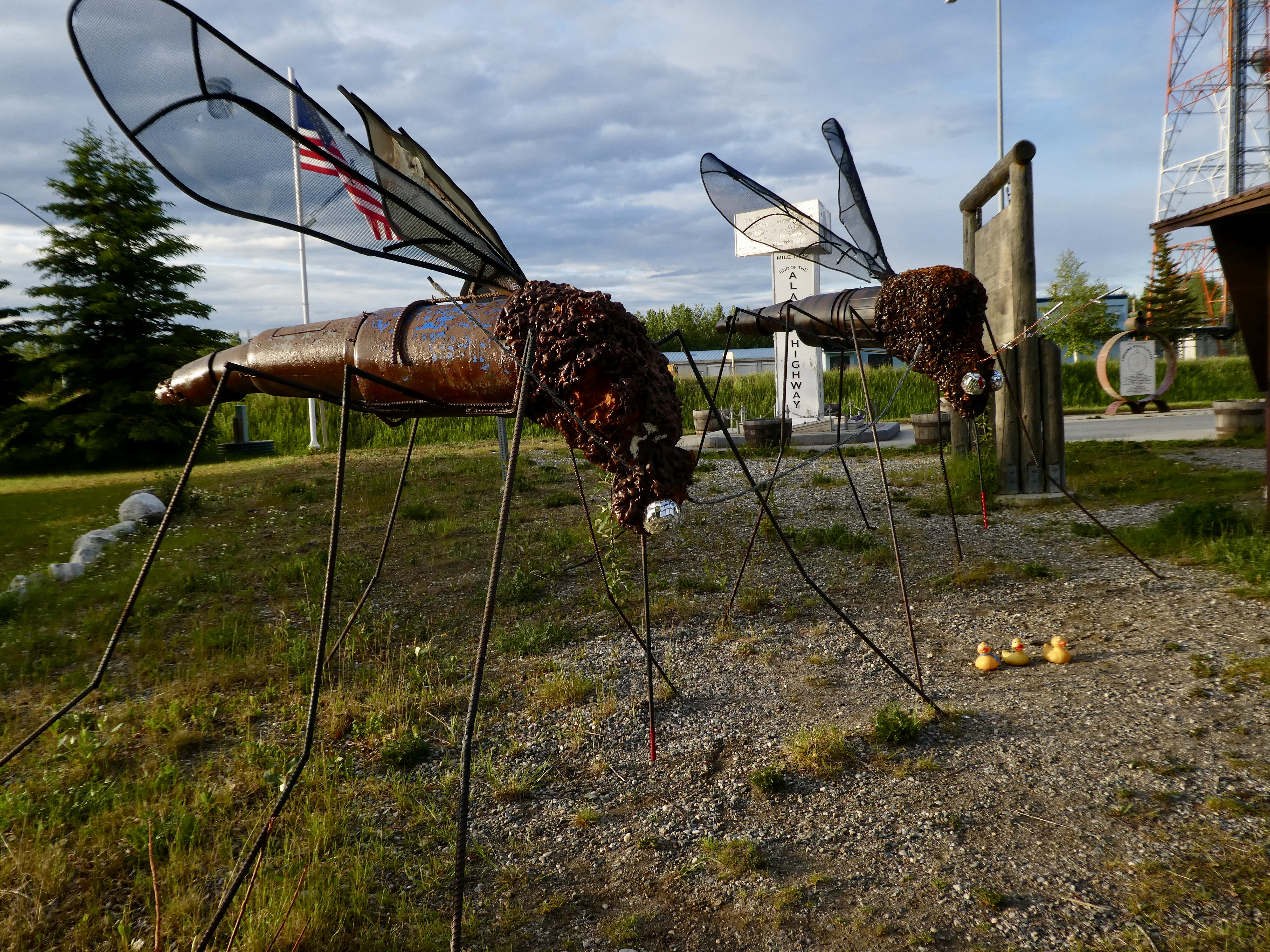
Outside we saw these giant mosquitos.

Mosquitos.

Again, Alaska has big mosquitos, but thankfully, not this huge.   This is the official start of the Alaska Highway for our trip.

Alaska Highway

Our adventure begins.   Now the highway is paved all the way.   Didn’t used to be paved.   Really hard on tires and windshields then.   We are told there are enough gas stations, but always stop.   The next one might be closed.   Several campgrounds and some motels.  A couple times we quickly stopped as huge Alaskan moose crossed the road.   They were too quick for us to get cameras.  The terrain was hilly with mountains to the south, toward Valdez and the end of the TransAlaskan Pipeline.   Best part was only seeing another vehicle every 15-30 minutes.   So peaceful.  About 200 miles (500 km) from Delta Junction, we reached the Canadian border.   We will enter Canada’s Yukon Territory.

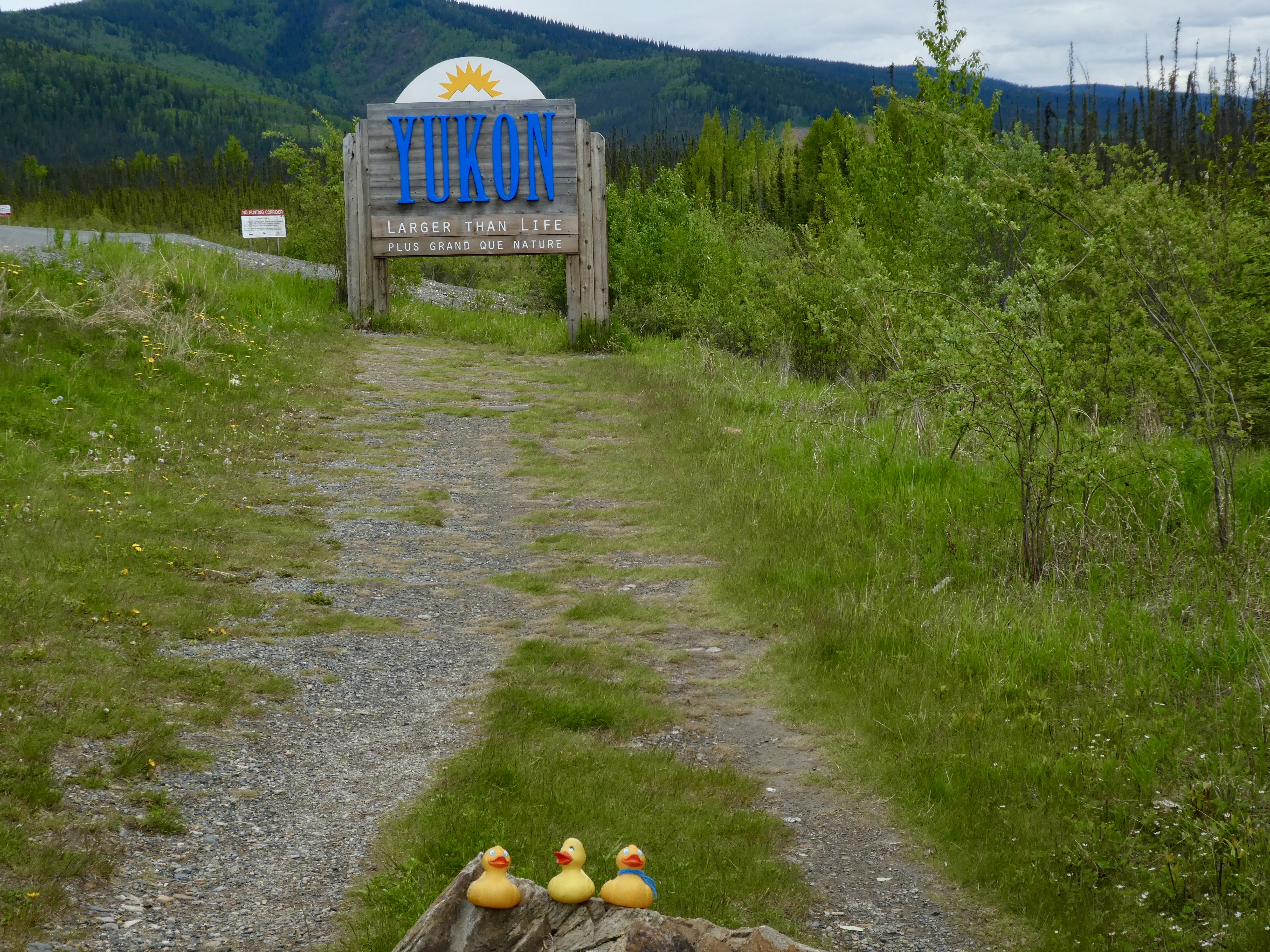
Welcome to Canada’s Yukon Territory

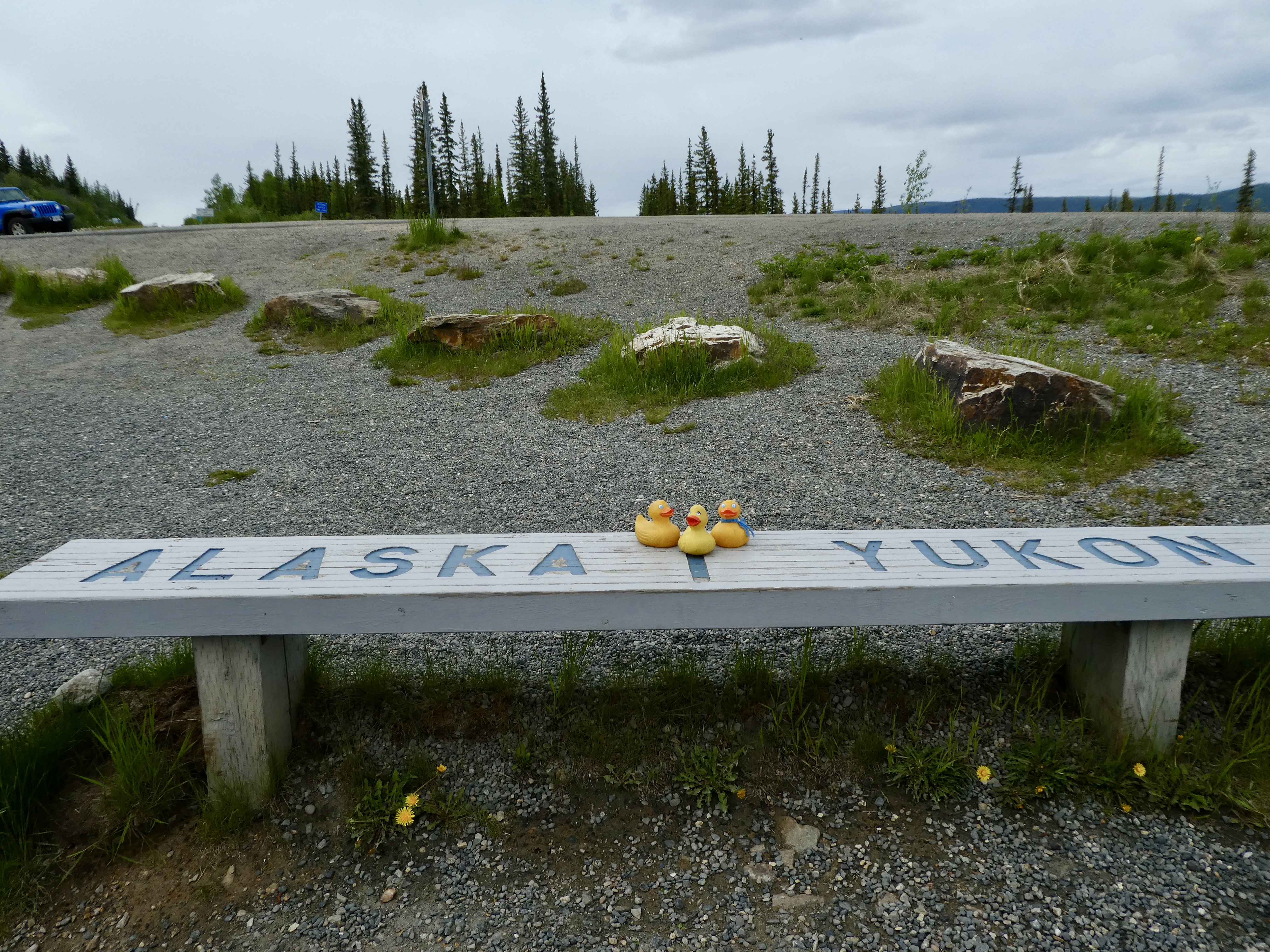
This is the first time for us ducks to visit Canada.   The humans were here before we joined the family.   We are sitting on the Friendship Bench.

Friendship Bench

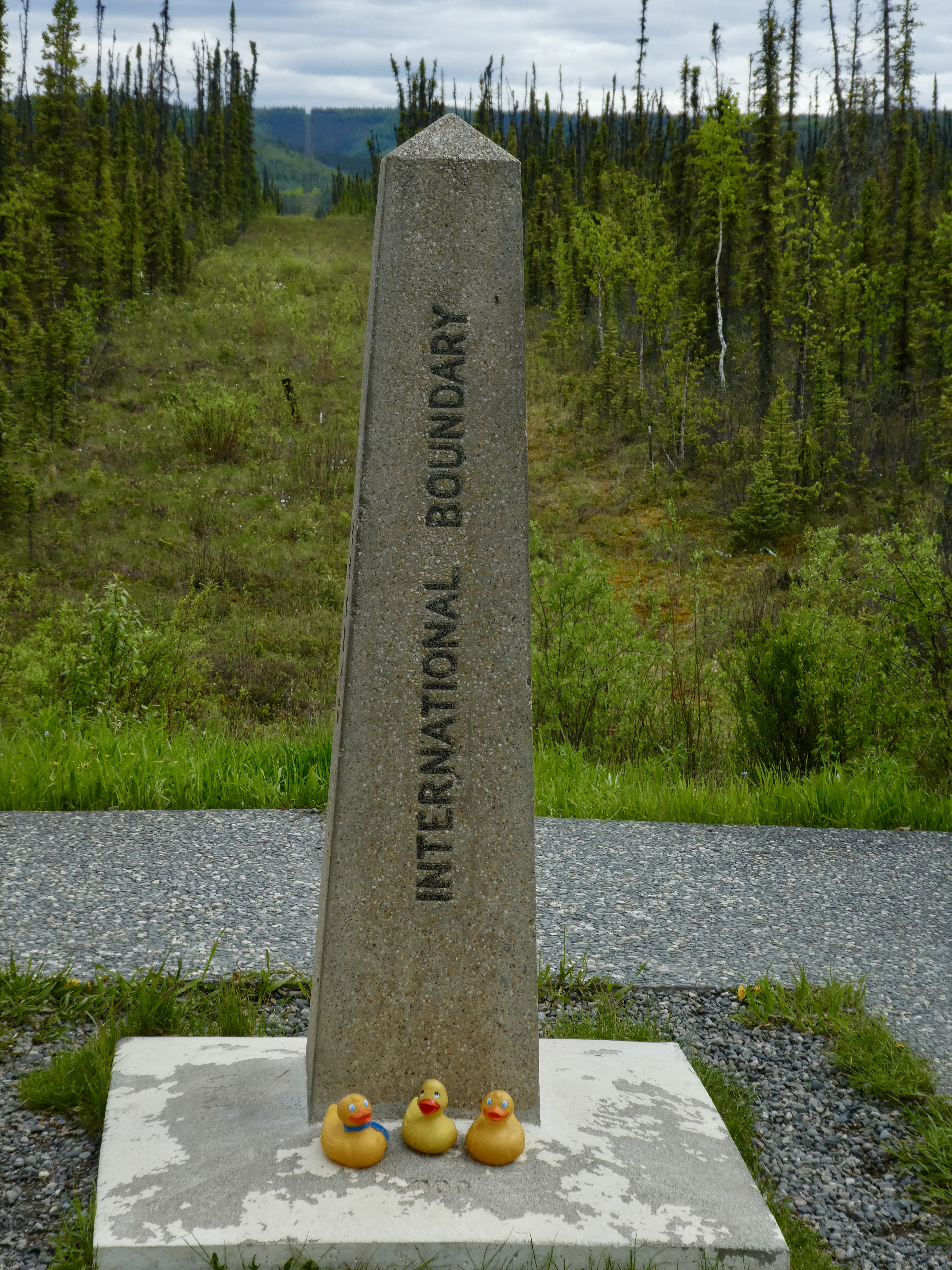
Americans and Canadians are friends.   We see the International Boundary stake, showing the 20 foot (6 meter) path cut by surveyors from 1904 to 1920 along the 141st meridian.

International boundary

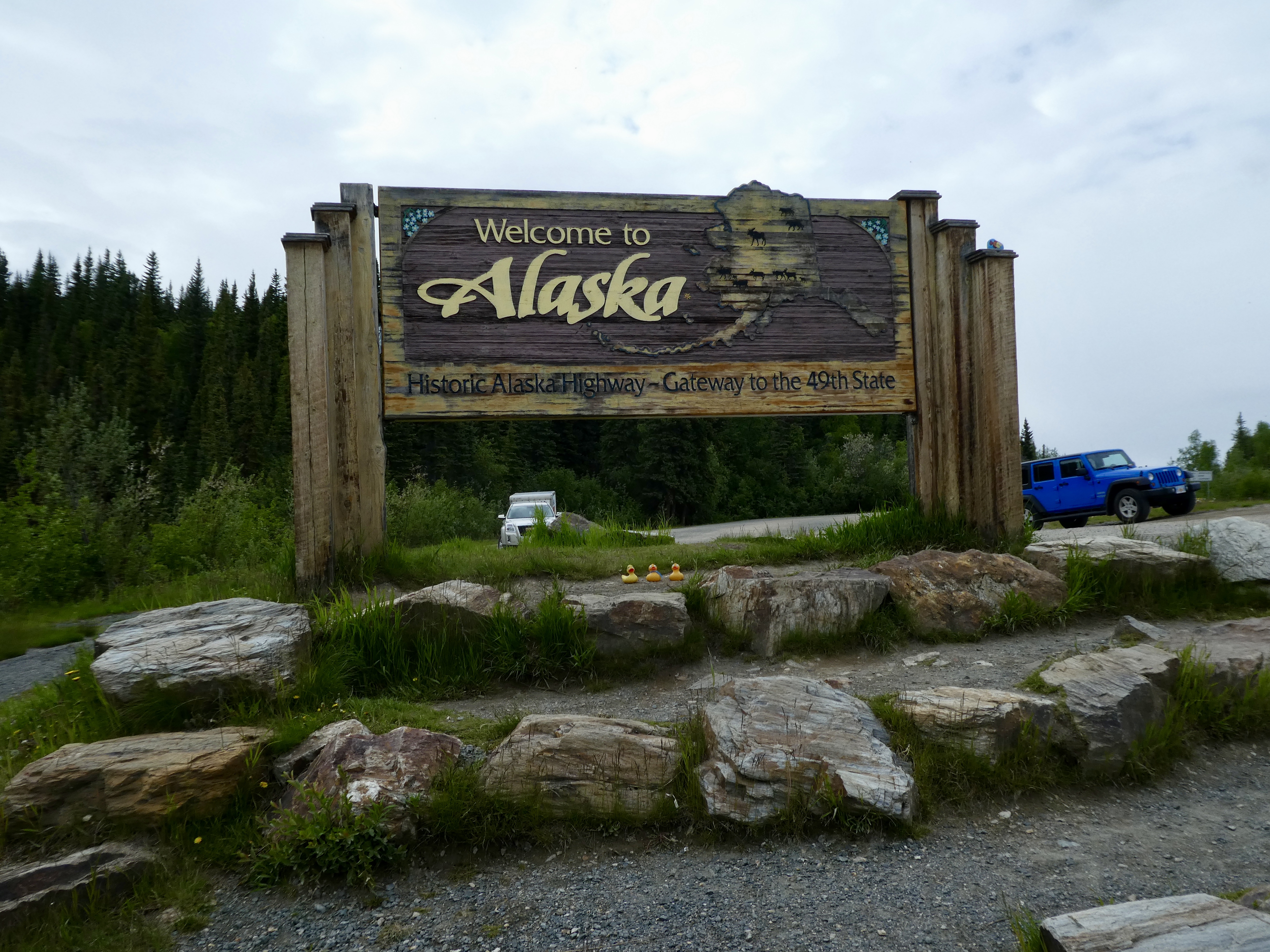
And for those entering Alaska, this sign is a must stop.

Welcome to Alaska

Of course, we had to sit under this sign also.  Isn’t this a beautiful lake, and at the international border.

Love the lake near international boundary

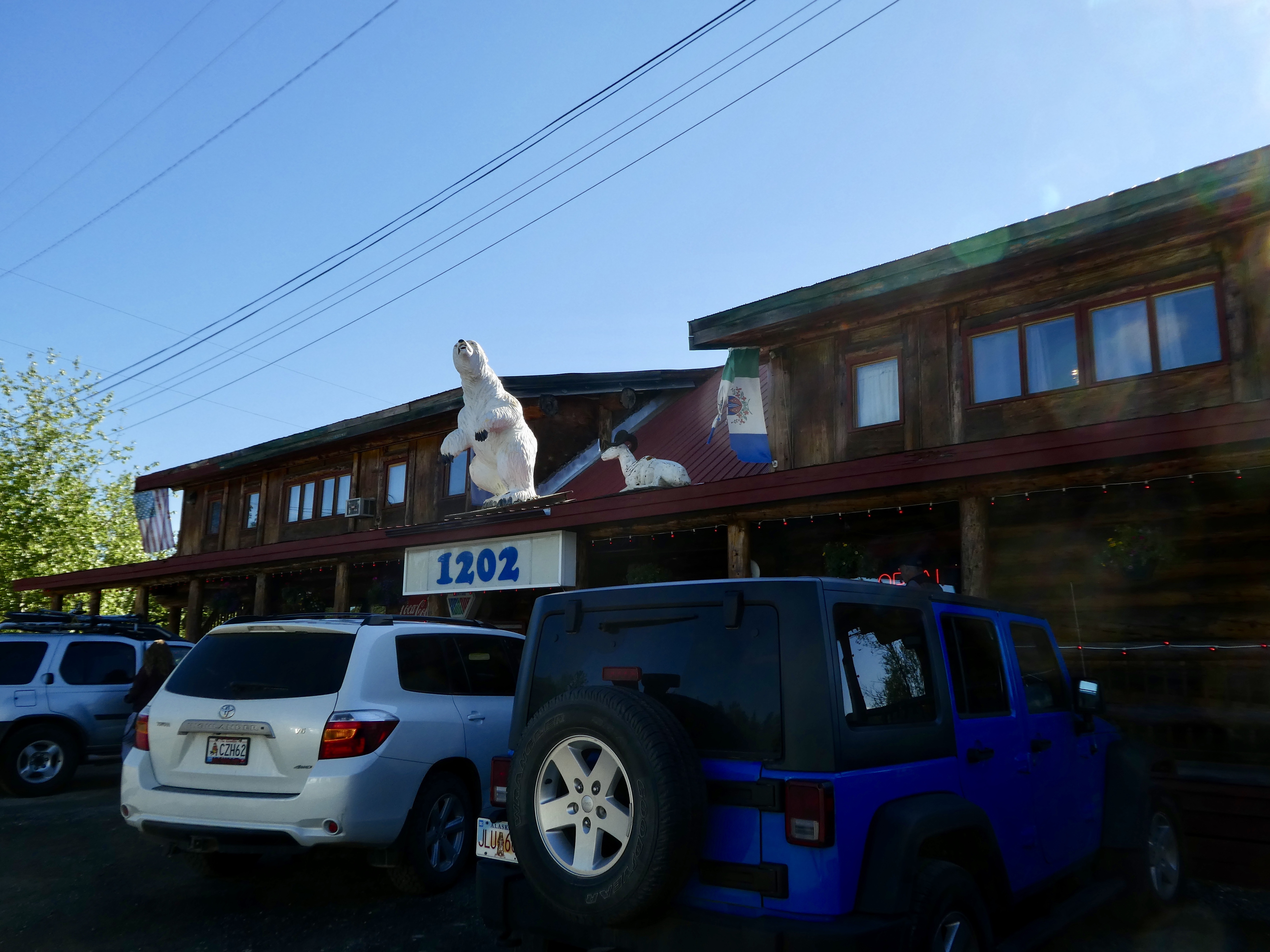
We love these views.   Driving another 10 miles, we stop at the official customs station.   The official was very nice and efficient.   We decided to stop in the first Canadian town.   This is Beaver Creek.   Our Alaska travel planner, The Milepost, says Beaver Creek is the most westerly Canadian community.   This is our motel, 1202 Motor Inn.

Our motel 1202 Motor Inn

Soapy and his mom like the room totally dark for sleeping.   That is hard to do with the long summer days.   There are only a few hours of darkness in the summer.   Mom and I like more windows and some light.   Soapy had a room in the front, with no windows.   Mom and I had a room in the back with windows.

Our room

This is actually a trailer attached to the building.   We were all happy.  Looking across the street, we loved these snow covered mountains.

From front of our hotel

After walking around town, then eating dinner, we slept really well.   Tomorrow we will see more of the Canadian Yukon.

Discovery Riverboat Tour, Fairbanks, Alaska with the Colorado Traveling Ducks

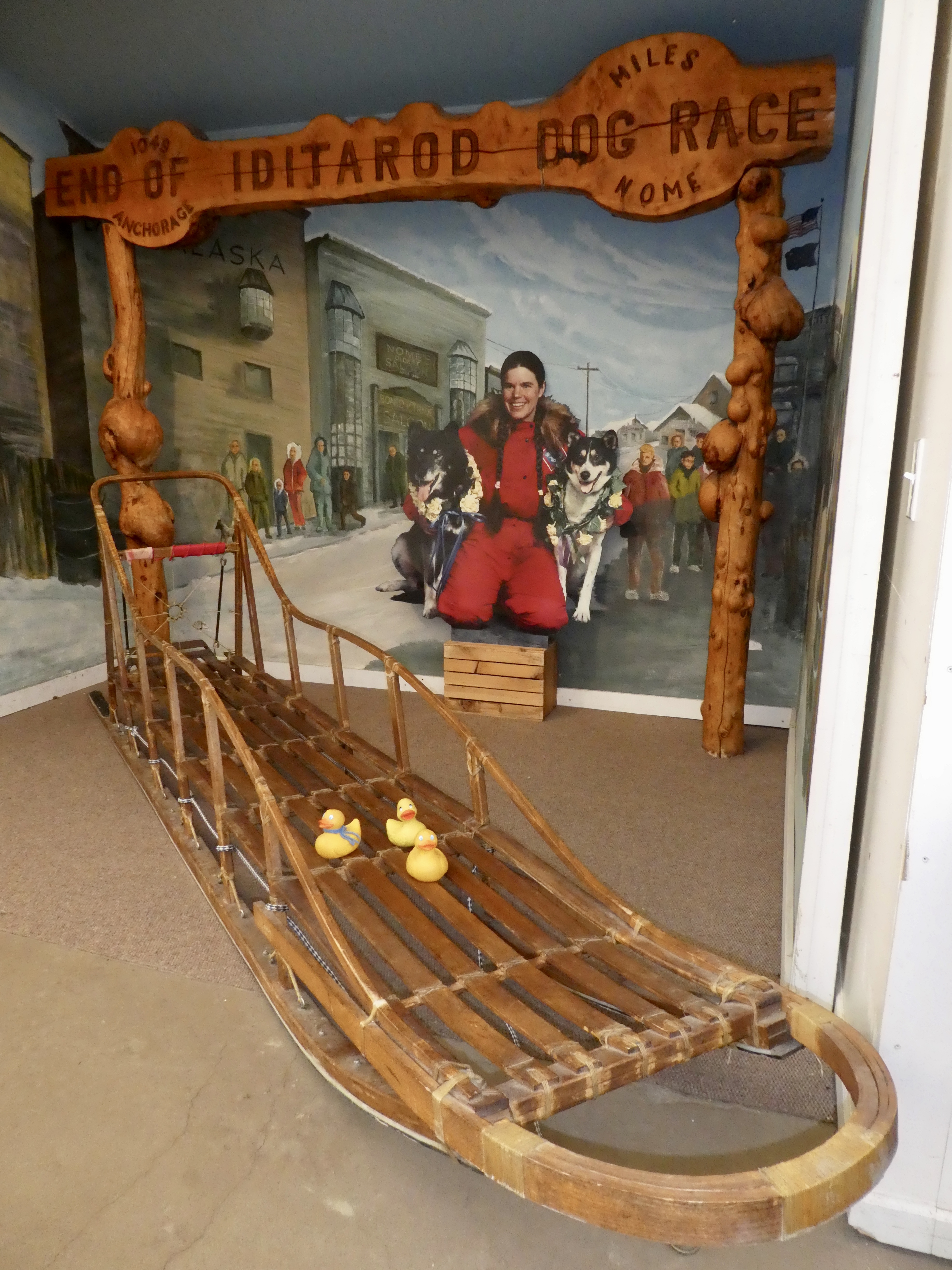
I, Zeb the Duck, had a great surprise last night.   Soapy Smith Duck and his mom flew to Alaska to be with us.   That is wonderful.   Today, I, Zeb, Eider and Soapy Smith Duck, took our two humans on a three hour riverboat tour.   Before getting on the riverboat, we had to look through the gift shop.   In reality, the moms were getting cold.   It was about 50 F (10 C) and the wind along the river was rather chilly.   They had long sleeves and light weight jackets, but they were still cold.   We ducks think they just wanted new jackets.   But, even that is fine.   Of course they bought jackets and we looked around.   Alaska is famous for dog sled racing, and a woman, Susan Butcher was a famous racer.   We loved this display dedicated to her.
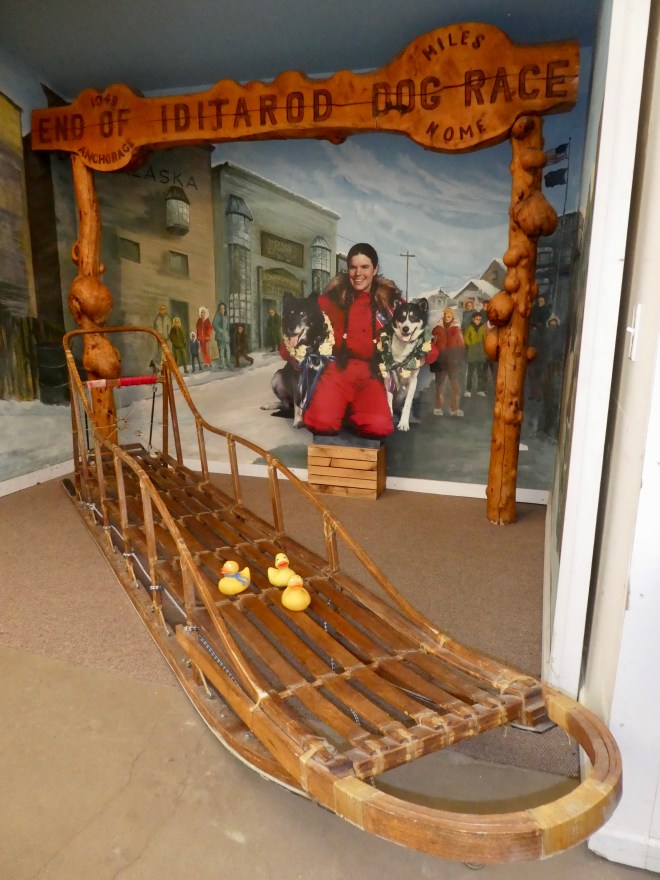
Dog sled with photo of Susan Butcher

We will tell you more about Susan later.   Well, time to get on our riverboat.

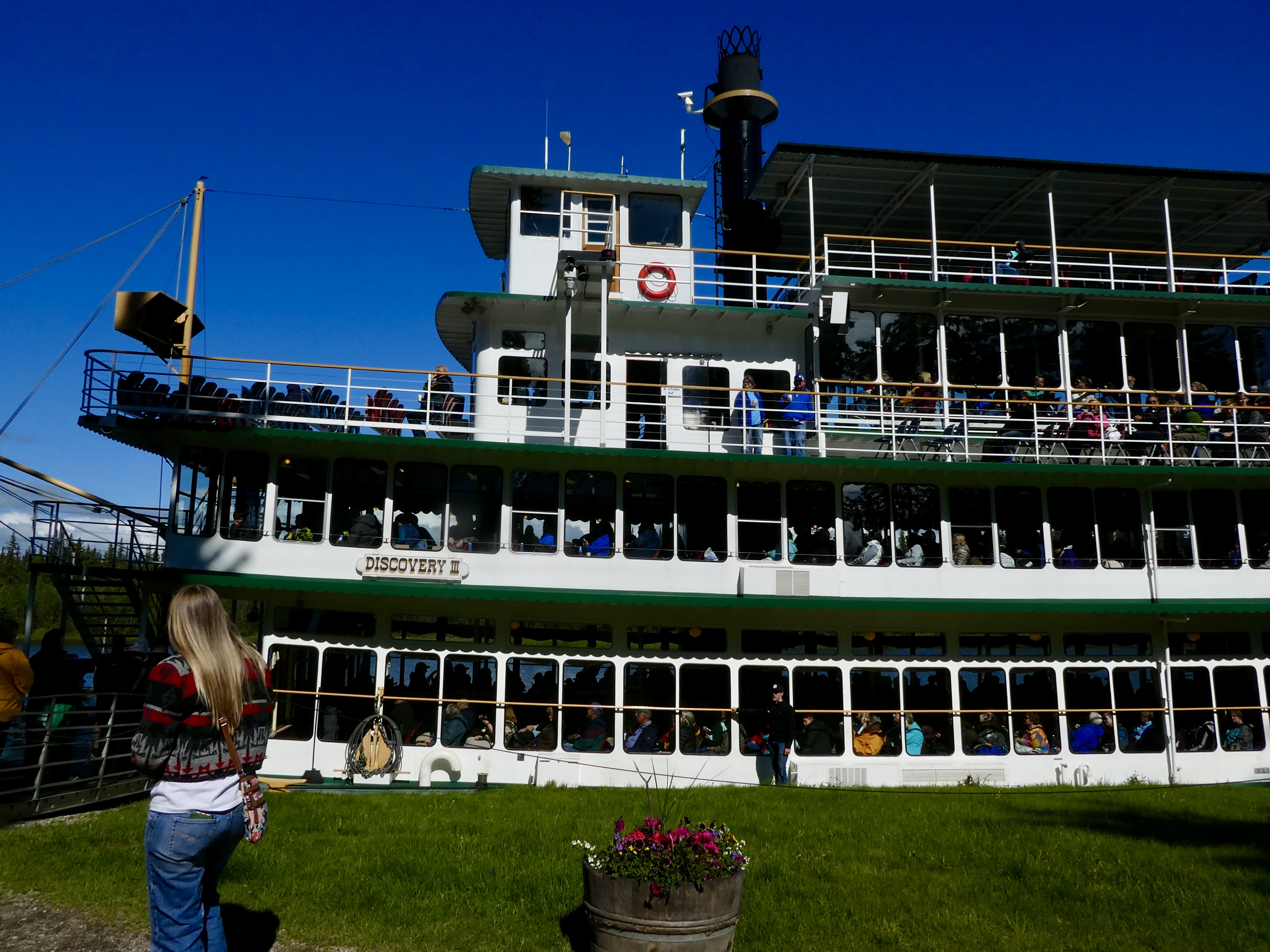
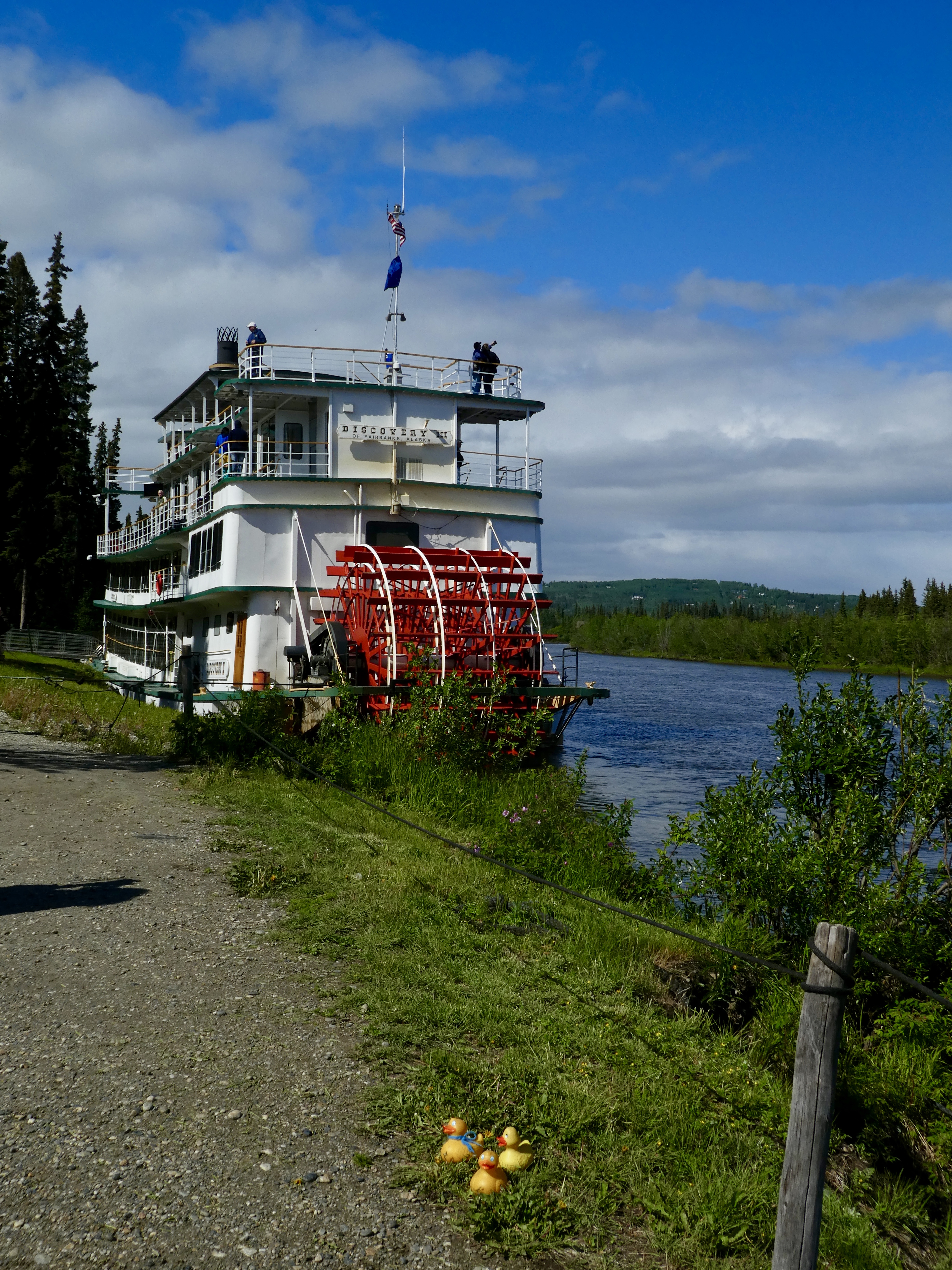
Riverboat Discovery III

This is Riverboat Discovery III.   One of the few sternwheeler boats in use.   We love the paddlewheel in the back.   The information says there are 20 paddles turned by hydraulic motors.   We will show you later.  Shortly after beginning our cruise on the Chena River, we watched a small plane take off on the river.   He circled the area and then, with pontoons, landed on the river.   In Alaska, and most of the Arctic, small planes are the way to travel.   The harsh climate makes building and maintaining roads very difficult.  Our first stop was the dog kennels now owned by Susan Butcher’s daughter, Tekla.   Sure a pretty place.

Tekla, daughter of Susan Butcher talks about her sled dogs

Susan Butcher won the Iditarod Race 4 times.   This is the famous dog sled race from Anchorage, Alaska to Nome, Alaska 1,100 miles away.  Susan passed away August 5, 2006 after a battle with leukemia.   Tekla explains that the dogs want to run.   They will pull that 4 wheeler around the kennel area.   We watch more of the run, but some is just too far out of our view.   We were not allowed to get off the boat.   And this is dog training?
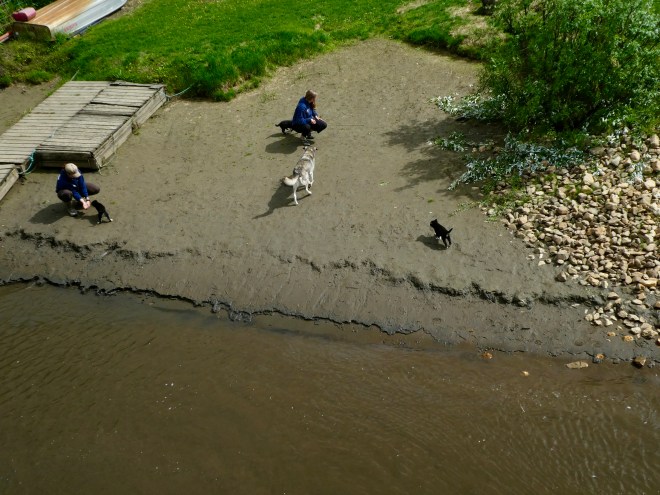
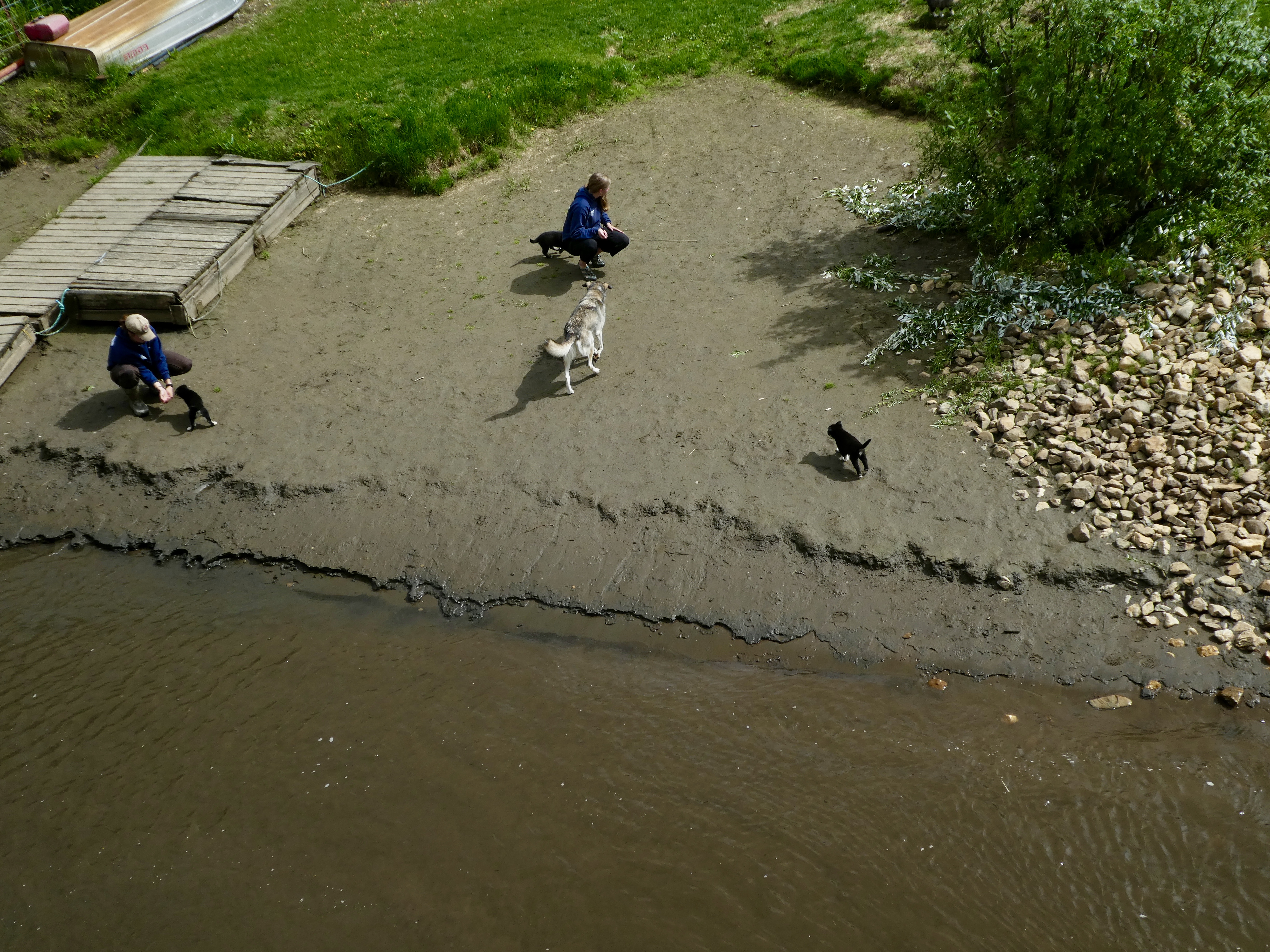
Tekla and young dogs

Tekla says the young dogs are learning to socialize.   Also they are learning commands.   It looks like fun playing on the muddy riverbank.   It is nice that training can also be fun.  Continuing along the river, we come to the meeting of the Chena River and the Tanana River.

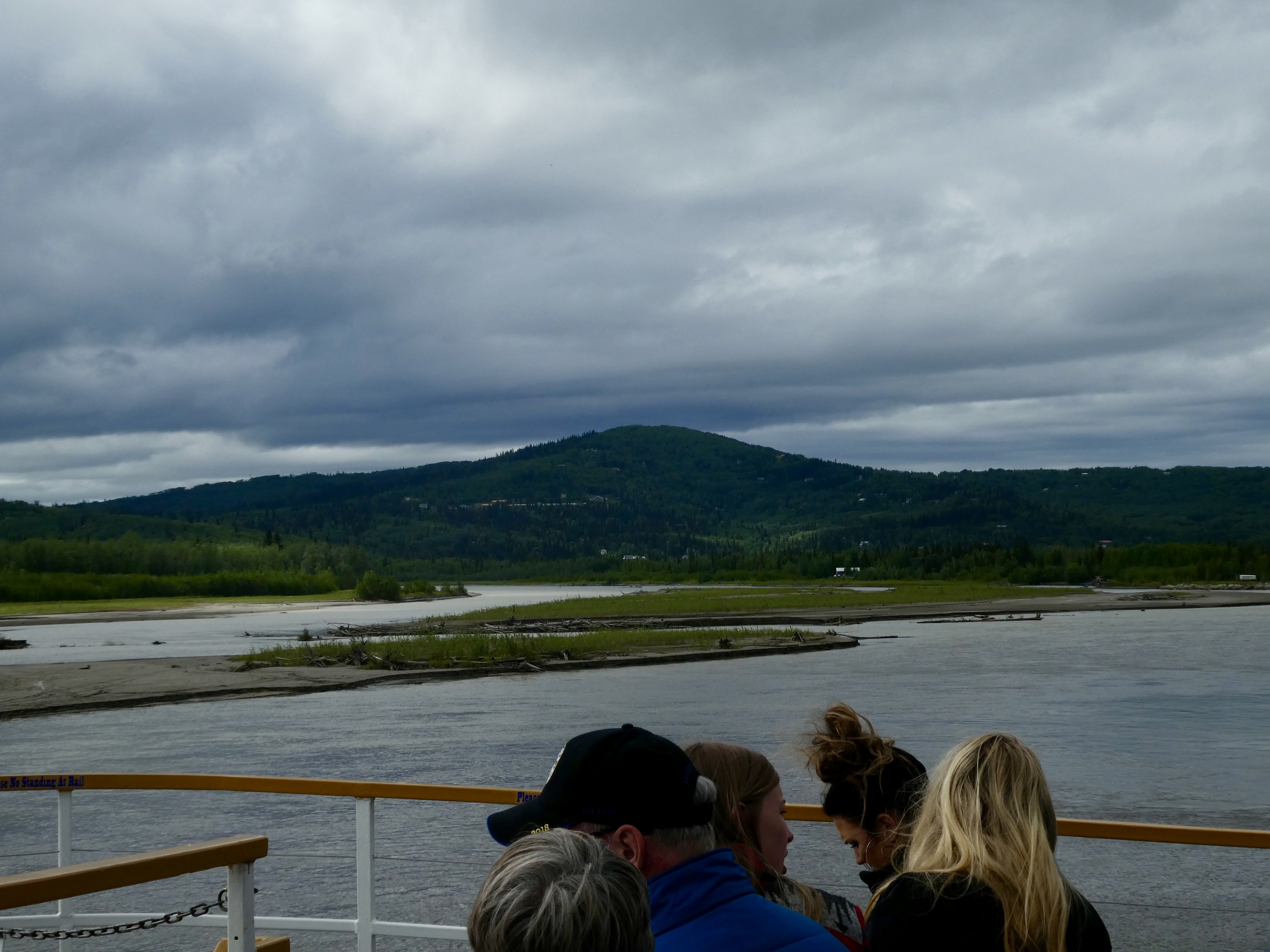
Meeting of Chena and Tanana Rivers

These rivers are tributaries for the Yukon River.   Isn’t this a pretty place?  In 1898 Charles M. Binkley hiked over Chilkoot Pass with other stampeders during the gold rush.   However, he was not particularly looking for gold, he wanted to chart and navigate the Yukon River and its tributaries.   Now, over 100 years and 5 generations of the Binkley family are offering very popular riverboat tours.   Our next stop, is Chena Indian Village.   While still on the boat, this lady, an Athabaskan Indian, shows us how to prepare salmon for the drying racks.
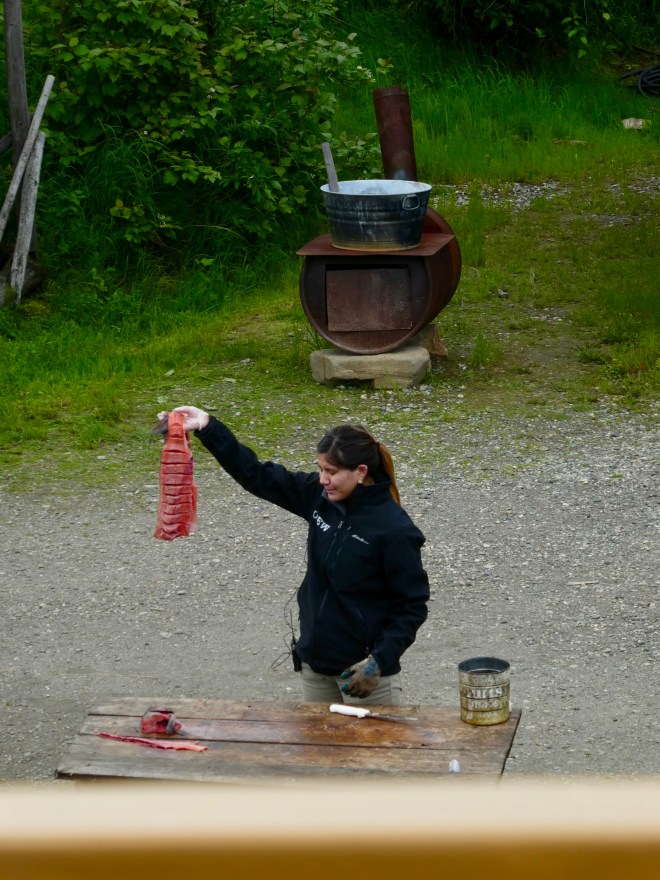
Salmon cut and ready for drying racks

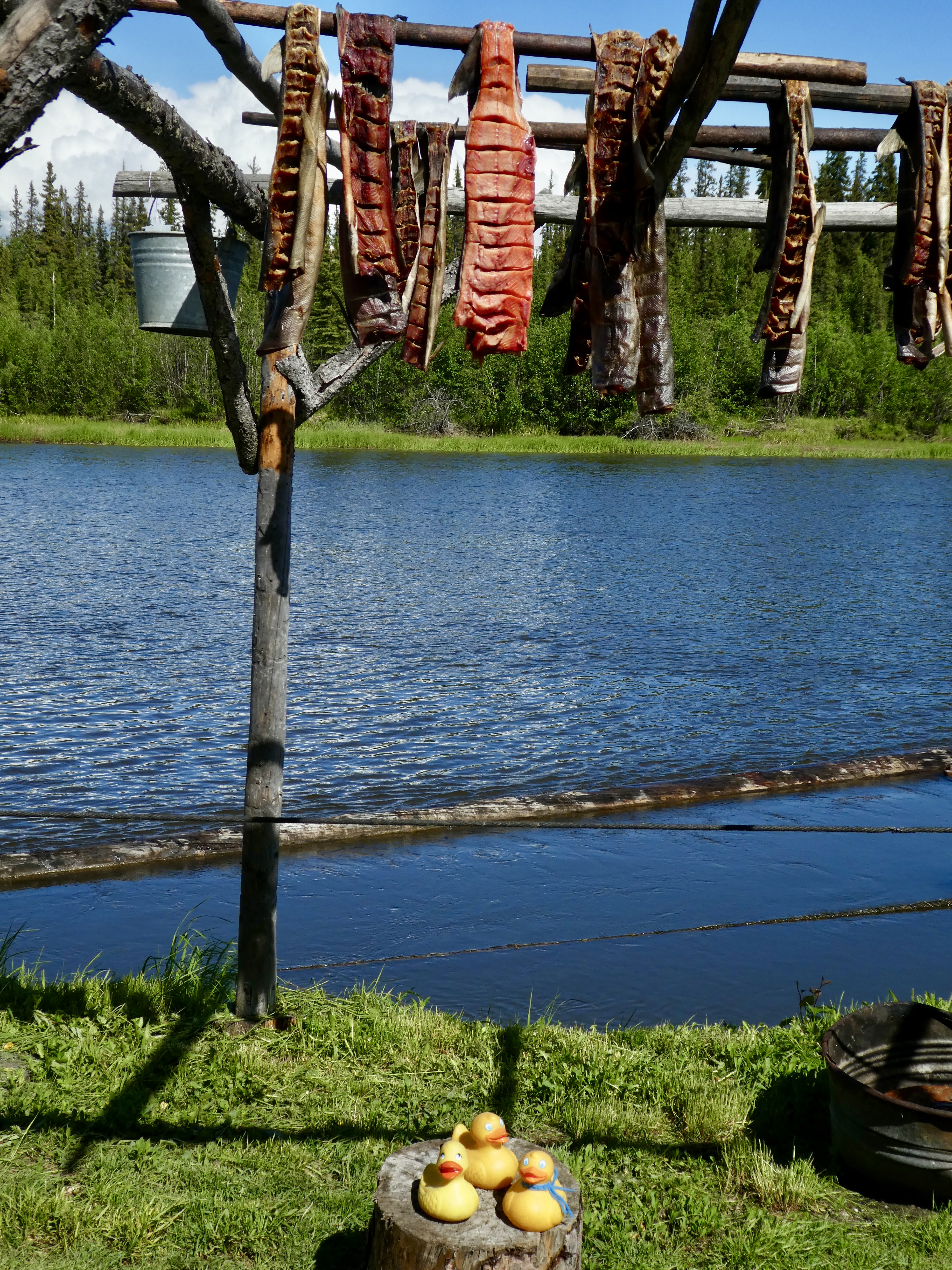
Skinned, filleted, cut or scored, and ready for the drying racks now.

Salmon drying

She made it look so easy.   We get off Discovery III, our riverboat, and explore this village.   This is a fish wheel.

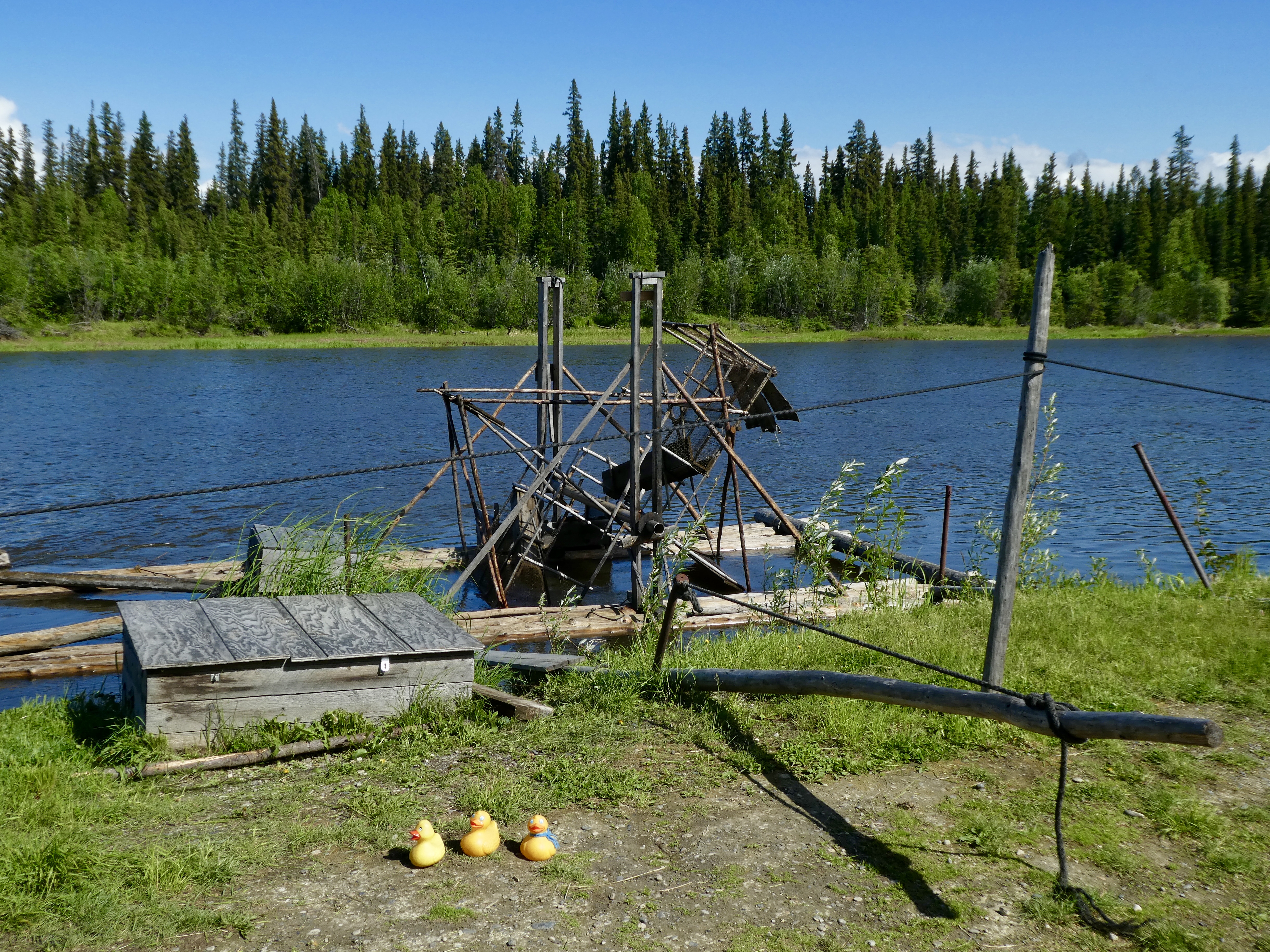
Fish wheel

The fish swim into the turning wheel and get caught.   This is easier that using an actual fishing pole.   The Athabaskans only catch and keep what they need.   During the long Arctic winters people may get lost or delayed while traveling.   This is a cache.   Notice that it is too high for animals to get inside.

Cache

It keeps necessary supplies for whom ever needs them.   Also, the cache is supplied by the owner for his own travels.   If you use something from the cache, try to replace it when you can for the next person.   Remember these winters have long nights and short days.   Temperatures of -40 (same for F and C) are not uncommon.   People help each other to survive these harsh conditions.   Of course in the summer, the days are long and the nights very short. In Fairbanks, in late June, there are 3 or less hours of darkness.   While in Chena Indian Village, we were taught some of the ways of the Athabaskan Indians.   We met the reindeer.
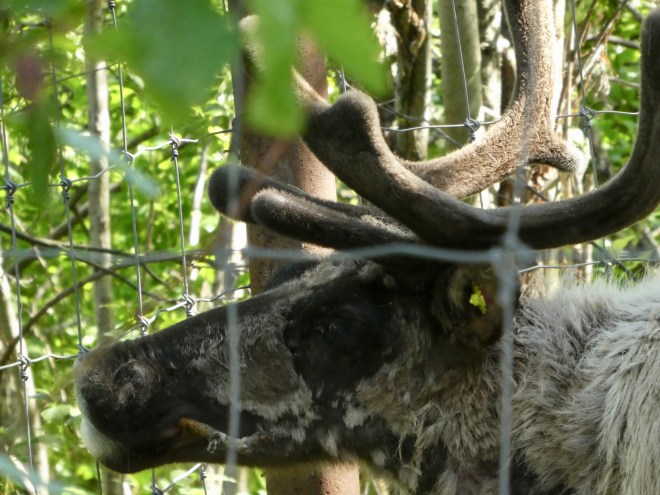
Reindeer

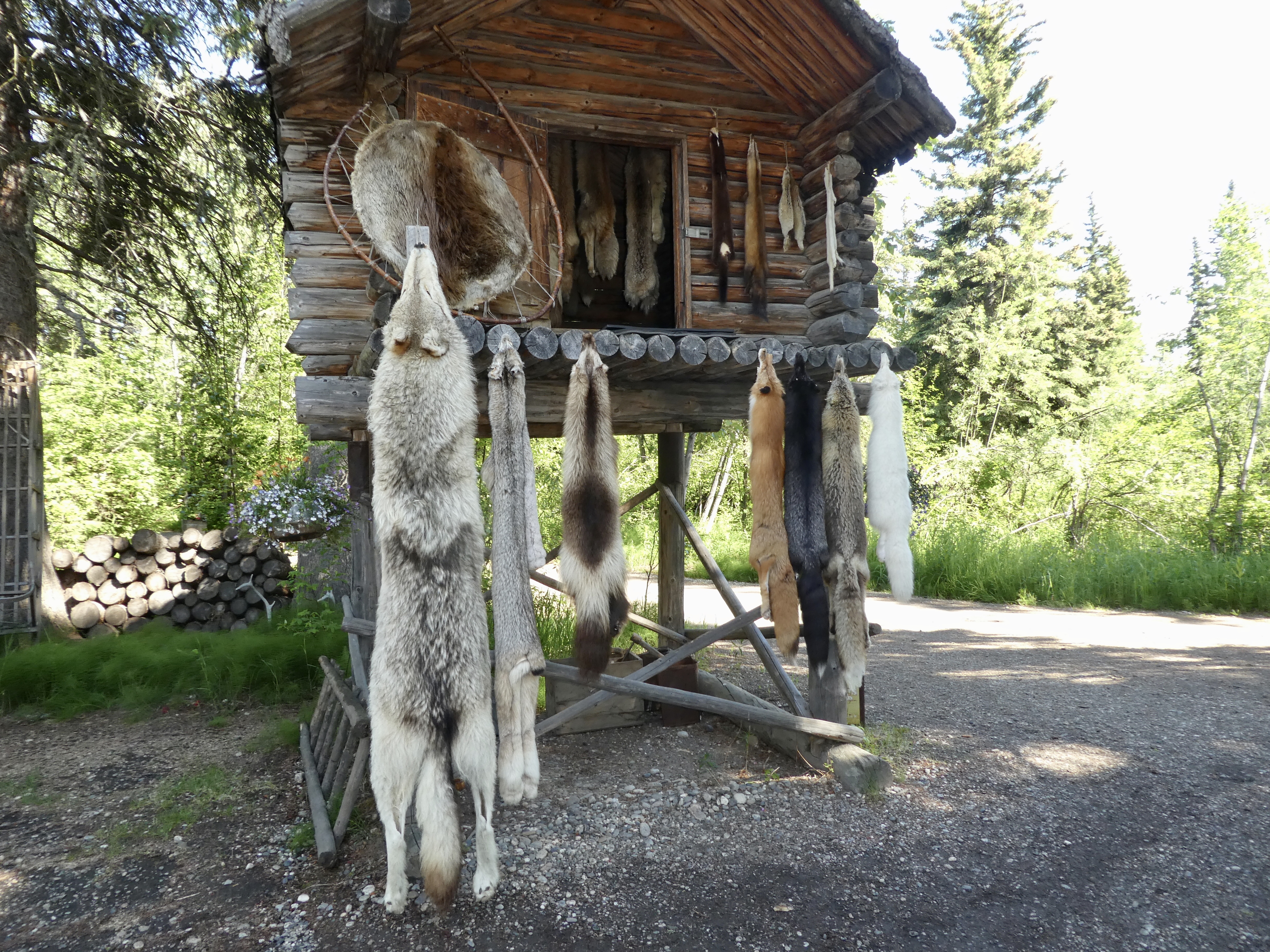
This reindeer are kept in a large enclosure for us to see.   They receive a healthy diet and are well cared for.   These are samples of fur pelts.

Fur pelts

These furs are very warm and necessary during the cold winters.   Here is a young lady wearing a very warm fur coat.
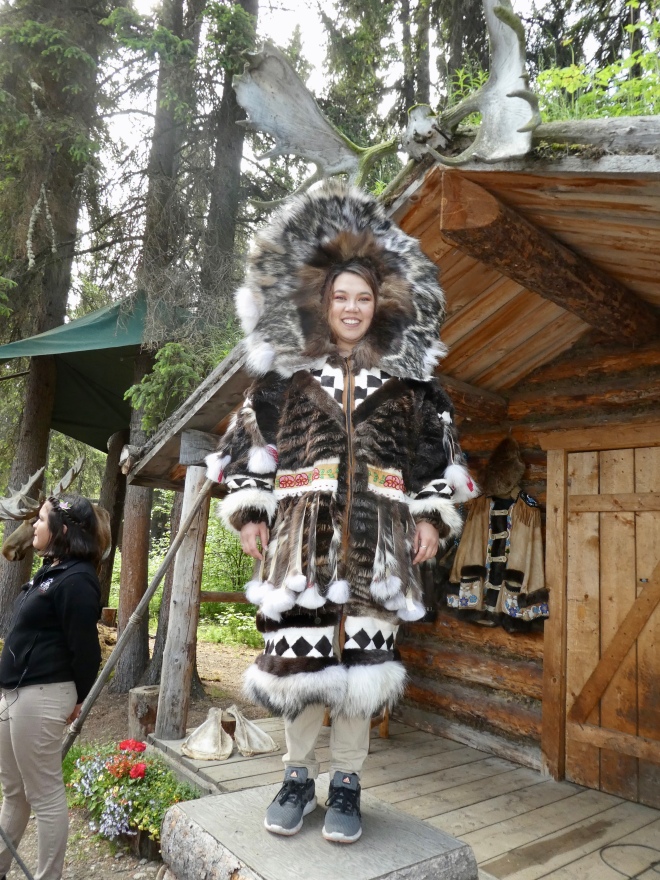
Athabaskan Indian girl in warm, decorative fur coat

Much work goes into making this coat and it is certainly well cared for and a prize possession.  Our last stop was the gift shop.  This is a statue of Granite.

Granite. Lead sled dog

Granite was the runt of the dog litter, but Susan Butcher saw great potential in him.  Granite became her lead sled dog and Granite lead her team to four wins in the Iditarod Dog Sled Race.   Discovery III is waiting to take us back to the starting point and to our cars.

Our boat, Discovery III, waiting for us

That is a great paddlewheel.   This a great boat tour.   When in Fairbanks we hope you enjoy this trip.   We loved it.
The Knotty Shop With Zeb and Eider Duck. Only in Alaska

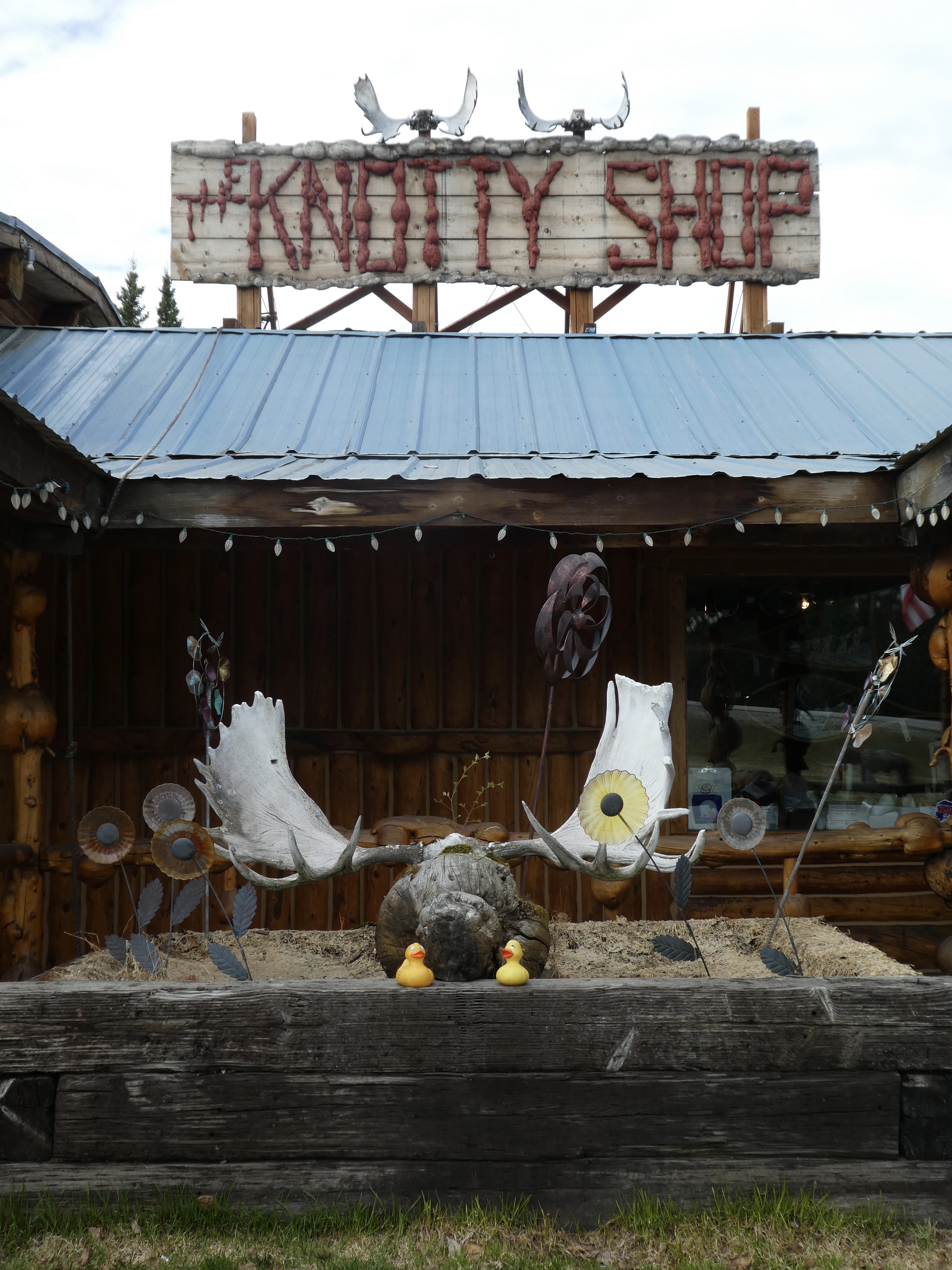
It is time for a little shopping in an unusual store.   This is The Knotty Shop in Salcha, Alaska. Follow the Richardson Highway south from Fairbanks to Salcha and you will discover The Knotty Shop.   Founded in 1989 to showcase Alaskan made gift items, this is a great store.

The Knotty Shop.  We are by a moose head.

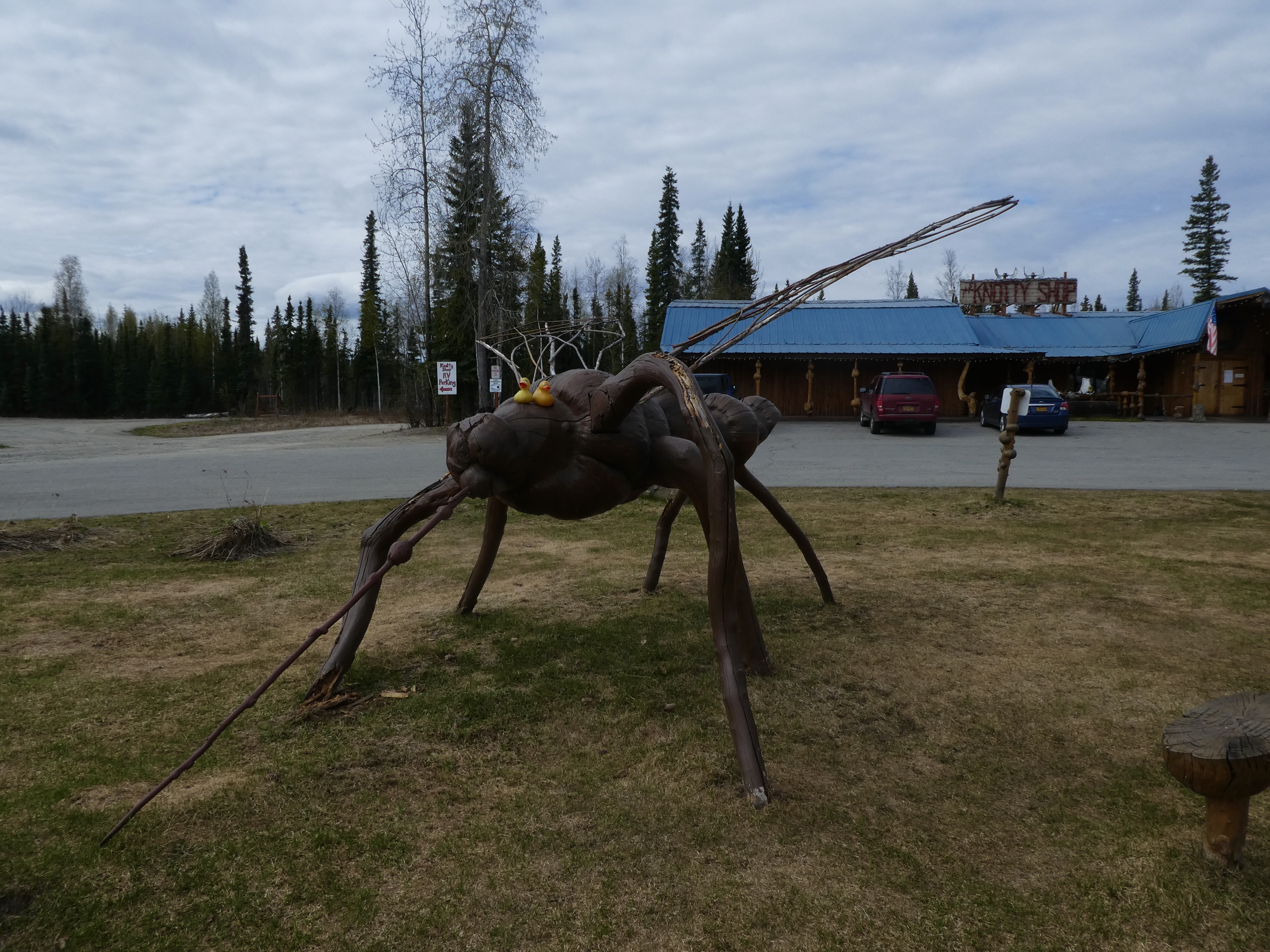
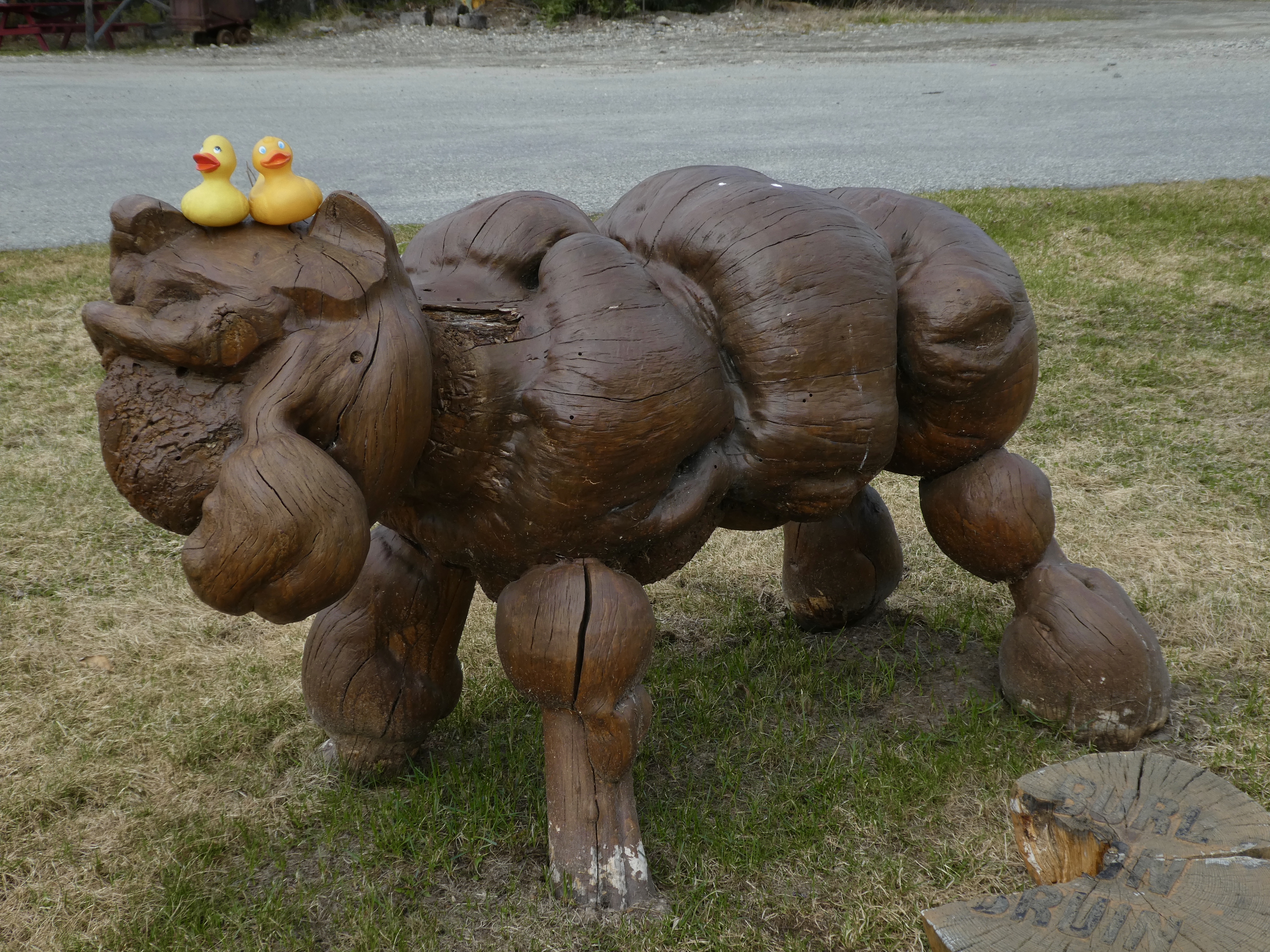
The posts and animals in front of the store are made of knotty pine.   Alaska has giant mosquitoes, but we are glad they are not really this big.

Giant mosquito

That stinger could kill humans and small ducks.

animal

There are a few animals carved here.

animal

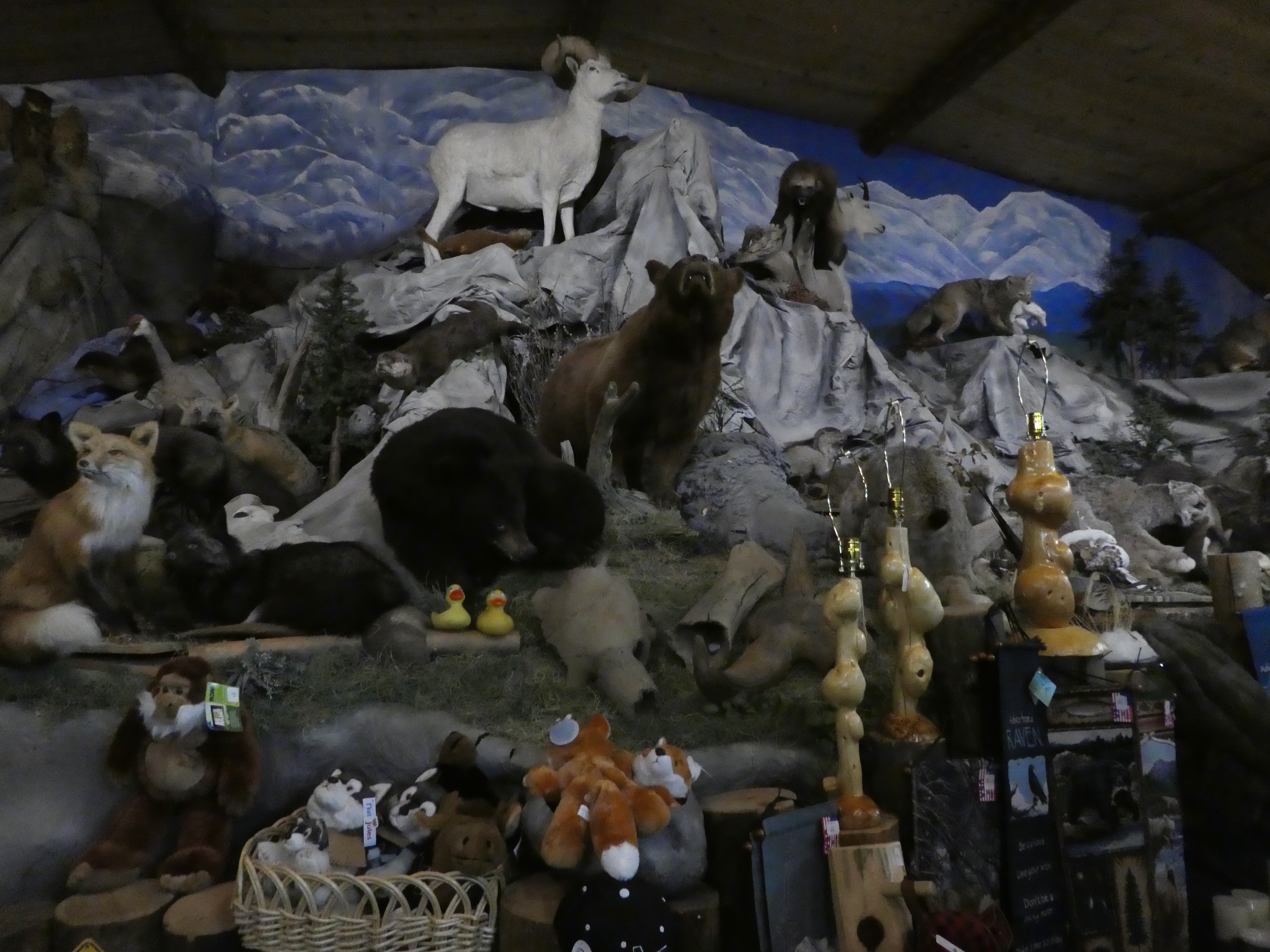
Even if the store wasn’t fascinating, and it is, these animals of knotty pine would make us enter this shop.  Toward the back of the store, we enjoyed this mountain with Alaska’s animals.

Animals of Alaska

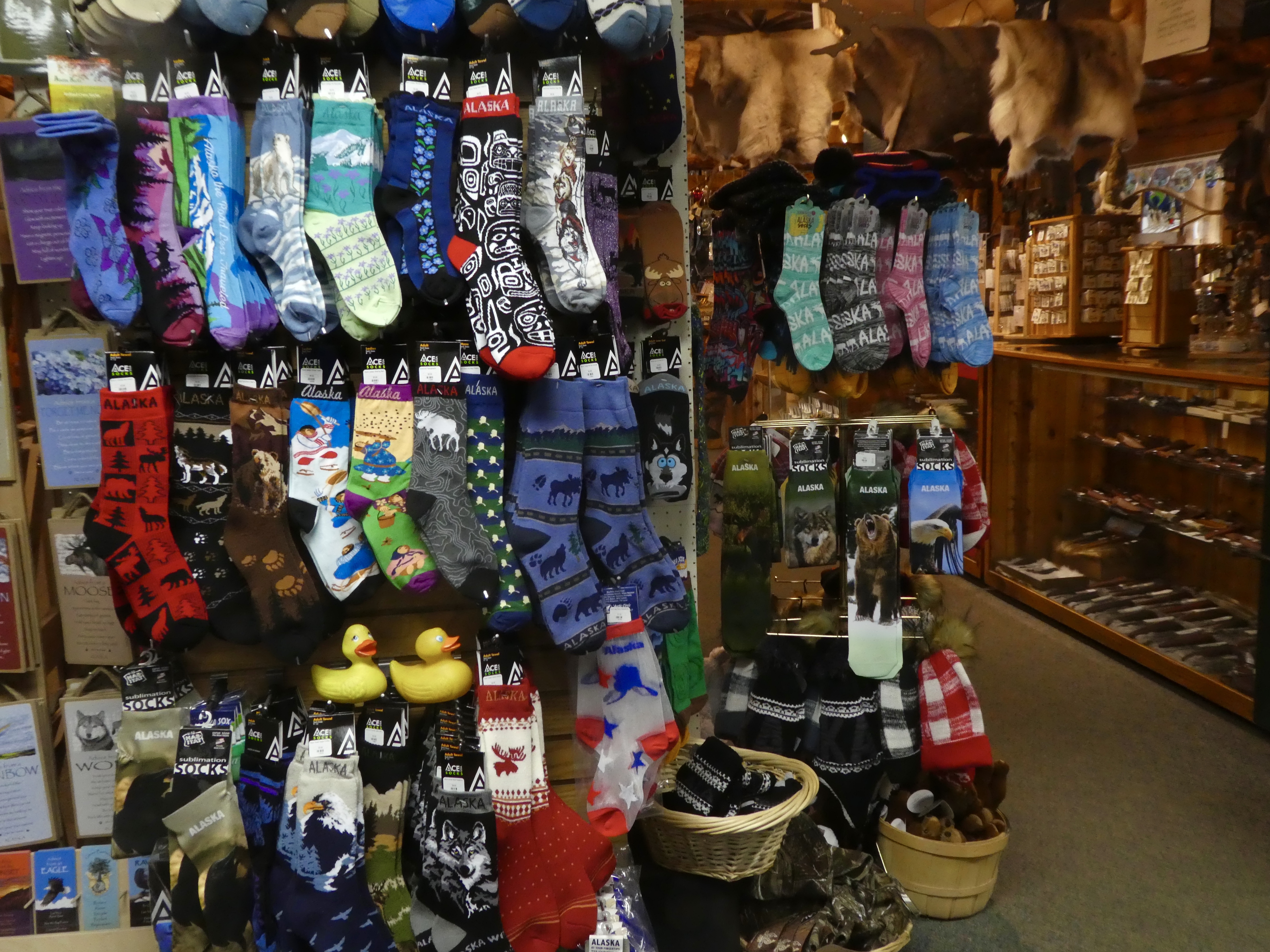
We Colorado Traveling Ducks have seen most of these alive while exploring Alaska.   The sock displays always intrigue mom.

Sock display

We have some of these socks at home now.

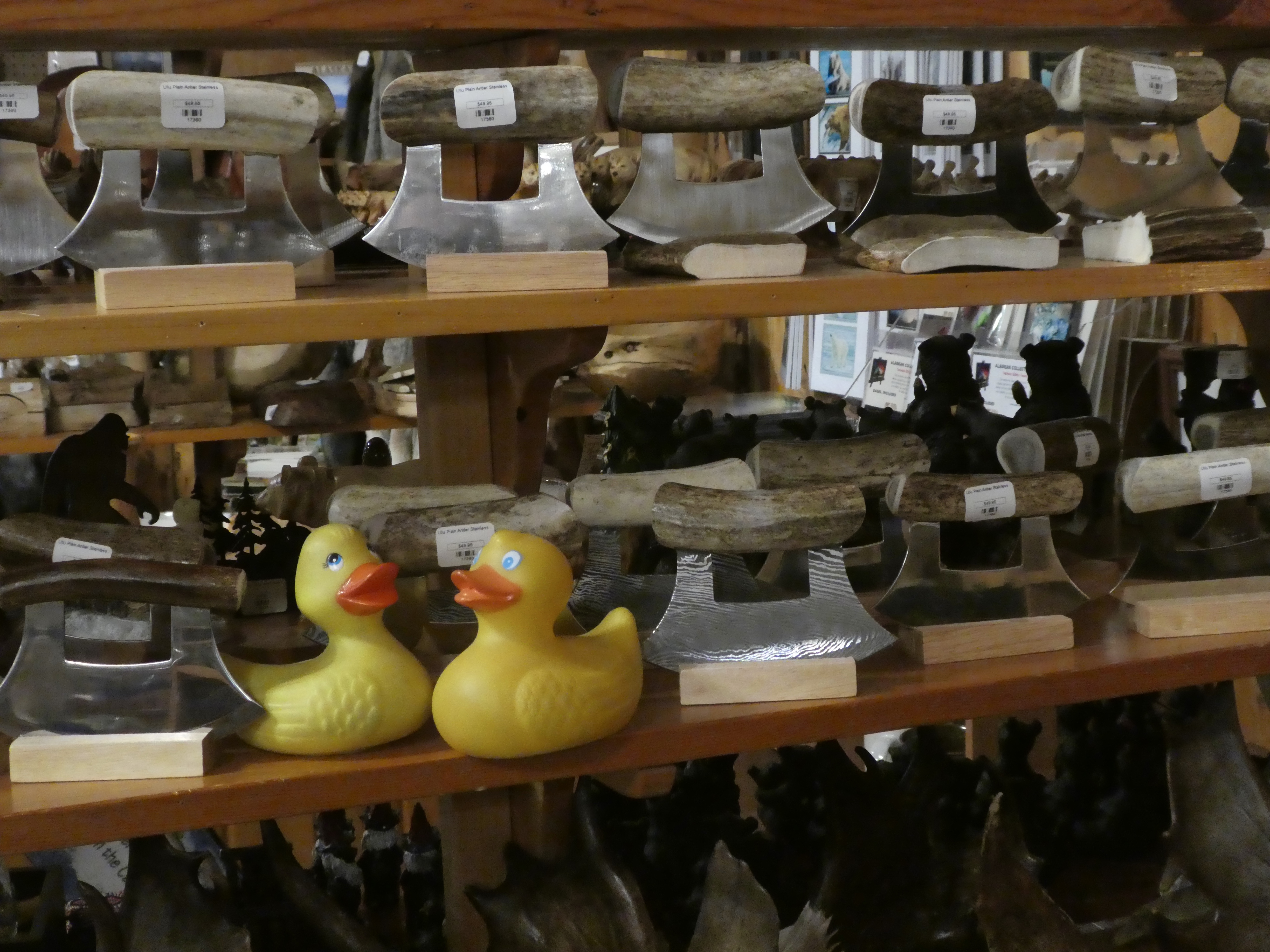
Ulu Knives

The Ulu knife of Alaska is handy for chopping and cutting.   This is a nice display with many choices for Ulu purchasing.  Hungry?

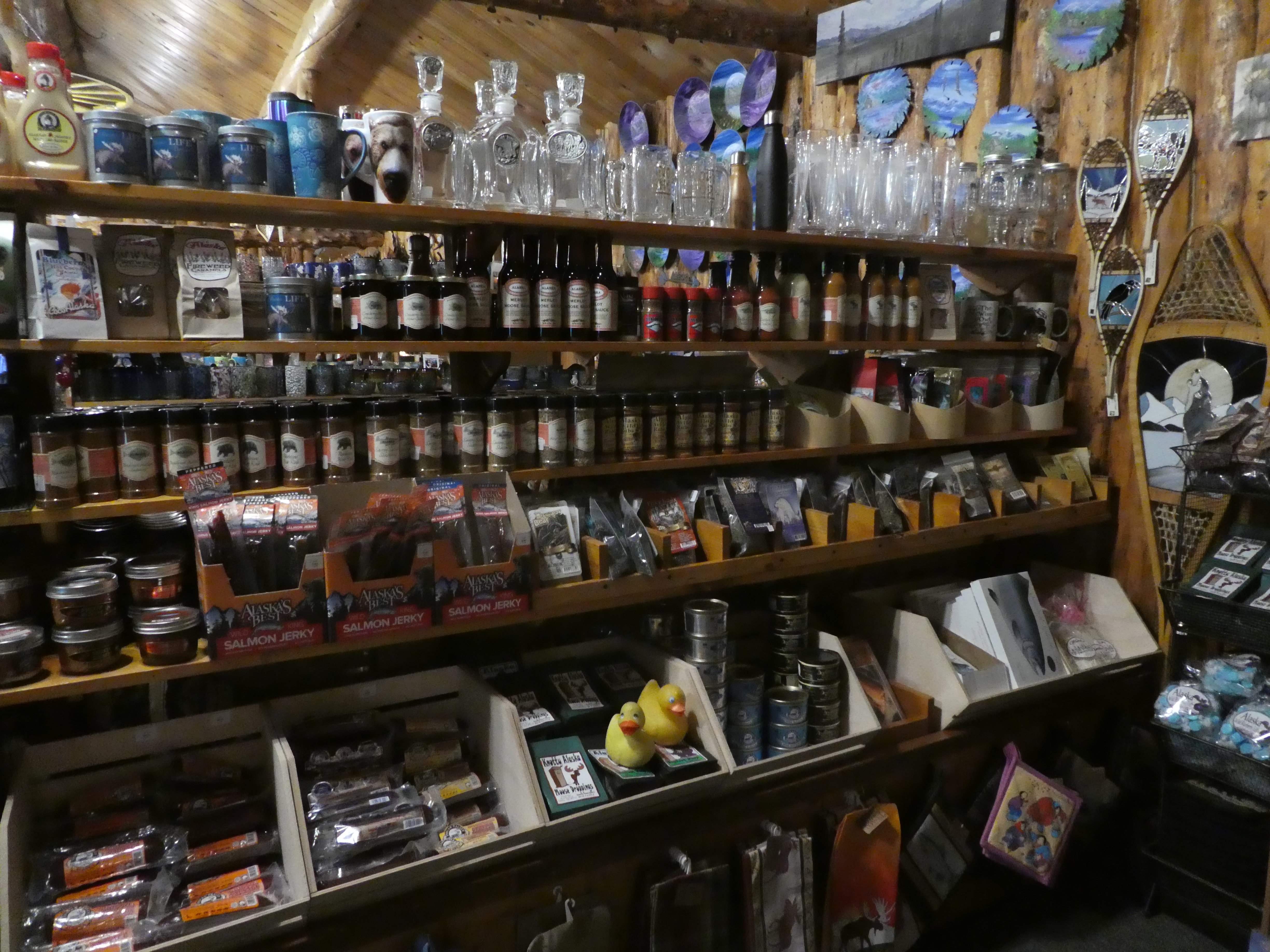
Alaskan made jams, jellies and sausage.

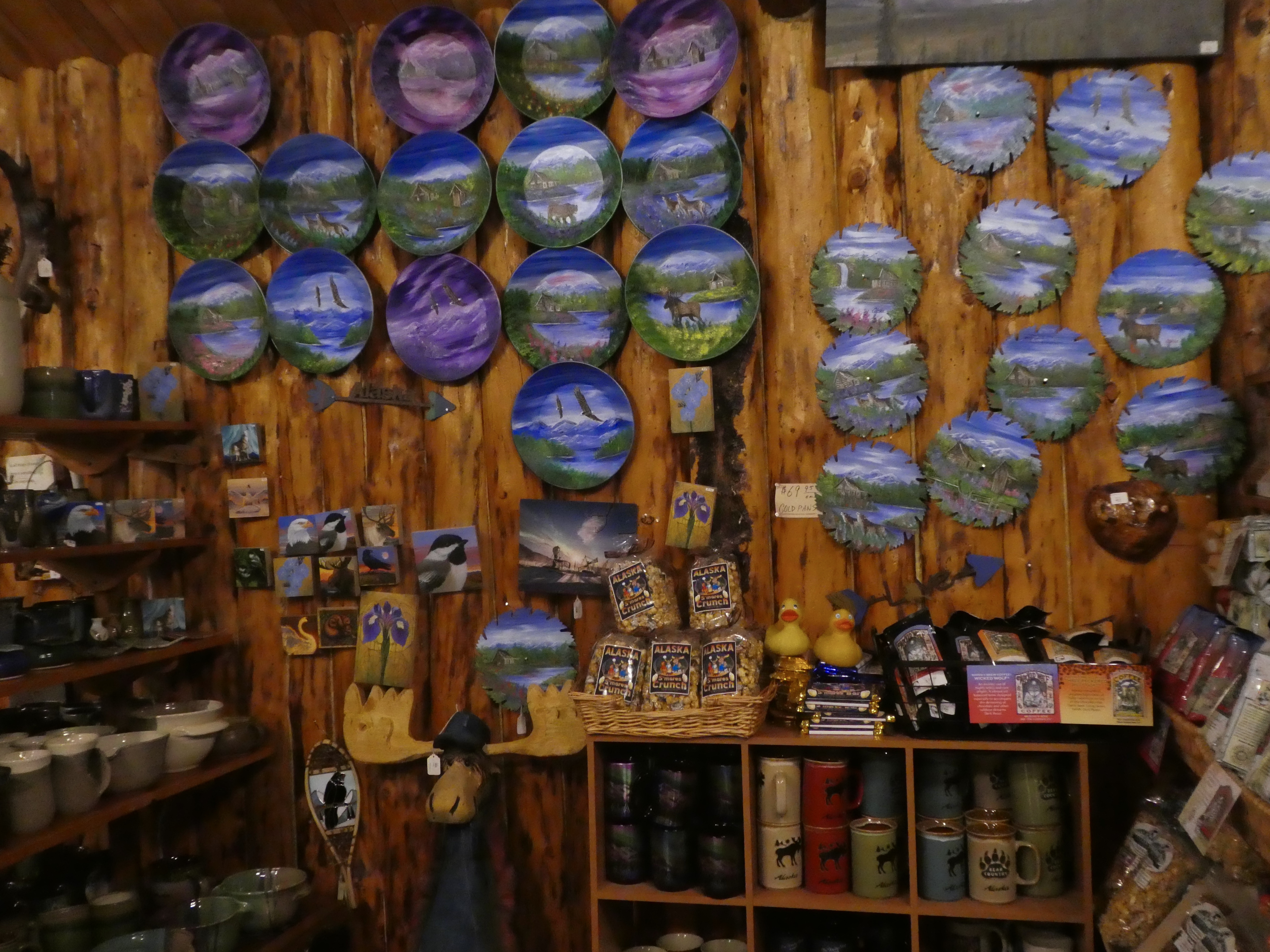
If you weren’t these jams and jellies will tease your taste buds.   And the sausage is flavorful.   Go ahead and indulge.   They are delicious.   These painted gold pans and saw blades are useful and decorative.

Painted gold pans and saw blades

We have gold pans and gold mining in Colorado, but we love these pans with Alaska scenes.   After a hard afternoon of shopping, we needed some ice cream.

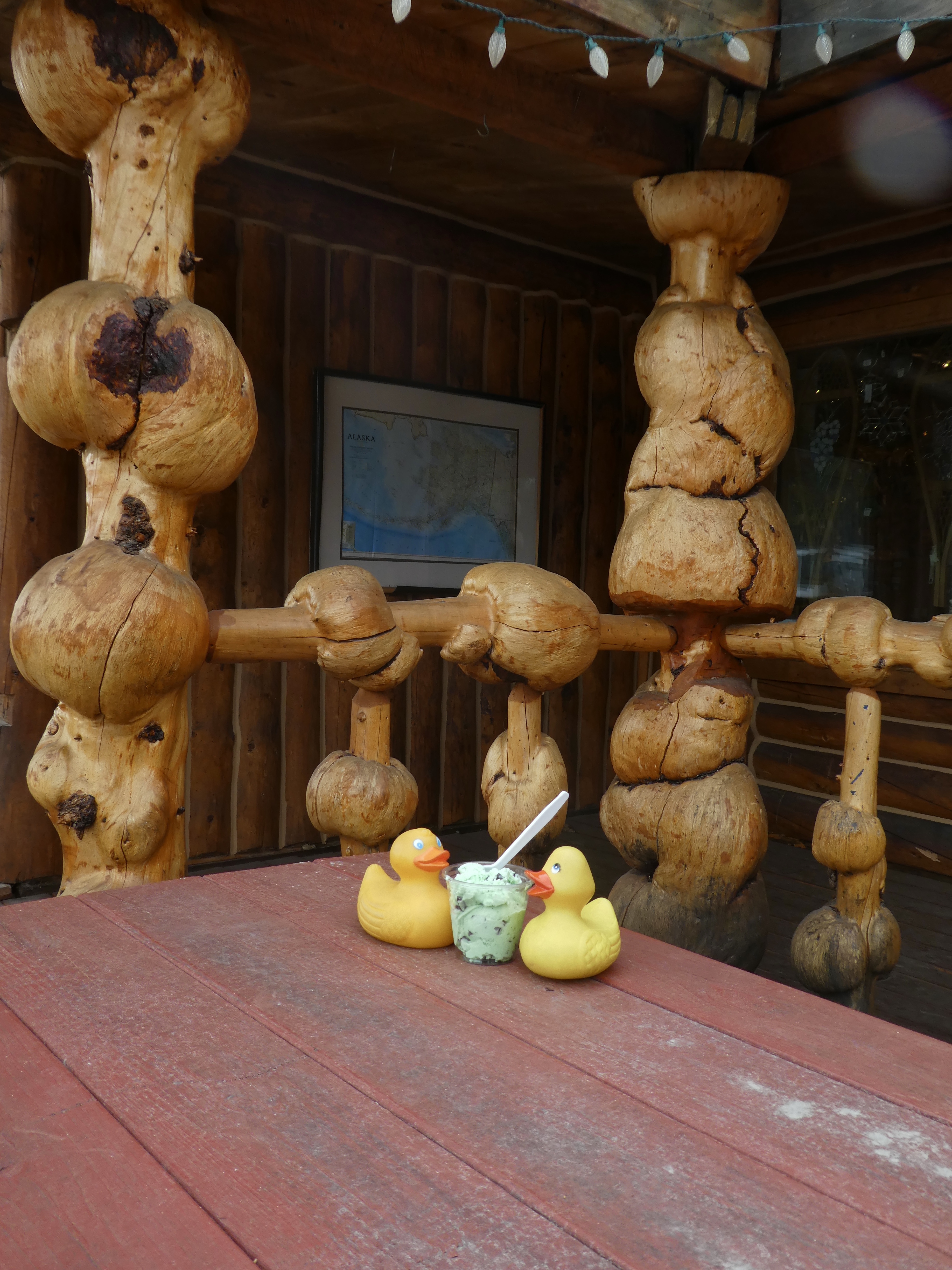
We love ice cream

Of course, mom bought her favorite, mint chocolate chip.   It is our favorite also.   Sitting on the knotty pine picnic tables eating Alaska made ice cream was a great end to our shopping trip.

Zeb and Eider Duck Visit Nenana, Alaska

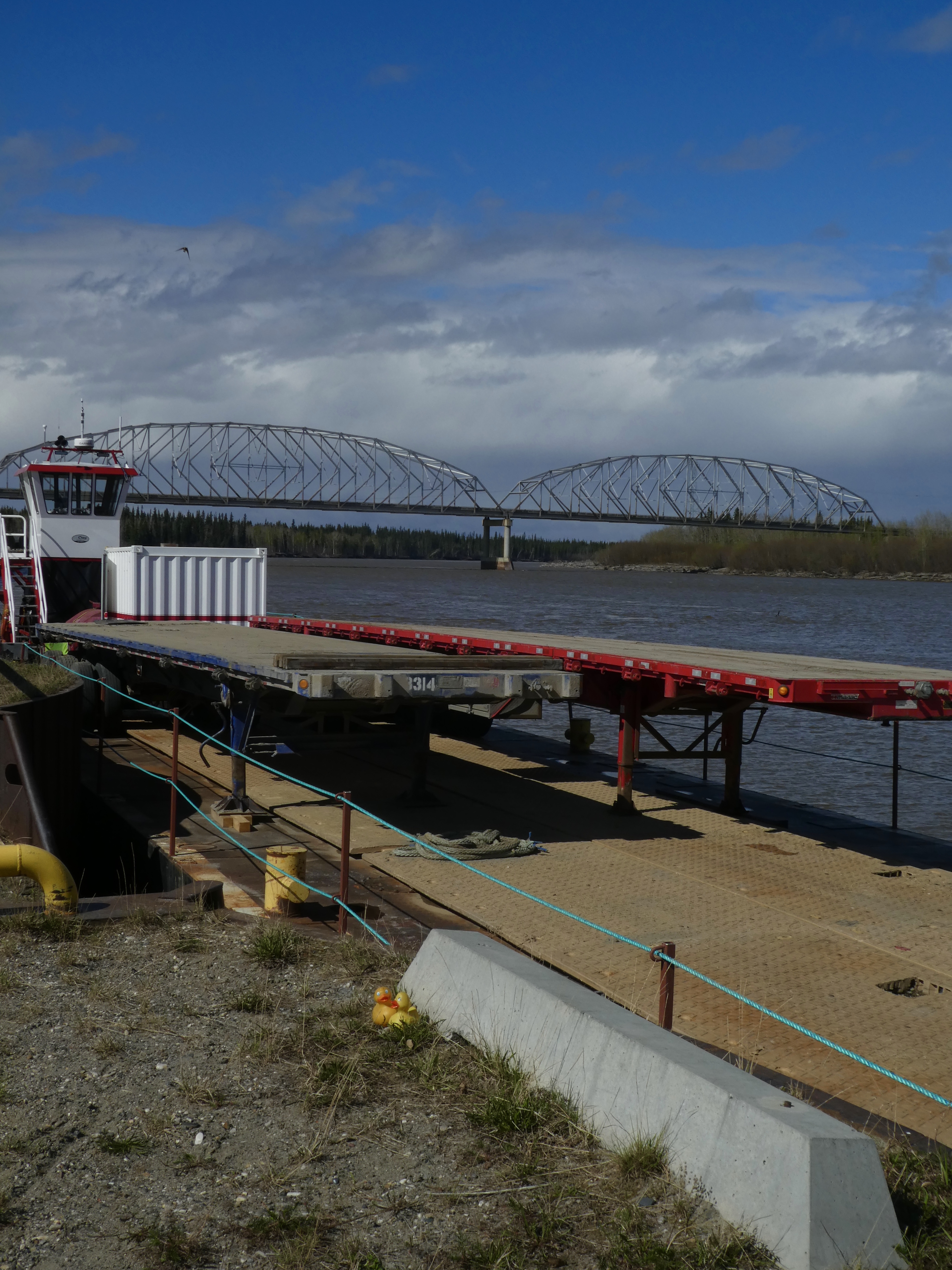
Driving south from Fairbanks on the Parks Highway, Nenana captured our attention.   Driving over the Alaska Native Veterans’ Honor Bridge, we stopped near the Visitor’s Center.   A sign explained that this bridge was dedicated to Native Alaskans, Eskimo and Indian, that fought in the wars for the United States.

Memorial Bridge over Tanana River. Entering Nenana, Alaska

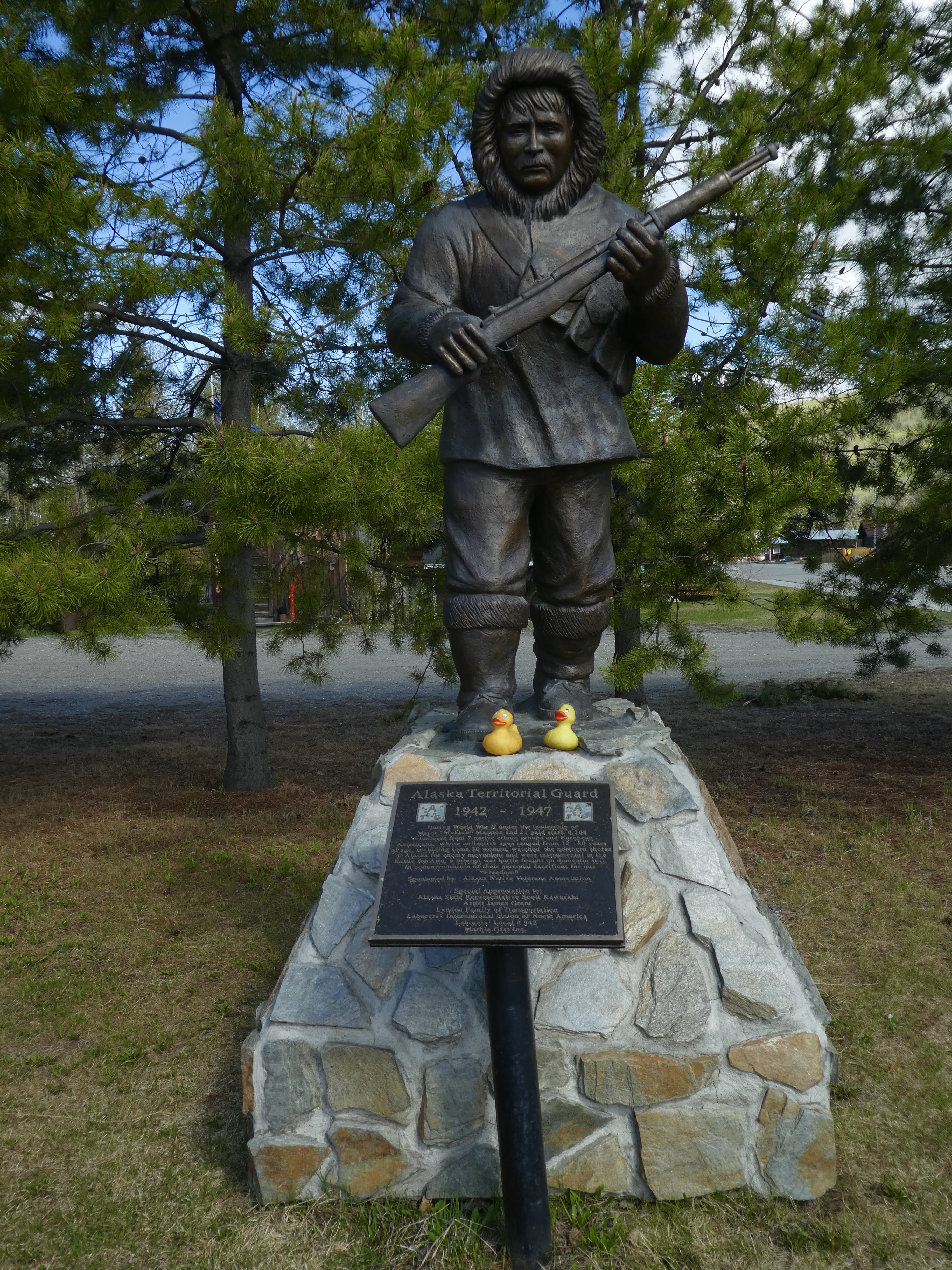
A great cause and a great bridge.    Another sign and statue was dedicated to The Alaska Territorial Guard.

Alaska Territorial Guard

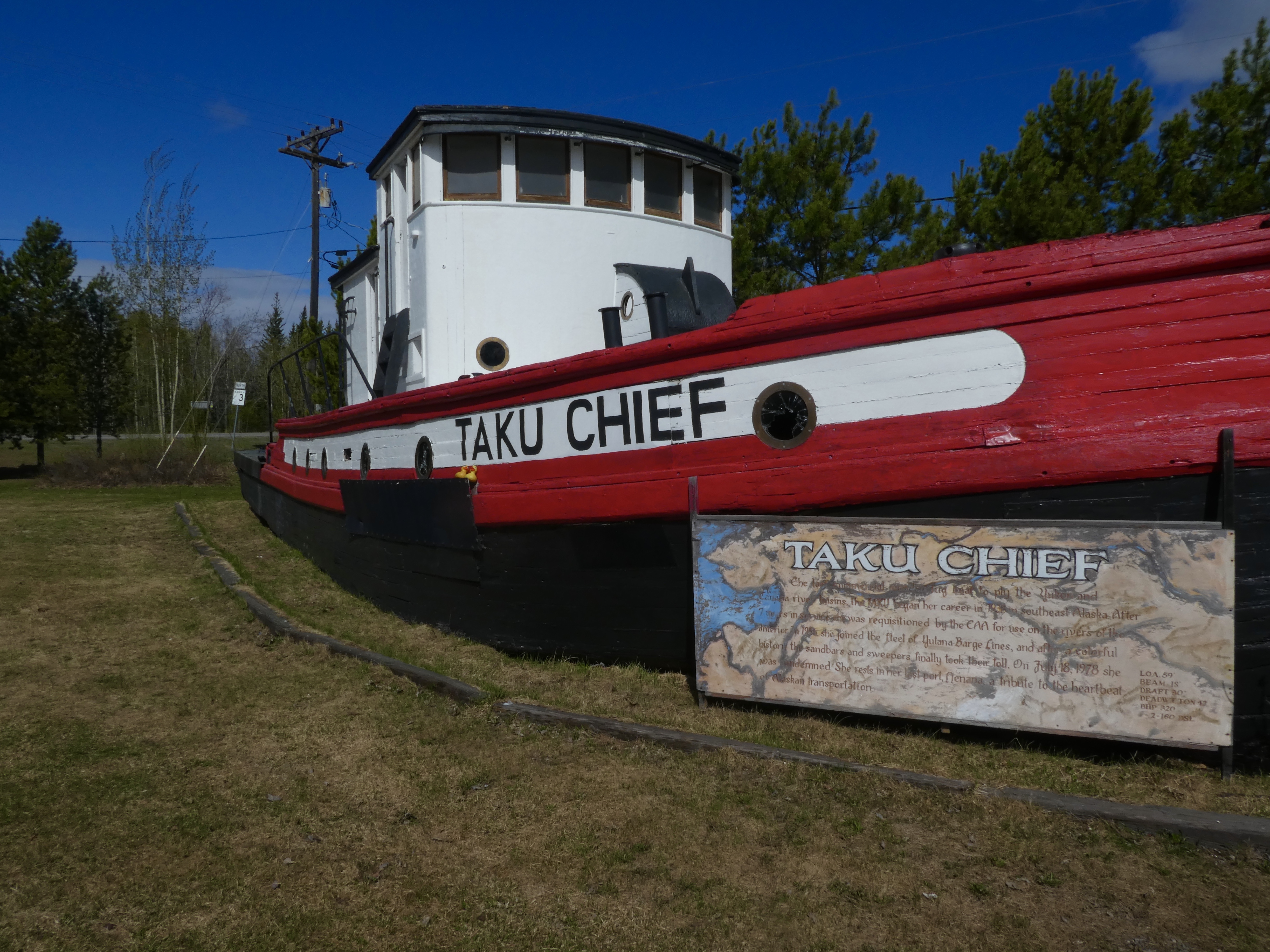
The sign referred to the years 1942-1947.   Here is a wooden tug boat, Taku Chief.

Taku Chief

Taku Chief was one of the last wooden tugs used on inland Alaskan rivers.   The wooden tug was designed by H. C. Hanson and launched by Olson and Sunde Marine Works in 1938.   Taku Chief was retired here, in Nenana, in 1978.  Further into town we visited the  Alaska Railroad Museum.

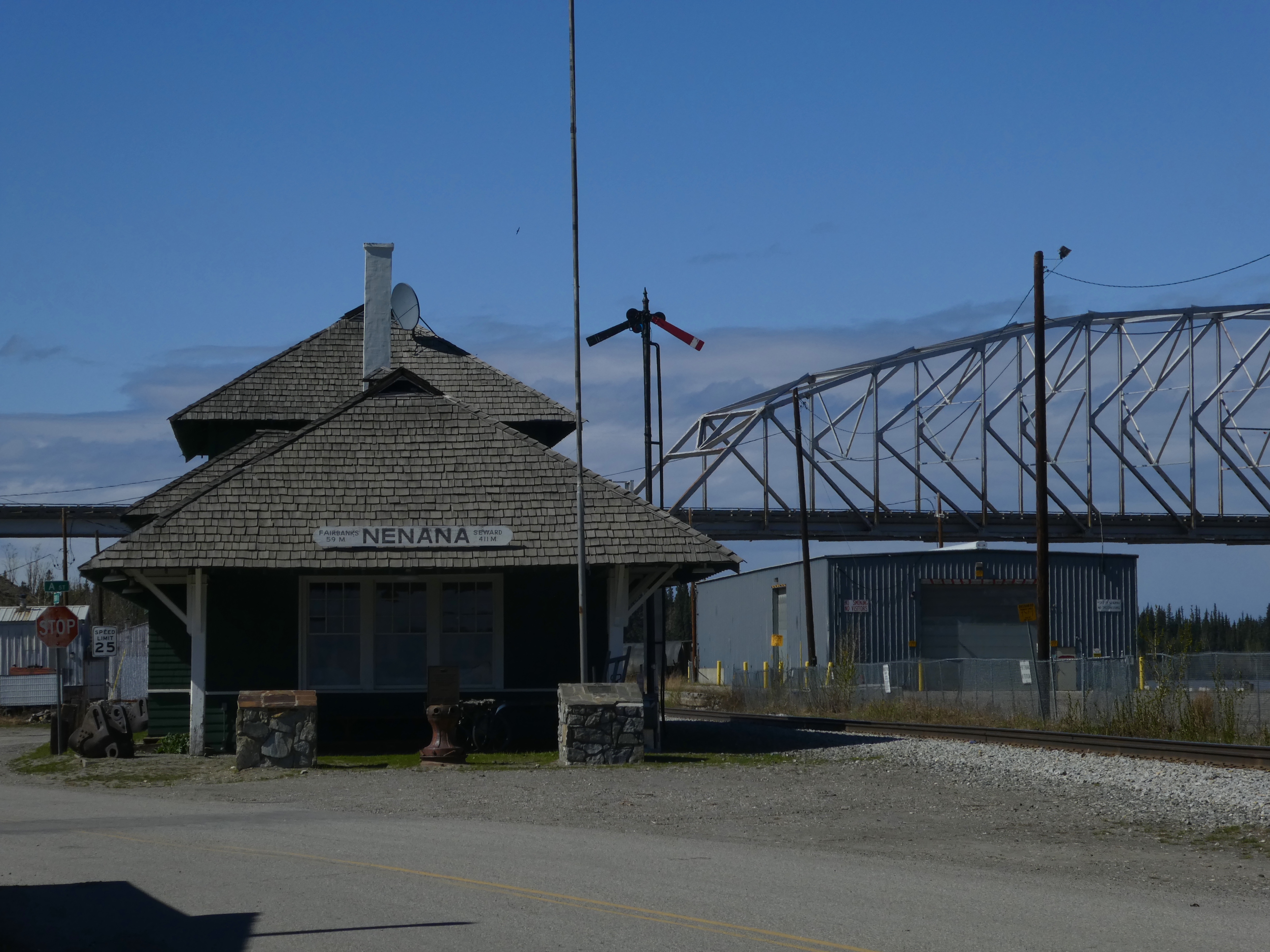
Train station and Alaska Railroad Mseum

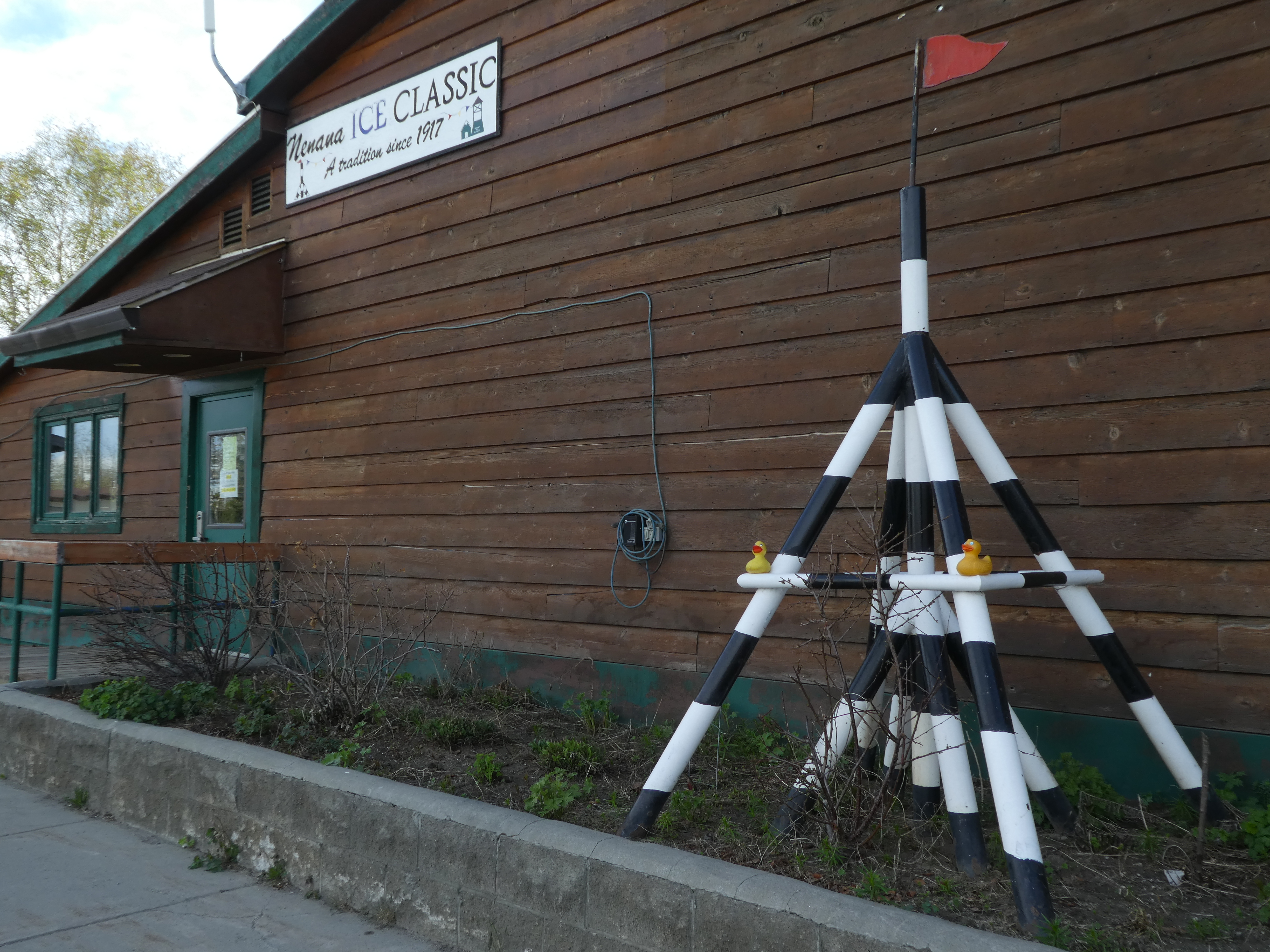
The railroad depot was completed in 1923, the same year that Presiden Warren Harding arrived here to drive the final golden spike, near the bridge, to commemorate the completion of the railroad between Anchorage and Nenana.   Near the train station is the site of the Nenana Ice Classic.

Nenana Ice Classic

Every spring there is a huge contest to predict the exact month, day, hour, minute and second of the ice break up on the Tanana River.   This tripod, attached to a clock, sits on the ice.   When the tripod moves, the ice has melted enough and the  winner of the spring classic is declared.  The winner wins several thousand US dollars.   One of the oldest buildings in Nenana, St. Mark’s Episcopal Church was built in 1905.

St.Mark’s Episcopal Church

The inside is beautiful.

Inside St. Mark’s Episcopal Church

In the early years, school was held here also.    Continuing through town, we stopped at the cultural center.

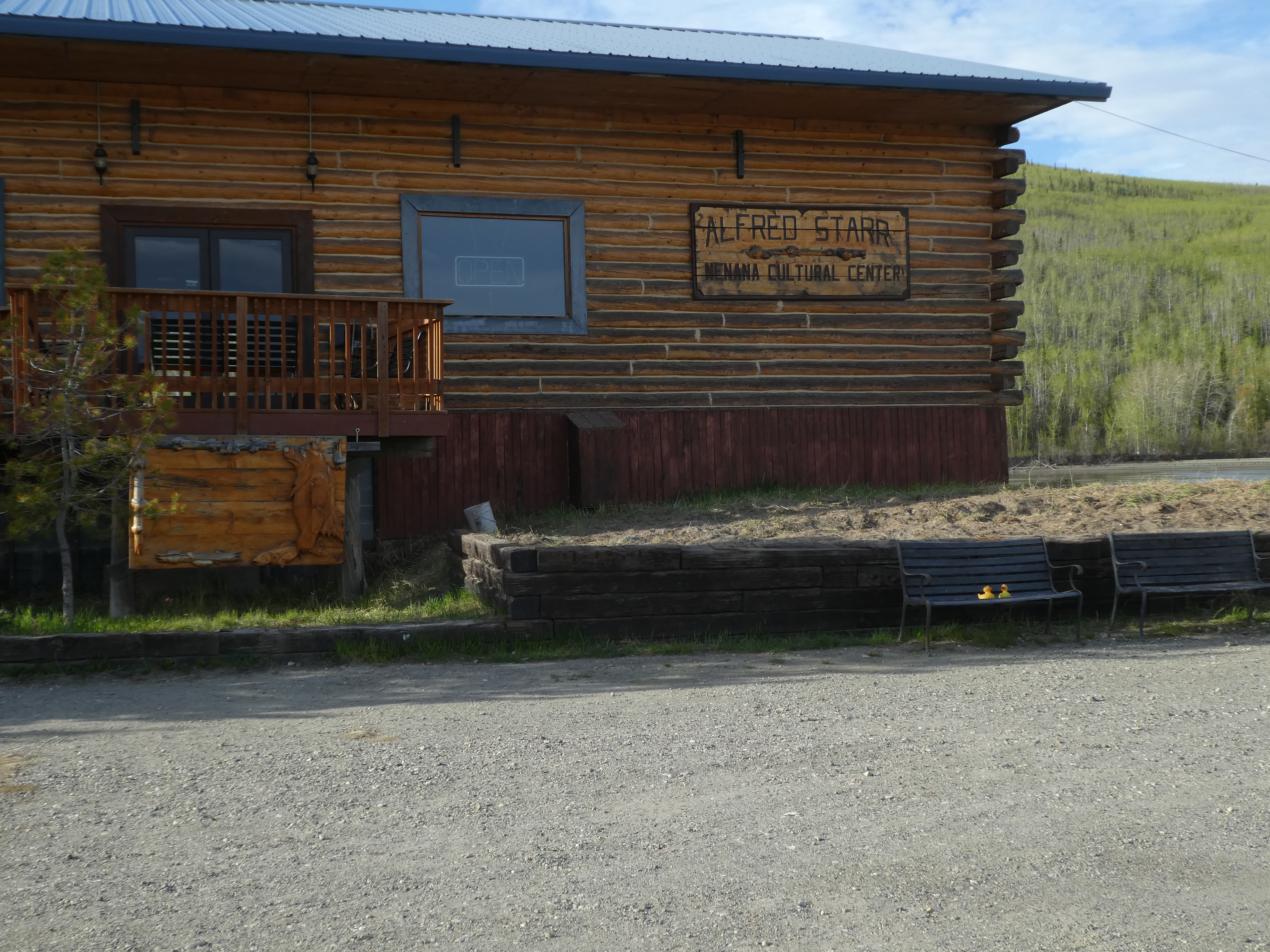
Nenana Cultrual Center

We watched some young boys practicing on drums.   The next building really called to us.

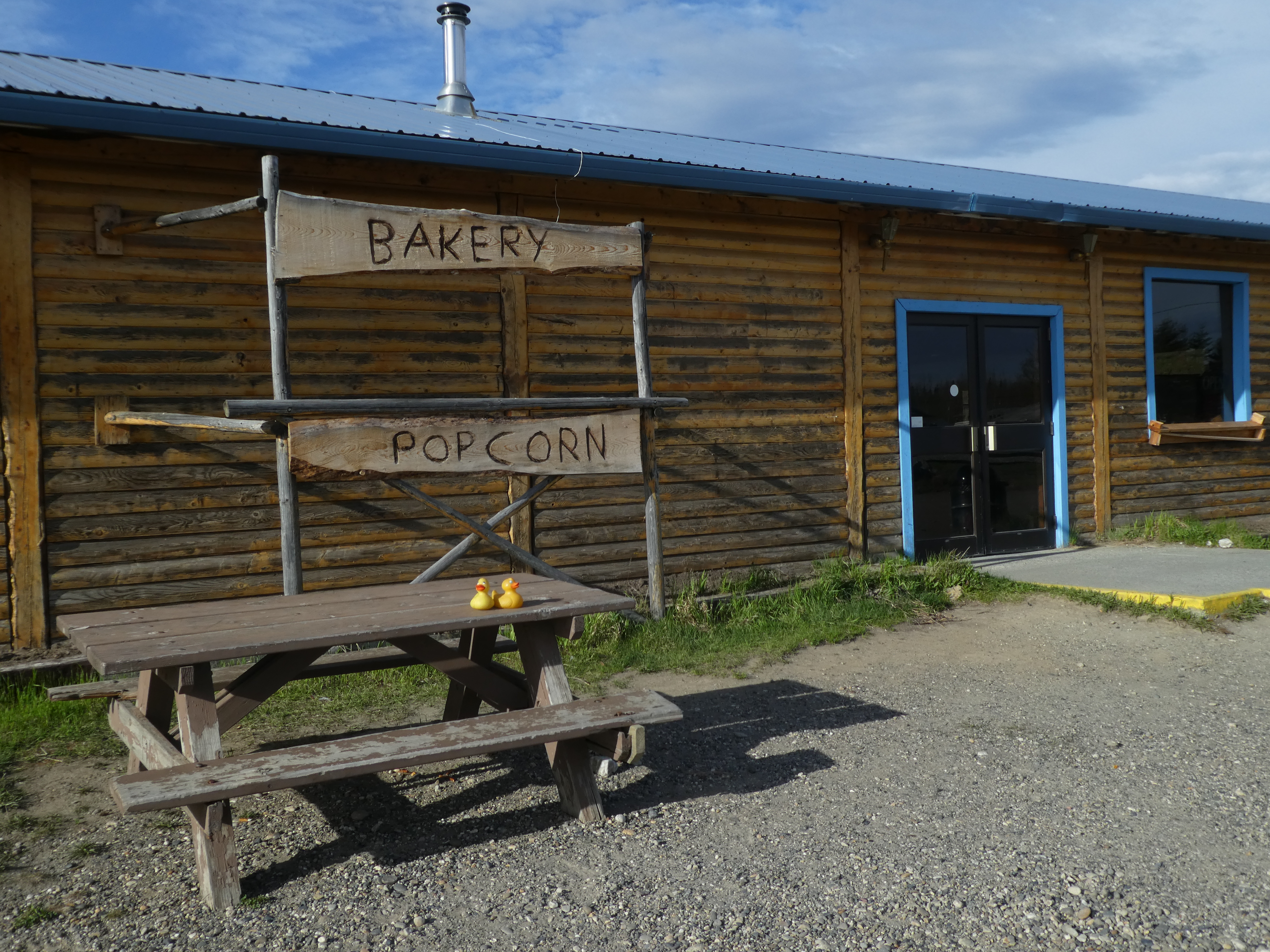
Bakery

Bakeries are always good.   We saw large cinnamon rolls with carmel topping.

Fresh, hot cinammon roll. Delicious!

The lady told us those were baked yesterday.   She would go upstairs to get a fresher one.   The baker sent her downstairs to get oven mits for our roll.   You can’t get baked goods any fresher!   And it was delicious.  After savoring our roll, we walked behind the bakery and admired the boats on the bank of the Tanana River.

Boat on bank of Tanana River

We really liked Nenana and will stop here if we are ever in the area again.   It would be nice to see you there also.

The Alaska Pipeline with Zeb and Eider Duck

Today Eider Duck wants to show us the famous Alaska Pipeline.   Remember, Eider lived with his dad in North Pole, Alaska, near Fairbanks.   He knows what the tourists wanted to see.   A few miles north of Fairbanks, at Fox, Alaska, we can see and touch the pipeline.   But first, a little about the famous Alaska Pipeline.  The real name is Trans-Alaska Pipeline System (TAPS).

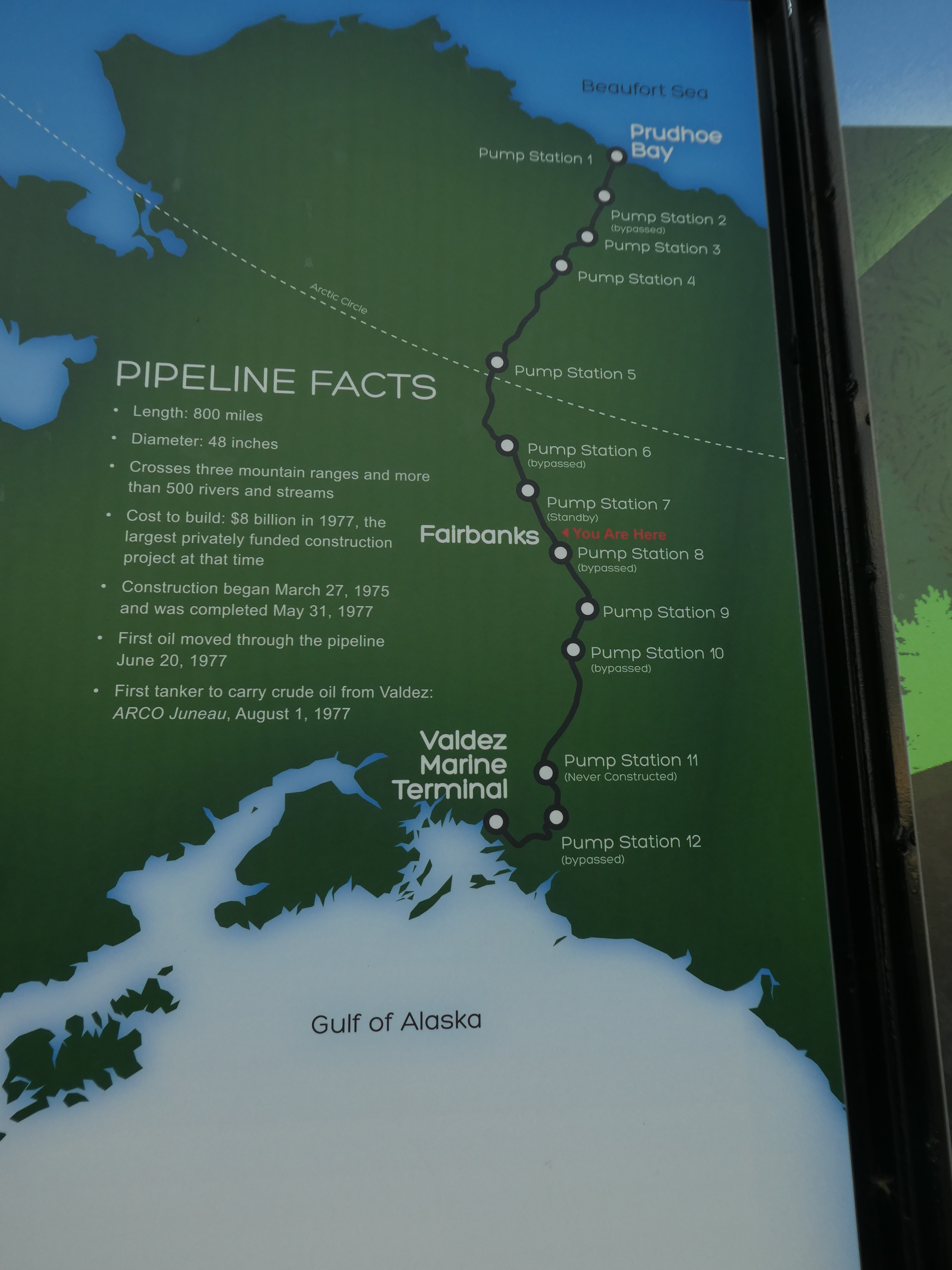
Alaska Pipeline Facts

The pipeline was built to transport oil from the Prudhoe Bay oil fields, north of Arctic Circle and near the Arctic Ocean, to the ice free port of Valdez.  This was a very big engineering accomplishment in the 1970’s.

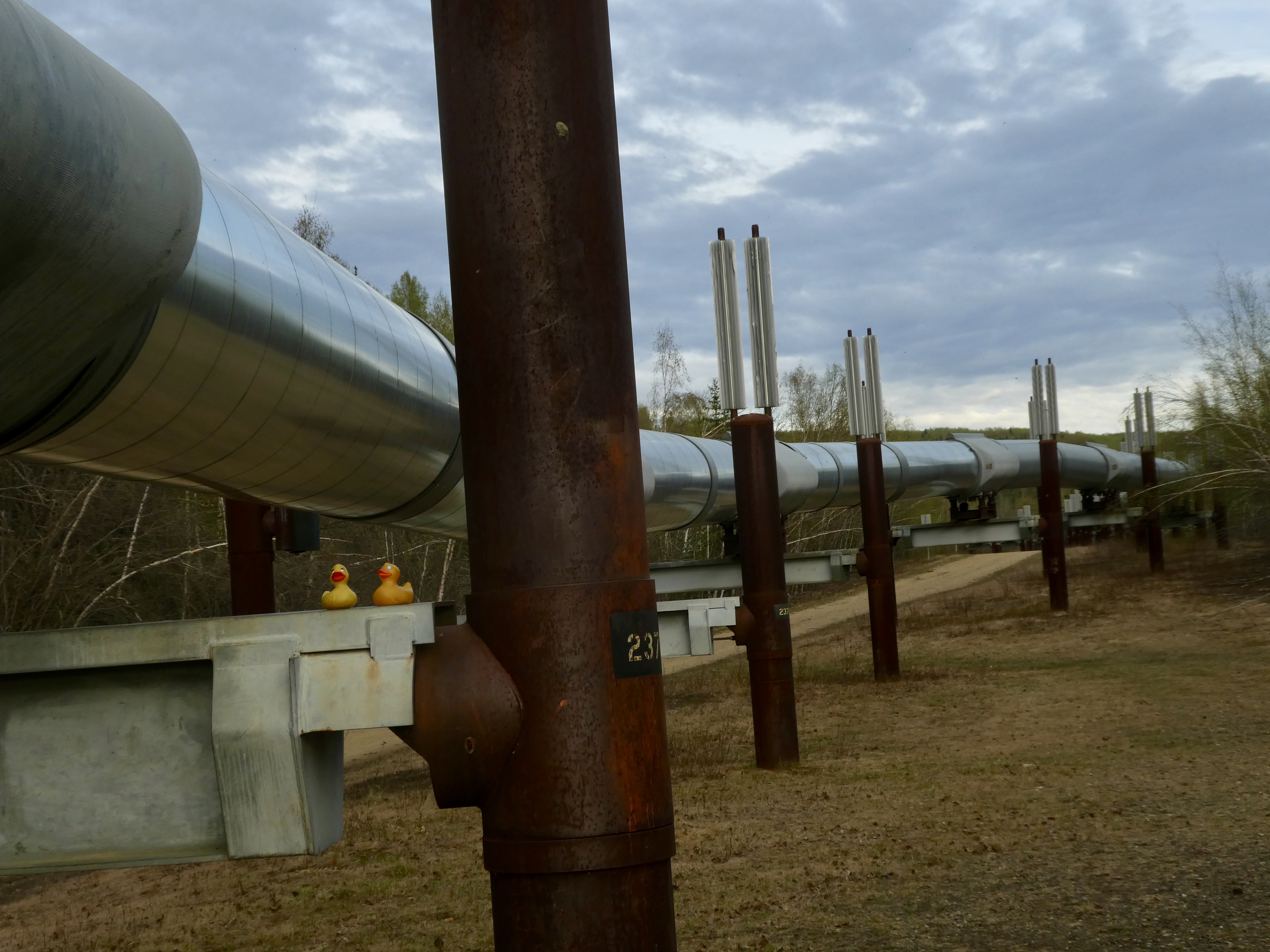
Zeb and Eider on the Alaska Pipeline

While this looks like the pipeline is rather low to the round, it isn’t.   Mom could hardly reach this ledge for us to sit.   This pipeline is 800 miles (1300 km) long.  An average of 1.5 million barrels of oil are transported through the pipeline every day.   It takes 11.9 days to reach Valdez.   The oil travels at 3.7 miles per hour (6 kilometers per hour).   There is a constant need to clean the inside of the pipe.
Pigs in the Pipeline

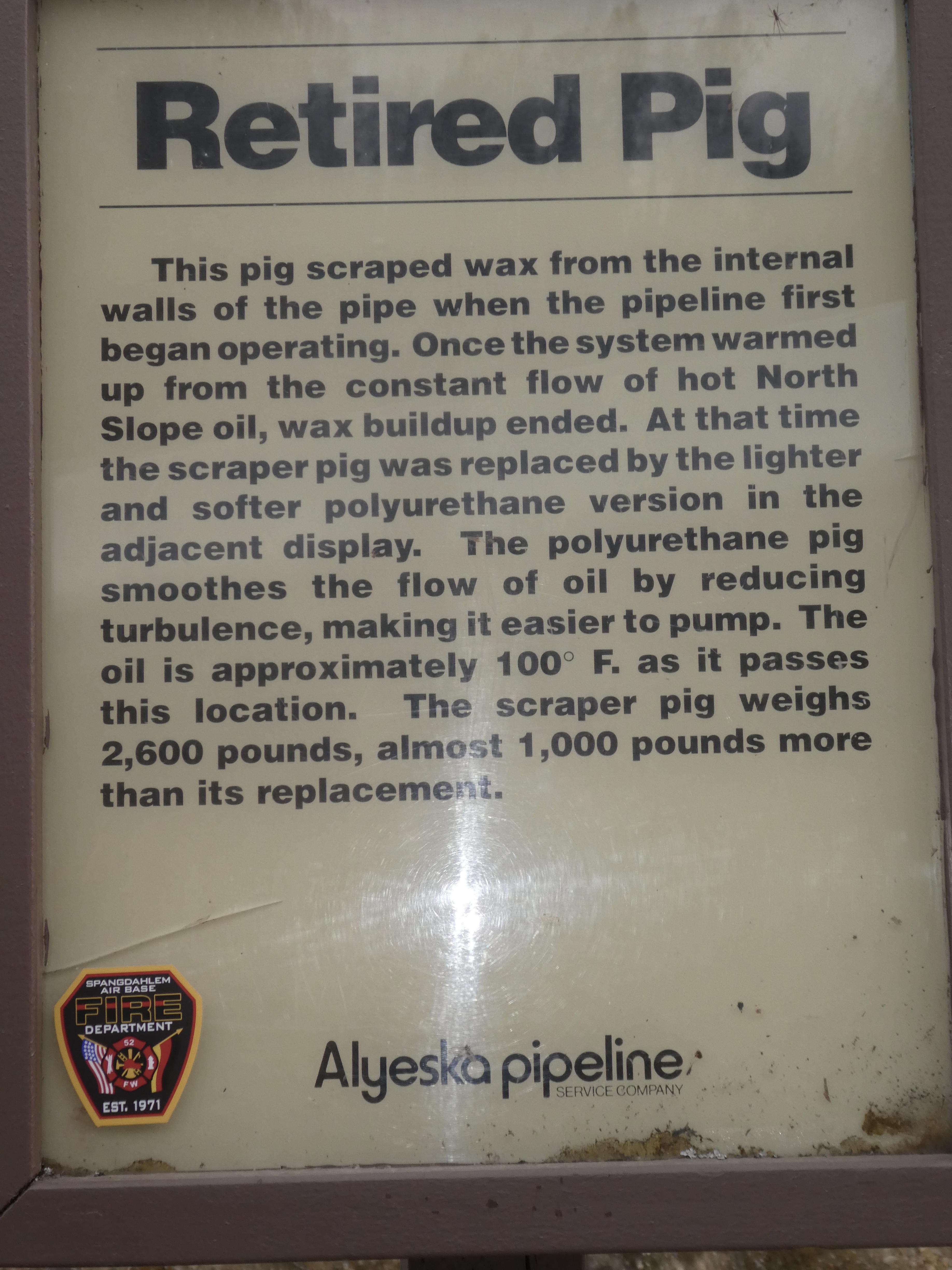
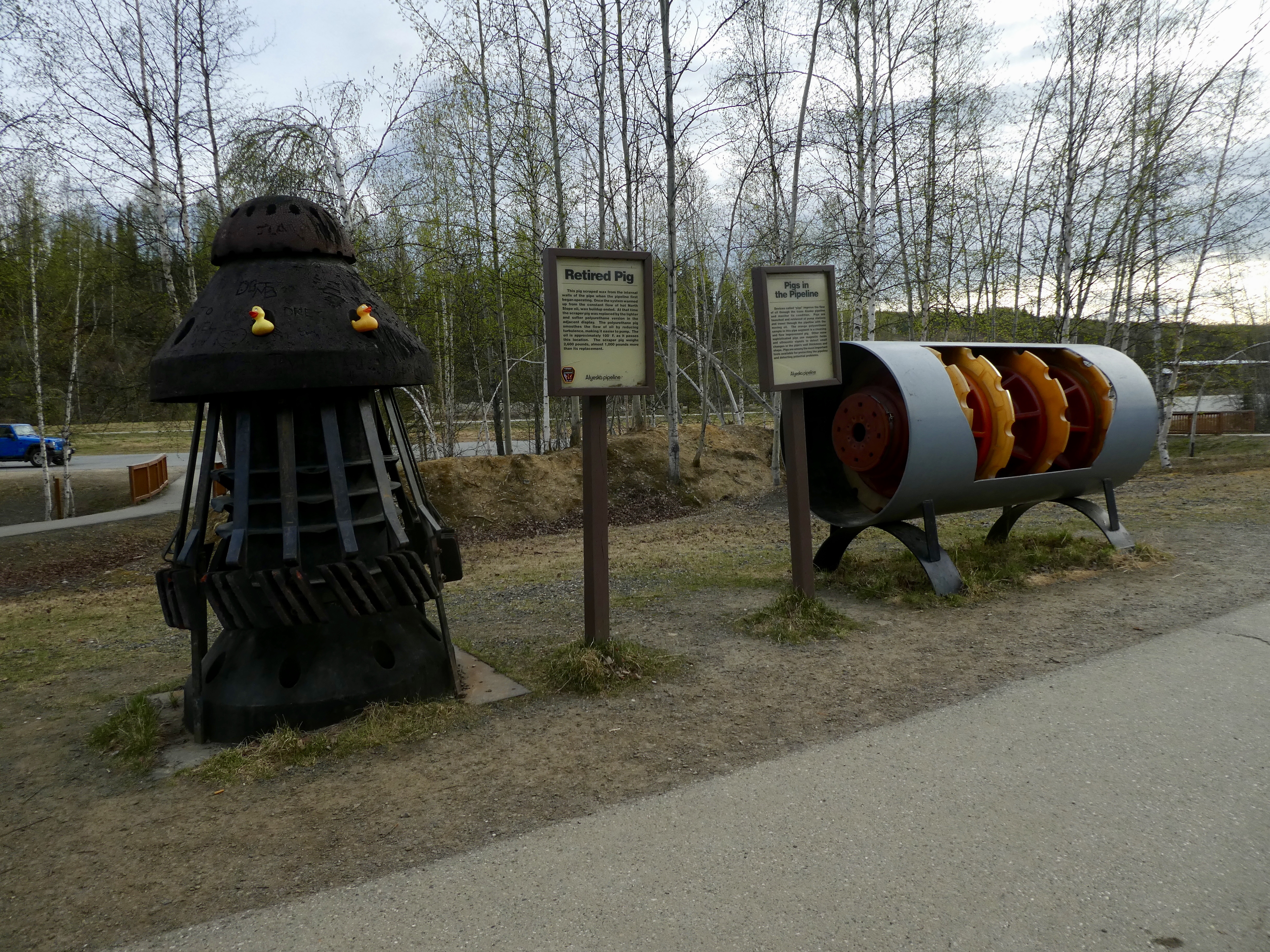
Items, called pigs, are put in the pipeline at Prudhoe Bay, for cleaning and other maintenance reasons.   Let’s look at the original and the current pigs.

Retired Pig and Current Pig

They have made changes since 1977.  The pipeline is elevated to protect the frozen ground.  Oil from the ground enters the pipeline at 120 degrees F (49C).   The oil cools to 111 degrees (44C) while traveling through the pipeline.    Permanently frozen ground is called permafrost.   If this permafrost thaws, the ground becomes unstable.   This is not good.  The pipe is insulated to keep the ground cold and release the heat into the air.   Also, moose, caribou, and reindeer migrate through much of northern Alaska.   These large animals must be able to walk under the pipeline.   An Alaskan moose is often 6 feet tall.   Sometimes the pipeline is underground.
Pipeline emerging from underground

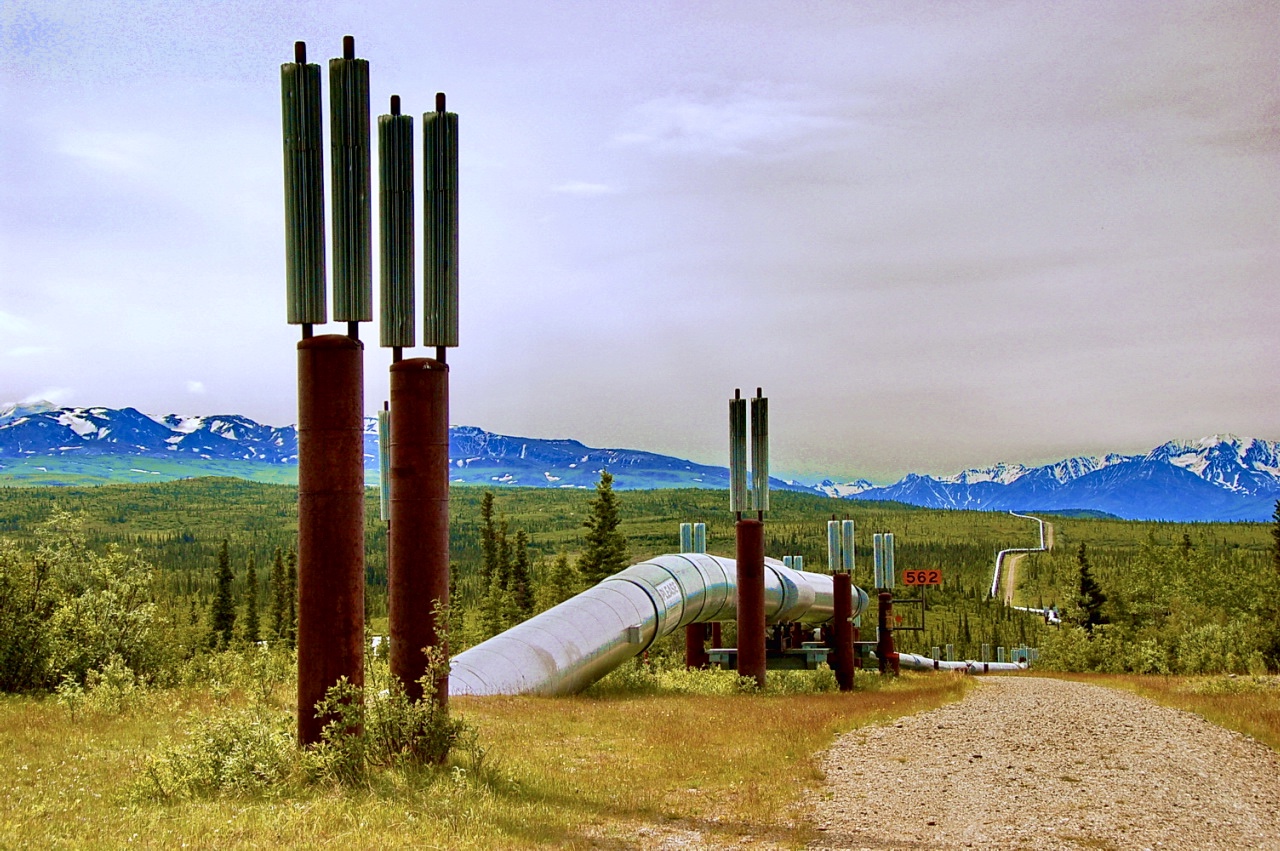
Here we can see the underground pipe breaking through the earth’s surface and continuing above ground.   When the pipeline is above ground, it has a zig zag pattern.   This zig zag layout allows for movement in the line, caused by heat, weather conditions and earthquakes.   This part of the Alaska Pipeline is south of Delta Junction, about 120 miles from Valdez.

Pipeline  Photo from internet free photos.

From the hill, you can see the zig zag pattern of the pipeline, heading toward the mountains.  Before building the pipeline, a 360 mile road from the Yukon River to Prudhoe Bay, needed to be built.   This road is used by excellent truck drivers, all year, to carry supplies to the people working in Prudhoe Bay.   The frozen area, north of the Arctic Circle, is difficult for construction.   The frigid winter temperatures, ice, wind, and snow, make living and driving conditions very difficult.   We, the Colorado Traveling Ducks and humans are in awe of those that built, maintain and work in these conditions.